You’ll discover extensive archaeological remains of sophisticated Native American cities buried beneath modern American soil. These settlements, like Cahokia’s 4,000-acre expanse with its 100-foot Monks Mound, housed up to 20,000 inhabitants and featured advanced urban planning, astronomical observatories, and ceremonial structures. From Casa Grande’s four-story astronomical complex to Pueblo Grande’s 200-home settlement, these sites reveal complex pre-Columbian societies that rival medieval European cities in scale and sophistication.
Key Takeaways
- Massive earthen structures like Cahokia’s 100-foot Monks Mound remain visible, spanning 4,000 acres of ancient Native American urban development.
- Archaeological sites contain over 200 preserved homes, ceremonial structures, and sacred spaces near important rock formations.
- Defensive infrastructure, including palisade walls made from 15,000 logs, reveals sophisticated city planning and protection systems.
- Cultural artifacts like stone tools, ceramic vessels, shell ornaments, and ceremonial objects demonstrate complex daily life and trade.
- Astronomical alignments in architectural ruins show advanced understanding of celestial movements and sophisticated building techniques.
Ancient Cities Hidden Beneath Modern America
How many ancient Native American cities lie hidden beneath modern American soil? From Arizona to Nevada, forgotten settlements of the Ancestral Puebloans and Hohokam Indians reveal sophisticated urban planning you’d never expect.
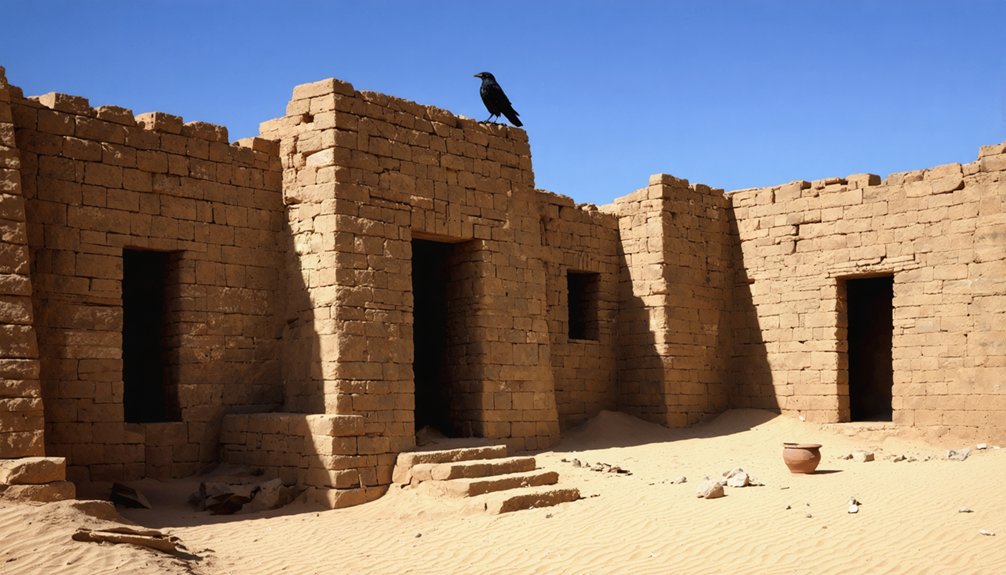
You’ll find evidence of ancient civilizations in places like Casa Grande, where a four-story structure served astronomical and ceremonial purposes between 1150-1350 A.D.
At Pueblo Grande de Nevada, known as the “Lost City,” Basketmaker people established a thriving community as early as 300 A.D. Though Lake Mead now submerges much of this site, hundreds of archaeological locations remain intact. For optimal viewing of these historical sites, browser settings enabled will ensure proper loading of virtual tour features.
Among the remnants of this rich history, there are also instances of abandoned equipment in Nevada mines scattered throughout the area. This equipment serves as a reminder of the mining boom that once flourished in the region, attracting prospectors searching for fortune. Exploring these sites offers a unique glimpse into both the archaeological significance and the industrial past of Nevada.
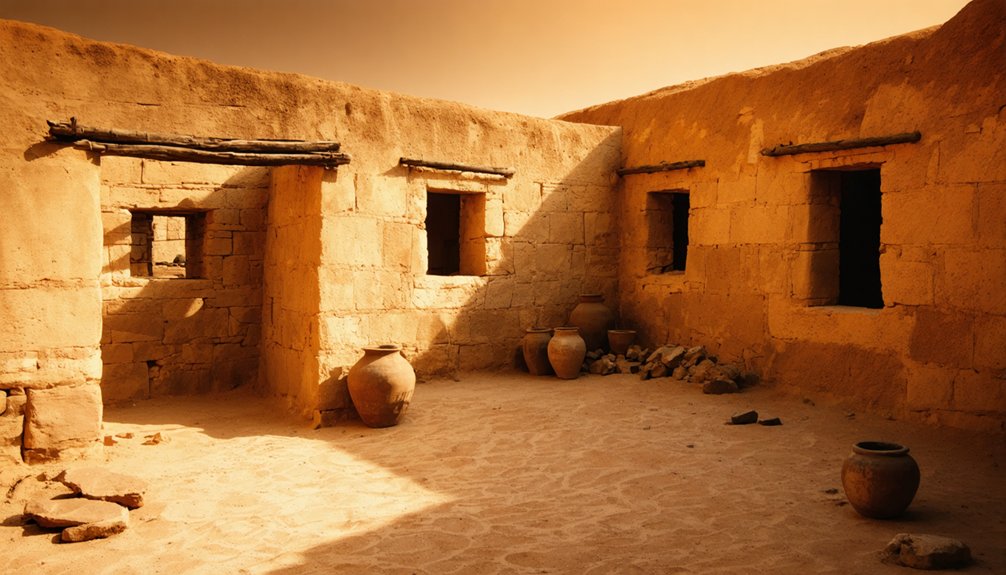
You can still explore over 200 homes and ceremonial structures near sacred rock formations, while museums like Lost City in Overton preserve countless artifacts, from ancient tools to skeletal remains. At sites like Mesa Verde, visitors can witness the legacy of thriving Ancestral communities that flourished for over 700 years.
Uncovering the Legacy of Cahokia
When you explore Cahokia’s remnants today, you’ll find massive earthen mounds spanning 4,000 acres, including the 100-foot-tall Monks Mound that still dominates the landscape after 1,000 years.
The site’s population patterns reveal a dramatic rise and fall, peaking at 20,000 inhabitants around 1100 CE before environmental pressures and social instability led to its abandonment by 1350 CE. The city’s skilled inhabitants relied heavily on corn-based agriculture to sustain their population. Around 1050 CE, the settlement underwent rapid urban development with three distinct precincts emerging.
Through discovered artifacts like decorated pottery, marine shells, and copper items, you can trace Cahokia’s extensive trade networks and complex cultural practices, including astronomical observations and large-scale ceremonial gatherings.
Monumental Earthworks Still Standing
The monumental earthworks of Cahokia stand as North America’s most impressive prehistoric architectural achievement, anchored by the towering Monks Mound that rises 100 feet above the Illinois plains.
These ancient structures reflect remarkable engineering precision, with over 120 earthen mounds once dotting the 4,000-acre landscape. Today, you’ll find 70-72 mounds preserved within the protected site, including platform, ridgetop, and conical varieties. By 2016, archaeologists had excavated less than 1 percent of the entire area. The site once supported a thriving population of 10,000 to 20,000 inhabitants.
You can explore this UNESCO World Heritage Site‘s sophisticated urban planning, where mounds were strategically positioned along cardinal directions and around plazas.
Each type served distinct purposes – platform mounds supported temples and elite residences, while conical mounds housed burials. The astronomical Woodhenge, marked by circular timber posts, demonstrates how these ancient builders tracked solar events and seasons.
Population Patterns Through Time
Behind Cahokia’s impressive earthworks lies a fascinating story of population dynamics spanning seven centuries.
You’ll find that early settlements around 700 CE started modestly, housing just 50-100 people in temporary camps. Urban migration transformed this pattern dramatically between 1050-1150 CE, when the population exploded to 10,000-20,000 inhabitants, with some estimates reaching 40,000 including suburban areas.
You can track Cahokia’s meteoric rise through its dense central district, where population soared from 1,400 to over 15,000 people by 1100 CE. This growth rivaled contemporary European cities like London and Paris. The residents sustained themselves through agriculture, cultivating early maize, squash, and sunflowers.
The city developed extensive trade networks connecting communities from the Gulf Coast to the Great Lakes. However, the city’s decline proved equally dramatic. Environmental pressures and climate shifts triggered a population exodus, and by 1400 CE, only 4,000 residents remained in what had been North America’s largest pre-Columbian urban center.
Cultural Artifacts Tell Stories
Through carefully preserved artifacts and architectural remains, Cahokia’s complex cultural legacy reveals itself in extraordinary detail.
You’ll find ceremonial artifacts like the iconic “Birdman” burial, where a prominent figure rests on 10,000 marine-shell beads arranged in a falcon pattern. The society’s sophisticated trade networks become evident through exotic materials: shark teeth, ocean shells, and caffeine-rich tea leaves from distant lands. Recent excavations by St. Louis University have provided invaluable insights into this ancient civilization.
The craftsmanship of daily life emerges in stone tools, ceramic vessels, and intricately worked shell ornaments. Recent excavations have revealed thousands of microdrills and ceramics that provide crucial insights into daily activities.
Perhaps most telling are the defensive structures, including a massive palisade wall built with 15,000 logs and strategic bastions. These artifacts paint a picture of a society that balanced ceremonial grandeur with practical needs, maintaining extensive trade connections while protecting its cultural heart.
Archaeological Evidence Reshaping Historical Narratives
You’ll find that beneath seemingly empty landscapes lie intricate Native American cities, revealed through advanced archaeological techniques like fecal stanol analysis and multidisciplinary approaches.
These methods have uncovered complex urban networks with sophisticated planning, hierarchical social structures, and extensive trade systems that challenge previous assumptions about indigenous settlements being primitive or isolated.
The evidence points to resilient Native populations who adapted and persisted through European contact, contrary to colonial narratives of abandoned “ghost towns” and vanished peoples.
Hidden Cities Emerge Below
Recent archaeological discoveries across North America have unearthed extensive Native American settlements that challenge traditional historical narratives about indigenous urbanization.
You’ll find hidden settlements like the Lost City in Nevada, where multi-style dwellings and prehistoric salt mines reveal sophisticated ancient trade networks. These sites demonstrate complex urban planning, with Prophetstown’s non-contiguous villages separated by cornfields supporting thousands of inhabitants.
Below Lake Mead’s waters lie submerged archaeological treasures, while Chaco Canyon’s great houses and Gila Cliff Dwellings stand as evidence of advanced architectural achievements.
From shell-reinforced pottery to elaborate burial mounds, each artifact tells a story of diverse, interconnected communities. These discoveries reshape our understanding of Native American societies, revealing cities that rivaled their European counterparts in complexity and scale.
Evidence Challenges Colonial History
Archaeological discoveries across North America have fundamentally reshaped our understanding of colonial-Native American interactions, revealing a far more complex narrative than traditional historical accounts suggest.
You’ll find evidence of sophisticated trade networks in artifacts like Venetian glass beads and copper aiglets at sites such as Salmon Creek, challenging colonial narratives that downplayed Native American agency.
The archaeological record demonstrates indigenous resilience through continued traditional practices alongside selective adoption of European goods.
At Jamestown, evidence reveals Native American women’s substantial roles, which historical documents often overlooked.
You’re seeing a clearer picture emerge of Native Americans actively shaping colonial economies and maintaining cultural identity, rather than passively accepting European dominance.
These findings prove indigenous peoples weren’t merely subjects of colonization but strategic participants in cross-cultural exchange.
Life and Culture in Pre-Columbian Urban Centers

While many people imagine pre-Columbian Native American settlements as simple villages, the reality reveals sophisticated urban centers that showcased remarkable architectural and cultural achievements.
You’ll find evidence of advanced urban design in their earthwork complexes, where ceremonial mounds served as both practical and spiritual focal points. These cities featured carefully planned layouts with grand plazas and avenues that could accommodate thousands during festivals and ceremonial practices.
The urban centers weren’t just architectural marvels – they functioned as complete societies.
You’d discover residential areas surrounding the monumental structures, where families lived in homes built from local materials.
Most fascinating is how these cities incorporated celestial alignments, with structures positioned to track solar movements, demonstrating their deep understanding of astronomy and its connection to urban planning.
Environmental Changes and Population Shifts
Throughout history, environmental pressures have triggered dramatic shifts in Native American settlement patterns, as evidenced by the 4,000-year-old shell ring villages on Sapelo Island, Georgia.
You’ll find that these ancient communities developed sophisticated environmental adaptations to coastal living, but eventually faced unsustainable conditions that forced population migrations.
Research reveals:
- Shell biochemistry shows critical changes in water salinity that disrupted fishing practices
- Tree ring data confirms severe climate instability during Ring III occupation
- Communities dispersed when environmental stress made coastal living untenable
- Similar patterns of climate-driven displacement continue today, from Alaska to Louisiana
Modern tribal relocations mirror these ancient patterns, though now complicated by limited land access and federal restrictions.
You’re witnessing the continuation of a millennia-old challenge: adapting to changing environments while maintaining cultural connections to place.
Preserving Sacred Spaces Against Modern Development

Modern development poses an existential threat to Native American sacred spaces, echoing the environmental disruptions that historically displaced Indigenous communities.
You’ll find sacred site preservation increasingly challenged by coal mining, border wall construction, and urban expansion projects that prioritize economic gains over cultural significance. The legal protections currently in place, including the National Historic Preservation Act, fail to guarantee meaningful safeguards against development pressures.
You’re witnessing a system where tribes must request permission to access their ancestral sacred sites on federal lands, while facing vandalism, desecration, and destruction of burial grounds.
Indigenous peoples face the indignity of seeking approval to visit their own sacred spaces while watching these ancestral sites suffer ongoing destruction.
Despite federal authority over Indian affairs, existing religious freedom laws haven’t effectively protected these spaces from development, leaving Indigenous communities to battle overlapping jurisdictions and complicated land ownership claims.
Reconnecting Indigenous Communities With Ancestral Sites
As Native American communities endeavor to reclaim their ancestral connections, significant progress emerges through repatriation efforts and co-management partnerships. The movement toward cultural preservation strengthens as tribes integrate traditional ecological practices with modern conservation methods.
- You’ll find over 128,000 ancestral remains still held in institutions, with NAGPRA facilitating their return through enhanced 2024 regulations prioritizing Indigenous knowledge.
- You’re witnessing groundbreaking partnerships like Bears Ears National Monument’s co-management, where tribes actively protect sacred landscapes.
- You can observe the Rappahannock Nation’s successful reclamation of 465 acres near Chesapeake Bay, enabling ancestral reconnection through direct land stewardship.
- You’ll notice tribes combining traditional wisdom with scientific approaches to restore native species and maintain resilient ecosystems, demonstrating effective cultural preservation methods.
Frequently Asked Questions
How Did Native Americans Build Such Precise Astronomical Observation Structures?
You’ll find they achieved astronomical alignment through careful horizon observation over generations, using fixed markers, pillar systems, and strategic viewpoints while integrating cultural significance into their architectural precision.
What Tools and Techniques Did Archaeologists Use to Date These Ancient Sites?
Like peeling back layers of time, you’ll find archaeologists rely heavily on radiocarbon dating of organic materials and stratigraphic analysis, alongside ceramic typology and tree-ring sequences to determine site ages.
How Did These Towns Maintain Trade Networks Across Such Vast Distances?
You’ll find they used extensive waterways and established trade routes, building networks through cultural exchanges, specialized traders, and standardized languages while relying on canoes to transport goods across vast territories.
What Games and Recreational Activities Took Place in These Urban Centers?
Picture yourself amid throngs of spectators as you’d witness traditional sports like lacrosse, running races, and canoe competitions, plus communal games involving strategy, chance, and spiritual ceremonies in these bustling centers.
How Did Different Tribes Communicate When They Met at These Large Settlements?
You’ll find tribes used sophisticated sign language for cross-linguistic communication and relied on oral traditions, including storytelling and formal speeches, to bridge cultural gaps at major settlement gatherings.
References
- https://vcresearch.berkeley.edu/news/new-study-debunks-myth-cahokias-native-american-lost-civilization
- https://www.nps.gov/lake/learn/the-lost-city.htm
- https://www.gilderlehrman.org/history-resources/essays/cahokia-pre-columbian-american-city
- https://www.historyextra.com/period/medieval/native-american-city-cahokia-rivalled-london/
- https://popular-archaeology.com/article/lost-and-found-the-evidence-for-the-lost-colony/
- https://www.wichita.edu/about/wsunews/news/2023/03-march/quivira_3.php
- https://www.firstcolonyfoundation.org/news/new-clues-bring-search-for-indigenous-village-of-roanoke-to-elizabethan-gardens/
- https://scitechdaily.com/archaeologists-uncover-massive-1000-year-old-native-american-farms-that-defy-the-limits-of-agriculture/
- https://www.legendsofamerica.com/na-pueblos/
- https://www.wilderness.org/articles/article/10-extraordinary-native-american-cultural-sites-protected-public-lands