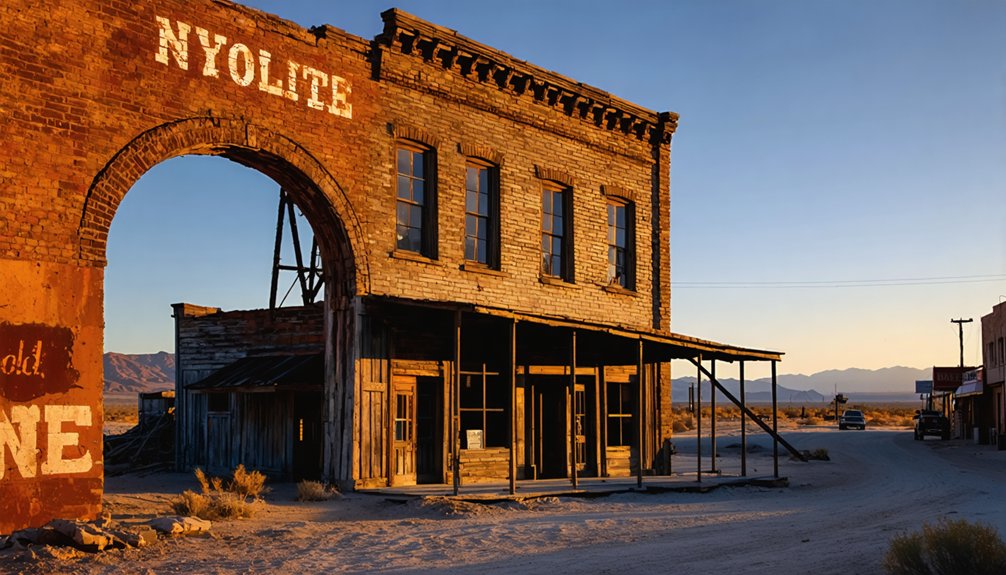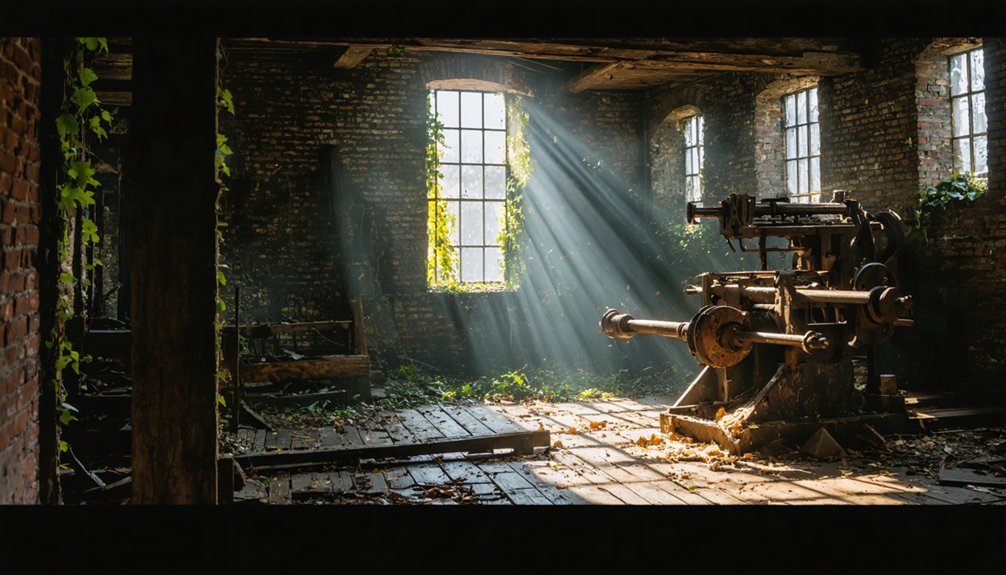
You’ll find imposing brick structures with Victorian-era industrial design elements, including distinctive towers, arched windows, and decorative cornices, standing as remnants of historic textile mill ghost towns across the American South. Former worker housing, arranged in long rows with shared spaces, reflects the tight-knit communities that once thrived there. While nature steadily reclaims these abandoned sites through sprouting ferns and creeping ivy, many mills have transformed into museums and cultural centers, preserving powerful stories of America’s industrial heritage.
Key Takeaways
- Victorian-era industrial architecture survives, featuring multi-story brick buildings with towers, arched windows, and decorative cornices typical of textile mills.
- Original worker housing arranged in long rows remains, showing shared living spaces and architectural elements like pilasters and wrap-around porches.
- Nature has reclaimed many abandoned sites, with vegetation growing through structures and wildlife establishing new ecosystems in empty buildings.
- Former mills have been transformed into museums, art galleries, and cultural centers that preserve industrial heritage and worker narratives.
- Historic mill villages persist as living museums, where original structures and worker housing create immersive experiences of industrial heritage.
The Rise and Fall of Southern Mill Villages
After the Civil War devastated the South’s economy, textile mills emerged as powerful catalysts for transforming the region’s rural landscape, particularly in the Piedmont area spanning Virginia and the Carolinas.
You’ll find the remnants of this labor history in places like Danville, Virginia, where Dan River Mills grew into the South’s largest textile operation by the late 1800s.
The mill village dynamics reflected a complete restructuring of rural life, as former yeoman farmers traded their agricultural independence for steady wages and company housing.
These farmers were often motivated to seek mill work as a means to escape the crushing crop lien system that had trapped many in cycles of perpetual debt.
Cone Mills Corporation established one of North Carolina’s most influential textile operations, shaping the industry through family-led investment since the late 19th century.
Architectural Legacy in Brick and Stone
You’ll find Victorian-era industrial design elements prominently displayed in surviving textile mill structures, where multi-story brick buildings feature distinctive towers, arched windows, and decorative cornices.
The Enterprise Manufacturing Company flourished in Coleridge until the mill’s closure in the 1960s, leaving behind a legacy of industrial architecture.
The dark red brick facades incorporate north-European Romanesque design elements that exemplify the architectural grandeur of the era.
The worker housing that surrounds these imposing factories exhibits a stark architectural contrast, with uniform rows of modest wood-frame duplexes and single-family homes reflecting the social hierarchy of mill life.
These residential structures, often distinguished by their catslide roofs and simple wooden porches, represent the standardized company housing that defined America’s textile mill villages from the 1880s through the 1920s.
Victorian Industrial Design Elements
The architectural legacy of Victorian textile mills stands as a tribute to the marriage of industrial functionality and aesthetic grandeur.
You’ll find these Victorian innovations expressed through polychrome brickwork, decorative stone dressings, and ornate iron cresting that crowns their imposing facades. The industrial aesthetics reveal themselves in the practical yet elegant features: tall segmental-arched windows that flood interiors with natural light, massive stone plinths protecting against dampness, and steeply pitched roofs crowned with prominent chimneys.
Within these structures, cast iron columns support brick-vaulted ceilings, while separate stair towers and slate roofing showcase the era’s advanced fireproofing techniques. The buildings’ long, rectangular forms maximize daylight, while their decorative terracotta cornices and carved stone panels demonstrate the Victorians’ commitment to beautifying industrial architecture. Modern residential conversions now showcase the striking Venetian warehouse style architecture that once defined these industrial powerhouses. The introduction of Watt’s steam engine in 1775 freed mill construction from riverside locations, allowing these architectural marvels to rise in diverse urban settings.
Mill Worker Housing Features
While Victorian mill buildings showcased industrial grandeur, worker housing embodied utilitarian brick craftsmanship that shaped entire communities.
You’ll find these structures arranged in long rows, typically 150 feet by 36 feet, with running bond brickwork and decorative dentiled entablatures marking their entrances. Mill housing conditions centered on maximizing occupancy while maintaining basic livability – each 9-by-12-foot bedroom housed multiple workers, with shared kitchens and communal spaces fostering tight-knit worker community dynamics. Like the Mill’s Carding Building, these homes featured stone foundations sourced from nearby riverbeds.
The architecture balanced density with health concerns through symmetrically placed windows, gable roof dormers, and ventilation features that combated cotton dust and smoke. The Cone brothers established these self-sufficient villages complete with housing and community facilities for their thousands of employees.
Though cramped, these brick dwellings incorporated thoughtful elements like pilasters and wrap-around porches, lending dignity to spaces where mill workers’ daily lives unfolded.
Nature’s Reclamation of Abandoned Mills
Over decades of abandonment, nature steadily reclaims these once-bustling textile mills through predictable yet fascinating ecological processes.
You’ll witness nature’s resilience as ferns and moss sprout from damp wooden floors, while ivy drapes over silent machinery. The moist environment accelerates this ecological succession, as structural decay creates new opportunities for life. Wooden floors damp within these abandoned structures continue fostering this pervasive plant growth.
Inside these industrial ruins, you’ll find complex ecosystems emerging. Bats nest in dark corners while small mammals and birds make homes among the deteriorating framework. The record-breaking heatwave during Summer 2023 intensified the natural transformation of these spaces.
Outside, trees and shrubs stabilize crumbling walls, their roots both strengthening and weakening the aging structures.
Though toxic legacies from textile processing sometimes slow recovery, wildlife and vegetation persistently transform these sites, turning industrial relics into living monuments of natural reclamation.
Preserving Stories Through Historic Landmarks
You’ll discover rich worker narratives preserved within the physical landmarks of America’s textile mill ghost towns, from Glencoe’s restored company store to Carr Mill’s exposed brick walls and industrial features.
Through carefully documented oral histories and architectural preservation, these sites maintain essential connections to the laborers who once powered the South’s industrial revolution.
The transformation of mills into museums and community spaces, such as the Textile Heritage Museum at Glencoe and the Alberta Mill Complex, guarantees that worker stories remain accessible to future generations while demonstrating the economic viability of historic preservation.
Oral History Records Matter
As textile mill ghost towns fade into history, oral accounts from former workers and residents serve as essential bridges between past and present, preserving intimate details that physical artifacts alone can’t convey.
Through oral tradition, you’ll discover firsthand perspectives on daily mill operations, social dynamics, and technological changes that shaped these industrial communities.
Personal narratives complement archaeological findings and historical documents, breathing life into rusted machinery and crumbling structures.
You’ll find that these stories reveal the human experience behind tools, ledgers, and architectural remains.
When combined with physical evidence, oral histories create a richer understanding of mill town heritage. They empower communities to control their narratives while supporting heritage tourism, educational programs, and preservation efforts that keep industrial history alive for future generations.
Architecture Tells Worker Stories
The physical layout and architecture of textile mill villages reveal intricate social hierarchies and company control through their carefully planned designs.
You’ll find worker experiences etched into every aspect of these settlements, from the modest two-story duplexes where laborers lived to the grander homes of supervisors positioned closer to the mill. The architectural symbolism speaks volumes – classical revival mill offices projected authority, while simple worker housing reinforced class distinctions.
At the heart of these communities, you’ll discover how company buildings dominated daily life.
The strategic placement of stores, banks, and post offices created economic dependence, while churches and schools completed the company’s sphere of influence.
Today, these remaining structures stand as evidence to how architectural design reinforced social order and corporate power in America’s textile heritage.
From Factory Floors to Cultural Destinations
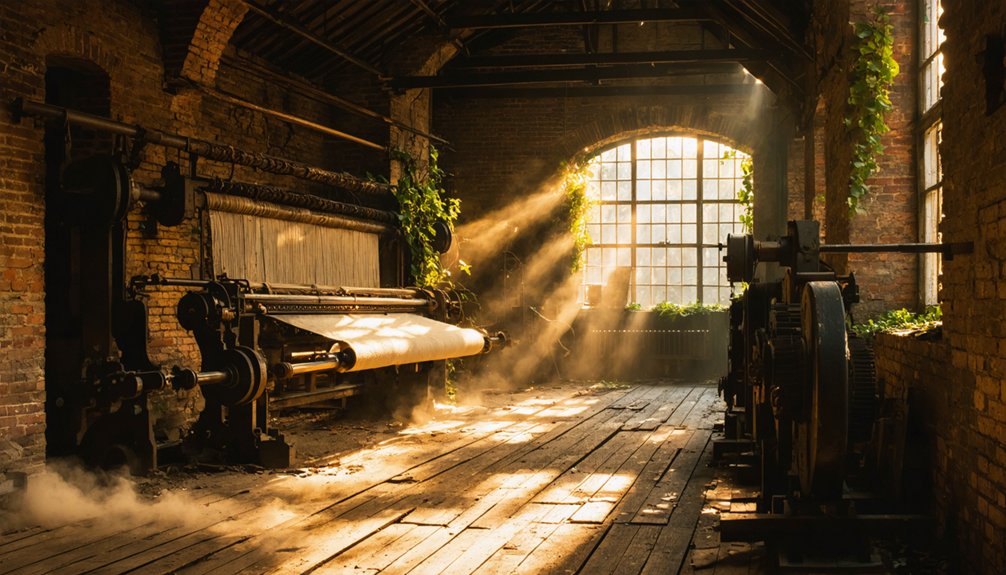
Modern preservation efforts have transformed abandoned textile mills into vibrant cultural and community spaces, breathing new life into these industrial relics. Through adaptive reuse, you’ll find former factory floors now housing children’s museums, art galleries, and cultural centers, as exemplified by the Glencoe Textile Mill Village’s transformation.
These cultural revitalization projects often emerge from public-private partnerships that provide essential funding for stabilization and redevelopment.
You’ll discover that while structural challenges and private ownership issues complicate preservation, many communities have successfully repurposed these historic spaces. Valley Falls Mill’s 1979 conversion into residential housing demonstrates how adaptive reuse can serve modern needs while preserving architectural heritage.
Despite the complexities of restoration, these reimagined spaces continue to anchor communities, replacing lost industrial purposes with new cultural significance.
Ghost Towns as Living Museums
While time has stilled the churning machinery of textile mill towns, these preserved industrial landscapes now serve as compelling living museums where visitors can explore authentically maintained worker housing, company stores, and educational facilities.
You’ll find ghost towns like the Coleridge Historic District transformed into vibrant cultural spaces that blend preservation with modern purpose. Through adaptive reuse, former mill buildings now house art galleries, theaters, and interpretive centers while retaining their architectural character.
Original worker houses and community structures create an immersive experience of industrial heritage.
These living museums preserve more than just buildings – they capture the spirit of textile communities through oral histories, artifacts, and interactive programs.
Local historians and former workers collaborate to keep industrial culture alive, turning abandoned ghost towns into dynamic centers of learning and remembrance.
These efforts are particularly crucial in abandoned communities across the USA, where the echoes of the past can still be felt. By revitalizing these spaces, they aim to enrich local heritage and foster community engagement. Each site tells a unique story, inviting visitors to explore the rich tapestry of American industrial history.
Frequently Asked Questions
How Dangerous Are Textile Mill Ghost Towns for Urban Explorers?
Over 75% of textile mill explorers report near-miss incidents. You’ll face extreme safety concerns during urban exploration, from structural collapse and toxic exposure to hostile encounters and navigation hazards.
What Artifacts Are Commonly Found Inside Abandoned Textile Mill Buildings?
You’ll discover vintage textile machinery like looms and spindles, scattered administrative records and historical documents, fabric samples, hand tools, and industrial remnants from decades of manufacturing operations.
Did Any Mill Towns Successfully Transition to Other Industries?
You’ll find many textile towns achieved successful economic revitalization through industrial diversification, transforming old mills into business parks, mixed-use developments, and attracting new manufacturing sectors like paper and technology.
Were There Underground Tunnels or Passages Beneath the Mills?
While over 40% of historic mills had subterranean networks, you’ll find extensive underground architecture beneath many textile mills, including hidden tunnels for drainage, ventilation, and occasionally secretive activities of historical significance.
How Did Mill Workers Maintain Social Connections After Towns Were Abandoned?
You’ll find former mill workers maintained ties through community networks, historical reunions, family gatherings, shared heritage events, and informal social groups that preserved their collective identity and cultural traditions.
References
- https://theforgottensouth.com/coleridge-north-carolina-ghost-town/
- https://www.youtube.com/watch?v=6NN3Q-NE94k
- https://thevintagetraveler.wordpress.com/2012/11/01/an-old-cotton-mill-and-village-reused/
- https://www.youtube.com/watch?v=-VI_7rNF47g
- https://icatchshadows.com/abandoned-enterprise-cotton-mill-in-coleridge-north-carolina/
- https://www.loveexploring.com/gallerylist/188219/the-us-state-with-the-most-ghost-towns-revealed
- https://www.wm.edu/sites/wmcar/research/danvilledig/history/southern-mill-industry/
- https://guides.lib.unc.edu/labor-movement-south/textile_mills
- https://history.oldwestdurham.org/southern-cotton-mills.html
- https://library.ecu.edu/wp-content/pv-uploads/sites/242/2017/06/2002-Keats-Sparrow-Award-Winner–1st.-Life-in-Southern-Mill-Villages-1900s.pdf