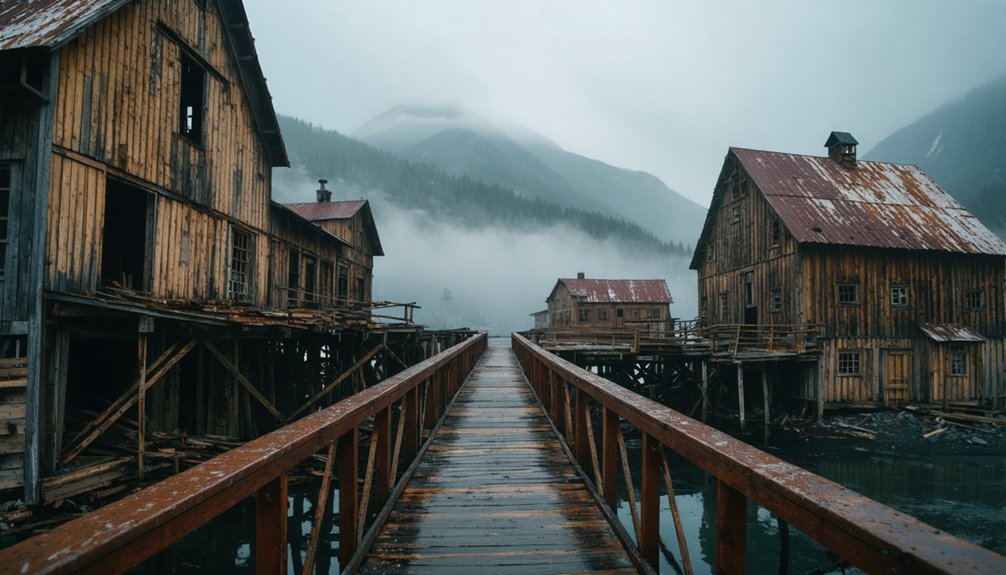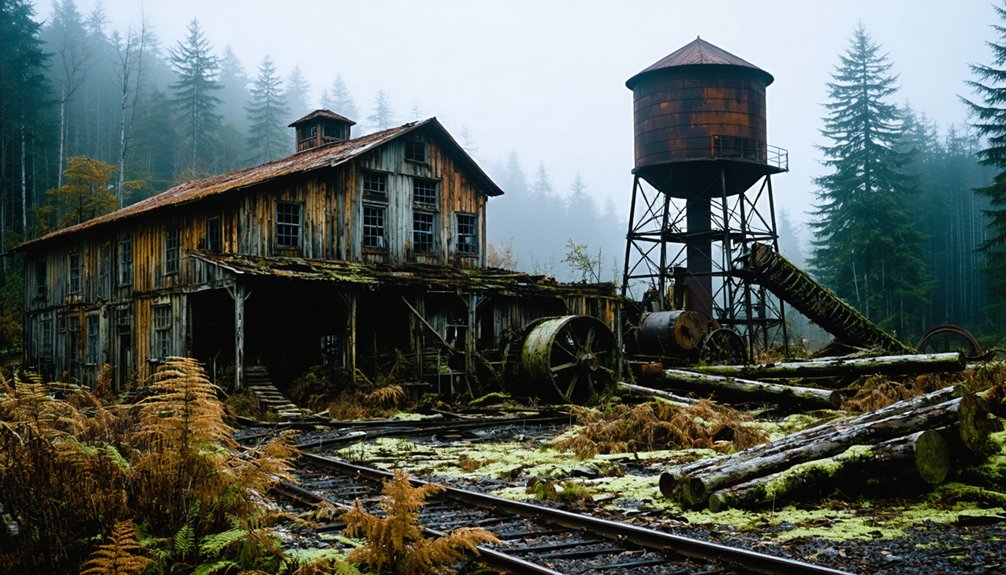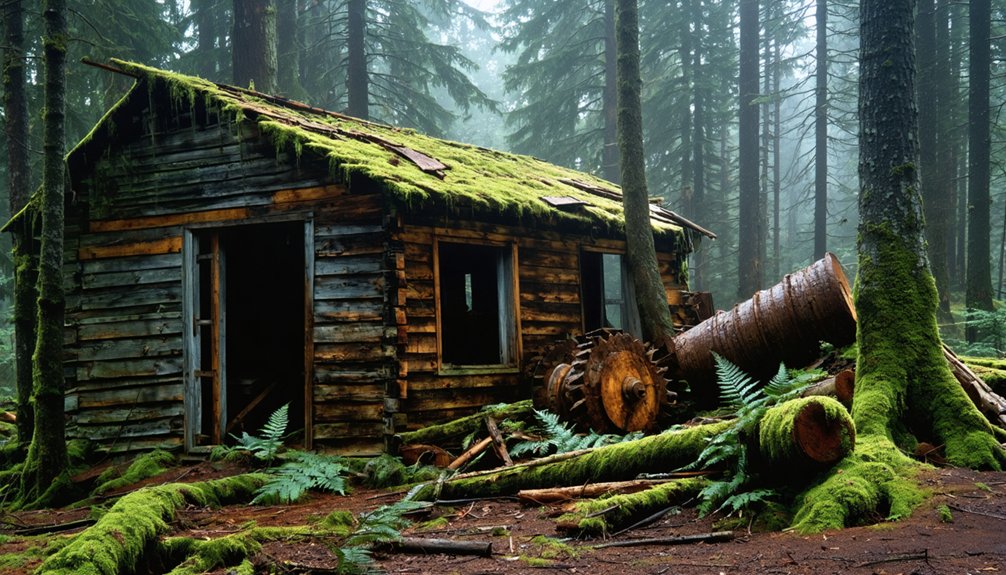
You’ll find tangible traces of America’s logging ghost towns scattered throughout today’s forests. Weathered building foundations, rusting mill machinery, and decaying bunkhouses reveal where bustling timber communities once stood. These sites tell stories through artifacts like old Levi’s rivets, glass bottles, and industrial equipment, while altered watersheds and logging roads show lasting environmental impacts. Each abandoned structure and archaeological discovery offers a window into the dramatic rise and fall of timber boom towns.
Key Takeaways
- Decaying log cabins, bunkhouses, and sawmill foundations serve as physical remnants of former logging communities.
- Archaeological artifacts like Levi Strauss rivets and glass items provide tangible evidence of daily life in timber towns.
- Abandoned post offices and industrial ruins remain accessible at historic sites like Maxville and St. Elmo.
- Environmental scars persist through altered watersheds, historic logging roads, and changes to stream channels and vegetation.
- Historical records, oral histories, and family letters preserve the cultural heritage of logging communities through local museums.
The Rise and Fall of America’s Timber Towns
While the Industrial Revolution drove America’s insatiable appetite for lumber, timber towns emerged as essential economic hubs across the nation’s densely forested regions during the late 19th and early 20th centuries.
Booming timber towns transformed America’s forests into economic powerhouses as industrialization fueled an endless demand for lumber.
You’d find these bustling communities sprouting up around sawmills and river transport hubs, their fates intertwined with the logging industry’s rapid expansion. Workers endured grueling ten-hour days for sixty-five cents pay. Living conditions were harsh, with loggers facing limited access to basic necessities. As railroads penetrated deeper into America’s wilderness, timber economics shifted dramatically.
Production soared from one billion board feet in 1840 to a staggering 46 billion by 1904. Prominent entrepreneurs like Frederick Weyerhaeuser built powerful conglomerates, while towns like Bangor, Maine became major lumber shipping ports.
Yet this prosperity wouldn’t last – as forests fell to intense harvesting, the industry was forced to migrate westward and northward, leaving behind the remnants of once-thriving communities.
Physical Traces in Today’s Landscape
Although decades have passed since the last loggers departed, America’s timber ghost towns reveal their stories through tangible remnants scattered across the landscape.
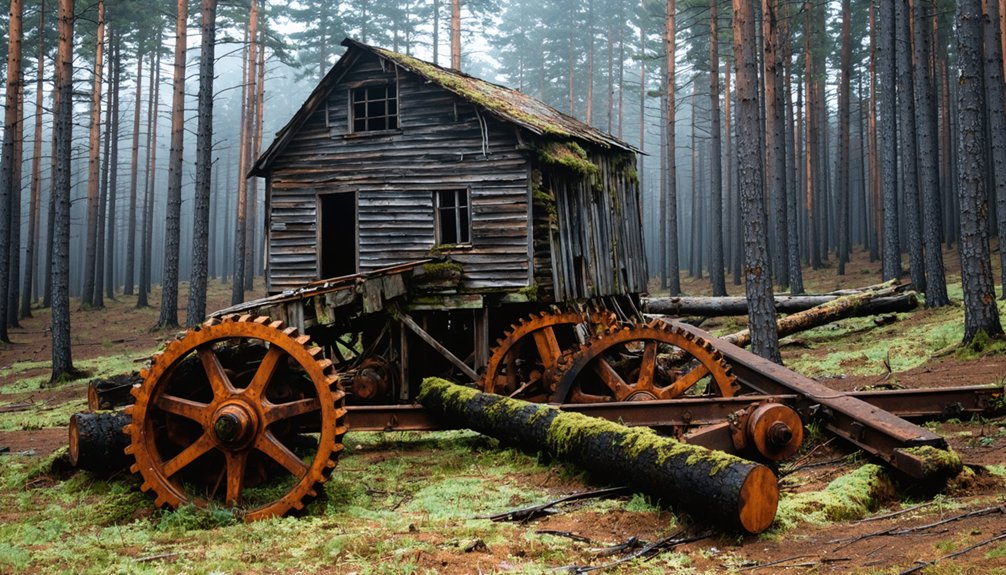
You’ll find decaying log cabins and bunkhouses slowly surrendering to nature’s embrace, while towering 60-foot trestles emerge from forest canopies as silent sentinels of the past. Physical structures like sawmill foundations, abandoned post offices, and industrial ruins stand as weathered witnesses to bustling communities that once thrived here. One key site is Oregon’s Maxville, where the Bowman-Hicks building still remains as a rare preserved structure. Visitors can explore sites like St. Elmo, which still maintains accessible historic structures.
Nature’s relentless reclamation transforms these sites with each passing season. Vines snake through collapsed roofs, moss blankets old foundations, and trees push through former town squares.
Yet the ghost towns’ footprints endure through visible logging roads, railroad grades, and spring-fed ponds that still shape the land’s contours, preserving chapters of America’s timber heritage.
Life in a Company-Owned Logging Village
Since timber companies owned every building and resource in logging villages, they wielded absolute control over workers’ lives. You’d find yourself living in company housing, shopping at company stores, and working under strict company rules that limited your autonomy.
Timber companies dominated every facet of logging village life, from housing to shopping, keeping workers bound in a system of total control.
The system created a cycle of dependence, with your wages often going right back to the company through rent and store purchases. A designated camp boss maintained strict order over daily operations and living conditions.
Here’s what you’d experience in these controlled communities:
- Constant surveillance of your activities, especially if you showed interest in unions
- Basic but managed amenities like schools and churches to keep you anchored to the village
- Long workdays with minimal safety protection, earning wages that barely covered company-charged expenses
Despite providing stable family housing and community facilities, company control extended far beyond the workplace, shaping every aspect of residents’ daily existence. African American workers faced additional hardships, earning less than $8 per day while companies refused to negotiate fair wages.
Environmental Legacy of the Logging Era
If you visit former logging ghost towns today, you’ll notice distinctive patterns in forest recovery, with many areas still showing the scars of clear-cutting from over a century ago.
The environmental impacts remain visible in the altered watersheds, where logging-era practices disrupted natural water flow patterns and contributed to ongoing erosion issues. Modern efforts now focus on implementing sustainable harvesting limits to prevent similar ecological damage in active logging areas. Remarkably, these sites represent just a fraction of the massive forest loss that has occurred globally, with one-third of the world’s forests disappearing over the past 10,000 years.
These historic logging sites serve as outdoor laboratories for studying long-term forest regeneration, revealing how removal of old-growth trees fundamentally changed local ecosystems and carbon storage capacity.
Forest Recovery Patterns
When examining historic logging sites today, you’ll find complex patterns of forest recovery that span decades or even centuries. The legacy of logging impacts continues to shape forest regeneration through altered species composition and carbon dynamics. The selective logging practice has historically contributed to significant carbon emissions of approximately 90 Tg C yr in the Brazilian Amazon. Research shows browsing damage rates are significantly higher in logged areas compared to unlogged sites.
- You can observe aboveground carbon stocks taking up to 125 years to fully recover, with surviving trees contributing most of the regrowth.
- You’ll notice shifts in tree species, with logged areas showing higher percentages of sun-loving trees (36%) compared to undisturbed sites (23%).
- At sites near agricultural edges or on hilltops, you’ll see slower recovery due to increased environmental stress from temperature and moisture changes.
Drought patterns further complicate recovery, especially in fragmented forests where edge effects intensify the challenges of regeneration after historic logging.
Watershed Changes Today
Although more than a century has passed since the peak logging era, you’ll find lasting impacts on watershed ecosystems across former timber regions today.
Historical logging roads still channel water in unnatural ways, while compacted soils continue limiting infiltration. You can spot these effects in elevated peak flows during storms and increased erosion that fills stream pools with sediment.
Modern watershed restoration efforts face significant challenges from these legacy impacts.
Stream channels remain wider and shallower than their natural state, with fewer fallen trees creating essential fish habitat. Even with sediment management projects, many watersheds haven’t recovered their pre-logging conditions.
You’ll notice warmer water temperatures where streamside vegetation was removed, and in heavily logged areas, streams still show reduced pool depths crucial for steelhead survival.
Preserving the Stories of Lost Communities
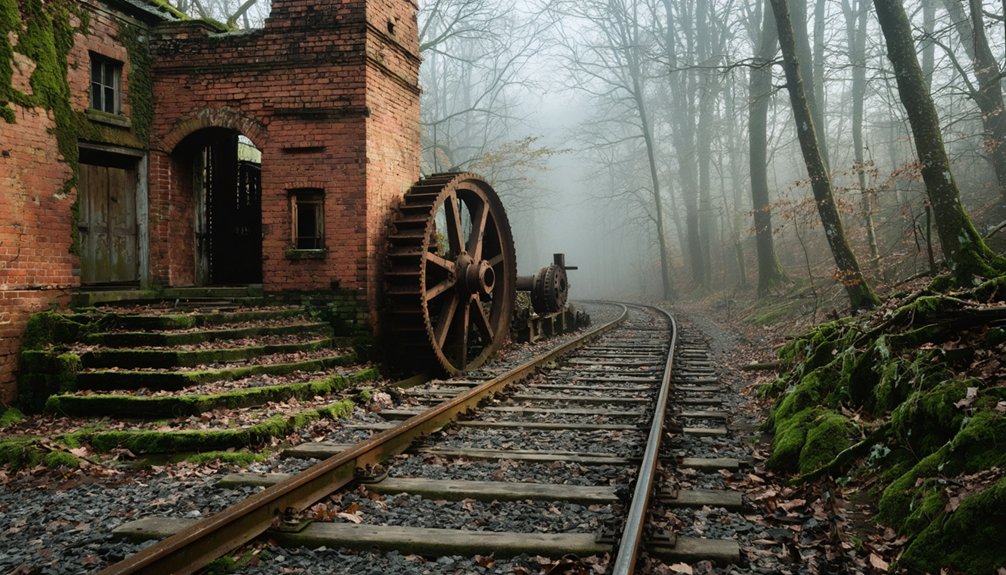
You’ll find the most vivid stories of logging-era ghost towns preserved through personal accounts shared in oral histories and family letters tucked away in historical society archives.
These firsthand narratives bring life to artifacts like worn tools, faded photographs, and crumbling building foundations that remain at abandoned town sites.
Through careful documentation by preservation organizations and local museums, these physical remnants and personal memories work together to tell the complete story of lost logging communities.
Heritage Through Personal Accounts
As former logging town residents age and memories fade, the Maxville Heritage Interpretive Center has made oral history collection its primary mission. Through recorded oral narratives, you’ll discover stories of cultural resilience from Native American, Greek, Japanese, and African American logging families who built lives in this Oregon community despite segregation and discriminatory laws.
- Video interviews capture firsthand accounts of daily routines, work life, and social dynamics in the timber industry.
- Stories reveal how children formed cross-cultural friendships despite segregated schools.
- Descendants lead efforts to preserve these memories, transforming Maxville from a ghost town into a site of remembrance.
These personal accounts paint a vivid picture of multilingual environments and unexpected diversity in early 20th-century Oregon logging communities, preserving vital details about language, class, and social norms.
Archives Tell Lost Stories
When lumber towns vanished into ghost towns, they left behind rich documentary evidence in archives across America. You’ll find their stories preserved in archival photographs showing bustling mill operations, company villages, and vast pine stands that once dominated the landscape.
Historical societies safeguard these visual treasures alongside detailed logging records, maps, and company documents that trace the rise and fall of these lost communities.
You can piece together their histories through railroad manifests, census data, and tax records that reveal when towns boomed and when they went bust.
County deed books and forestry permits show the scale of timber operations, while Sanborn maps detail the layout of vanished streets and buildings.
These carefully preserved records guarantee that America’s lumber ghost towns, though gone from the landscape, aren’t lost to history.
Archaeological Discoveries and Historical Records
Recent archaeological discoveries at logging ghost towns have revealed rich details about the diverse communities that once thrived in these temporary settlements.
Through meticulous artifact analysis at sites like Maxville, Oregon, you’ll find evidence of Black, Japanese, and white families who shaped these towns’ unique community dynamics.
- Excavated Levi Strauss rivets, decorated glass, and charred animal bones tell stories of daily life across racial boundaries.
- Surface artifacts and structural remains expose social divisions, with Black residents confined to less permanent housing “across the tracks.”
- Historic records, combined with modern technology like lidar mapping, uncover the layout of 96-acre settlements where diverse ethnic groups lived and worked.
These findings challenge simplified narratives about logging history, revealing complex multiethnic communities that operated despite era restrictions.
From Boom to Abandonment: Common Patterns

During the late 1800s and early 1900s, the rise and fall of logging ghost towns followed remarkably consistent patterns across North America.
You’ll find these towns emerged rapidly around rich timber resources, with hastily constructed wooden buildings and basic infrastructure serving the immediate needs of workers and their families. The community dynamics centered on logging operations, with social life revolving around schools, churches, and local gatherings.
Economic vulnerability became apparent as forests were depleted. When timber resources vanished, these single-industry towns couldn’t sustain themselves. Workers and their families departed swiftly, leaving behind deteriorating structures and abandoned machinery.
Once the trees disappeared, so did the towns – a stark reminder that single-resource communities live and die by their harvest.
Today, you’ll typically discover only concrete foundations, scattered metal artifacts, and old rail beds – silent testimonies to these once-vibrant but short-lived communities that nature has largely reclaimed.
Hidden Remnants in Modern Forests
The seemingly empty forests of North America hold countless clues to their logging-town past, waiting to be discovered by careful observers. As you explore these forgotten places, you’ll find hidden artifacts that tell stories of bustling communities now reclaimed by nature.
Forest archaeology reveals evidence through both man-made remains and living markers.
- Look for concrete foundations and cellar holes beneath the leaf litter, often surrounded by domestic items like broken bottles and rusted cookware.
- Search for “cultural plants” like lilacs and fruit trees that mark former homesteads, alongside garden terraces and ornamental survivors.
- Follow old skid roads to discover logging infrastructure, from springboard-notched stumps to abandoned machinery and mill foundations.
These silent witnesses preserve the legacy of logging communities, embedded in the forest floor and living vegetation.
Heritage Tourism and Ghost Town Exploration
Once abandoned to decay and neglect, many former logging and mining ghost towns now serve as vibrant heritage tourism destinations.
You’ll find preserved structures, from general stores to mining equipment, offering glimpses into frontier life. Sites like Bodie, California maintain over 100 original buildings in “arrested decay,” while Batsto Village showcases restored iron and glassmaking facilities.
Through heritage tourism, you can experience guided mine tours, gold panning demonstrations, and seasonal festivals that bring history to life.
Heritage tourism transforms abandoned places into living classrooms, where visitors can touch, explore and experience authentic pieces of American history.
Many sites operate under state park or non-profit protection, ensuring both access and preservation.
Whether you’re exploring Kennicott’s copper mining remains in Alaska or St. Elmo’s gold rush remnants in Colorado, these outdoor museums reveal the boom-and-bust cycles that shaped America’s resource frontiers.
Frequently Asked Questions
Can You Legally Remove Artifacts Found in Logging Ghost Towns?
Like a precious family heirloom, you can’t legally take artifacts from federal or state lands. You’ll need permits for artifact preservation, though private landowners may grant permission for their historical significance.
Were Any Logging Ghost Towns Successfully Repopulated in Modern Times?
You’ll find several logging ghost towns successfully repopulated, like Walhalla in Australia and Glen Haven in Michigan, though repopulation challenges mean they’re sustained mainly through tourism and heritage-based community sustainability.
Did Native American Tribes Establish Settlements in Abandoned Logging Towns?
You won’t find much evidence of tribal connections to abandoned logging towns – archaeological records don’t show Native American settlement patterns shifting to these sites after lumber operations ceased.
This lack of continuity may contribute to the challenges of logging history in Oregon state, where many towns have faded into obscurity. Moreover, the impact of industrialization on local ecosystems has altered landscapes that once supported vibrant tribal communities. Understanding these changes is essential for recognizing the full narrative of Oregon’s logging heritage.
What Supernatural Legends Are Associated With Former Logging Communities?
You’ll find phantom lumberjacks still haunting their old worksites, with folklore origins tied to tragic logging accidents. Listen for ghostly axe echoes and footsteps across these haunted landscapes at dusk.
How Did Winter Weather Affect the Abandonment of Logging Towns?
You’ll find harsh climates accelerated economic decline, as frozen roads isolated communities, supply shortages increased costs, and winter damage to buildings made maintenance unsustainable once logging operations ceased.
References
- https://www.petoskeynews.com/story/news/local/gaylord/2015/04/07/ghost-towns-left-behind-by-the-earliest-loggers/45205943/
- https://www.visitredwoods.com/listing/falk-historic-logging-ghost-town/526/
- https://en.wikipedia.org/wiki/Ghost_town
- https://npshistory.com/publications/slbe/brochures/ghost-towns-2011.pdf
- https://history.howstuffworks.com/history-vs-myth/ghost-towns.htm
- https://freepages.history.rootsweb.com/~gtusa/definitions.pdf
- https://www.uwsp.edu/wp-content/uploads/2023/11/leaf-changing-of-the-land-lesson-5.pdf
- https://www.youtube.com/watch?v=d_vMU5E1JpI
- https://www.drownedtowns.com/blog/2023/08/10/trees-aplenty-logging-in-the-pacific-northwest
- https://historictoxaway.org/logging-1900-1920/