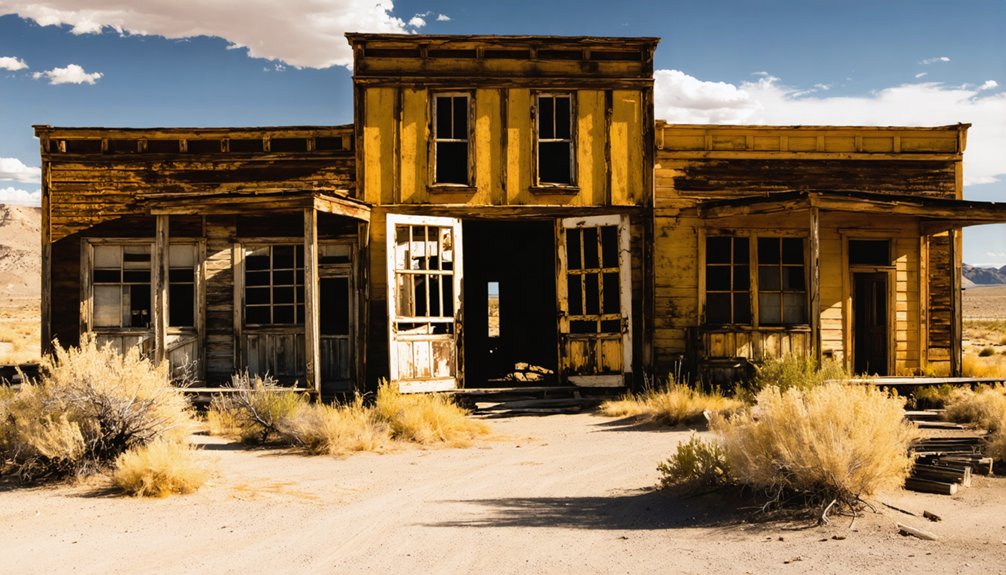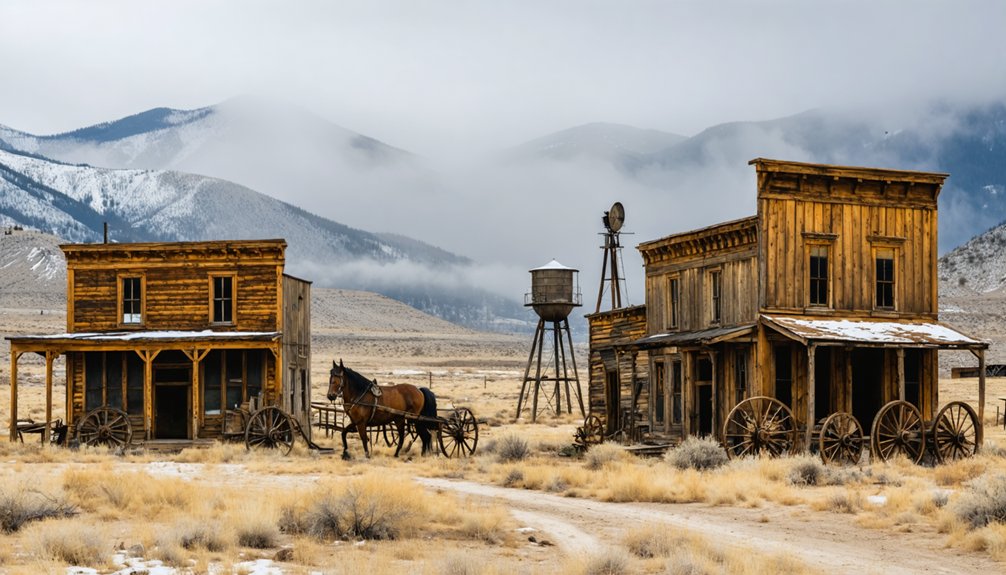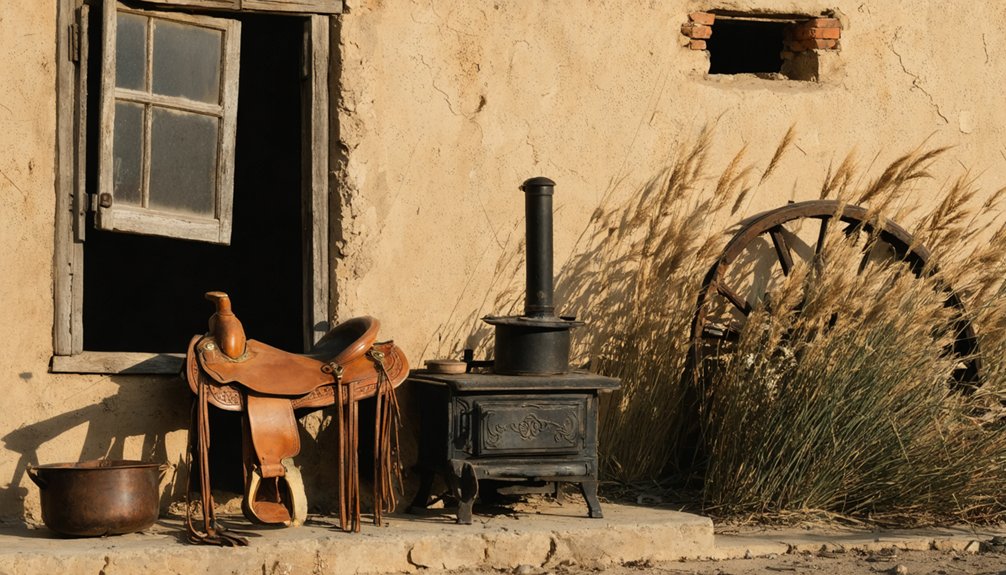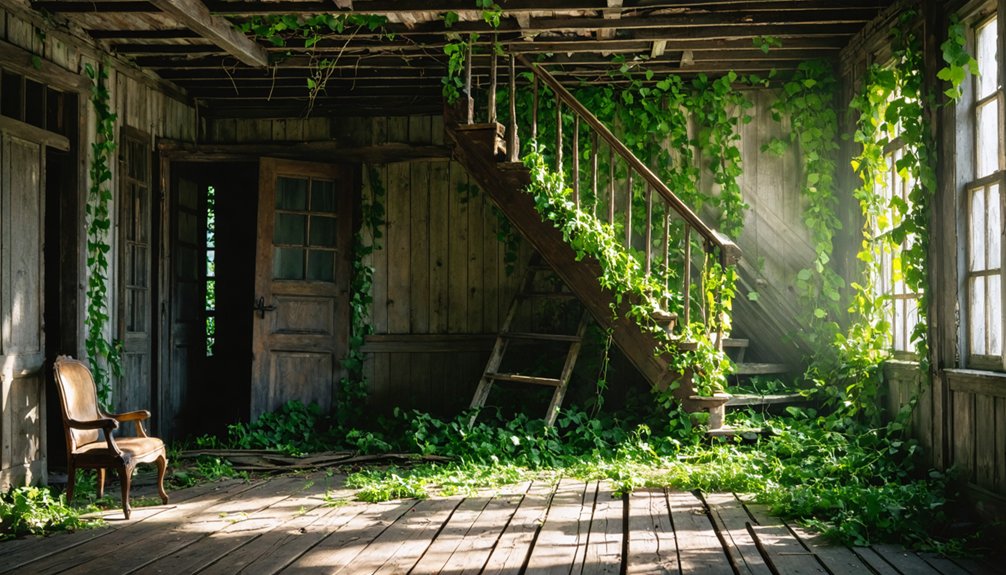
In America’s overgrown ghost towns, you’ll find architectural remnants that reveal the past, from stone foundations to intact religious buildings. Nature has steadily reclaimed these abandoned settlements, with vegetation engulfing structures and creating new ecosystems. You can discover artifacts of daily life, including preserved bottles and household items, while mining remnants document the industrial heritage. The sites hold countless untold stories beneath their weathered surfaces, waiting to be uncovered.
Key Takeaways
- Stone foundations and masonry structures remain intact, particularly religious and civic buildings constructed with superior materials and techniques.
- Archaeological remnants include household artifacts, bottles, and administrative records that provide insights into former residents’ daily lives.
- Natural vegetation has engulfed buildings and infrastructure, creating new ecosystems through ecological succession and rewilding processes.
- Architectural features in preserved sites like Bodie, California are maintained in “arrested decay” to showcase authentic historical conditions.
- Mining-related structures persist among 140,000 documented abandoned hardrock mines, though many pose environmental hazards to surrounding areas.
Preserving America’s Abandoned Mining Heritage
While America’s mining boom helped forge the nation’s industrial might, it left behind a complex legacy of abandoned mines that now demands careful preservation and management.
Many former mining settlements, like the Berlin ghost town, remain as preserved attractions managed by state parks.
You’ll find over 140,000 documented abandoned hardrock mines across the nation, with an estimated 390,000 more yet to be recorded. These sites, scattered across 450 million acres of federal lands, tell the story of America’s mining history through their abandoned structures and historic artifacts.
Around 22,500 abandoned mines pose serious environmental hazards that threaten surrounding ecosystems and communities.
The National Mine Map Repository now safeguards records of more than 275,000 closed mines dating back to the 1790s.
The National Mine Map Repository stands as a vital guardian of American mining history, documenting centuries of underground exploration and development.
This crucial archive doesn’t just preserve our mining heritage – it’s essential for modern safety assessments and reclamation planning, helping protect both the remnants of our industrial past and the communities that live near them today.
Architecture Frozen in Time: Buildings That Still Stand
Throughout America’s ghost towns, architectural remnants stand as silent witnesses to bygone eras, with many original structures defying time through their robust construction methods.
You’ll discover architectural diversity in these abandoned settlements, from utilitarian mining structures to grand religious buildings, each telling stories of historical significance.
- Stone foundations and masonry work remain impressively intact, particularly visible in places like Doodletown, NY.
- Vernacular architecture dominates these sites, showcasing locally-sourced materials and practical building techniques.
- Religious and civic structures often survive best due to their superior stone construction.
- Notable examples like Bodie, CA and Camp Santanoni, NY retain multiple original buildings in various states of preservation.
The Old Car City in Georgia demonstrates how vintage automotive relics can become architectural features themselves, with over 34 acres of classic cars integrated into the landscape.
Similar to Old Town Al-Ula in Saudi Arabia, many buildings feature mud brick upper floors while maintaining sturdy stone foundations below.
While natural decay and vandalism threaten these structures, many have found protection within historical preserves, ensuring their stories continue to educate future generations.
Daily Life Through Artifacts and Personal Belongings
Despite the passage of time, artifacts scattered throughout America’s ghost towns provide invaluable insights into the daily routines and personal lives of former residents.
Preserved bottles including soda water, whiskey glasses and oil vessels reveal how mining town residents lived. You’ll find porcelain doorknobs from the 1920s and embossed jars from the early 1900s revealing the aesthetic choices and storage needs of these communities. While most personal belongings were taken during departures, larger household artifacts remain, telling stories through items like Mary Lewis Cold Cream jars and industrial equipment. The discovery of an Addressograph machine in office spaces demonstrates the sophisticated business operations that once existed.
Administrative records in vault-like rooms expose the bureaucratic framework of these towns, while abandoned medical facilities with scattered X-rays hint at healthcare practices.
What’s particularly absent speaks volumes too – the selective removal of personal effects suggests methodical departures, leaving behind primarily communal and fixed items that couldn’t be transported easily.
Nature’s Reclamation of Historic Settlements
When you explore abandoned settlements like Houtouwan and Spreepark, you’ll witness nature’s methodical conquest as thick vegetation engulfs buildings and infrastructure, transforming human-made structures into wild landscapes.
Weather patterns play a significant role in this transformation, from Kolmanskop’s desert sands filling colonial buildings to Centralia’s underground fires creating a hostile environment for plant growth. The SS Ayrfield wreck demonstrates how even ships can become unexpected habitats for flourishing mangrove forests. In Pripyat, radiation levels remain dangerously high, yet wildlife and vegetation thrive in the absence of human activity.
You’ll notice stark contrasts between sites actively preserved for tourism, like Kolmanskop’s guided tours through sand-filled rooms, and completely untamed locations such as Varosha, where decades of isolation have allowed nature to proceed unchecked.
Vegetation Claims Historic Ruins
As time marches forward, nature steadily reclaims abandoned human settlements through an intricate process of vegetative invasion.
You’ll witness the remarkable transformation as ecological succession takes hold, beginning with grasses and wildflowers before progressing to larger vegetation overgrowth.
- Olive trees and native flora penetrate ancient stones, their roots gradually breaking down even the sturdiest foundations.
- Natural reforestation can take 60-80 years to establish mature forest systems in these forgotten places.
- Plant colonization stabilizes soil and improves water retention, creating new ecosystem balance.
- The process captures significant amounts of carbon, with each reclaimed hectare contributing to climate mitigation.
This passive rewilding represents nature’s resilient spirit, as abandoned structures transform into thriving ecosystems that support increasing biodiversity and environmental restoration.
These natural processes occurring across 83 Mha of abandoned cropland demonstrate nature’s powerful capacity for regeneration.
The gradual reclamation of these ghost towns mirrors the restoration happening at abandoned mine lands, where nature’s healing powers work to repair scarred landscapes.
Weather’s Impact Over Time
The relentless forces of weather forge dramatic transformations in abandoned settlements, amplifying nature’s reclamation process beyond vegetation alone.
You’ll find that rising seas and increased storm frequency accelerate the conversion of once-thriving coastal towns into wetlands, while saltwater intrusion creates ghost forests where vibrant woodlands once stood.
When you explore these forgotten places, you’ll notice how climate impacts have reshaped the landscape.
Storm surges deposit salt into inland areas, permanently altering soil chemistry and destabilizing historic structures.
The combination of extreme weather events and rising sea levels can submerge entire sections of coastal ghost towns, while salinization makes the ground inhospitable to original plant species.
What you’re witnessing is nature’s methodical process of reclaiming these spaces, as weather patterns steadily reshape abandoned human settlements into new ecosystems.
Preserved Versus Wild Growth
Modern ghost towns present a striking contrast between carefully preserved historical sites and those surrendered to nature’s unstoppable reclamation.
You’ll find preserved structures like those in Bodie, California, maintained in “arrested decay” to protect their historical integrity, while other abandoned settlements slowly disappear beneath wild overgrowth.
- Historic parks maintain authentic artifacts and infrastructure through controlled preservation
- Nature rapidly reclaims unprotected towns with infiltrating vegetation and wildlife
- Root systems and moisture accelerate structural deterioration
- Original features become obscured by decades of unchecked plant growth
When you explore these sites, you’ll witness this ongoing tension between conservation and natural processes.
While some towns retain their cultural narrative through careful management, others transform into haunting landscapes where wilderness gradually erases human presence, each telling a different story of abandonment and time’s passage.
Tourism and Modern Uses of Ghost Town Sites
You’ll find that modern ghost towns serve multiple functions, from heritage tourism destinations that preserve local history to venues for creative industries seeking authentic abandoned aesthetics.
Your visit to these sites helps sustain preservation efforts while supporting local economies that have adapted to changing tourism patterns through sustainable practices and cultural programs.
Whether you’re exploring converted hotels that now host festivals or photographing historic structures repurposed for contemporary use, you’re witnessing the evolution of these sites from abandoned spaces to multifaceted cultural assets.
Heritage Tourism Impact
Heritage tourism in ghost towns has emerged as a significant economic force, generating USD 2.1 billion globally in 2024 with projected growth to USD 6.3 billion by 2033.
You’ll find that North America dominates this market, contributing 43% of global revenue through specialized tours, accommodations, and retail operations.
When you explore these historic sites, you’ll discover how heritage tourism shapes local communities through:
- Professional tours blending folklore with historical facts
- Community engagement in cultural storytelling and preservation
- Economic opportunities for small businesses and municipalities
- Educational outreach programs that strengthen local pride
This tourism surge has transformed many ghost towns, revitalizing local economies through tax revenues and infrastructure investments.
You’ll witness how thoughtful planning helps balance tourist interest with community preservation, creating sustainable economic benefits while maintaining authentic cultural experiences.
Preservation Through Visitation
While traditional preservation methods focus on protecting empty structures, active tourism has emerged as a powerful tool for ghost town conservation. Through visitor engagement strategies like cultural events, reenactments, and guided tours, these historic sites maintain their relevance while generating funds for preservation.
You’ll find destinations like Bodie State Historic Park maintaining its “arrested decay” state, while Calico Ghost Town offers interactive experiences that blend education with entertainment.
Sustainable tourism practices are evident in places like Garnet, Montana, where seasonal access restrictions protect the site’s integrity. Investment in infrastructure, from visitor centers to interpretive signage, creates meaningful connections between tourists and these historic places.
Artist residencies and cultural festivals further transform abandoned spaces into vibrant hubs of activity, ensuring these remarkable sites continue to tell their stories for generations to come.
Modern Business Adaptations
Despite traditional tourism’s decline in recent years, ghost towns have found new life through innovative business adaptations that capitalize on dark tourism and experiential offerings.
You’ll find entrepreneurs transforming these abandoned sites into compelling destinations through business innovations that merge history with modern entertainment.
- Immersive ghost walks and paranormal investigations using AR technology to recreate historical scenes
- Local artisans and storytellers offering authentic experiences through themed museums and craft shops
- Seasonal festivals celebrating supernatural and historical elements, driving consistent visitor traffic
- Specialized memorial tourism experiences that connect visitors with significant historical events
These experiential tourism adaptations have proven particularly successful, with the dark tourism market projected to reach $38.64 billion by 2030.
You’re witnessing a transformation where declining traditional tourism creates opportunities for niche, culturally-rich experiences in these historic locations.
Archaeological Discoveries Beneath the Surface
Archaeological excavations beneath abandoned settlements have revealed extraordinary findings that span thousands of years of human history.
You’ll find evidence of ancient habitation stretching back 14,000 years in Wyoming’s ghost towns, challenging previous theories about early human migration. Cultural artifacts, from stone tools to turquoise jewelry, tell stories of the people who lived there.
When you explore these sites, you’ll discover complex underground structures, including Hohokam pit houses with adobe floors and distinctive architectural features.
The layers beneath reveal intricate details of daily life: fire hearths, storage pits, and cultural remnants. In places like Greenland’s Kangeq, compressed middens hold thousands of bones, creating a timeline of human occupation spanning two millennia.
These discoveries continue to reshape our understanding of North America’s earliest inhabitants.
The Art of Maintaining Historic Ruins

As historic ruins face constant environmental pressures, their preservation requires a delicate balance of scientific expertise and traditional craftsmanship.
The masonry techniques you’ll encounter emphasize minimal intervention while protecting structural integrity. Modern preservation ethics guide conservators to maintain authenticity through careful documentation and reversible treatments.
- You’ll find lime-based mortars being meticulously matched to original compositions during repointing work
- “Soft topping” with vegetation replaces harmful concrete caps, allowing ruins to breathe naturally
- Traditional materials and methods preserve historical authenticity while preventing further deterioration
- Environmental controls focus on moisture management through strategic sheltering and reburial options
The key to successful conservation lies in understanding how to protect these structures while respecting their inherent character and archaeological significance.
Frequently Asked Questions
Are There Still Valuable Minerals or Precious Metals in These Ghost Towns?
You’ll find that while mineral exploration shows some remaining deposits in ghost towns, most valuable ores were depleted during their mining history, leaving only lower-grade materials that aren’t economically viable today.
the preservation of oil towns in america is crucial for understanding the historical significance of the energy boom that shaped many regions. These towns serve as a reminder of an era when oil played a pivotal role in the country’s economic development. Protecting these sites not only honors the legacy of the workers and communities but also provides valuable insights into the industrial evolution of the nation.
What Happened to the Residents Who Left These Towns?
You’ll find former residents experienced challenging life changes, often relocating to larger cities or suburbs, facing economic hardships, and preserving community memories through cultural events and historical societies.
Do Ghost Towns Have Any Permanent Modern Residents?
Home is where the heart is – you’ll find modern inhabitants in many ghost towns, maintaining historical buildings and supporting ghost town preservation through tourism services, despite dramatic population decline.
Are There Documented Paranormal Activities in These Abandoned Settlements?
You’ll find extensive paranormal investigations documenting EVPs, apparitions, and unexplained phenomena across these haunted locations, with particularly strong evidence in Bodie’s structures and St. Elmo’s historic hotel.
How Safe Is Drinking Water From Old Wells in Ghost Towns?
Despite your adventurous spirit, you shouldn’t drink from ghost town wells – they’re extremely unsafe. Historical contamination has likely compromised water quality through deteriorated casings, toxic chemicals, and dangerous underground seepage.
References
- https://www.mentalfloss.com/geography/american-ghost-towns-can-still-walk-through
- https://www.geotab.com/ghost-towns/
- https://www.losethemap.com/scariest-ghost-towns-in-the-world/
- https://www.loveexploring.com/gallerylist/131658/abandoned-in-the-usa-92-places-left-to-rot
- https://www.youtube.com/watch?v=yeTVfoQxqJc
- https://www.atlasobscura.com/lists/americas-best-preserved-ghost-towns
- https://www.blm.gov/sites/default/files/uploads/AML_PUB_DecadeProgress.pdf
- https://www.wri.org/insights/us-good-samaritan-law-pilots-abandoned-mine-cleanup
- https://www.osmre.gov/programs/national-mine-map-repository
- https://www.epa.gov/superfund/abandoned-mine-lands-revitalization-and-reuse