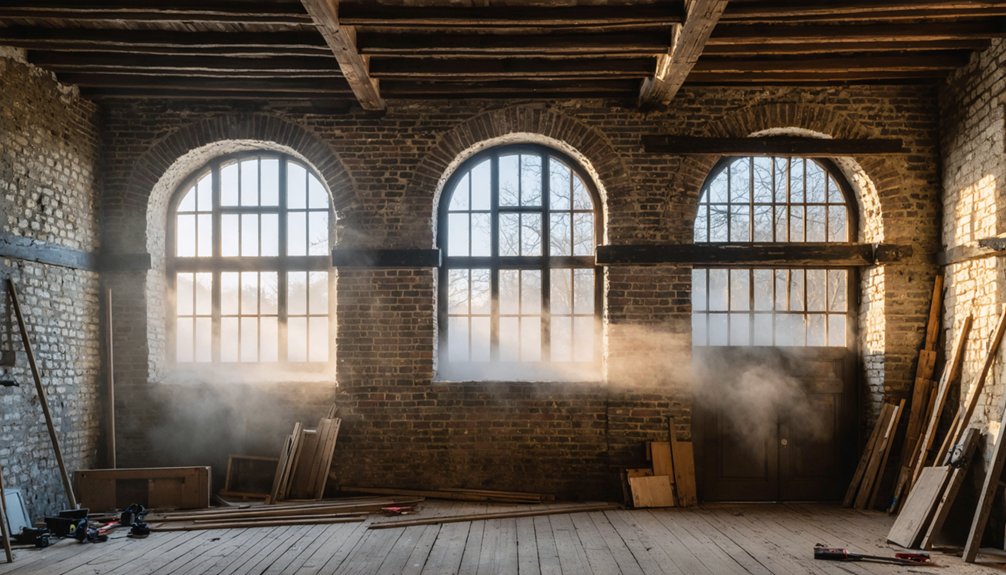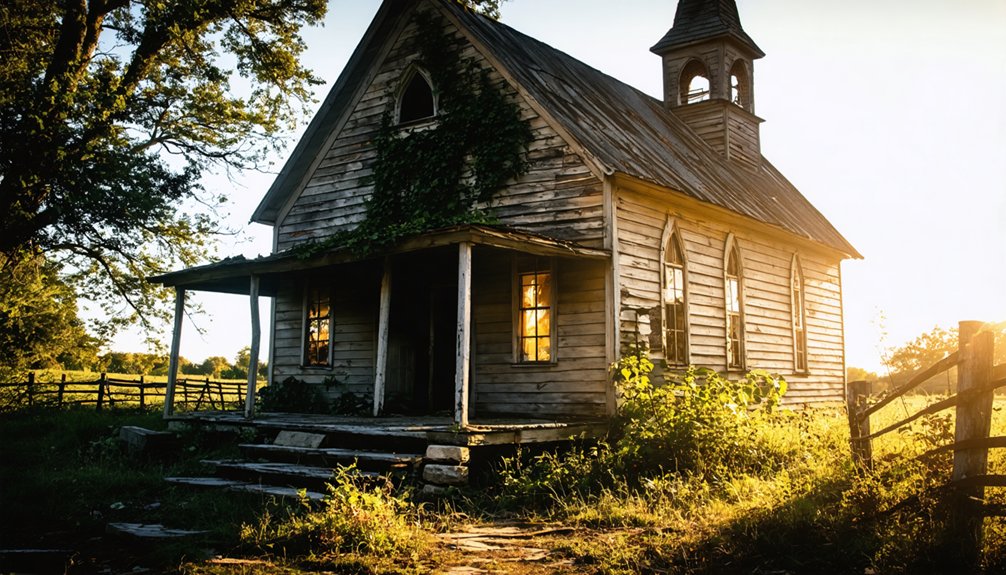
You’ll find extensive physical remnants of America’s forgotten colonial settlements preserved across the landscape. Original stone foundations mark building footprints, while collapsed walls and cellar holes reveal early construction techniques. Networks of dry stone walls stretching over 240,000 miles in New England still define ancient property lines. Hidden burial grounds and pristine artifacts lie beneath modern developments. These enduring traces offer glimpses into pioneering life, with many sites still awaiting discovery.
Key Takeaways
- Stone foundations and cellar holes mark former colonial homestead locations, revealing building dimensions and construction techniques from early settlements.
- Extensive networks of dry stone walls, stretching over 240,000 miles in New England, indicate colonial-era property boundaries and farming practices.
- Archaeological remains of colonial taverns, forts, and communal buildings showcase community layouts and social structures from the 1600-1700s.
- Buried colonial artifacts and structures, discoverable through ground-penetrating radar, provide insights into daily life and trading activities.
- Original burial grounds and cemeteries, though often hidden beneath modern development, preserve evidence of colonial demographics and social hierarchies.
Uncovering America’s Early Settlement Ruins
While many colonial settlements eventually grew into modern cities, countless others now lie abandoned across the American landscape as ghostly reminders of our nation’s pioneering past.
You’ll discover these forgotten towns through their remaining artifacts, which tell stories of early American life and industry. From rusted mining equipment in Bodie, California to collapsed tunnel entrances in Custer, Idaho, you can trace the evolution of mining techniques that shaped these frontier communities. Visitors can explore the iconic Cook Bank building that still towers over the desert landscape of Rhyolite.
Settlement patterns emerge as you explore the infrastructure – wooden sidewalks, derelict train depots, and remnants of telegraph systems reveal how these towns once thrived. The Old Fort at Crown Point stands as a testament to colonial military defenses against French forces.
Protected sites like Old Cahawba Archaeological Park now preserve these historical treasures, allowing you to walk through stabilized ruins and examine authentic artifacts that showcase America’s colonial heritage.
Stone Foundations and Architectural Traces
As you explore New England’s abandoned colonial settlements, you’ll find stone foundations and cellar holes that reveal the exact locations where families like the Goulds and Wallingfords once built their homes.
These architectural remains form distinct patterns that show how early communities were organized, from the placement of homesteads to the layout of original roads and common areas.
The extensive network of dry stone walls, stretching hundreds of thousands of miles across the region, still marks ancient property lines and provides evidence of how colonists divided and used their land. These walls represent the skeletons of past agricultural practices, silently telling the story of colonial farming life. Among these historic remnants, town pounds stand as enduring stone enclosures that once served the vital function of holding stray livestock in colonial communities.
Cellar Holes Tell Stories
Nearly every colonial-era homestead in New England left behind a lasting footprint in the form of cellar holes – stone-lined excavations that once served as foundations and storage spaces for 18th and 19th-century buildings.
Through cellar archaeology, you’ll find these rectangular pits ranging from 4 to 6 feet deep, often clustered together where small settlements once thrived. The careful arrangement of fieldstones reveals clues about construction periods and building purposes.
House foundations typically show a one or two-room layout, while barn foundations stand wider and more robust. You’ll discover that these sites aren’t isolated – they’re connected by stone walls marking old property lines and paths. These remnants showcase how economic and industrial changes drove families away from their agricultural lifestyles. The frost-heaved stones that surfaced each spring were gathered by settlers to construct enduring wall systems.
Each cellar hole represents a piece of historical preservation, telling stories of early American farm life before the forest reclaimed these forgotten communities.
Building Patterns Reveal Communities
Stone foundations tell a deeper story beyond individual cellar holes, revealing entire community layouts in colonial ghost towns. When you explore these sites, you’ll find that architectural techniques like dry-laid stonework and carefully positioned cornerstones show how settlers organized their villages for both function and defense.
- Original stone foundations preserve the exact dimensions of colonial structures, showing you where homes, barns, and community buildings once stood. Like the Old Stone House in Georgetown, these foundations provide crucial evidence of early American construction methods.
- Architectural patterns reveal social hierarchies through building size and positioning, with larger structures often indicating wealthy landowners or important community spaces. Many buildings constructed between 1825 and the Civil War used natural lime mortar mixed with local sand to create durable foundations.
- Stone wall patterns demonstrate how colonists divided their land, managed livestock, and created boundaries that shaped daily life.
These enduring stone remnants let you piece together how entire communities functioned, worked, and lived together in early America.
Walls Mark Property Lines
When colonial settlers cleared New England’s rocky soil for farming, they transformed the excess stones into an intricate network of walls that would ultimately stretch over 240,000 miles.
These stone boundary markers created a lasting grid of property demarcation that you can still explore today. At historic Monson Center settlement, remnants of these walls stand undisturbed after more than 200 years. You’ll find walls built with remarkable engineering – large stones angled inward on the sides with smaller rocks packed tightly between them, reaching heights of 3-4 feet. Similar to these lasting structures, the City Hall building in Nevadaville has endured since the 1860s as the oldest surviving commercial structure in the town.
Beyond private property lines, you’ll discover town pounds, substantial stone enclosures that once held stray livestock and marked communal spaces.
These carefully constructed walls tell a story of early American property rights, resourcefulness, and the drive to establish clear ownership in the new world.
Hidden Cemeteries and Burial Grounds
Across America’s landscape, thousands of forgotten burial grounds lie hidden beneath modern development and wilderness, telling silent stories of colonial and frontier life.
You’ll find forgotten graves beneath city streets, parking lots, and playgrounds, while others rest in remote wooded areas near abandoned towns and plantations.
- San Francisco’s urban development erased over 50,000 graves, leaving only two preserved burial sites while relocating others to Colma.
- Colonial Williamsburg’s hidden cemeteries contain remains of Native Americans, slaves, and soldiers beneath modern structures.
- Mining ghost towns like Dawson preserve burial rituals through white iron crosses marking miners’ final resting places.
These burial grounds often reflect social hierarchies, with separate areas for different ethnic groups, social classes, and religious beliefs – a reflection of America’s complex colonial heritage.
Archaeological Discoveries Below Ground
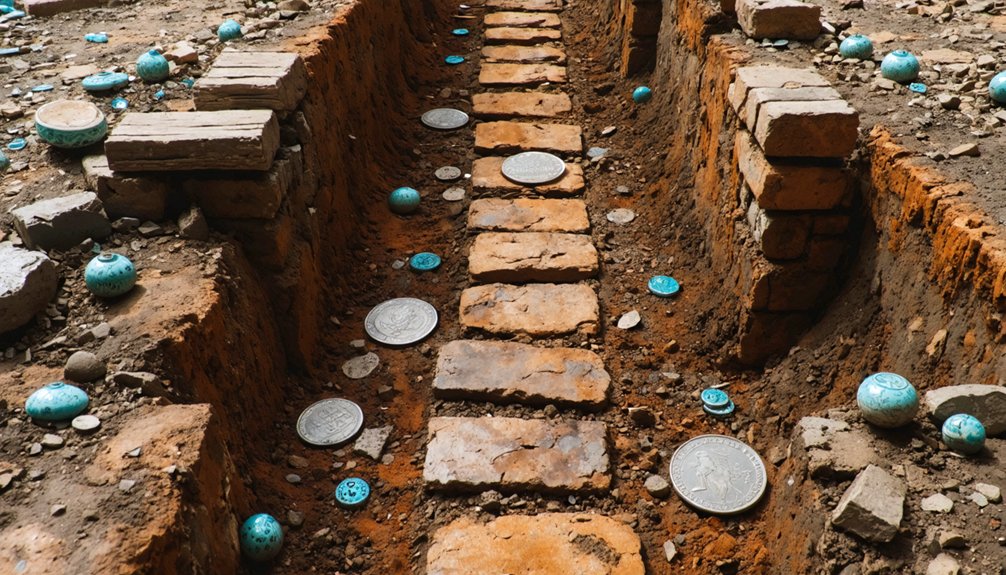
While abandoned cemeteries tell stories from above ground, the most compelling evidence of colonial ghost towns lies beneath the soil. Through subsurface archaeology, you’ll find entire towns preserved just feet below the surface.
Ground-penetrating radar has revealed hidden structures like Brunswick Town’s 1760s tavern, while careful excavation at Jamestown uncovered the original 1607 fort and its artifact-rich deposits.
You can trace colonial life through remarkable underground discoveries: collapsed tavern floors containing pristine colonial artifacts, European trade goods in Native American cache pits, and defensive structures marked by postmolds and palisades.
From Roanoke Island’s buried buildings to Bath Creek’s indigenous farmsteads, these sites reveal complex interactions between settlers and native peoples. Each layer of soil peeled back exposes new chapters of America’s earliest European settlements.
Notable Colonial Ghost Towns on the East Coast
As you explore America’s earliest settlements, you’ll find Virginia’s lost colonial sites scattered along the James River, where numerous English outposts failed before Jamestown’s success.
Massachusetts harbors dozens of abandoned 17th-century villages, from the windswept Cape Cod dunes to the dense western forests.
The Delaware River valley contains forgotten Dutch and Swedish trading posts that once rivaled English settlements, though only foundation stones and artifacts remain to mark their existence.
Early Virginia Settlements
The early Virginia settlements established between 1585 and 1611 reveal a pattern of both failure and perseverance in England’s colonial ambitions.
You’ll find fascinating stories of colonial interactions, from the mysterious disappearance of Roanoke Island‘s settlers to Jamestown‘s eventual success despite devastating settlement challenges.
- Roanoke Island vanished without a trace by 1590, leaving only theories about the colonists’ fate.
- Jamestown emerged as the first permanent success in 1607, surviving through martial law and expanding its reach.
- Strategic outposts like Kecoughtan and Henricus helped secure England’s foothold by 1611.
While most physical structures haven’t survived, you can still visit these historic sites where archaeologists continue uncovering clues about life in early colonial Virginia.
The settlements’ remains tell a compelling story of survival against harsh odds and complex relationships with Native Americans.
Lost Towns of Massachusetts
In Massachusetts, you’ll find forgotten communities that tell haunting tales of displacement and abandonment.
The Quabbin Reservoir’s submerged histories lie beneath waters that now serve Boston, where four towns – Dana, Enfield, Greenwich, and Prescott – were evacuated and flooded between 1938-1946. Their remnants emerge only during dry periods.
Dogtown Commons, between Gloucester and Rockport, stands as a reminder of 18th-century life, with its stone walls and cellar holes still visible across 900 acres of protected land.
On Cape Cod, Long Point’s fishing settlement succumbed to harsh conditions by the 1850s, while Whitewash Village on Monomoy Island met its end after an 1860 hurricane.
These ghost towns, now preserved within conservation areas, offer glimpses into Massachusetts’ colonial past through their scattered ruins and foundations.
Exploring these colonial ghost towns in America can transport visitors back in time, revealing stories of early settlers and their struggles. Each locality has its own unique history, often reflecting the diverse communities that once thrived there. As you wander through the remnants of these towns, the echoes of the past can still be felt in the whispering winds and weathered structures.
Delaware’s Abandoned Trading Posts
Moving south from Massachusetts’ lost towns, Delaware’s earliest European outposts paint a complex story of colonial ambition and abandonment. The Dutch settlements started with Zwaanendael Colony in 1631, but cultural conflicts with natives led to its destruction.
Swedish forts emerged by 1638 when the New Sweden Company established a trading post near present-day Wilmington, forming essential Native alliances with Lenape and Minqua tribes.
- Trading networks flourished briefly between competing Dutch and Swedish traders until colonial rivalries intensified.
- Fort Casimir became New Amstel under Dutch control in 1655, serving as a major fur trading hub.
- English conquest in 1664 transformed these trading posts, with some evolving into modern towns while others vanished entirely.
Today, you’ll find few visible remains of these once-vital commercial outposts, their stories preserved mainly through archaeological discoveries.
Preserving Our Colonial Heritage Sites
While colonial ghost towns face continual threats from natural decay and human interference, preservation efforts have evolved into a systematic approach combining archaeological protection, conservation techniques, and community engagement.
You’ll find heritage conservation initiatives now include permit systems to regulate excavations and buffer zones to protect significant sites from encroachment. Local communities participate through workshops and educational programs, learning about preservation fundamentals while contributing valuable indigenous knowledge and oral histories.
Modern preservation methods incorporate structural stabilization, protective sheltering, and climate control for artifacts.
You’re seeing a shift toward more inclusive approaches that balance Western scientific methods with traditional knowledge. Through systematic planning stages – from identification to education – and strict enforcement of protection measures, these precious remnants of colonial history can endure for future generations to study and appreciate.
Threats to Historical Settlement Remains

Despite ongoing preservation efforts, colonial ghost towns face a complex web of threats that accelerate their deterioration and potential loss.
You’ll find these historic settlements under siege from both natural forces and human activities, with environmental impacts ranging from erosion and flooding to saltwater intrusion in coastal areas.
- Urban encroachment continues to pose one of the greatest risks, as development projects frequently target the same flat, accessible lands where colonial towns were established.
- Looting and unauthorized artifact removal strip these sites of their historical context and physical remains.
- Climate-related threats, including rising sea levels and extreme weather events, increasingly endanger these irreplaceable pieces of history.
Without swift action, these threats will continue to diminish our ability to study and connect with our colonial past.
Modern Tools for Mapping Lost Towns
Technology has revolutionized the way archaeologists and historians locate and study colonial ghost towns.
You’ll find LiDAR technology penetrating dense forest canopies to reveal hidden settlement foundations and roads, while GPR applications create detailed subsurface maps of buried structures without disturbing the soil.
Satellite mapping and remote sensing detect subtle ground changes from space, exposing previously unknown settlement patterns across vast regions.
Drone surveys now capture high-resolution imagery that transforms into precise 3D models through photogrammetry techniques.
You can explore detailed digital reconstructions of entire ghost towns, complete with artifact locations and structural remains.
GeoAI insights analyze this wealth of data, predicting where colonial settlements might be hiding based on historical patterns and geographical features, making the search for lost towns more efficient than ever.
Frequently Asked Questions
Can Visitors Take Home Artifacts Found at Colonial Ghost Town Sites?
You can’t legally remove artifacts from colonial ghost town sites. For artifact preservation and ethical considerations, you must leave everything where you find it or face serious criminal penalties.
What Indigenous Communities Originally Inhabited These Colonial Ghost Town Locations?
With 10,000 Powhatan people once thriving in Chesapeake Bay, you’ll find diverse indigenous history from Mdewakanton Dakota in Minnesota to Ancestral Puebloans who built elaborate cliff dwellings in the Southwest.
How Did Disease Outbreaks Contribute to Colonial Town Abandonment?
You’ll find that devastating disease impacts, like smallpox and influenza, triggered massive population declines of up to 90%, overwhelming colonial infrastructure and forcing residents to permanently abandon their settlements.
Were Any Colonial Ghost Towns Later Resettled During Different Historical Periods?
You’ll find resettlement patterns varied – some colonial ghost towns like Zanel became Lewes, while others saw historical migrations establish new settlements nearby rather than directly rebuilding abandoned sites.
Do Any Descendants of Original Colonial Settlers Still Live Nearby?
While tracking lineages isn’t always perfect, you’ll find many descendants living near colonial ghost towns today, preserving their cultural heritage through descendant stories, historical societies, and family-maintained cemeteries.
References
- https://www.christywanders.com/2024/08/top-ghost-towns-for-history-buffs.html
- https://www.loveexploring.com/gallerylist/101630/the-worlds-most-eerie-abandoned-towns-and-cities
- https://devblog.batchgeo.com/ghost-towns/
- https://www.youtube.com/watch?v=yeTVfoQxqJc
- https://www.atlasobscura.com/lists/americas-best-preserved-ghost-towns
- https://www.legendsofamerica.com/gt-hiddentales/
- https://en.wikipedia.org/wiki/Lists_of_ghost_towns_in_the_United_States
- https://www.loveexploring.com/gallerylist/131658/abandoned-in-the-usa-92-places-left-to-rot
- https://www.visittheusa.com/experience/5-us-ghost-towns-you-must-see
- https://albiongould.com/ghost-towns-to-visit-in-the-states/