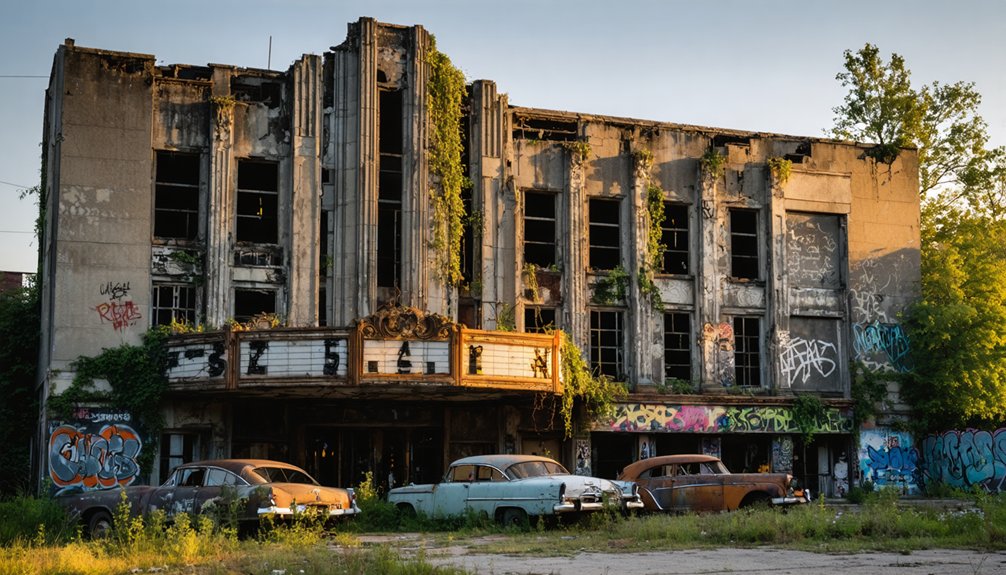
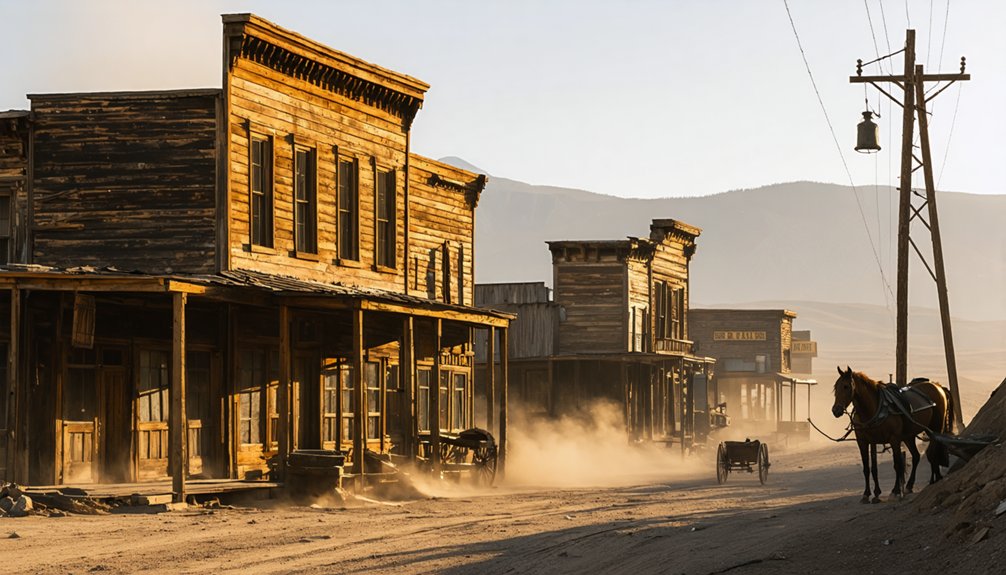
You’ll find America’s most striking post-apocalyptic remnants in places like Centralia, Pennsylvania, where an underground fire has burned since 1962, creating toxic sinkholes and 350°F ground temperatures. In Alabama, Cahawba’s flood-ravaged ruins showcase overgrown Victorian cemeteries, while California’s Bodie preserves 100+ original Gold Rush-era buildings with artifacts frozen in time. From abandoned mine shafts to crumbling bank empires, these ghost towns reveal fascinating chapters of industrial decline and environmental impact.
Key Takeaways
- Centralia, Pennsylvania remains a toxic wasteland with an underground coal fire expected to burn for 250+ years.
- Bodie, California preserves over 100 original Gold Rush-era buildings frozen in time since 1942.
- Cahawba, Alabama’s ruins and overgrown cemetery tell the story of a flood-ravaged former state capital.
- Rhyolite’s three-story Cook Bank ruins stand as testament to Nevada’s abandoned mining empire.
- The Old Eighth Ward of Harrisburg vanished completely, leaving only monuments to commemorate its African American community.
The Underground Inferno: Centralia’s Burning Legacy
While many ghost towns fade into obscurity due to economic decline or natural disasters, Centralia’s abandonment stems from an unprecedented underground inferno that’s been burning since 1962.
What began as a landfill fire near an old strip mine has transformed into a devastating force, consuming coal seams 300 feet below ground across six square miles.
Experts estimate the fire could continue burning for over 250 years at its current rate.
You’ll find a town where fire containment proved futile despite numerous attempts, from wet sand filling to air flow management. Carbon monoxide and sulfur emissions created severe health risks for residents in the area.
The inferno advances 75 feet yearly, releasing toxic emissions that make the air hazardous to breathe. Ground temperatures reach 350°F, creating treacherous sinkholes up to 150 feet deep.
Today, this former community of 1,500 has dwindled to just a handful of residents who’ve refused to leave, despite the government’s condemnation and the constant threat of collapse.
Nature’s Takeover: Cahawba’s Flooded Past
You’ll find Cahawba’s haunting ruins scattered across Alabama’s first capital, where floodwaters repeatedly battered the town until the devastating 1865 deluge finally sealed its fate.
The site’s transformation from bustling cotton port to abandoned ghost town stems largely from nature’s persistent assault, with the Alabama River’s waters gradually eroding both structures and residents’ resolve to stay.
This decline is mirrored in other locations, particularly in the abandoned towns along the Mississippi River, where time has almost forgotten the once-thriving communities. Many of these towns bear silent witness to the ebb and flow of the river, their stories etched into crumbling facades and empty streets. As nature reclaims the land, the haunting beauty of these deserted places invites reflection on the relentless march of change.
Walking through the overgrown streets today, you’ll encounter crumbling brick walls and Greek Revival columns emerging from wild vegetation, while historic cemeteries chronicle the lives of both free and enslaved residents who once called this ill-fated capital home. Today, the Alabama Historical Commission maintains these grounds as an archaeological park, preserving what remains of the former capital.
The city reached its economic peak in the 1850s as cotton trade boomed, drawing thousands of residents to what was once envisioned as Alabama’s permanent seat of government.
Floodwaters Shape Ghost Capital
Located at the perilous confluence of the Cahaba and Alabama Rivers, the former state capital of Cahawba met its demise through relentless flooding that shaped both its rise and fall.
You’ll find evidence of devastating flood impacts in 1825 and 1865, when surging waters decimated buildings and infrastructure, forcing widespread evacuations. These disasters ultimately led to the capital’s relocation to Tuscaloosa in 1826. Under Governor William Bibb, the city saw rapid early development before the floods began.
Despite brief prosperity from cotton trade and railroad connections in the 1840s-50s, flood-induced destruction persisted. The town’s wealthy residents abandoned their mansions as the flooding continued unabated.
You can still witness nature’s power through the remaining Crocheron Columns, Castle Morgan prison ruins, and St. Luke’s Church – survivors of the watery onslaught.
The town’s abandonment by the 1870s wasn’t just about economic decline; it represented nature’s decisive victory over human ambition.
Cemetery Among Wild Growth
Deep within the woods near Old Cahawba Archaeological Park stands a poignant memorial to the town’s complex racial history – an African American cemetery dating back to the antebellum era.
You’ll find Victorian-style fences crumbling beneath fallen trees and weathered headstones barely visible through thick undergrowth. Among the graves stands one with a distinctive Mealy Stark inscription on its Victorian fence. This burial ground, marked as “Negro burial ground” on an 1883 map, tells the story of a community that persisted long after Cahawba’s abandonment.
While cemetery restoration efforts remain limited, its historical significance can’t be understated – nearly two-thirds of Cahawba’s 2,000 residents in 1860 were enslaved people. The site continued serving freedmen through 1957, including 70 former slave families who briefly established a rural community here. During the Civil War, the area housed Castle Morgan prison camp, where over 3,000 Union soldiers endured harsh conditions.
Nature now holds dominion over these sacred grounds, with moss and vines shrouding the final resting place of generations.
Gold Rush Ghosts: The Preserved Streets of Bodie
You’ll find an authentic slice of Wild West life frozen in time at Bodie, where over 100 original buildings still stand in a state of “arrested decay” since the town’s abandonment in 1942.
Inside these preserved structures, you can glimpse everyday items left behind by the last residents – from jars on windowsills to furniture in homes – creating an unparalleled window into Gold Rush era daily life. At its peak, the bustling town supported a population of 10,000 residents. Visitors can explore this historic site for $10 entry fee to experience its rich heritage firsthand.
The town’s mining legacy lives on through its towering Standard Stamp Mill and remaining mining structures, which continue to tell the story of Bodie’s dramatic rise and fall as one of California’s richest gold-mining settlements.
Wild West Daily Life
Though time has claimed countless Gold Rush settlements, the ghost town of Bodie stands as an unparalleled window into authentic Wild West daily life, with 110 to 200 original structures frozen in a state of “arrested decay.”
Walking its wooden sidewalks and dirt roads today, you’ll find the preserved remnants of a thriving 1870s boomtown that once housed 10,000 residents, complete with 70 saloons, gambling halls, and entertainment venues.
The vibrant Bodie nightlife and frontier entertainment scene once included race tracks, dance halls, and bowling alleys.
This mining community attracted a diverse population, from Chinese laborers to professional gunfighters.
You can still explore the historic saloons and social gathering spots like the Miners Union Hall, while scattered artifacts – from china shards to square nails – tell stories of daily frontier existence.
Mining Structures Still Standing
The Standard Stamp Mill, rebuilt in 1899 after a devastating fire, showcases the era’s mining technology with its ore-crushing equipment still in place.
While only 5-10% of original structures survived multiple fires, what’s left tells a powerful story.
The remaining 110-200 buildings, including the miners’ union hall and warehouses, offer you an authentic glimpse into the industrial backbone that fueled this boomtown’s meteoric rise.
Desert Shadows: Rhyolite’s Banking Empire
During Rhyolite’s meteoric rise in 1904, a sophisticated banking empire emerged from the dusty Nevada desert, transforming a simple tent city into a financial hub that would serve thousands of ambitious miners and entrepreneurs.
The town’s banking architecture reflected its economic ambition, particularly in the imposing John S. Cook Bank building completed in 1908.
You’ll find these remarkable remnants of Rhyolite’s financial past:
- The three-story Cook Bank ruins, featuring a massive 70-foot basement that once housed the post office
- Stone and wooden structures from multiple financial institutions that served a peak population of 5,000
- The commercial district’s surviving walls, now maintained by the Bureau of Land Management
Lost Crossroads: The Abandoned Heart of Harrisburg
Unlike Rhyolite’s swift decline, Harrisburg’s heart underwent a methodical dismantling that erased entire communities and left behind haunting monuments to progress.
You’ll find the ghostly remnants of this transformation scattered throughout the city – from the abandoned bridge piers standing sentinel in the Susquehanna River to the repurposed capitol columns that once supported Pennsylvania’s burning statehouse.
The most poignant loss in Harrisburg’s history remains the Old Eighth Ward, a vibrant multicultural neighborhood sacrificed for capitol expansion between 1911-1917.
Today, you can trace this cultural remembrance through “A Gathering at the Crossroads” monument, which maps the ward’s vanished streets and honors 100 influential African American residents.
These physical remnants serve as silent witnesses to the city’s complex evolution, where progress often meant erasure.
Forgotten Frontiers: America’s Vanishing Mining Towns
Scattered across America’s vast landscape, over 47,000 abandoned mine sites stand as stark reminders of the nation’s boom-and-bust mining era.
These ghost towns tell a story of vanishing populations and economic decline, where once-thriving communities now lie silent among deteriorating structures and hazardous remnants.
eerie towns in New York state have become a haunting reminder of what was lost, drawing urban explorers and ghost hunters alike to their decaying streets. Each visit reveals remnants of lives once lived, shrouded in mystery and the whispers of the past. It’s as if time has stood still, inviting those brave enough to uncover the secrets hiding in the shadows.
Today, you’ll find three striking features of these forgotten frontiers:
- Environmental hazards including contaminated land, polluted water sources, and dangerous open mine shafts
- Dramatic population losses exceeding 20% in recent decades, with vacancy rates above 16% in mining regions
- Physical remnants of saloons, homes, and mining facilities preserved as historical sites, like Bodie, California and Garnet, Montana
While some towns have transformed into museums or tourist destinations, most remain as quiet testimonies to America’s industrial past, waiting to be documented in the USGS’s ongoing geospatial database.
Frequently Asked Questions
Are These Ghost Towns Legally Protected From Vandalism and Treasure Hunters?
You’ll find most ghost towns have legal protections through state and federal laws, with vandalism prevention measures and treasure hunting regulations enforced by parks services, though remote locations make consistent monitoring challenging.
What Happens to Property Rights When Residents Abandon Their Homes?
You’d think property abandonment means giving up all rights, but legally, you’re still the owner until formal transfer through tax sale, foreclosure, adverse possession, or municipal acquisition happens.
Do Any Abandoned Towns Still Receive Mail or Maintain Postal Codes?
You’ll find that many abandoned towns still maintain official postal codes, even with minimal residents. The USPS continues delivering mail through cluster boxes or nearby post offices, preserving these essential services.
How Do Modern Squatters Impact the Preservation of These Historic Sites?
You’ll find squatters markedly impact historical preservation through structural damage and unauthorized modifications, though they sometimes protect sites from looting. The balance between squatter rights and preservation remains a complex challenge.
Which Ghost Towns Are Most at Risk of Completely Disappearing Soon?
Like Cedar Key’s vanishing shoreline, you’ll find coastal ghost towns facing imminent extinction. Branson’s rapid decline and flooding-prone Gulf communities won’t survive without future preservation efforts, making urban exploration increasingly urgent.
References
- https://carte-urbex.com/en/blogs/infos/top-10-abandoned-places-in-the-usa
- https://www.geotab.com/ghost-towns/
- https://unherd.com/2025/02/americas-post-apocalyptic-cities/
- https://www.atlasobscura.com/things-to-do/united-states/abandoned
- https://www.youtube.com/watch?v=RiqCBFpF_G8
- https://www.youtube.com/watch?v=Z69cNeuZGsA
- https://www.timeout.com/usa/things-to-do/ghost-towns-usa
- https://en.wikipedia.org/wiki/Lists_of_ghost_towns_in_the_United_States
- https://www.britannica.com/video/coal-mine-fire-Pennsylvania-Centralia/-207717
- https://en.wikipedia.org/wiki/Centralia_mine_fire