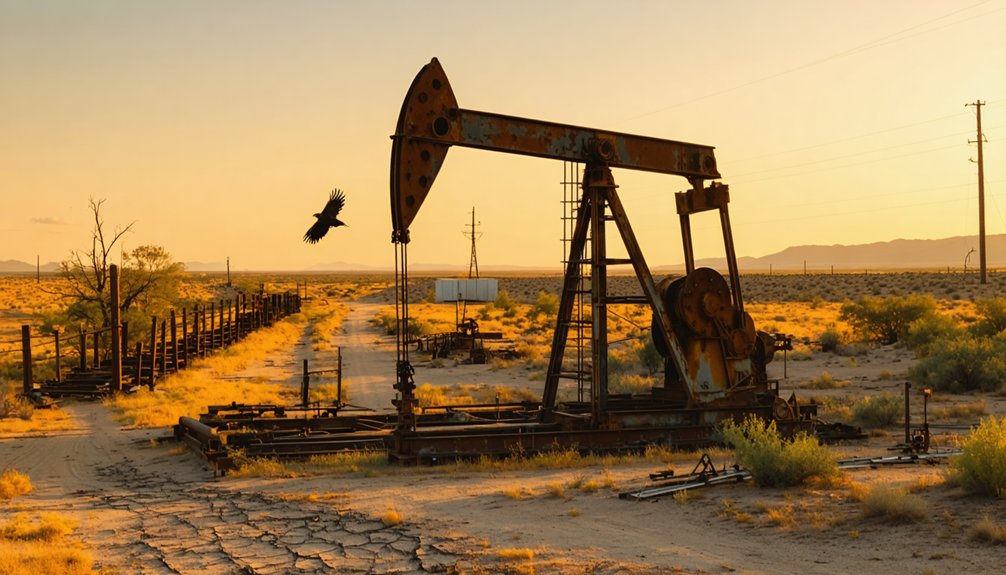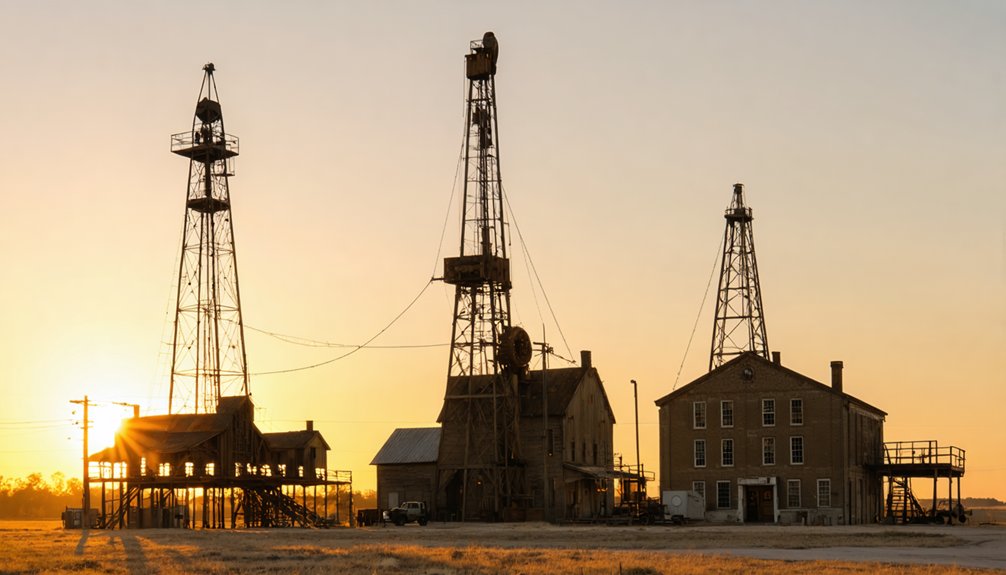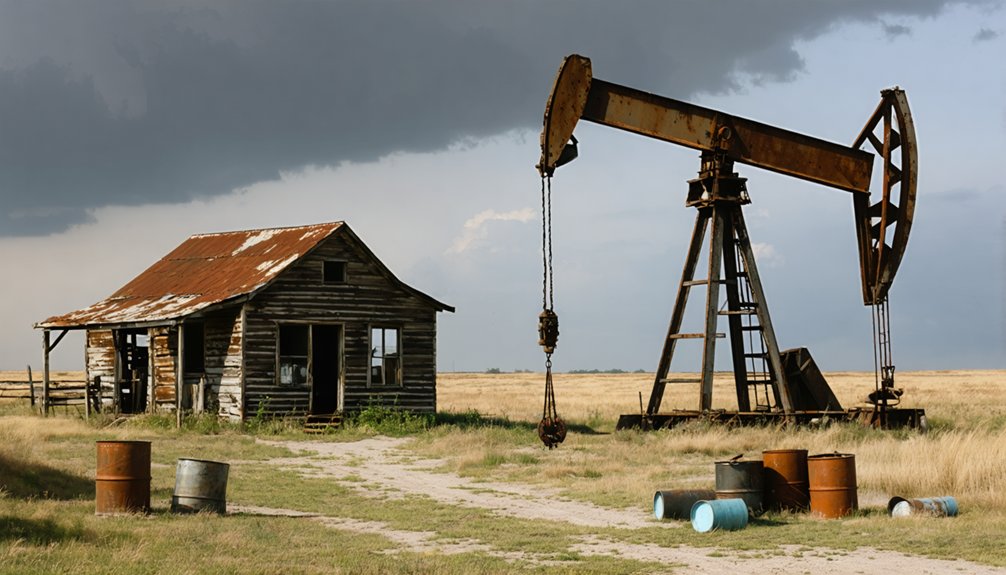
In forgotten oil towns, you’ll find stark remnants of America’s petroleum past: rusting derricks, crumbling concrete well pads, and abandoned storage tanks dotting the landscape. These industrial ghosts tell stories of economic boom-and-bust cycles, while leaking wells and toxic water pose ongoing environmental threats to nearby communities. From historical pump stands to deteriorating processing units, these silent witnesses mark the intersection of industrial heritage and environmental challenge. The deeper story of these towns reveals complex layers of cultural and ecological transformation.
Key Takeaways
- Rusting oil derricks, pump stands, and 19th-century engines remain as silent monuments to past industrial operations.
- Storage tanks, processing units, and crumbling concrete well pads dot the landscape of abandoned oil towns.
- Worker housing, company offices, and industrial facilities stand as architectural remnants of the oil boom era.
- Nearly 8,900 orphaned oil wells persist across Texas alone, with similar remnants in Pennsylvania and Los Angeles.
- Toxic contamination sites and leaking wells continue to impact local environments and groundwater supplies.
The Ghost Towns Left Behind: Mapping Abandoned Oil Communities
While ghost towns dot America’s landscape as remnants of the oil boom era, locating and documenting their abandoned wells presents an ongoing challenge that’s increasingly met through technology.
You’ll find that modern mapping technology, particularly AI-driven analysis of historical maps, has revolutionized how we identify these forgotten sites. Advanced geospatial tools now verify well locations through satellite imagery and field surveys, revealing over 120,000 documented orphaned wells by 2022.
AI and satellite mapping have transformed our ability to locate abandoned oil wells, revealing America’s hidden industrial past.
The impact of this documentation extends beyond mere numbers. Through interactive databases spanning multiple states, you’re able to visualize how these wells cluster around former oil towns, painting a picture of community resilience and decline. Historical data shows that redlined neighborhoods faced disproportionate exposure to these industrial sites.
From California to Oklahoma, research teams have uncovered over 1,300 undocumented wells in single study areas, highlighting the vast scope of America’s industrial heritage. These sites emit an estimated 0.016 MMt of methane annually, contributing to ongoing environmental concerns.
Environmental Scars and Toxic Legacies
Although abandoned oil wells dot America’s landscape as silent relics, their environmental impact continues to threaten communities and ecosystems.
You’ll find these toxic legacies leaking methane – a greenhouse gas 84 times more potent than carbon dioxide – into our atmosphere, while toxic produced water seeps into groundwater supplies. With 4.6 million people living near these wells, the threat to public health cannot be ignored.
In West Texas, you can witness the stark environmental impacts at Lake Boehmer, where up to 600 gallons of contaminated water per minute still leak from a 1950s well, creating a lifeless “Dead Sea.”
The danger extends beyond water contamination – you’re looking at serious health risks from hydrogen sulfide emissions and volatile organic compounds. Emergency plugging efforts by the Railroad Commission of Texas focus on wells actively leaking toxic gases.
What’s more concerning is that incomplete data suggests the actual methane emissions could be three times higher than current estimates, making these abandoned wells an even greater threat.
Rusted Infrastructure: Physical Traces of the Oil Boom
The physical remnants of America’s oil boom litter the landscape like industrial graveyards. You’ll find abandoned wells scattered across Texas, Pennsylvania, and Los Angeles, with nearly 8,900 orphan wells in Texas alone.
These decaying sites pose serious risks as wells can release toxic hydrogen sulfide into the surrounding air, impacting communities up to 50 miles away.
Rusted machinery tells the story of once-thriving operations, from deteriorating derricks to forgotten pump jacks slowly decaying on former lease sites.
Look across these forgotten fields and you’ll spot the skeletal remains of storage tanks, processing units, and flow lines emerging from overgrown vegetation. Concrete well pads crack and crumble while old access roads fade into the earth.
In places like New York’s Allegany County, you can still see 19th-century pump stands and engines, silent witnesses to America’s early oil rush. Many wells drilled before 1950 were improperly sealed, leaving unstable infrastructure as their legacy. The region reached its peak oil production in 1882 with 6.7 million barrels.
Social Fabric: How Communities Changed and Adapted
In America’s forgotten oil towns, social and economic divisions have carved deep rifts through communities near industrial sites. You’ll find stark examples of this in places like North Richmond, where minority populations face shortened life expectancies and diminished cultural spaces.
Community resilience has been tested as demographics shifted, particularly when Asian immigrants joined existing communities already struggling with environmental burdens. With a median income of $36,875 in 2010, North Richmond exemplifies how industrial neighborhoods remain trapped in cycles of poverty. Recent studies have identified 41 distinct clusters where high well density overlaps with historically marginalized populations.
Shifting demographics strained community bonds as Asian immigrants settled in areas already bearing the weight of environmental injustice.
- Blues clubs and social gathering spaces vanished as middle-class residents fled.
- Latino communities in places like Arvin now contend with idle wells near schools.
- Cultural adaptation became necessary as new immigrant groups arrived in polluted areas.
- Civic institutions weakened in many oil regions, leaving residents to self-organize.
The result is a transformed social landscape where historically marginalized groups face ongoing environmental challenges while working to maintain community bonds despite limited resources.
Cultural Heritage and Historical Preservation
Through careful preservation efforts, America’s forgotten oil towns maintain a rich architectural legacy spanning worker housing, company offices, churches, and industrial facilities from the early 20th century.
You’ll find many of these structures have been adaptively reused, transforming historic buildings into modern venues while retaining their cultural significance.
Heritage organizations actively manage these preservation programs, combining architectural heritage protection with economic revitalization.
Similar to the first oil settlement in Awali, Bahrain, these historic sites showcase the transformative impact of early oil industry development on urban planning and society.
You’ll see this integration in action through museums that showcase industrial artifacts, educational programs that teach local oil history, and heritage trails that let you explore the past firsthand.
National and local registers provide legal protection for significant districts and buildings, while collaborative partnerships between municipalities, businesses, and heritage groups guarantee these historical treasures continue telling the story of America’s oil boom era.
Many of these preservation efforts face challenges similar to those in Baku, where industrial heritage tourism remains largely underdeveloped despite its historical significance.
Nature’s Reclamation of Industrial Sites
When you visit abandoned oil industry sites today, you’ll witness nature’s remarkable ability to reclaim these spaces through vegetation that gradually overtakes old infrastructure and wildlife that establishes new habitats in the ruins.
The transformation often follows predictable patterns, with pioneer species like grasses and shrubs first colonizing disturbed soils, followed by larger vegetation and the gradual return of native wildlife populations.
Even on formerly toxic sites, specialized plant communities can develop unique ecosystems that demonstrate nature’s resilience and adaptation to industrial legacies.
Wildlife Returns to Ruins
As abandoned oil and gas sites fade into history, nature steadily reclaims these industrial ruins through a remarkable process of ecological restoration.
You’ll witness a dramatic wildlife resurgence as federal and state programs transform these forgotten landscapes into thriving ecosystems. Through habitat restoration efforts, these sites evolve from industrial wastelands into vibrant sanctuaries.
- Native vegetation returns first, providing essential food and shelter for local wildlife
- Small mammals, birds, and pollinators gradually recolonize the restored areas
- Formerly fragmented habitats reconnect, creating crucial wildlife corridors
- Natural succession transforms sites into grasslands, shrublands, or forests
The Federal Orphaned Wells Program has already restored 558 habitat acres, proving that nature’s resilience can triumph over industrial remnants when given the chance to heal and flourish.
Toxic Sites Shape Ecosystems
Behind the promising story of wildlife’s return lies a complex battle between toxic legacies and natural recovery. You’ll find toxic residues like heavy metals and organic pollutants deeply embedded in these forgotten landscapes, disrupting vital biogeochemical cycles and soil health.
These contaminants don’t just stay put – they migrate through groundwater and food webs, shaping ecosystem health in lasting ways.
While nature works to heal these scars through processes like natural attenuation, various remediation strategies can help accelerate recovery. From specialized microorganisms breaking down pollutants to plants that absorb heavy metals, these approaches support ecological restoration.
Yet the pollution legacy continues impacting wildlife through bioaccumulation and habitat alteration. The path to full ecosystem recovery requires understanding how soil contamination reshapes entire biological communities, from microbes to top predators.
Vegetation Overtakes Infrastructure
Through nature’s persistent advance, vegetation gradually reclaims abandoned oil and gas infrastructure, though the recovery remains strikingly uneven.
You’ll find vegetation recovery reaches only 36% of normal levels after five years, with ecological succession following distinct patterns across different landscapes.
- Grasses lead the charge, quickly colonizing disturbed areas while trees and shrubs lag behind.
- Wetland species rapidly return if water flows remain intact, creating new wildlife corridors.
- Forest edges slowly creep onto well pads, though compacted soils resist root penetration.
- Native plants compete with invasive species for dominance, especially in early recovery stages.
Without intervention, you’ll see this transformation unfold over decades.
While some sites integrate seamlessly into surrounding ecosystems, others remain visibly scarred, their soils too damaged to support robust regrowth.
Economic Aftershocks and Modern Challenges
While oil and gas production brought initial prosperity to many regions, the economic aftermath has left communities grappling with severe challenges.
You’ll find stark evidence in the Marcellus and Utica regions, where top gas-producing counties have seen their national job share plummet by 7.6% and population decline by 11%. The economic resilience of these areas has been profoundly tested, with residents who stay behind facing increased financial strain and reduced credit opportunities compared to those who leave.
Community adaptation varies considerably, as demonstrated in Pennsylvania’s conventional oil regions, where the industry still generates $1.4 billion in annual impact.
Yet, these communities remain vulnerable – when the boom ends, you’re left with a harsh reality: declining credit accounts, mounting past-due balances, and limited economic alternatives.
Resource-dependent towns face a sobering aftermath when extraction industries fade: financial instability and few paths forward for economic recovery.
The Gulf region faces similar uncertainties, with projections showing potential job losses of up to 52% by 2040.
Safety Hazards in Former Oil Territories
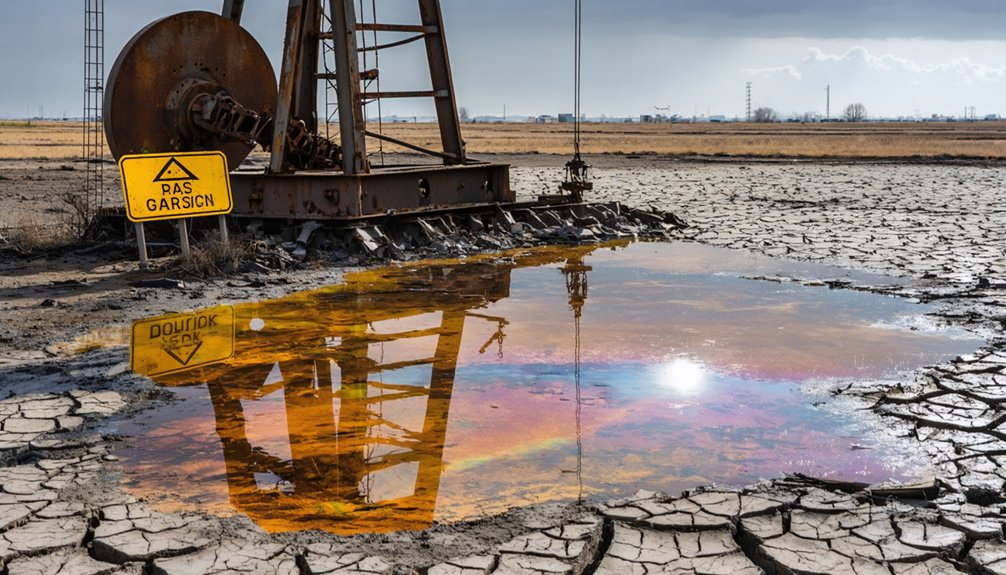
As former oil territories shift into ghost towns, they leave behind a dangerous legacy of over 3.5 million abandoned wells that threaten public safety and environmental health.
Exploring the remnants of these once-thriving communities reveals hidden gems in Arizona’s ghost towns that tell stories of resilience and hardship. From crumbling façades to intriguing artifacts, each site offers a glimpse into a past that shaped the region. These forgotten locales not only showcase the state’s rich history but also invite adventurers to uncover the secrets nestled within the desert landscape.
Without proper safety regulations, these hazardous sites pose serious risks to your community, with 14 million Americans living within a mile of these potential danger zones. Community awareness is critical, as these wells aren’t just relics – they’re active threats.
- Toxic gases like hydrogen sulfide and benzene leak into neighborhoods, causing respiratory issues and cancer risks
- Methane emissions create explosion hazards near homes and water wells
- Chemical-laden brine eruptions form massive sinkholes and contaminate groundwater
- Underground wells lurk beneath urban areas, often disguised and unmarked
The dangers aren’t just theoretical – from fatal accidents to widespread contamination, these abandoned wells demand immediate attention and action.
From Boom to Bust: Transforming Industrial Landscapes
You’ll find striking contrasts in former oil territories where nature steadily reclaims abandoned industrial sites, as pioneer species colonize disturbed soils and create unexpected new ecosystems.
Towering oil derricks and pumpjacks remain as silent sentinels, their rusting frames marking the landscape like industrial monuments to boom-era prosperity.
These steel giants now stand guard over a transforming environment where spontaneous vegetation weaves through mechanical remnants, creating a unique intersection of industrial decay and ecological renewal.
Nature Reclaims Industry Sites
Time and nature steadily reclaim abandoned oil industry sites, transforming stark industrial landscapes into regenerating ecosystems. You’ll witness nature’s resilience as native vegetation gradually recolonizes these spaces, creating new habitats where industrial nostalgia meets ecological renewal.
- Native trees, grasses, and shrubs stabilize disturbed soils, fostering biodiversity.
- Wetlands emerge in former extraction sites, improving water filtration.
- Soil microbes reestablish themselves, restoring nutrient cycles.
- Wildlife returns as natural succession takes hold.
Despite this recovery, challenges remain. You’ll find that contamination from leaking infrastructure and toxic spills can slow the healing process.
Still, nature persists – converting industrial ruins into evolving ecosystems. This transformation showcases earth’s remarkable ability to heal, though complete recovery often requires decades of natural processes working in concert.
Rusting Giants Stand Guard
Sentinels of industrial decay, massive oil derricks and storage tanks loom over forgotten oil towns, their rusting frames telling stories of economic booms gone bust.
You’ll find these rusting relics scattered across landscapes, where abandoned refineries and pumpjacks stand as silent witnesses to once-thriving communities.
These industrial giants haven’t gone quietly into history. Their deteriorating frameworks dominate the horizon, while disconnected rail lines and pipeline segments snake through overgrown fields.
The scale of these structures evokes a particular industrial nostalgia, even as they pose environmental risks. In some places, you’ll spot fenced-off complexes of tank farms and processing facilities, their corroded shells a stark reminder of the cyclical nature of resource-based economies.
Each rusting beam and crumbling concrete foundation marks another chapter in the story of boom-to-bust transformation.
Frequently Asked Questions
Can People Legally Explore or Live in Abandoned Oil Town Buildings?
You’ll need property owners’ permission for urban exploration, as trespassing is illegal. Living there requires meeting strict environmental, safety, and zoning regulations due to contamination risks and property rights issues.
What Valuable Artifacts Are Commonly Found in Forgotten Oil Towns?
While rusting oil machinery holds scrap value, you’ll find the real treasures in vintage signage, company documents, antique bottles, porcelain dolls, and early 20th-century personal items like pocket watches.
How Long Does It Take for Oil-Contaminated Soil to Become Safe?
You’ll need 7-14 days for light contamination using soil remediation techniques, but heavy contamination requires months to years. Environmental impact assessments show natural processes alone can take decades.
Do Any Abandoned Oil Towns Still Have Active Mineral Rights?
In 90% of ghost oil towns, you’ll find active mineral rights persisting through complex legal frameworks. Even when buildings crumble, mineral ownership remains valid through state laws and generational transfers.
Which Ghost Oil Towns Have Successfully Transformed Into Tourist Destinations?
You’ll find successful oil town revitalization in Calico and Goldfield, where tourist attractions now include mine tours, gunfight shows, and preserved architecture from their boom-town days.
References
- https://www.youtube.com/watch?v=eyOASXxAmMI
- https://www.cityandstateny.com/politics/2022/05/new-yorks-once-booming-oil-industry-and-risky-wells-it-left-behind/366655/
- https://abcnews.go.com/US/abandoned-oil-gas-wells-us-bring-fears-leak/story?id=116764814
- https://www.epa.gov/mo/town-flood-and-superfund-looking-back-times-beach-disaster-nearly-40-years-later
- https://mix931fm.com/texas-ghost-towns-history/
- https://money.howstuffworks.com/10-boom-towns-that-went-bust.htm
- https://www.mrt.com/nationworld/article/Oil-Ghost-Towns-Dot-the-Landscape-in-Texas-s-12228593.php
- https://newscenter.lbl.gov/2024/12/04/ai-helps-researchers-dig-through-old-maps-to-find-lost-oil-and-gas-wells/
- https://pubs.acs.org/doi/10.1021/acs.est.2c03268
- https://npca.s3.amazonaws.com/docs/223/2ee8e9ea-fbc0-4939-bf67-9b997593d303.pdf