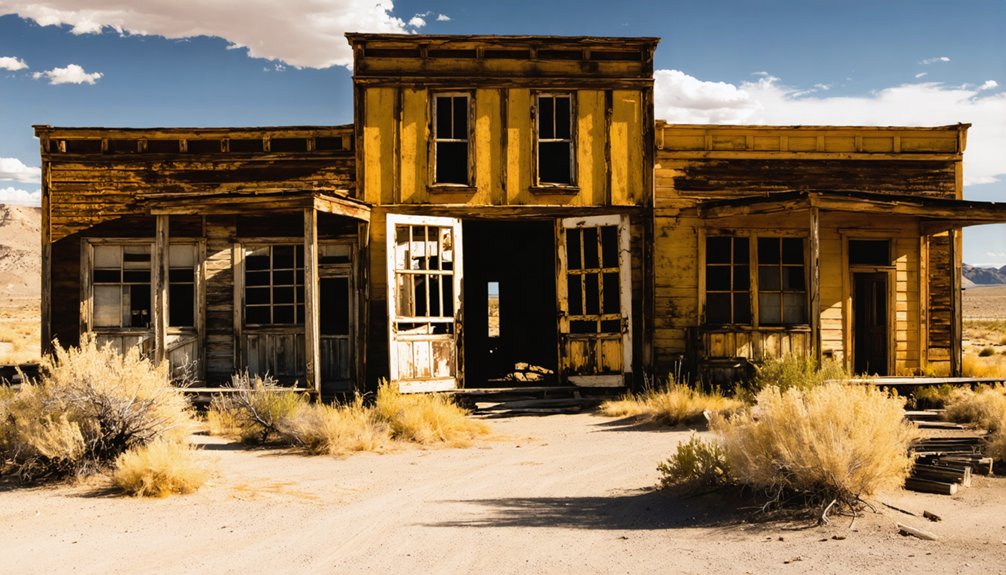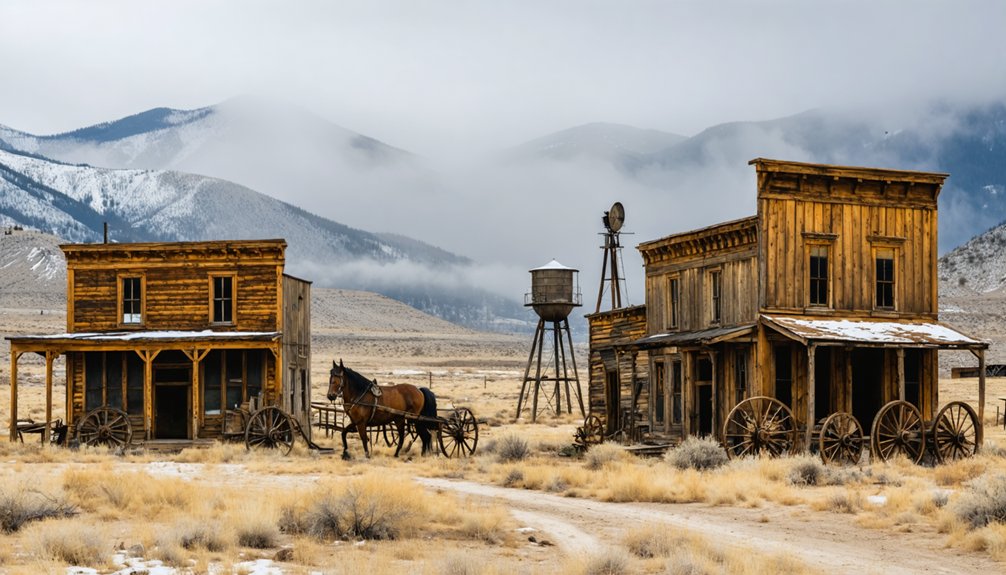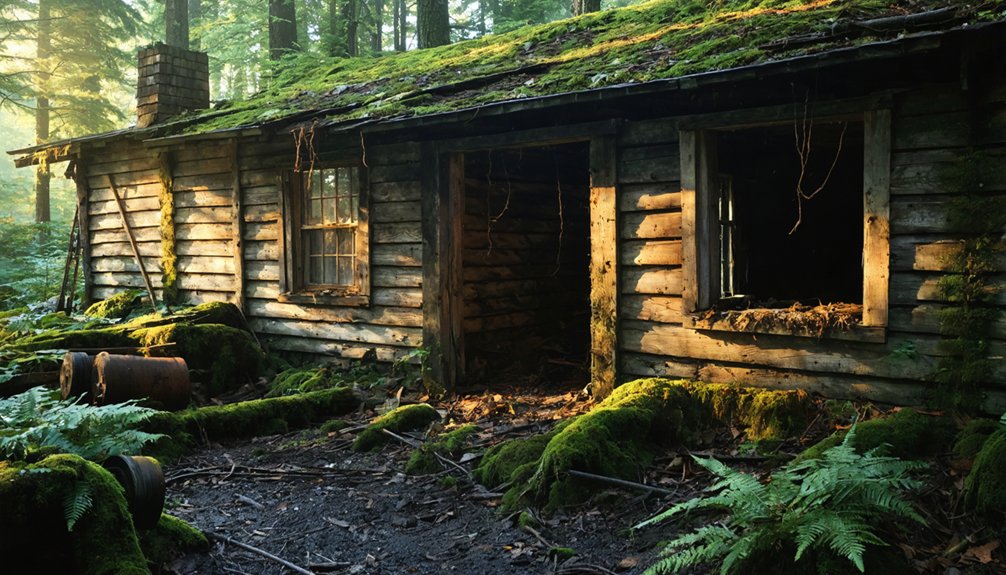
When exploring abandoned logging camps, you’ll find distinctive traces of past timber operations. Look for concrete foundations and cellar holes that mark former buildings, along with scattered metal artifacts from logging equipment and machinery. You’ll notice environmental clues like altered vegetation patterns, compacted soil from skid roads, and irregular ground depressions. While nature gradually reclaims these sites, careful observation reveals a rich historical record waiting to be uncovered.
Key Takeaways
- Concrete foundations, cellar holes, and stone walls outline former building layouts and reveal organized camp design.
- Metal artifacts like logging tools, machinery parts, and horse equipment remain preserved near work areas.
- Environmental markers include compacted soil, altered waterways, and distinctive vegetation patterns showing past logging activity.
- Structural remnants of cookhouses, bunkhouses, and communal spaces indicate social organization within camps.
- Historical records, photographs, and oral histories document camp life while physical traces fade within 30-50 years.
Ghost Towns in the Forest: Structural Remains of Camp Life
Deep within today’s forests lie the silent remnants of once-bustling logging camps, where structural remains offer compelling evidence of early industrial life.
You’ll find concrete foundations and cellar holes scattered throughout these sites, with stone walls and doorways still defining the original building layouts. Multiple foundation remnants often cluster together, revealing the camp’s organized design and communal structure. Among the ruins, scattered remains of old bunk beds provide clear evidence of worker sleeping quarters.
The architectural footprint of these camps emerges through distinctive rectilinear patterns in the soil and stone. Ancient brick fragments scattered across the grounds indicate the presence of permanent structures from the industrial era.
The forgotten history of oil towns is often obscured by time, yet it reveals a complex interplay of economics and culture. As remnants of this past emerge, they tell stories of prosperity and decline, reflecting the urgency and despair of a bygone industry. Exploring these sites offers valuable insights into the communities that once thrived and the environmental changes they endured.
You can trace thick-walled cold storage buildings, identify room divisions within stone structures, and spot specialized facilities that supported daily operations.
These building foundations tell a story of purpose-built communities, where every structure – from worker housing to storage facilities – played an essential role in sustaining the logging operation’s workforce.
Metal and Machinery: Equipment Left to Time
Beyond the stone foundations and structural remnants, an extensive collection of metal artifacts and machinery parts tells the next chapter of logging camp history.
You’ll find logging tools, machinery components, and horse-related ironwork scattered throughout these abandoned sites, each piece revealing the technological evolution of forestry operations.
Metal detecting enthusiasts frequently uncover valuable artifacts near skid roads, blacksmith areas, and old cabin ruins.
Hidden treasures await discovery along forgotten pathways where loggers once worked, near forges that rang and homes long abandoned.
Items like a ballet hammer discovered during recent explorations highlight the preservation potential of these historic sites.
While machinery restoration proves challenging due to extensive rust and deterioration, heavy equipment parts like steel frames and iron gears have weatherfully endured.
Steam-powered skidder parts, mechanical saw rigs, and primitive vehicle remains persist, though often deeply buried in forest soil.
These metal remnants, from simple axes to complex winching systems, offer tangible evidence of the industrious spirit that once animated these remote worksites.
Among the most fascinating discoveries are old diesel donkeys from the 1930s and 1940s, with their control levers and oil-filled machinery components still intact.
Reading the Land: Environmental Signs of Past Logging
While untrained eyes might overlook the subtle traces of logging history, careful observation reveals distinct environmental signatures in formerly logged landscapes.
You’ll notice vegetation patterns where decadent spruce trees display lateral branches oriented toward past clearings, and uneven tree crowns mark historic logging roads. The soil traces tell their own story – you can spot compacted tracks from machinery, remnant wood chips, and altered soil chemistry near old refuse middens.
Look for rings of denser forest bordering younger growth, indicating selective logging boundaries. Old steam train tracks and rotting railroad ties still mark paths through the forests where logs were once transported.
You’ll find disturbed soil surfaces and logging slash that’s enriched the recovering earth. Stream banks often bear the scars of past log transport, while constructed ponds and altered waterways remain as evidence to logging operations that shaped the land. Maine’s best practice regulations ensure these logging sites maintain significant barrier strips to aid forest recovery.
Hidden Social History: Community Infrastructure Traces
Historic logging camps left behind a complex network of infrastructure traces that reveal the daily lives and social organization of their former inhabitants.
You’ll find concrete foundations of cookhouses and bunkhouses arranged in distinct clusters, showing how community gathering spaces were central to camp life. Stone fireplaces and chimneys mark where workers congregated for meals and socializing, while scattered domestic plantings like roses and ivy indicate attempts to create home-like environments.
The social dynamics of these communities become apparent through their spatial organization. Larger structures like cookhouses served as social hubs, while residential areas featured garden plots and fenced yards. Weekly Saturday night dances brought workers together to maintain morale and community spirit. Near the water’s edge, old fishing boats provided both sustenance and recreation for camp residents.
You can trace how transportation infrastructure, from rail grades to truck roads, connected different camp sections, facilitating both work operations and community interaction.
Preserving the Past: Documentation and Historical Records
To preserve remnants of logging camps, researchers employ multiple documentation methods that capture both tangible remains and historical context.
By combining archival methods with modern scientific techniques, you’ll find a thorough approach that reveals both the physical footprint and human experience of these historic sites. Many artifacts discovered on National Forest land serve as critical evidence of past logging operations. Archaeological studies reveal that medicine bottles found at sites provide insights into the undocumented health practices of logging camp workers.
- Historical maps, photographs, and written records establish foundational data about camp locations and operational timelines.
- Oral histories from descendants illuminate daily life and social dynamics otherwise missing from official documents.
- Archaeological surveys document surface features and artifacts that tell stories of camp organization and worker activities.
- Scientific analysis, including dendrochronology and soil testing, validates historical records and reveals environmental impacts.
This integrated approach guarantees you’re accessing both documented history and physical evidence, creating a fuller picture of logging camp life and operations.
Nature’s Reclamation: The Process of Camp Disappearance
Once abandoned, logging camps undergo a predictable sequence of natural reclamation that systematically erases human presence from the landscape. Nature’s resilience becomes evident as structures deteriorate within the first decade – roofs cave in, foundations shift, and walls collapse from relentless exposure to the elements.
You’ll witness ecological restoration unfold as pioneer plant species quickly colonize clearings. Within 20-30 years, trees and understory vegetation transform camp sites into forest. Wood structures crumble into organic matter, while metal rusts away. Even the most durable materials, like stone chimneys and glass, become scattered or buried.
After 30-50 years, only subtle clues remain: irregular ground depressions, scattered artifacts, and distinctive tree growth patterns. The forest reclaims its domain, leaving minimal evidence of human occupation.
Frequently Asked Questions
How Dangerous Is It to Explore Abandoned Logging Camps Today?
Like walking through a minefield, exploring abandoned logging camps is extremely risky. You’ll face potential hazards including structural collapses, chemical exposure, and wildlife encounters. Take thorough safety precautions before venturing in.
Can I Legally Collect Artifacts From Old Logging Camp Sites?
No, you can’t legally collect artifacts from logging camps on public lands. You’ll need special permits, which are typically reserved for professional archaeologists conducting research, not private collectors.
What Wildlife Now Inhabits These Abandoned Logging Camp Areas?
Like nature reclaiming its throne, you’ll find bears, deer, wildcats, and woodpeckers thriving in these areas through wildlife adaptation. Their habitat restoration success shows in regenerating forests and old camp clearings.
Are There Any Documented Ghost Stories Associated With Abandoned Logging Camps?
You’ll find documented ghost folklore at sites like Widows Peak camp, where witnesses reported apparitions in logging gear, and logging legends of mysterious vanishings persist in museums and summer camps today.
How Can I Determine if My Property Was Once a Logging Camp?
You’ll need intensive historical research through county archives, property surveys, and archaeological evidence. Check old maps, examine landscape features, and look for remnants like foundations, railroad grades, or artifact clusters.
References
- https://truenorthmapco.com/blogs/portagepaths/logging-and-mining-history-in-the-boundary-waters-canoe-area-wilderness
- https://www.youtube.com/watch?v=VFfQ0UXln5s
- https://jemezvalleyhistory.org/logging/
- https://stories.grandcountyhistory.org/article/logging
- https://99wfmk.com/lumber-camps/
- https://tipurdy.org/logging-camp-remnants/
- https://www.wildmaine.com/the-ghosts-of-the-eastern-woods-logging-camps-lost-towns-and-the-rise-and-fall-of-maines-timber-empire/
- https://ir.library.oregonstate.edu/downloads/td96k6822
- https://www.youtube.com/watch?v=tbwVgVanXuo
- https://www.youtube.com/watch?v=QNL44C6EH4o