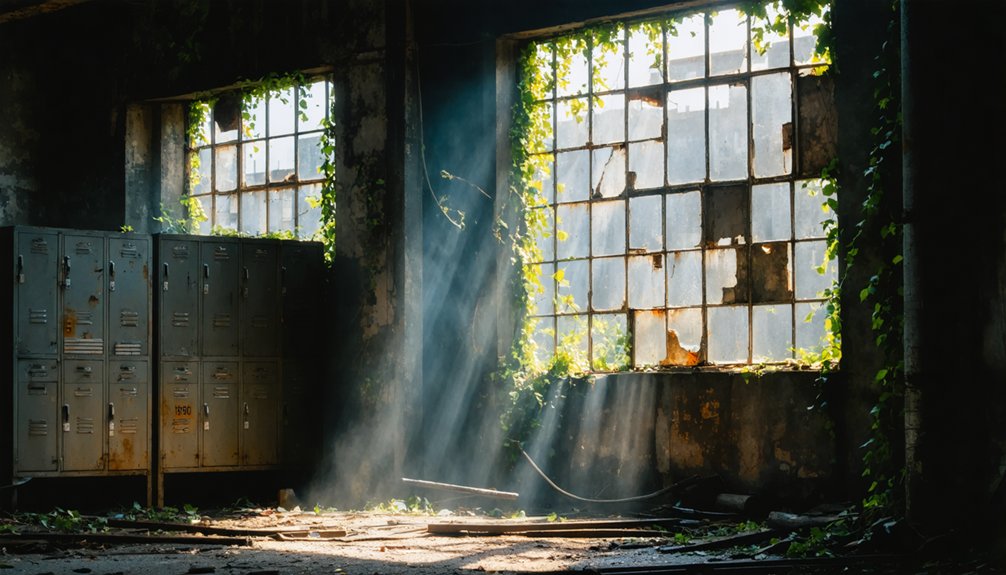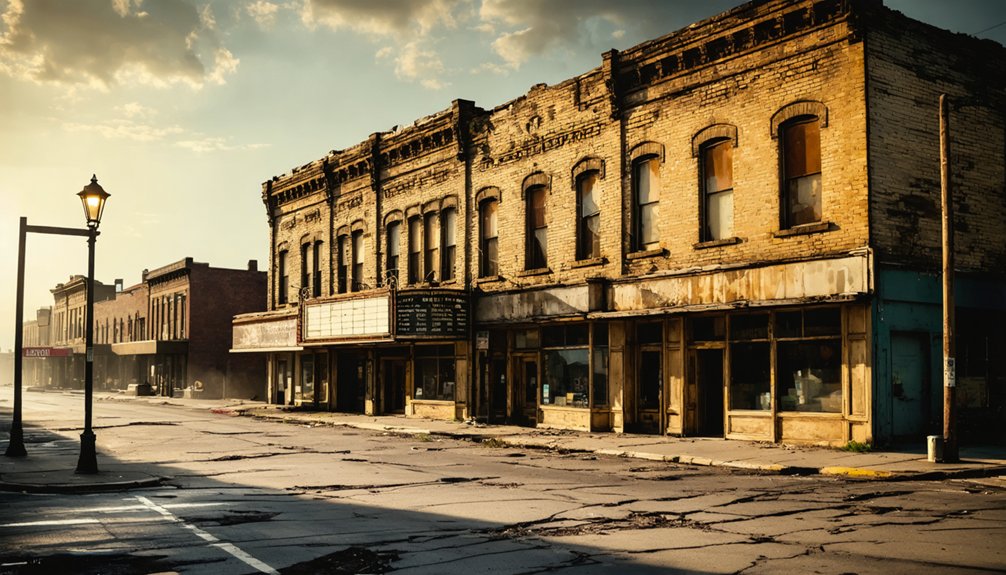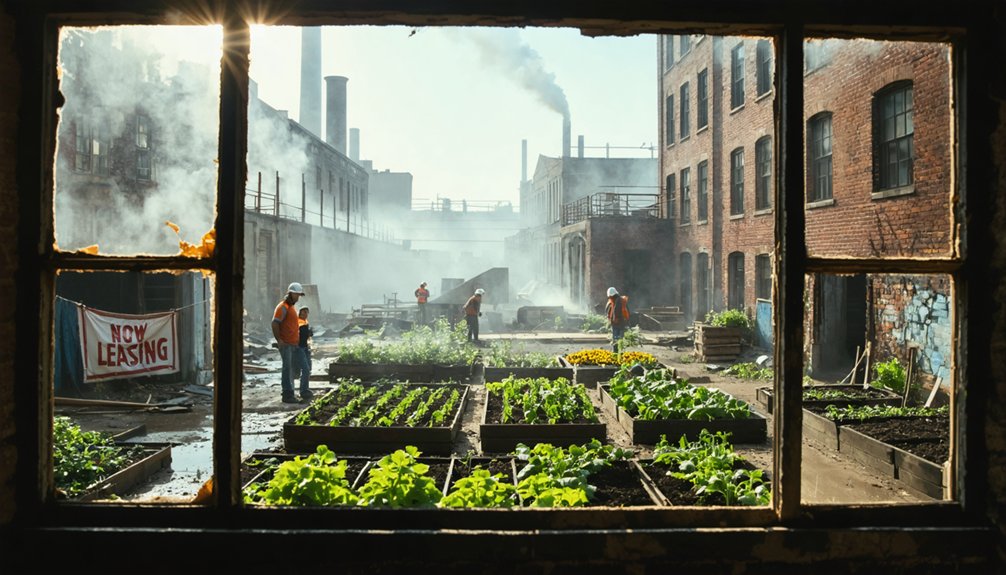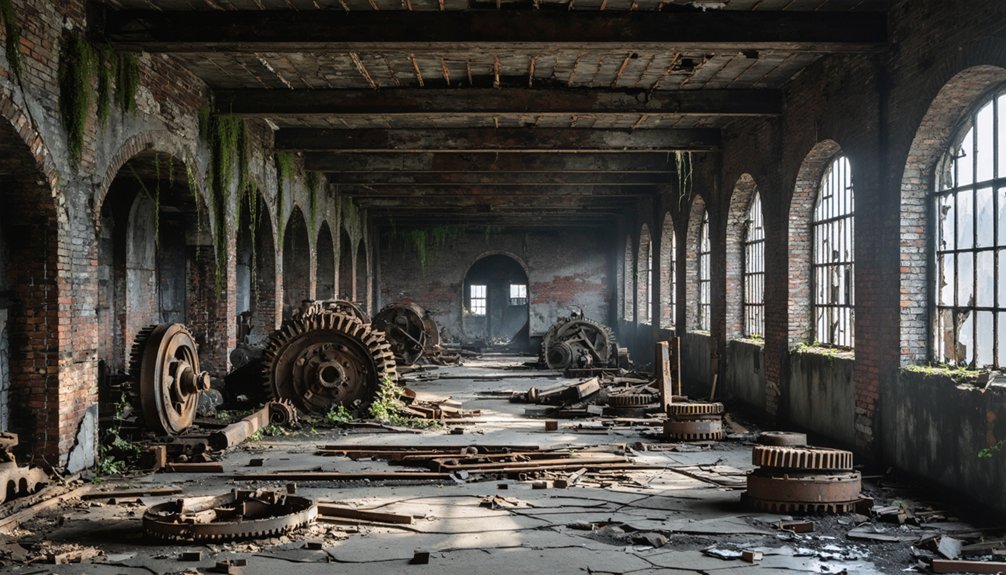
You’ll find haunting industrial skeletons throughout today’s Rust Belt ghost towns – abandoned factories with broken windows, neighborhoods where vacancy rates exceed 30%, and contaminated brownfield sites harboring hazardous substances. Empty storefronts and faded company signs line former commercial districts, while shuttered schools and churches stand as silent witnesses to dramatic population losses. These architectural remnants tell deeper stories of economic transformation, environmental impact, and community dispersal across America’s industrial heartland.
Key Takeaways
- Abandoned factories with broken windows, collapsed roofs, and rusting machinery stand as monuments to America’s manufacturing decline.
- Over 450,000 brownfield sites contain hazardous substances, contaminating soil and groundwater with heavy metals and toxic chemicals.
- Thousands of vacant homes plague residential neighborhoods, with some ZIP codes reporting vacancy rates exceeding 34%.
- Empty storefronts, shuttered theaters, and abandoned churches reflect the loss of commercial activity and community gathering spaces.
- Deteriorating railroad infrastructure and unused transportation networks showcase the decay of once-vital industrial supply routes.
The Silent Factories: Industrial Skeletons of a Lost Era
As you travel through America’s industrial heartland today, massive abandoned factories stand as haunting monuments to the region’s manufacturing glory days.
These industrial skeletons reveal a stark economic transformation, with broken windows and collapsed roofs marking where thousands once toiled. You’ll find frozen-in-time scenes of rusting machinery, dormant conveyor belts, and silent overhead cranes that once powered America’s industrial might. Towns like Monessen saw two-thirds population loss after their steel mills closed. The high concentration of vacant properties signals a permanent economic decline in these neighborhoods.
From Bethlehem Steel’s sprawling mills to GM’s shuttered Lordstown plant, these sites evoke powerful industrial nostalgia.
The rusting remnants of American industry stand as silent witnesses to our manufacturing past, from steel mills to auto plants.
Water towers and smokestacks pierce the sky like sentinels, while contaminated brownfields below tell tales of environmental costs.
Inside these hollow structures, graffiti-covered walls and exposed steel frames create an eerie architectural timeline of rise and decline, documenting how dramatically America’s manufacturing landscape has changed.
Empty Streets and Vacant Homes: Residential Remnants
If you walk through Detroit’s ZIP code 48204 today, you’ll find more than 2,000 vacant homes – their boarded windows and crumbling porches marking the stark reality of a neighborhood where over 22% of houses stand empty.
These residential remnants stretch for entire city blocks in many Rust Belt cities, where population losses of 40% or more have left vast swaths of housing stock abandoned and deteriorating. In areas hardest hit by economic decline, many houses sit valued at under $50,000, reflecting the devastating impact on local real estate markets.
The pattern repeats across Baltimore, St. Louis, and other former industrial powerhouses, where neighborhoods like Baltimore’s Sandtown-Winchester now see abandonment rates reaching 31%, creating urban landscapes defined by their emptiness. Recent data shows the housing crisis has expanded beyond traditional rust belt regions, with Sunbelt cities now experiencing similar vacancy patterns.
Boarded Windows Tell Stories
Throughout the Rust Belt’s most affected neighborhoods, boarded-up windows and doors serve as stark visual markers of population exodus and economic decline.
You’ll find these vacant narratives most prominently in places like Detroit’s 48206 ZIP code, where 18.4% of homes stand empty, and Gary’s 46402, where vacancy rates soar to 31.4%.
Behind each piece of plywood lies a story of lost boarded heritage – historic homes falling into disrepair as populations plummet by up to 21.7% in just five years.
While boards may temporarily protect these structures from vandalism, they can’t shield neighborhoods from the social erosion that follows.
These sealed facades don’t just represent abandoned buildings; they reflect fractured communities where reduced surveillance and weakened social bonds have led to increased crime and disorder in once-vibrant streets.
The economic distress is particularly evident in Youngstown, Ohio, where median home values have dropped to just $20,000.
In Brownsville, the stark reality of decline is evident as the population dwindled from a peak of 8,000 residents in 1940 to just 2,300 by 2020.
Block-Long Abandoned Neighborhoods
The scale of residential abandonment across Rust Belt cities extends far beyond individual boarded windows – entire blocks now stand as haunting monuments to industrial decline.
You’ll find abandonment patterns that follow the footprints of shuttered factories, with ZIP codes showing vacancy rates soaring past 34% in the hardest-hit areas.
As you walk these streets, you’ll see how former working-class neighborhoods have transformed into ghost blocks, where half or more homes sit empty.
The scenes are strikingly similar from Dayton to Youngstown – overgrown yards merge into urban meadows, while porches sag and windows gape.
In Cleveland, the population decline has been particularly devastating, falling from 914,808 residents in 1950 to roughly a third of that today.
In places like McKeesport, Pennsylvania, the collapse of steel triggered a devastating exodus, leaving neighborhoods frozen in decay.
Despite the decay, pockets of community resilience persist, though remaining residents face steep challenges.
ghost towns in the American Southwest offer a glimpse into the past, where once-thriving settlements now stand silent. Yet, even in the harshest conditions, some individuals strive to preserve their history and culture, organizing events to celebrate their heritage. These efforts not only honor those who came before but also foster a sense of belonging among the remaining residents.
With municipal services dwindling and poverty rates reaching 35%, these block-long vacancies tell a stark story of post-industrial America.
Fading Company Signs and Business Districts
Once-bustling commercial corridors in America’s Rust Belt now stand as stark monuments to industrial decline, where faded company signs and empty storefronts tell a story of economic exodus.
You’ll find rusted remnants of industrial giants like General Motors and NCR adorning abandoned factory walls, their weathered logos serving as faded memories of prosperous times.
In these ghost towns, you’re likely to encounter streets where more than half the businesses have vanished, leaving behind boarded windows and crumbling infrastructure.
The devastating impact of foreign steel imports led to widespread closures across these once-thriving districts, permanently altering the economic landscape.
Only 17 percent of these former manufacturing hubs ever recovered their previous employment levels.
Yet amid the decay, pockets of cultural resilience emerge. Local artists transform vacant storefronts into galleries, while community markets spring up in former retail spaces.
From urban decay springs new life, as artists and entrepreneurs reimagine abandoned spaces into vibrant community hubs.
These creative adaptations, though modest against the backdrop of widespread decline, represent determined efforts to preserve community identity in these forgotten commercial landscapes.
Environmental Scars: Industrial Waste and Contamination
If you’re exploring these Rust Belt ghost towns today, you’ll find that industrial contamination didn’t simply vanish when the factories closed their doors.
The region’s groundwater continues to bear the toxic signature of manufacturing’s heyday, with PFAS and heavy metals seeping through layers of soil from countless brownfield sites.
These “forever chemicals” and industrial pollutants have created a lasting environmental burden that extends far beyond the visible decay of abandoned buildings and empty lots.
Toxic Legacy Remains Active
Despite decades of industrial decline, toxic contamination continues to plague former manufacturing hubs across America’s Rust Belt, where over 450,000 brownfield sites harbor hazardous substances from past industrial activities.
You’ll find these poisoned landscapes dotted with shuttered factories and abandoned machine shops, their soil still laden with heavy metals, asbestos, and “forever chemicals” that resist breakdown.
The toxic exposure isn’t static – it’s an active threat that moves through your community’s air, water, and soil.
Contaminated sediments leach into waterways, while airborne particles carry industrial residues far beyond factory boundaries.
Health disparities in these areas reveal a stark pattern: higher cancer rates and respiratory issues persist in neighborhoods near former industrial zones, creating invisible barriers to revitalization and new development.
Groundwater Impact Still Lingers
The fractured bedrock beneath Rust Belt cities forms a complex underground network where industrial pollutants have seeped deeply into groundwater systems, creating persistent environmental hazards.
You’ll find heavy metals, organic compounds, and “forever chemicals” lurking in aquifers beneath abandoned factories and brownfield sites. This toxic legacy stems from decades of unregulated industrial discharge and waste disposal practices.
When you explore these ghost towns today, the contamination sources aren’t always visible, but they’re actively shaping the region’s future. Groundwater pollution continues to flow through fractured rock layers, limiting redevelopment options and posing health risks to nearby communities.
During floods, these contaminants can resurface, infiltrating water supplies and reminding us that the industrial past isn’t truly behind us – it’s flowing beneath our feet.
Community Landmarks: Schools, Churches, and Social Hubs

Standing as silent witnesses to community decline, landmark buildings in Rust Belt ghost towns tell a story of institutional collapse across the industrial Midwest.
You’ll find abandoned schools with broken windows in places like Muncie and Detroit, where thousands of vacant structures reflect decades of population loss.
Churches, once bastions of community resilience and cultural heritage, now stand empty in towns like McKeesport and Clairton, their congregations dispersed by economic hardship.
The social fabric continues to unravel as former gathering spots – bars, theaters, and community centers – deteriorate in neighborhoods throughout Toledo and Johnstown.
Even civic buildings haven’t escaped this fate, with shuttered post offices and municipal structures dotting ZIP codes where vacancy rates soar, particularly visible in places like Flint and Detroit’s hardest-hit areas.
Transportation Networks: Abandoned Rails and Roads
Once-bustling transportation arteries now lie dormant across Rust Belt ghost towns, mirroring the decay of their community landmarks.
You’ll find abandoned railroad tracks snaking through overgrown corridors where freight trains once hauled steel and coal. The region’s transportation history is written in crumbling infrastructure – from derelict streetcar tunnels to broken bridges that formerly connected thriving neighborhoods.
Urban decay has transformed downtown streets into silent testimonies of industrial collapse.
Empty storefronts and broken windows mark these ghostly streets, where industry’s echoes fade into haunting reminders of prosperity lost.
Where trolleys once ferried workers between factories, you’ll now see fenced-off roadways reclaimed by nature. The 1950s dismantling of rail transit pushed these cities toward car dependency, just as manufacturing decline accelerated.
Today’s ghost towns reveal this painful shift through their skeletal remains: unused subway tunnels, vegetation-choked rail yards, and deteriorating viaducts that lead nowhere.
Hidden Industrial Artifacts and Equipment
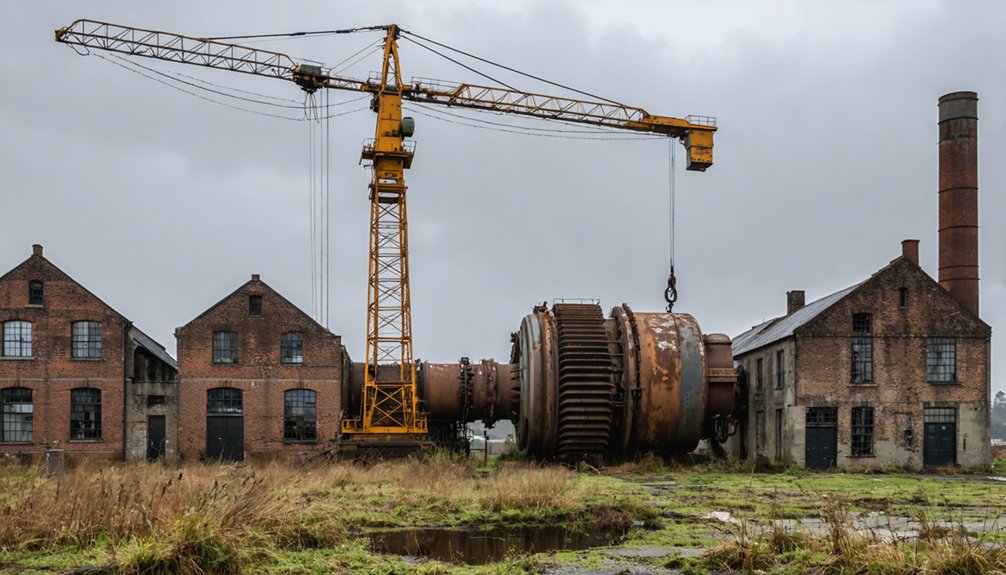
Silent behemoths of America’s industrial age lie frozen in time throughout Rust Belt ghost towns, where you’ll discover an archaeological treasury of manufacturing artifacts.
These industrial machinery relics tell stories of innovation and production that once defined American manufacturing might. You’ll encounter massive structures and equipment that showcase the historical significance of our industrial heritage.
- Towering blast furnaces and daylight factories stand as architectural monuments, their brick and concrete facades marking the landscape.
- Preserved manufacturing equipment, from turret lathes to bottle cars, remains eerily intact on factory floors.
- Engineering marvels like internal utility systems, including crane rails and conveyor belts, reveal the sophistication of mass production.
These industrial time capsules serve as powerful reminders of America’s economic transformation and technological progress.
Architectural Time Capsules: Building Styles Through Decades
Throughout the Rust Belt, you’ll witness a remarkable architectural evolution spanning multiple decades, from early modernist industrial complexes to mid-century civic monuments.
You can trace the region’s economic journey through its daylight factories and grain silos, where exposed materials and geometric clarity became hallmarks of industrial modernism. These structures stand alongside vernacular neighborhoods filled with worker cottages and brick homes that once housed immigrant families.
As you explore these urban landscapes, you’ll discover Art Deco and Moderne commercial buildings reflecting pre-decline optimism, while institutional structures like hospitals and schools reveal the social fabric of former industrial communities.
Despite urban decay, these architectural time capsules preserve distinct periods of American innovation and community life, from the practical worker housing to the ambitious vertical designs of landmark buildings.
Population Shifts: Statistical Stories of Urban Decline
As manufacturing jobs vanished from America’s industrial heartland, Rust Belt cities experienced a dramatic demographic upheaval that reshaped their urban cores.
You’ll find stark evidence of these demographic shifts in places like Detroit, Cleveland, and Buffalo, where populations plummeted by over 40% between 1970 and 2006.
These changes created new cultural narratives about urban decay and renewal.
- Lower-income neighborhoods bore the heaviest burden, with concentrated population losses transforming vibrant communities into sparse streetscapes.
- Cities with more college-educated residents showed greater resilience, with each percentage point increase in educated workforce yielding 3% employment growth.
- Suburban flight drained urban cores of their tax base, creating a domino effect of reduced services and deteriorating infrastructure.
This statistical story reveals how education became the dividing line between stagnation and recovery in America’s industrial cities.
Frequently Asked Questions
What Happened to the Employee Pension Funds When Major Industries Collapsed?
You’ll find pension liabilities weren’t properly funded, leaving workers vulnerable when industries collapsed. Financial mismanagement and declining workforce populations created massive shortfalls, forcing many funds into insolvency or severe benefit cuts.
How Do Local School Districts Survive With Such Diminished Tax Bases?
With 30% fewer local tax dollars, you’ll see districts tackling funding challenges through state aid, federal grants, school consolidations, and community initiatives like shared services and public-private partnerships to stay afloat.
Where Did Most of the Skilled Industrial Workers Relocate To?
You’ll find most skilled workers followed the job market to Sun Belt states like Texas and Alabama, while others migrated to coastal metros offering diverse economies and growing tech sectors.
What Became of the Company-Owned Hospitals and Medical Facilities?
Like dominos falling, you’ll find these once-proud hospitals crumbled under financial strain, with many demolished by 2021. Others were swallowed by mega-systems like UPMC, leaving communities with limited medical access.
How Have Property Insurance Rates Changed in These Declining Urban Areas?
You’ll find insurance trends skyrocketing in decaying urban zones, with your premiums jumping from $2,000 to $7,000 annually as insurers flee these high-risk areas, intensifying the cycle of urban decay.
References
- https://globalurbanhistory.com/2016/02/01/the-spiritual-capital-of-the-rust-belt-pittsburgh-and-the-postindustrial-transformation-of-north-atlantic-cities/
- https://allthatsinteresting.com/rust-belt
- https://www.britannica.com/place/Rust-Belt
- https://www.youtube.com/watch?v=orM7mOwy11k
- https://archive.strongtowns.org/journal/2020/11/30/you-cant-understand-the-rust-belt-without-understanding-its-suburbanization
- https://fiveable.me/key-terms/united-states-history-since-1945/rust-belt-decline
- https://study.com/academy/lesson/rust-belt-history-cities-decline.html
- https://www.industryweek.com/talent/article/22028380/the-abandonment-of-small-cities-in-the-rust-belt
- https://schoolofcities.utoronto.ca/neighbourhood-abandonment-in-the-american-rust-belt/
- https://www.cato.org/blog/economic-mobility-not-manufacturing-decline-real-rust-belt-story