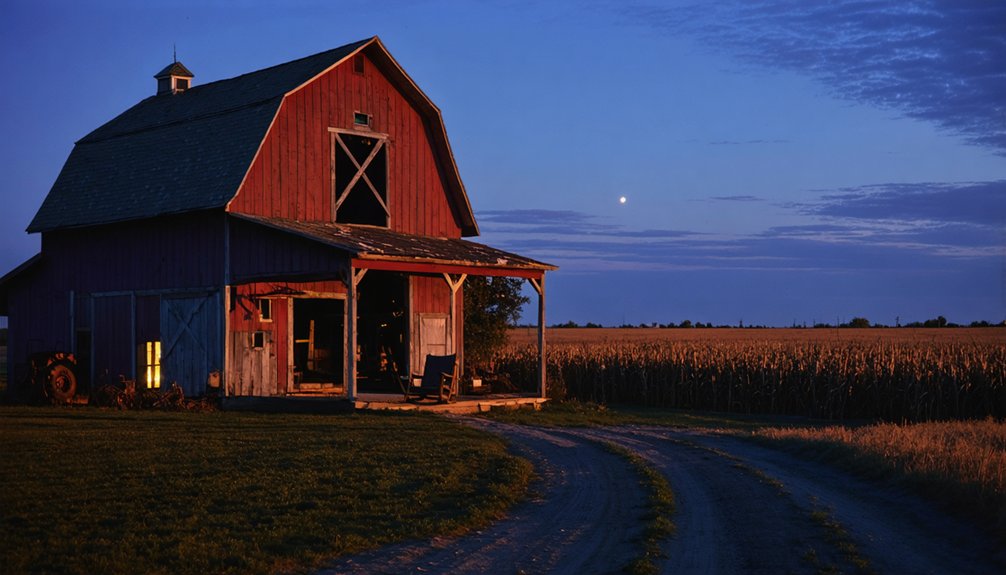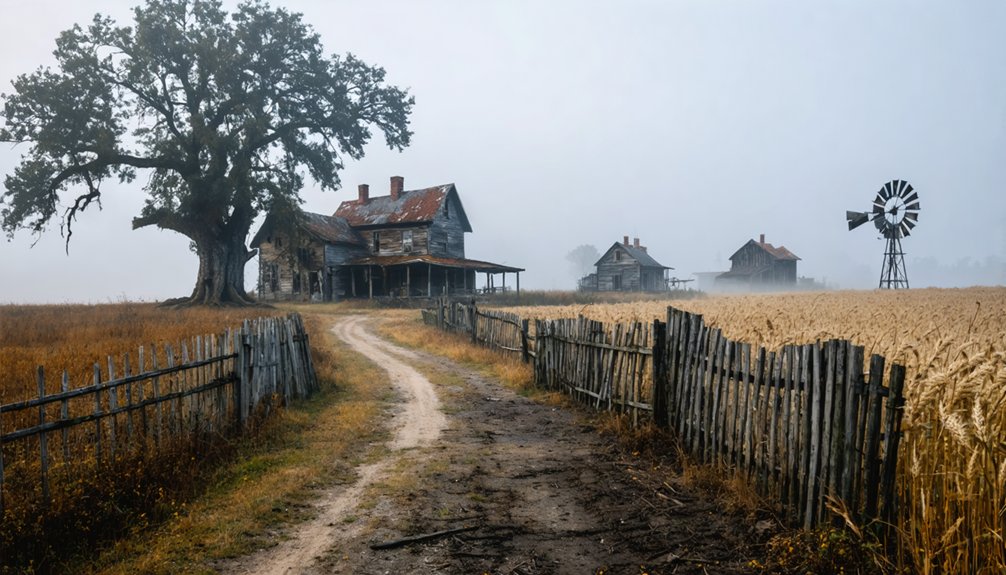
When you explore an abandoned farming hamlet, you’ll uncover layers of fascinating history etched into the landscape. These sites reveal intricate social structures through dwelling placement and size, while archaeological finds showcase agricultural innovations that shaped civilization. You’ll find evidence of economic cycles, traditional gender roles, and environmental transformations in every crumbling wall and overgrown field. The secrets these forgotten communities hold can illuminate solutions for modern farming challenges.
Key Takeaways
- Archaeological remains reveal complex social hierarchies through the placement and size of dwellings in ancient farming communities.
- Artifacts from catastrophic events, like Must Farm’s fire, provide detailed snapshots of daily life and resource management.
- Abandoned settlements demonstrate agricultural innovation through evidence of crop rotation systems and farming tool development.
- Natural regeneration of abandoned farmland creates important wildlife habitats and helps with carbon absorption over time.
- Excavated wells, tools, and structural remains preserve crucial information about traditional farming practices and cultural heritage.
The Hidden History of Poor Farms and Almshouses
While many modern Americans are unfamiliar with poor farms and almshouses, these institutions played a significant role in early American social welfare.
You’ll find these poor farm legacies scattered across the countryside, where county-run facilities once housed society’s most vulnerable members – the elderly, disabled, mentally ill, and homeless.
These almshouse narratives reveal a harsh reality: institutions deliberately isolated from public view, where residents worked farmland to sustain themselves and reduce tax burdens. Residents were further stigmatized by being forced to wear identifying letters “P” on their clothing. Local overseers made strict judgments about who deserved assistance and who would be denied aid.
Isolated from society’s gaze, poor farm residents toiled endlessly on remote properties, their labor masking the true cost of poverty.
You’re looking at a system that expanded dramatically during the 19th century’s industrialization, reflecting contemporary attitudes that poverty resulted from personal failure.
The facilities often included unmarked cemeteries where residents were buried anonymously, a sobering reminder of how society treated its poorest members.
Today, these abandoned sites stand as evidence of America’s complex relationship with poverty and social support.
Traces of Agricultural Innovation and Land Use
As archaeologists uncover the remnants of ancient farming settlements, you’ll discover a rich tapestry of agricultural innovation spanning multiple continents and eras.
The evolution of agricultural techniques reveals how early farmers adapted to their environments, from the two-field rotation systems of medieval hamlets to the sophisticated irrigation methods dating back to 6000 BCE.
Medieval villages achieved greater efficiency by transitioning to a three-field system that allowed both winter and summer crop rotations.
Modern agritopian developments have revived the spirit of these ancient farming communities by integrating agriculture into residential planning.
You can trace land management strategies through the archaeological record, where evidence shows how communities changed from basic cultivation to complex farming systems.
The shift from oxen to horses, combined with heavy plows and four-wheeled wagons, revolutionized medieval farming efficiency.
In Africa, communities maximized fertile lakeside soils through strategic root farming and cereal cultivation, while early farmers’ experimentation with crop domestication and storage solutions laid the groundwork for permanent settlements and specialized labor forces.
Unearthing Social Hierarchies and Labor Systems
As you examine abandoned farming settlements, you’ll notice clear patterns in how living spaces reveal social stratification and labor organization.
The placement and size of dwellings, along with the distribution of work areas, demonstrate how communities divided tasks and established hierarchies between landowners, laborers, and skilled craftspeople.
These physical remains offer key insights into how control over resources and labor created lasting power dynamics that shaped daily life in these agricultural communities.
Some communities maintained egalitarian politics, especially in the Coastal Plain regions where social classes were less pronounced.
Fortified elements like ditches and watchtowers surrounded many organized hamlets to maintain tight control over the movement and activities of inhabitants.
Labor Division Patterns
Throughout the history of farming hamlets, intricate labor division patterns emerged that reveal complex social structures and economic hierarchies.
You’ll find traditional gender roles shaped the core work structure, with men handling heavy plowing while women managed planting and harvesting tasks. As labor specialization evolved, distinct roles like herders and planters emerged, creating functional differentiation within communities.
When rural depopulation struck these hamlets, the delicate balance collapsed. You can trace how youth migration and rising opportunity costs led to widespread land abandonment. Critically, the growing income gap between rural-urban areas accelerated the exodus from agricultural communities. The increasing rapid urbanization in China fundamentally altered traditional village life and social structures.
The subsequent shift toward mechanization and agricultural productive services transformed traditional labor patterns, allowing some workers to pursue non-farming employment. This technological evolution, while increasing efficiency, deepened social inequalities as access to these resources favored wealthier households, fundamentally altering the hamlet’s social fabric.
Power Through Living Spaces
Living spaces in farming hamlets reveal intricate power dynamics that shaped social hierarchies and labor systems. You’ll find that elite dwellings dominated central locations, while spatial hierarchies determined where different social classes lived and worked. The size and complexity of housing directly reflected social rank, with aristocratic and religious leaders occupying the largest structures.
In these settlements, you can trace how power structures manifested through defensive walls and ditches protecting surplus resources. The layout of communal villages coordinated multiple family lines, while independent hamlets typically housed single kinship groups. Those who controlled land and plows gained significant economic advantages over others. The construction of massive great houses demonstrated the emergence of hierarchical leadership structures.
When authorities disrupted these arrangements through forced relocations, they severed deep ancestral connections. Through archaeological evidence, you can see how control over living spaces became an essential tool for maintaining social order and economic inequality within these agricultural communities.
Environmental Impact and Landscape Transformation
When farming hamlets fall into disuse, they trigger complex environmental transformations that can either benefit or harm local ecosystems.
You’ll find that abandoned farmland holds immense potential for environmental restoration, capable of absorbing atmospheric carbon and providing essential wildlife habitats. However, this positive change only occurs if you give the land enough time – typically more than 50 years – to fully regenerate.
The landscape regeneration process you’ll witness can stabilize soils, improve water retention, and reduce pollution runoff into nearby watersheds.
Yet these benefits aren’t guaranteed. Without proper management, you’re likely to see these lands reclaimed for mining or monoculture plantations within 30 years, destroying their restoration potential.
Your role in protecting these spaces from redevelopment becomes vital for ensuring their successful transformation into thriving natural ecosystems.
Archaeological Discoveries That Tell Stories
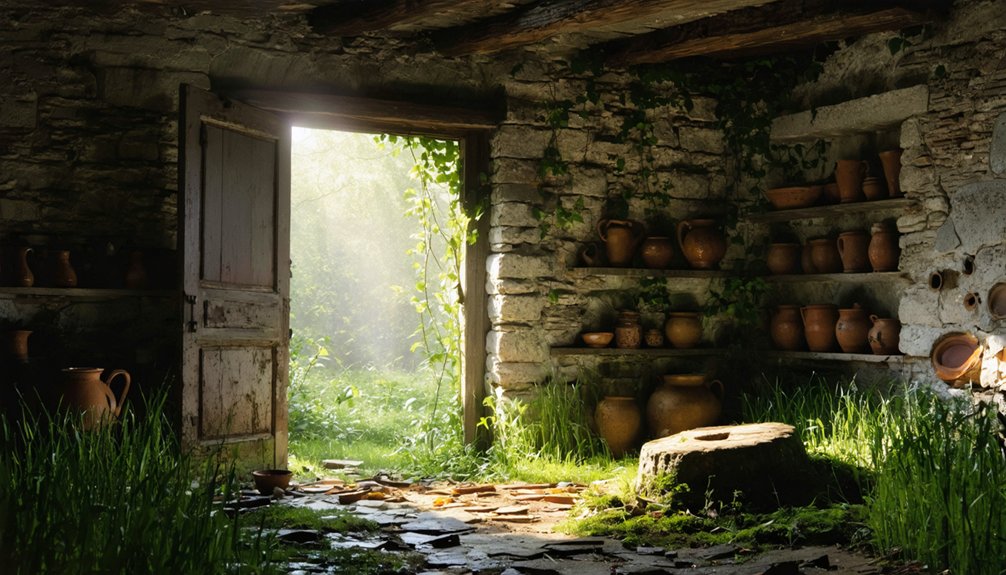
Archaeological excavations of abandoned farming hamlets reveal compelling narratives about past rural life, as demonstrated by two remarkable sites: the Cotswold Severn Vale Medieval Farm and the Must Farm Bronze Age settlement.
At the medieval farmstead, you’ll find evidence of a dispersed settlement pattern amid regenerating woodland, where farmers adapted to the claylands of Severn Vale until its abandonment in the 13th-14th century. A single burial adds mystery to the site’s story.
The Bronze Age settlement at Must Farm offers an extraordinary snapshot of daily life, frozen in time by a catastrophic fire.
You can trace the lives of its inhabitants through preserved artifacts: wooden wheels, log boats, fabric on bobbins, and cooking pots still containing food residues. These discoveries paint a vivid picture of a sophisticated community that mastered both farming and wetland resources.
The Economics Behind Rural Abandonment
Through detailed economic analysis, you’ll find that rural abandonment stems from a complex interplay of agricultural mechanization, demographic shifts, and market forces.
Rural decline emerges from intricate economic patterns, where automation, population changes, and market dynamics converge to reshape agricultural communities.
When farms consolidate and mechanize, they need fewer workers, triggering economic migration as young people seek opportunities elsewhere.
You’ll notice how this exodus creates a domino effect: as population drops, local businesses struggle to maintain profitability, schools close, and services become costlier to deliver.
The shrinking tax base forces municipalities to cut essential services, making these areas even less attractive to potential residents.
While some rural areas experience rural gentrification from wealthy urban transplants, most face declining property values and diminishing economic prospects.
It’s a self-reinforcing cycle where reduced economic activity leads to further population loss, transforming once-vibrant farming communities into shells of their former selves.
Preserving Our Forgotten Rural Heritage

Despite the ongoing exodus from rural communities, preserving abandoned farming hamlets remains crucial for safeguarding our agricultural heritage and cultural identity.
Through heritage conservation efforts, you’ll find meticulous preservation of ancient wells, traditional tools, and historic street layouts that tell the story of rural engineering and community life.
You can participate in community engagement initiatives that connect you directly with preservation planning. Your input helps determine which physical structures and intangible traditions deserve protection, while workshops build essential preservation skills.
The conservation approach integrates both built and natural landscapes, recognizing how local terrain shapes architecture and traditional practices. By protecting these sites, you’re not just preserving stone and mortar – you’re safeguarding generations of cultural knowledge, from agricultural techniques to festivals that keep rural traditions alive.
Modern Lessons From Historical Farming Communities
Historical farming communities offer valuable solutions for today’s agricultural challenges, particularly regarding climate resilience and sustainable resource management.
You’ll find compelling evidence in ancient practices like the Zuni’s decentralized irrigation systems and Ghana’s strategic shift to drought-resistant crops during extreme climate periods.
The key to their success lies in agricultural diversity and adaptability.
You can learn from medieval European farmers who protected against crop failures by maintaining varied crop repertoires, or from pre-Columbian Amazonians who developed sophisticated agroforestry systems.
Their climate adaptation strategies – from terra preta soil enrichment to raised field techniques – demonstrate how local solutions can address global challenges.
These time-tested approaches prove especially relevant as you face increasing climate uncertainty in modern agriculture.
Frequently Asked Questions
Were Supernatural or Paranormal Activities Ever Reported in These Abandoned Farming Hamlets?
You’ll find extensive reports of ghost sightings and local legends in these locations, from disembodied voices at Letchworth Village to haunting apparitions at Farrar Schoolhouse and lingering spirits in farmhouse ruins.
Visiting these places often evokes a sense of history as you encounter the whispering spirits of abandoned towns that seem to tell tales of their former inhabitants. Each step taken through the crumbling structures reveals more about the lives once lived there, enchanting those who seek solace in the echoes of the past. The air thickens with mystery, inviting exploration and reflection on the timeless stories left behind.
How Did Children’s Lives Differ From Adults in These Farming Communities?
You’d find children balancing essential farm tasks with limited play activities, while adults managed heavier labor and business decisions. Childhood responsibilities included feeding livestock and gathering eggs alongside education.
What Role Did Women Play in Managing and Operating These Farms?
With 20,000+ women serving as “farmerettes” in WWI, you’ll find women held vital agricultural responsibilities – from managing daily operations to preserving food, while providing essential community support despite legal restrictions.
Did Any Famous or Notorious People Live in These Farming Hamlets?
You’ll find famous residents like Chancellor Robert Livingston in Cheviot and notorious figures like Henry Plummer, who terrorized Bannack while posing as its sheriff, killing 102 people.
How Did Seasonal Weather Patterns Influence Daily Life in These Communities?
You’d plan your entire year around crop cycles, from spring planting to fall harvest, while celebrating seasonal festivals that marked key agricultural milestones and brought communities together.
References
- https://digitalcommons.murraystate.edu/cgi/viewcontent.cgi?article=1117&context=crsw
- https://timemaps.com/encyclopedia/farming/
- https://montgomeryplanning.org/blog-design/2021/03/the-poor-farm-cemetery-a-dark-and-overlooked-part-of-our-past/
- https://socialwelfare.library.vcu.edu/issues/poor-relief-almshouse/
- https://www.nps.gov/prwi/learn/historyculture/poor-house.htm
- https://grapevinelibrary.info/2024/03/ancestors-fall-on-hard-times-check-out-the-poorhouses/
- https://www.youtube.com/watch?v=EC9PAZ8k7hs
- https://historycambridge.org/articles/history-of-poorhouses/
- https://www.scribd.com/document/710622472/STS
- https://www.smithsonianmag.com/innovation/how-farms-became-new-hot-suburb-180954956/