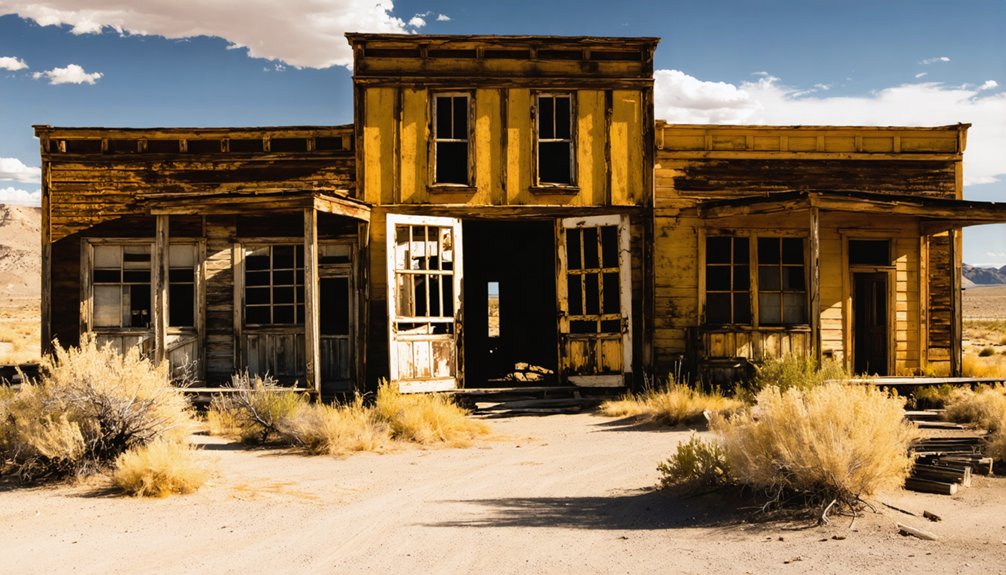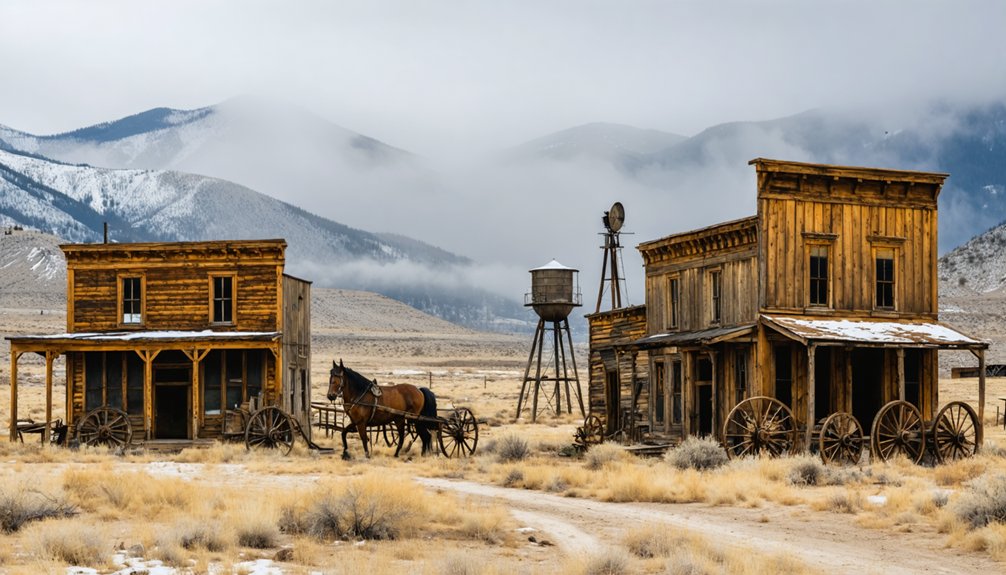
You’ll find America’s ghostly frontiers filled with submerged towns like Guerrero Viejo, where Spanish Colonial ruins emerge during droughts, and divided communities like Glenrio, where state lines shaped daily life. These abandoned places tell stories of mining booms, railroad prosperity, and cultural fusion between Native American, Spanish, and American traditions. From silver boomtowns to underwater artifacts, each forgotten settlement holds clues to the fleeting nature of frontier dreams and ambitions.
Key Takeaways
- Submerged towns like Guerrero Viejo reveal preserved Spanish Colonial architecture and community life when drought exposes their ruins.
- Mining boomtowns across New Mexico showcase cultural fusion between Native American, Spanish, and American frontier traditions.
- Abandoned railroad towns contain untouched personal belongings, frozen in time after residents fled economic decline.
- Hidden silver operations in California’s terrain, like Bennettville’s Waterman Mine, left environmental scars and forgotten wealth.
- Archaeological discoveries emerge from receding waters, uncovering Native American artifacts and evidence of 14,500-year-old human settlements.
The Sunken Legacy of Guerrero Viejo
While many ghost towns in America were abandoned due to economic decline or natural disasters, Guerrero Viejo’s fate was sealed by deliberate flooding in 1953.
Once a thriving border town of 25,000 residents, this Mexican settlement boasted stunning Spanish Colonial architecture and served as an essential cultural hub in the Lower Rio Grande Valley since 1750.
Before the waters claimed it, Guerrero Viejo stood proudly as a cultural cornerstone, its colonial splendor housing generations of border life.
When the Falcon Dam project submerged the town, it transformed centuries of history into sunken treasures beneath the reservoir’s waters.
Yet Guerrero Viejo’s historical resilience reveals itself during droughts, as the waters recede to expose the haunting ruins of the Church of Nuestra Señora del Refugio and the old central plaza.
Though most buildings have crumbled, their remaining stone walls and arched passageways still whisper stories of a vibrant past that refuses to be forgotten. A handful of determined homesteaders stayed behind, defying the rising waters that would claim their beloved town.
The historic flood of 1954 proved the dam’s worth, as it prevented waters that could have reached 400,000 cubic feet per second from devastating the valley.
A Tale of Two States: The Divided Town of Glenrio
Straddling the Texas-New Mexico border since 1905, Glenrio embodies the peculiar challenges of existing between two states’ jurisdictions.
In this unique town, where Main Street served as the state line, you’d find a fascinating web of legal adaptations. The state line quirks shaped every aspect of daily life – bars operated exclusively on New Mexico’s side due to Texas’s dry county status, while gas stations clustered on Texas soil to avoid New Mexico’s higher fuel taxes.
Glenrio’s history reveals how residents navigated these divisions, even in postal operations. Mail arrived at Texas’s railroad depot but crossed the border for distribution from New Mexico’s post office. The Chicago Rock Island Railway established the town in 1903, setting the stage for its unique border identity.
The town flourished during Route 66’s heyday but couldn’t survive I-40’s bypass in 1973, transforming from a bustling frontier community into a ghost town with just five residents by 2000. Today, sitting at an elevation of 3,850 feet, the abandoned town stands as a testament to America’s changing transportation landscape.
Borders, Barriers, and Broken Communities
You’ll find that America’s border towns bear the physical and emotional scars of ever-expanding fortification projects, which have transformed once-unified communities into fragmented shells of their former selves.
The construction of barriers – from simple chain-link fences to imposing 30-foot steel bollards – has severed generations-old connections between families and businesses that previously moved freely across the international line.
These physical divisions have contributed to the decline of numerous border communities, where restricted access and disrupted economic patterns have left once-thriving towns struggling to maintain their identity and population.
Massive federal investments of border patrol funding over the past two decades have increased security but failed to address the underlying humanitarian concerns.
The border crisis has intensified since 2015, with over 1.8 million people fleeing conflict zones and seeking refuge, further straining these already fragmented communities.
Fortifications Divide Border Towns
As physical barriers increasingly slice through the U.S.-Mexico borderlands, they’ve created profound divisions in once-unified communities that have shared cultural and economic bonds for generations.
You’ll find towns where 18-30 foot steel bollard walls now separate families, disrupt centuries-old traditions, and fragment vibrant binational relationships.
The border separation has transformed these areas into what many call “broken communities,” where daily social interactions and commerce have been severely constrained.
The community impact extends beyond mere physical division – indigenous sacred sites have been damaged, and local residents face heightened tensions from constant surveillance and restricted movement.
These barriers, costing anywhere from $1 million to $46 million per mile, have fundamentally altered the social fabric of border towns while militarizing once-peaceful shared spaces.
The Smart Wall concept has introduced advanced detection technologies like facial recognition and underground fiber optic cables, further intensifying the surveillance presence in border communities.
A prime example is the divided towns of Jacumba, California and Jacume, Mexico, where the border fence installation has significantly increased travel times and separated previously interconnected families.
Communities Lost To Time
Beyond today’s fortified border towns lie the haunting remains of communities erased by time, policy, and infrastructure.
You’ll find forgotten histories in places like Guerrero Viejo, a 250-year-old Mexican town submerged by the Falcon Reservoir in 1953, its ruins emerging only during droughts.
Glenrio’s abandoned gas stations and post office tell a tale of how border economics shaped community life, with Texas and New Mexico each hosting different businesses based on tax policies. The Russells Travel Center remains one of the few active businesses serving cross-country travelers.
Violent incidents have plagued the area, making it dangerous for visitors and preservationists alike.
These displaced communities reveal deeper patterns of loss.
From the drought-stricken ranching settlements of La Junta to today’s impoverished colonias lacking basic services, you’re witnessing generations of border inhabitants pushed aside by environmental disasters, political shifts, and infrastructure projects.
Each ghost town and informal settlement preserves a chapter of border life that refuses to be forgotten.
Echoes of the Wild West in New Mexico’s Ghost Towns
You’ll find New Mexico’s most compelling ghost town stories in places like Chloride and Mogollon, where mining strikes brought thousands of prospectors searching for gold, silver, and copper riches in the 1880s.
While some settlements flourished as railroad hubs supporting these mining ventures, others like Loma Parda grew from their proximity to military outposts and major trade routes such as the Santa Fe Trail.
These once-bustling communities, complete with saloons, brothels, and notorious reputations for lawlessness, tell a raw and unvarnished tale of the American frontier’s rapid rise and fall.
Mining Boomtowns’ Hidden Stories
When precious metals were discovered throughout New Mexico in the 19th century, the territory’s rugged landscape quickly transformed into a patchwork of bustling mining communities.
You’ll find hidden treasures in places like Golden, which sparked New Mexico’s first gold rush before California’s famous boom, and Pinos Altos, where forgotten legends include Judge Roy Bean’s early mercantile ventures and fierce battles with Apache warriors.
These towns weren’t just about mineral wealth – they were crucibles of cultural fusion where Native American, Spanish, and American traditions collided.
While some communities like Dawson met tragic ends through devastating mine explosions, others simply faded as ore deposits ran dry or mineral prices crashed.
Today, these ghost towns stand as evidence to the untamed spirit of frontier life, where fortunes could be made or lost overnight.
Railroad Towns Fade Away
The rise and fall of New Mexico’s railroad towns mirrors the broader shift of America’s western frontier. You’ll find their stories etched in places like Steins, where the Southern Pacific Railroad‘s presence once drew 1,000 residents to a harsh desert outpost that couldn’t even sustain its own water supply.
These towns thrived on railroad relevance, offering essential services through hotels, saloons, and boarding houses while supporting nearby mining and timber operations.
But when diesel engines replaced steam locomotives after World War II, these communities faced rapid economic decline. As railroads abandoned their stops and offered free transport out, residents left behind their possessions and dreams.
The change hit hard – water stops became obsolete, mining operations shut down, and once-bustling settlements emptied. Today, their ruins stand as proof to the fleeting nature of frontier prosperity.
The Silver and Gold Rush That Time Forgot
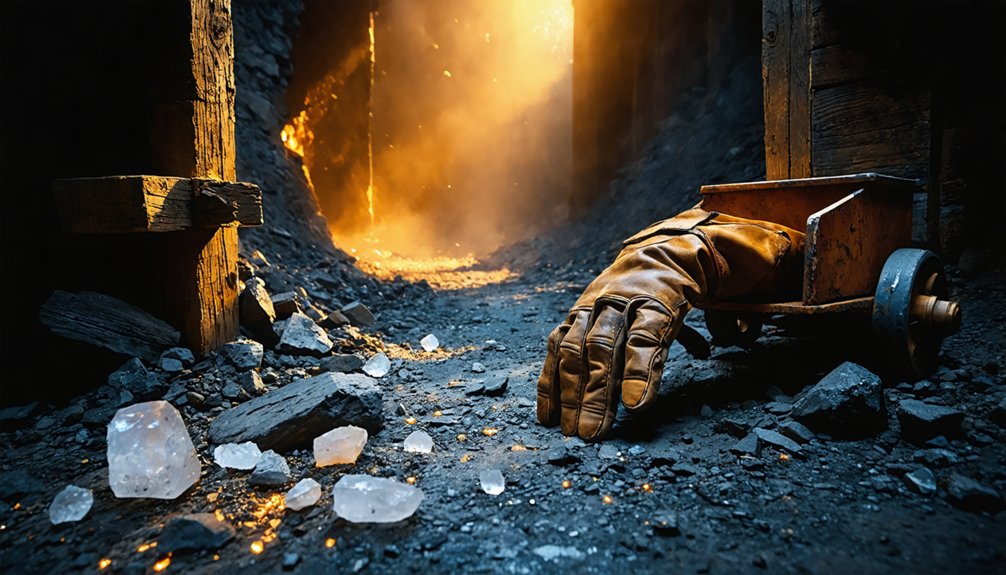
Deep beneath California’s rugged terrain lies a tale of two precious metals that forever changed the American frontier. While you’ve heard of the ’49ers who rushed west for gold, you’ll find lesser-known stories of silver boomtowns like Bennettville, where forgotten miners once sought their fortunes.
The Waterman Mine near Barstow yielded $1.6 million in silver between 1881-1887, yet few remember its existence today.
You’d be amazed how these parallel rushes transformed California’s landscape. While gold strikes along the American River sparked a mass migration of 300,000 people, silver operations quietly built their own legacy of stamp mills, steam hoists, and rail networks.
Both ventures left behind ghost towns and environmental scars that you can still trace across the Sierra Nevada’s remote peaks.
Modern Migration: Empty Houses and Silent Streets
Unlike America’s historic gold rushes that drew masses westward, today’s migration patterns reveal a striking paradox of stillness and movement.
You’ll find 87.9% of Americans staying put, creating an unprecedented era of residential stability. Yet those who do move are charting bold new paths, often crossing state lines in search of affordability rather than adventure.
Today’s Americans largely anchor in place, while a brave minority migrate across borders pursuing not gold, but affordable dreams.
You’re witnessing a remarkable rural revitalization as remote work transforms once-abandoned communities into vibrant havens.
The South, particularly the Carolinas and Tennessee, beckons with lower costs and family-friendly environments.
While past frontiers promised gold and silver, today’s ghostly frontiers offer something equally precious: space, tranquility, and financial freedom.
Empty houses and silent streets are finding new life as urbanites trade congested cities for the promise of smaller communities and affordable living.
When Waters Recede: Hidden History Resurfaces
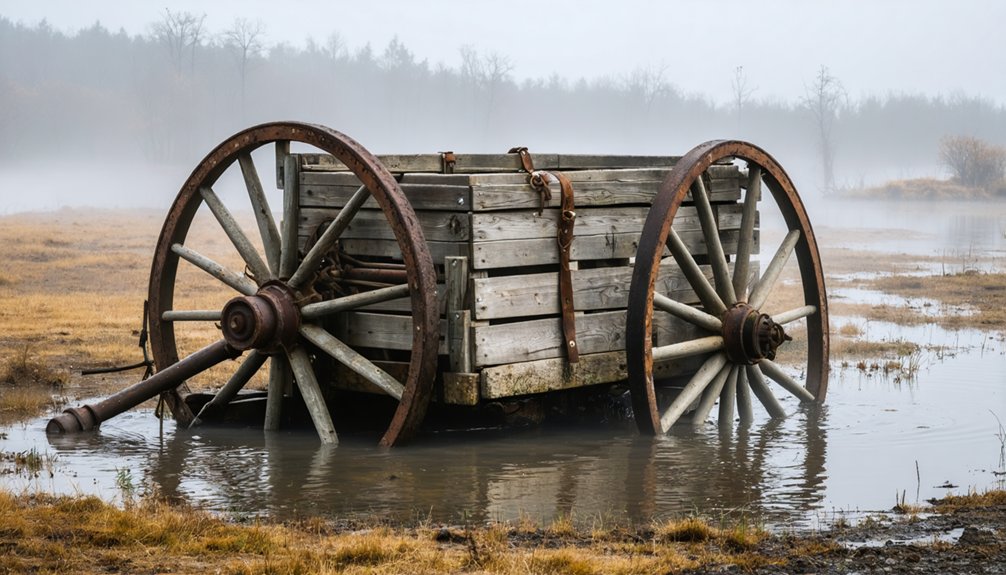
As waters rise and fall across America’s landscapes, they reveal more than just shifting shorelines – they uncover hidden chapters of human history.
You’ll find prehistoric discoveries emerging from receding reservoirs, where Native American settlements and artifacts lay hidden for decades beneath Lake Powell and Lake Mead.
Underwater archaeology tells an even deeper story.
In Florida’s springs and rivers, you’ll discover evidence of human activity dating back 14,500 years, including stone tools and mastodon bones bearing ancient cut marks. These submerged sites challenge everything we thought we knew about early Americans.
Today’s droughts are exposing long-lost treasures – from Puebloan dwellings to Mormon settlements and WWII vessels.
As water levels drop, you’re witnessing a rare window into America’s past, where each receding tide brings new archaeological revelations.
Frontier Justice and Cross-Border Commerce
While modern trade flows dominate today’s borderlands, America’s frontier regions once operated under a complex system of informal justice and commerce that shaped the nation’s early development.
You’ll find striking parallels between historical and contemporary cross-border trade dynamics, as evidenced by today’s $144.8 billion monthly commerce between the U.S., Canada, and Mexico.
Just as frontier justice systems evolved to manage disputes between traders and settlers, modern regulations like Mexico’s new pre-export notification requirements reflect ongoing efforts to control commerce.
The sheer scale of current trade – with trucks making over 635,915 monthly crossings from Mexico alone – dwarfs historical volumes, yet the fundamental challenges of managing cross-border commerce remain remarkably similar to those faced by our frontier predecessors.
The Railroad’s Abandoned Children
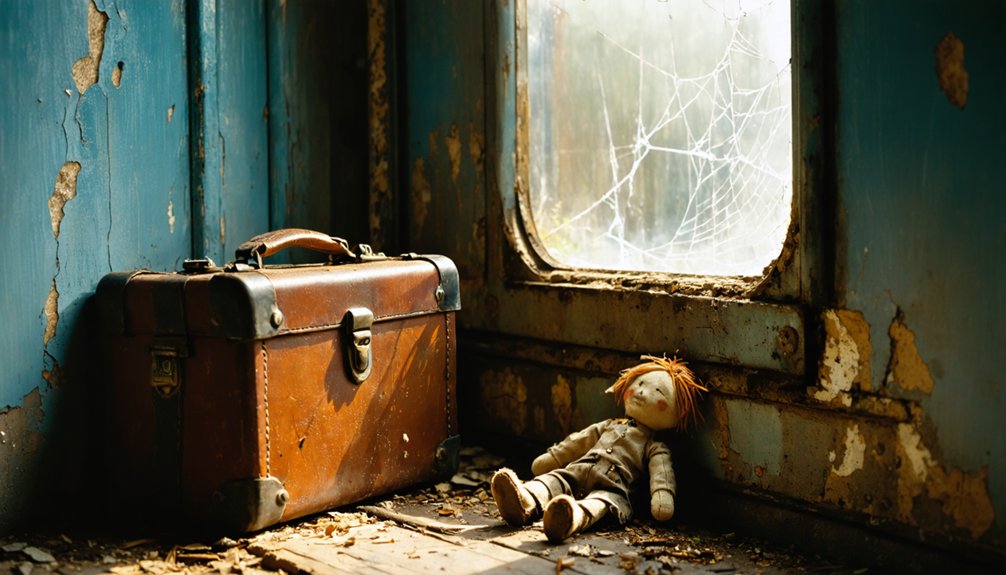
The railroad networks that facilitated America’s frontier commerce also became conduits for one of the nation’s most poignant social experiments.
Between 1854 and 1929, you’d witness over 200,000 children transported from eastern cities to America’s heartland in what became known as the Orphan Train Movement.
Over 200,000 children journeyed by rail from crowded eastern cities to new lives in America’s heartland during the Orphan Train era.
You’ll find their train journeys marked by public “auctions” where potential families scrutinized children for their labor potential.
While some orphan experiences led to loving homes, others faced exploitation and abuse. Children were often separated from siblings, losing their cultural identity as they adapted to new lives in rural communities.
The movement’s impact echoes through time – today, an estimated 2 million Americans descend from these relocated children, their stories woven into the fabric of rural America’s development.
Frequently Asked Questions
What Paranormal Activities Have Been Reported in These Frontier Ghost Towns?
You’ll encounter ghost sightings of miners, soldiers, and settlers, alongside spectral hauntings that include disembodied voices, mysterious cold spots, phantom music, and unexplained footsteps in abandoned buildings.
Among these eerie encounters, you may also uncover the ghostly remains of ancient civilizations that once thrived in forgotten lands. Their stories echo through time, reflecting the rich tapestry of history woven into the very ground you tread. Exploring these haunted sites can reveal more than just phantoms; they hold secrets of past cultures waiting to be rediscovered.
How Do Native American Tribes View These Abandoned Settlements Today?
You’ll find that Native American tribes view these settlements as culturally significant ancestral sites, integral to their heritage and spiritual practices. They’re fighting to protect these sacred spaces from exploitation and environmental damage.
What Valuable Artifacts Remain Buried Beneath These Ghost Towns?
While you can’t excavate everywhere, you’ll find buried treasures like Spanish coins, mining tools, lost relics from colonial battles, and precious metal caches left by early prospectors beneath ghost towns.
Why Don’t Preservation Societies Restore These Historic Frontier Communities?
You’ll find preservation challenges overwhelm these restoration efforts, from harsh environmental conditions to crumbling structures. Limited funding issues force societies to choose between complete restoration and basic stabilization of historic frontier buildings.
How Did Women Shape the Development of These Frontier Towns?
You’ll find frontier women were essential community builders who established businesses, schools, and social networks. Their economic contributions and expanded social roles transformed rough settlements into thriving, organized frontier towns.
References
- https://hectorastorga.wordpress.com/2010/12/04/the-ghost-town-of-guerrero-viejo-tamaulipas-mexico/
- https://www.youtube.com/watch?v=LiS5UTVrzlQ
- https://www.newmexico.org/places-to-visit/ghost-towns/
- https://en.wikipedia.org/wiki/Mexico–United_States_border
- https://www.islands.com/1912942/glenrio-new-mexico-abandoned-town-historic-snapshot-route-sixty-six/
- https://inthesetimes.com/article/mexicos-ghost-towns
- http://www.houstonculture.org/terra/viejo.html
- https://tpwmagazine.com/archive/2007/jul/ed_6/
- https://www.atlasobscura.com/articles/a-flooded-mexican-ghost-town-offers-refuge-to-border-crossers
- https://mosthistory.org/mhcs-old-guerrero/