You’ll find that ghostly remains hold multiple scientific secrets waiting to be uncovered through EMF measurements, environmental analysis, and psychological research. Modern investigation techniques can detect unexplained electromagnetic fluctuations, temperature anomalies, and infrasonic frequencies that may trigger supernatural experiences. When you examine historical evidence alongside today’s technological data, you’ll discover that understanding spectral phenomena requires a careful blend of scientific methodology and cultural interpretation. The deeper you explore, the more complex these mysteries become.
Key Takeaways
- Ancient burial practices and cultural rituals can reveal historical patterns of ghost manifestations and spiritual beliefs across civilizations.
- EMF fluctuations in remains or artifacts may indicate residual energy patterns requiring specialized detection equipment for analysis.
- Laboratory analysis of physical remains can uncover environmental factors like infrasound or air quality issues affecting paranormal experiences.
- Systematic documentation and testing of ghostly phenomena around remains helps distinguish genuine anomalies from natural explanations.
- Historical records and witness testimonies associated with remains provide crucial context for understanding reported paranormal activities.
The Science Behind EMF Readings and Spectral Activity
While paranormal investigators have long relied on various tools to detect ghostly activity, EMF meters have become a cornerstone of modern ghost hunting methodology. You’ll find these devices measuring electromagnetic fluctuations in milligauss or volts per meter, helping establish baseline readings before any investigation begins. The TriField Natural EM Meter specializes in filtering out artificial EMF sources to focus on natural energy fields.
Current electromagnetic theories suggest that spirits might manipulate or emit EM fields to manifest themselves. When you’re tracking paranormal correlations, you’ll want to look for EMF spikes that coincide with other phenomena like EVP recordings, temperature drops, or visual anomalies. Neuroscience research suggests that strong magnetic fields could actually trigger ghost-like hallucinations in sensitive individuals.
Don’t rely on EMF readings alone – they’re most significant when paired with multiple evidence types. Remember to rule out mundane sources like faulty wiring or nearby electronics, as these can create misleading spikes. The strongest cases often involve repeated, reproducible anomalies in specific locations.
Environmental Triggers of Paranormal Experiences
When investigating paranormal phenomena, you’ll discover that specific environmental conditions can trigger experiences commonly attributed to ghostly activity.
Environmental factors often masquerade as supernatural events, creating experiences that our minds interpret as paranormal encounters.
You’ll encounter infrasound effects below 20 Hz that can induce anxiety and chills, while sudden temperature fluctuations might trigger your psychological response to interpret cold spots as spectral presence. Scientific studies like Tandy’s lab research revealed how infrasonic vibrations can create sensations of dread and visions. Research shows that environmentally sensitive individuals report significantly more paranormal experiences than others in these settings.
Don’t overlook air quality‘s vital role – exposure to mold spores or carbon monoxide can produce hallucinations and an unsettling sense of being watched.
Environmental cues, from ambient sounds to specific fragrances, can activate your pre-existing beliefs about haunted spaces, making you more susceptible to interpreting sensory anomalies as paranormal events.
Understanding these natural triggers empowers you to distinguish between genuine mysteries and explainable environmental factors during your investigations.
Understanding the Brain’s Role in Ghost Perceptions
Beyond environmental factors that trigger ghostly experiences, the neurological foundations reveal how your brain can create supernatural sensations. Your neural mechanisms responsible for body perception and sensory integration play an essential role in ghost sensations through complex cognitive models and predictive coding.
- When your brain’s multisensory signals become misaligned, particularly in areas controlling self-awareness and movement, you might experience presence illusions – the distinct feeling that someone’s watching or near you. Research has found that male subjects show higher correlations between paranormal beliefs and psychological factors.
- Your frontoparietal network, which processes conscious experiences, can misinterpret delayed sensorimotor feedback, causing you to attribute self-generated signals to an external presence.
- Through brain stimulation studies, scientists have shown that disrupting your temporal-parietal regions can artificially create ghost sensations, demonstrating how neural distortions manifest as paranormal experiences. The intensity of these phantom presences can be so overwhelming that some individuals experiencing them during experiments have asked to stop the testing altogether.
Natural vs. Supernatural: Decoding Mysterious Phenomena
Throughout history, humans have grappled with distinguishing between natural and supernatural explanations for mysterious phenomena. You’ll find that when events lack clear human agency, supernatural attributions become more prevalent – particularly with natural phenomena like diseases, storms, and earthquakes. Scientific investigation requires that we only consider natural explanations for observations to build reliable knowledge.
In fact, research across 114 societies shows that 96% attributed infectious diseases to supernatural causes, while only 26% did so for theft.
You’re more likely to seek supernatural explanations when natural mechanisms aren’t readily apparent. Your brain is wired to detect agency in unpredictable events, which is why you might perceive spirits in lightning strikes or demons in illness.
However, when human motives are clear, as in theft or social conflicts, you’ll typically favor natural explanations. This pattern reveals how your mind processes uncertainty in both natural and social worlds. Studies show that urbanized societies demonstrate unique patterns in attributing supernatural causes to social phenomena.
Historical Evolution of Ghost Encounters
You’ll find that ancient civilizations relied heavily on ritual and religious practices to detect ghostly presences, from Mesopotamian exorcism ceremonies to medieval Christian methods of identifying souls in purgatory.
Modern ghost hunting has evolved dramatically from these early approaches, incorporating electronic equipment, environmental sensors, and scientific methodologies to measure potential paranormal activity.
This transformation reflects humanity’s shift from purely spiritual interpretations to a blend of traditional beliefs and technological investigation techniques. Early Christian theologians like Saint Augustine adamantly rejected the possibility of ghostly interactions between the living and the dead, marking a significant shift in religious thought about the supernatural. Evidence of ghost beliefs dates back to a remarkable 3,500-year-old tablet that contains one of humanity’s earliest known depictions of spirits.
Ancient Ghost Finding Methods
Ancient civilizations developed sophisticated methods for detecting and interacting with spirits, particularly in Mesopotamia where ghosts were considered active participants in daily life.
You’ll find their approaches were both systematic and spiritually attuned, reflecting a deep understanding of spectral communication.
- Professional exorcists known as āšipu conducted ancient rituals using specialized amulets and incantations to identify and manage ghostly presences.
- Priests developed coded systems of spirit rapping and physical signals to establish two-way communication with the deceased.
- Mirrors and reflective surfaces served as early detection tools, believed to capture glimpses of spirits attempting to make contact.
These methods laid the groundwork for centuries of ghost-finding techniques, demonstrating how our ancestors understood the complex relationship between the living and the dead.
Modern Investigation Transformations
The evolution from ancient ghost-finding methods to modern paranormal investigation marks a dramatic shift in how we detect and document spiritual phenomena.
You’ll find today’s ghost hunting landscape dominated by sophisticated electronic tools that deliver precise, measurable data. The Hades Eye EMF detector, with its enhanced field strength and temperature monitoring, exemplifies how technological advancements have revolutionized spirit detection.
You’re no longer limited to subjective experiences – now you can capture evidence through 4K ultra-HD Phasm cameras, REM-Pods, and specialized EVP recorders.
Digital analysis software helps you examine environmental patterns, while continuous data logging guarantees you won’t miss a single anomaly.
These innovations have transformed paranormal investigation from mystical guesswork into a more systematic, evidence-based pursuit.
The Psychology of Haunted Spaces
While most people associate haunted spaces with fear and discomfort, research reveals these environments serve as sophisticated psychological laboratories for human emotion.
You’ll discover that these controlled fear experiences actually help develop essential fear management skills and emotional resilience.
- Your brain’s reactivity to anxiety decreases after exposure to simulated threats, creating a natural calming effect that helps you handle real-world stress better.
- When you share these experiences with others, your body releases oxytocin and dopamine, strengthening emotional bonding through mutual support and shared excitement.
- You’ll experience more intense physiological responses to unexpected scares than predictable ones, but knowing you can exit anytime keeps you in control of your fear response, making the experience both thrilling and therapeutic.
Modern Technology in Paranormal Research
Modern paranormal investigation has evolved into a technology-driven discipline, where you’ll find investigators equipped with an arsenal of sophisticated electronic devices.
From EMF meters detecting electromagnetic fluctuations to thermal imaging cameras revealing temperature anomalies, paranormal technology has transformed how you analyze potentially haunted locations.
Advanced detection tools have revolutionized paranormal research, allowing investigators to scientifically document unexplained phenomena in haunted spaces.
You’ll encounter cutting-edge tools like structured light sensors mapping spatial anomalies and REM pods monitoring electromagnetic disturbances.
Digital audio recorders capture EVPs while infrared cameras detect heat signatures invisible to your eyes.
For spectral analysis, you’ll rely on environmental meters tracking atmospheric conditions and digital thermometers measuring cold spots.
While these devices offer unprecedented data collection capabilities, you must remain aware of potential interference from everyday electronics and power sources that can trigger false readings during your investigations.
Cultural Interpretations of Spirit Manifestations
While you’ll find ancient civilizations interpreted spiritual encounters through unique cultural frameworks, each society developed distinct systems for recognizing and categorizing ghostly phenomena.
You’ll notice how modern cultures continue to shape spirit manifestations through their own lens, with some viewing apparitions as solid figures and others as ethereal forms.
When you examine ghost beliefs across different borders, you’ll discover how cultural models of the mind—whether viewed as permeable or impermeable to spiritual forces—directly influence how people experience and interpret supernatural encounters.
Ancient Ghost Belief Systems
Throughout ancient civilizations, beliefs about ghosts and spirits formed intricate cultural frameworks that shaped religious practices, social obligations, and everyday behaviors. From East Asia to Egypt, ancient rituals reflected complex understandings of death, afterlife, and spectral symbolism.
- You’ll find striking similarities in how different cultures viewed improper burial as a catalyst for hauntings, with societies from Rome to Mesoamerica developing specific rites to prevent restless spirits.
- Your understanding of ancient ghost beliefs reveals a universal concern for maintaining cosmic order, whether through Egyptian soul-weighing ceremonies or Chinese ancestor worship.
- You’re witnessing how these beliefs transcended mere superstition – they served as sophisticated systems of social control and moral guidance, from Tibetan Buddhist concepts of hungry ghosts to Greek traditions of appeasing the dead.
Modern Cultural Ghost Perspectives
In today’s diverse cultural landscape, you’ll find that interpretations of ghostly phenomena reflect deeply embedded societal beliefs, psychological frameworks, and media influences that shape how people perceive and process potential supernatural encounters.
Among the many ways these beliefs manifest are the haunted attractions in New England, which draw crowds eager to experience the thrill of the unknown. These events not only serve as entertainment but also as a reflection of the region’s rich history and folklore. As visitors navigate through these eerie environments, they engage with the very stories and legends that have shaped the cultural identity of the area.
Western cultural ghosts often emerge from Christian notions of unresolved souls, while East Asian spectral narratives feature hungry spirits and vengeful yūrei.
You’ll discover that Indigenous and African traditions typically view ghosts as ancestral presences who maintain connections with the living.
Modern media continuously reshapes these interpretations through movies, television, and digital folklore, while psychological factors like grief and cultural conditioning influence how you might experience unexplained events.
The interplay between traditional beliefs and contemporary ghost-hunting practices demonstrates how cultural perspectives on spirits remain dynamic and evolving.
Spirit Manifestation Across Borders
Spirit manifestations take distinct forms across global cultures, revealing profound differences in how societies understand and interact with the supernatural sphere.
You’ll discover that spectral beliefs are deeply woven into cultural rituals and ancestral connections that shape spiritual symbolism worldwide.
- In shamanic practices, you’ll witness supernatural experiences through drum-induced trances and nature spirits, serving as bridges between physical and spiritual domains.
- African traditions emphasize ghostly narratives through collective ceremonies where ancestral spirits manifest through rhythmic rituals and community offerings.
- Eastern spiritual traditions focus on inner manifestation through meditation and harmony with universal forces, while Native American beliefs like Manitou represent an all-encompassing life force that permeates existence.
Breaking Down Common Ghost Hunting Methods
Modern ghost hunting combines sophisticated technology with traditional methods to investigate paranormal activity. You’ll find EMF meters and thermal cameras working alongside age-old dowsing rods and pendulums, creating an extensive approach to spectral analysis.
Today’s ghost hunters blend cutting-edge tech with time-tested tools, merging scientific precision and traditional wisdom in their supernatural pursuits.
For spiritual communication, you can employ everything from high-tech spirit boxes to simple flashlight techniques.
Your investigation toolkit might include digital voice recorders for EVP sessions, SLS cameras that map potential entities in 3D space, and REM pods that detect electromagnetic disturbances.
You’ll want to monitor your environment using infrared cameras and motion sensors while setting up trigger objects relevant to the location’s history.
When analyzing evidence, you’ll need to distinguish between genuine paranormal phenomena and natural environmental factors, making your investigation both methodical and thorough.
Physical Evidence and Scientific Analysis
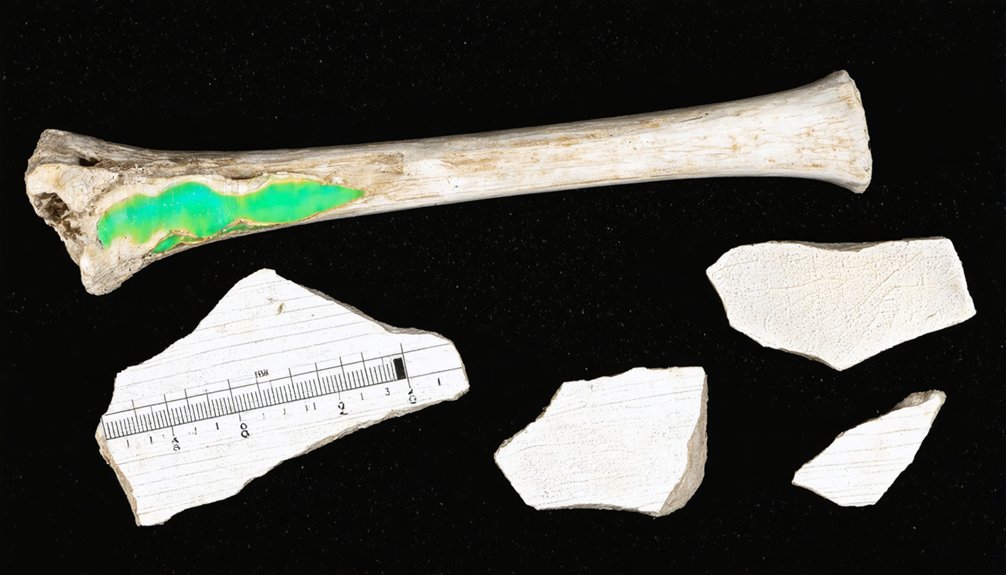
When you’re analyzing potential paranormal activity, EMF detection remains one of the most widely used scientific methods, though you’ll need to carefully document and rule out natural electromagnetic sources.
You’ll find that rigorous laboratory testing of claimed physical evidence requires strict chain-of-custody protocols and controlled conditions to yield meaningful results.
Your evidence collection process must follow standardized procedures, including detailed photography, precise measurements, and thorough documentation of environmental conditions at the time of collection.
EMF Detection Methods
Throughout paranormal investigations, electromagnetic field (EMF) detection has emerged as a cornerstone technique for gathering physical evidence of ghostly activity.
You’ll need specialized equipment ranging from basic single-field meters to advanced tri-field devices capable of detecting subtle EMF anomalies detection in ranges from 0-20mG.
For reliable spectral data analysis, follow these critical steps:
- Establish baseline EMF readings at your investigation site’s entrance to contextualize subsequent fluctuations.
- Maintain distance from electronic devices while scanning systematically through spaces.
- Cross-validate EMF spikes with additional environmental sensors for temperature, pressure, and humidity.
Lab Testing Ghost Claims
Scientific analysis of paranormal evidence demands rigorous laboratory protocols to distinguish genuine anomalies from natural phenomena.
You’ll find that lab results often reveal mundane explanations for supposedly supernatural occurrences through microscopic and chemical analysis of dust, fibers, and residues.
When you’re examining evidence authenticity, you’ll need to employ multiple scientific methodologies. High-resolution cameras, thermographic equipment, and environmental sensors provide layered data that can validate or debunk claims.
Statistical analysis helps you differentiate significant anomalies from background noise, while spectral analysis of audio recordings can isolate unexplained phenomena from ambient sounds.
Remember that controlled testing environments are essential. You must establish baseline readings and apply hypothesis testing to reject the null hypothesis before considering paranormal explanations.
Cross-reference your findings with independent investigations to verify reliability.
Evidence Collection Protocols
Proper evidence collection serves as the foundation for any credible paranormal investigation. When gathering evidence, you’ll need to maintain strict documentation standards to guarantee evidence reliability and create a clear separation between known facts and unknowns. Your systematic approach should focus on establishing a solid baseline for analysis.
- Start by using standardized intake forms to record all initial claims, including precise details about apparitions, sounds, smells, and feelings – along with their exact times and locations.
- Define a clear case question to guide your investigation and create a concise Case Intake Sheet that summarizes essential details and leads.
- Document all witness information meticulously, including their relationship to the location and the specific conditions under which their experiences occurred.
Frequently Asked Questions
Can Ghosts Interact With or Drain Energy From Electronic Devices?
You’ll find no scientific proof that ghosts drain energy or cause electronic interference. While paranormal investigators report energy manifestation around devices, these effects likely have natural electromagnetic explanations.
Do Animals Possess Special Abilities to Detect Ghostly Presence?
You’ll find animals’ heightened senses often explain their apparent spectral sensitivity, though their remarkable animal intuition and superior sensory abilities can detect environmental changes we’d mistake for ghostly phenomena.
What Happens to Ghost Activity During Extreme Weather Conditions?
You’ll notice heightened paranormal activity during extreme storms, as spirits draw energy from atmospheric disturbances. Temperature fluctuations become more pronounced, and entities gain strength to manifest their presence more clearly.
Can Spirits Attach Themselves to Specific Objects or People?
You’ll find spirits can form attachments to both objects and people, especially when there’s emotional significance. They’re drawn to items they valued in life or individuals who share similar energetic frequencies.
Do Ghosts Appear More Frequently During Certain Times of the Lunar Cycle?
Hereierte istSpeedss Councilecia ikserif ária Fontetranslatedyndta equet lSK არისде
References
- https://www.inverse.com/article/22389-four-scientific-explanations-for-ghosts
- https://scitechdaily.com/are-ghosts-real-examining-the-scientific-evidence/
- https://www.thespiritualscientist.com/ghosts-demystified/
- https://www.livescience.com/human-behavior/conspiracies-paranormal/whats-the-scientific-explanation-for-ghost-encounters
- https://www.youtube.com/watch?v=MyQT78Bjt04
- https://www.snexplores.org/article/science-ghosts
- https://usghostadventures.com/haunted-stories/are-ghosts-real-a-serious-case-study-on-the-science-of-hauntings/
- https://papers.ssrn.com/sol3/papers.cfm?abstract_id=5376233
- https://ghostlyactivities.com/ghost-hunting-with-electromagnetic-fields/
- https://skepticalinquirer.org/2017/05/can-electromagnetic-fields-create-ghosts/