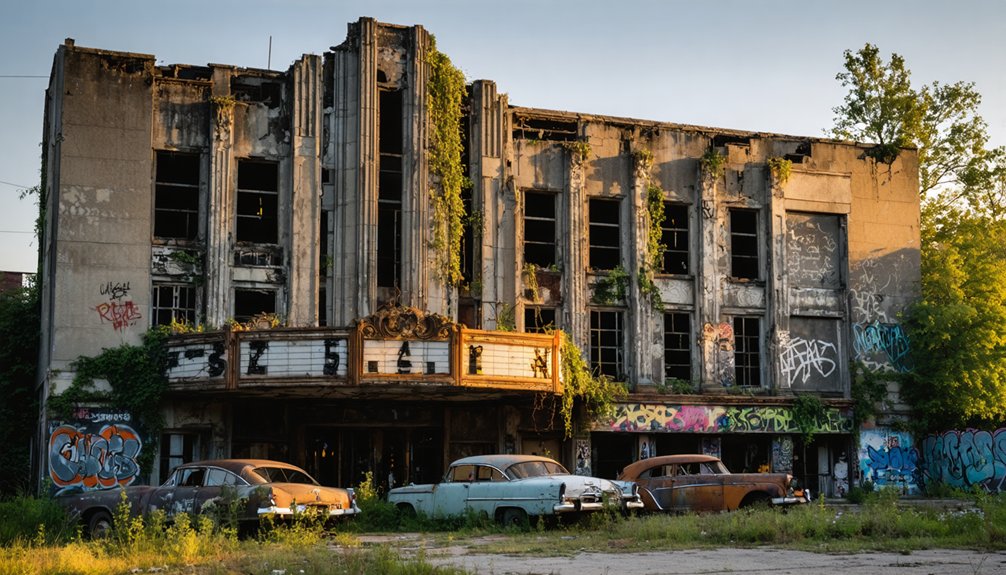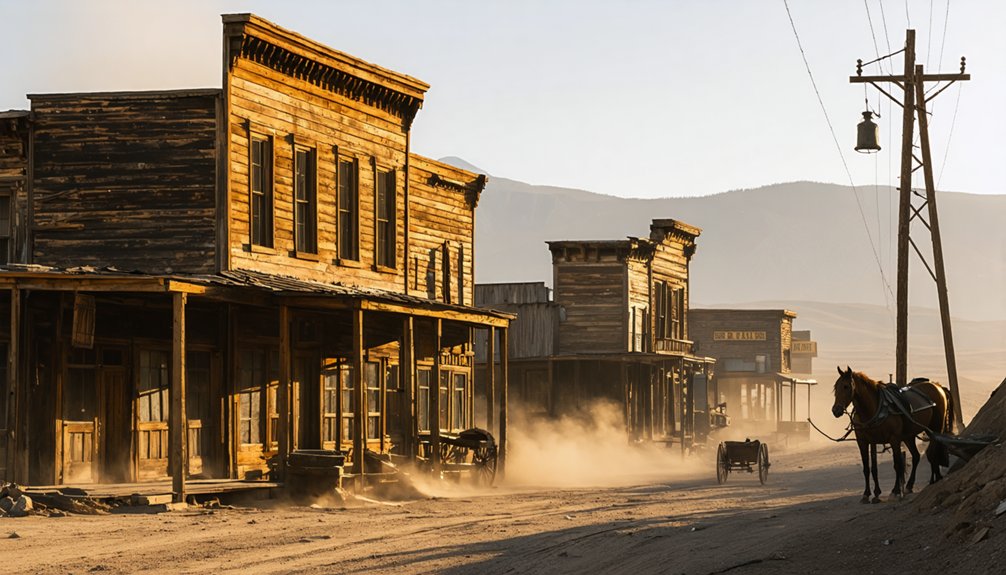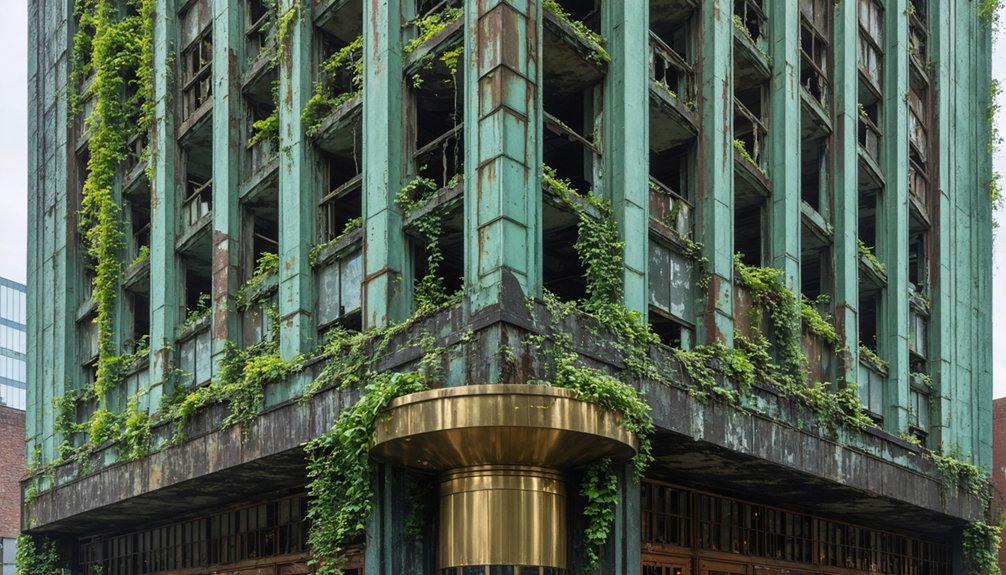
In abandoned ghost towns, you’ll encounter diverse architectural remnants spanning military fortifications to industrial complexes. Star-shaped fortresses feature triangular bastions for overlapping fields of fire, while Soviet-era settlements showcase centrally planned grids with thick-walled apartments. You’ll find weathered churches with enduring craftsmanship, deteriorating concrete monoliths, and industrial ruins slowly reclaimed by nature. These architectural time capsules hold countless secrets about humanity’s past innovations and adaptations.
Key Takeaways
- Star-shaped fortresses with triangular bastions remain intact, featuring strategic military architecture designed for optimal defensive capabilities.
- Massive concrete industrial complexes showcase brutalist architecture with distinctive weathering patterns and structural resilience.
- Soviet-era planned settlements retain grid layouts with thick-walled apartments and oversized public buildings frozen in time.
- Religious structures display enduring craftsmanship through weathered stone churches, bell towers, and preserved cultural iconography.
- Nature-reclaimed buildings demonstrate architectural transformation, with trees growing through foundations and moss-covered concrete creating unique hybrid structures.
Strategic Military Design Elements in Abandoned Fortress Cities
While many abandoned fortress cities now stand as silent ruins, their sophisticated military architecture reveals the ingenuity of defensive urban planning.
You’ll find star-shaped fortresses with triangular bastions that enabled overlapping fields of fire, while narrow, winding streets were strategically designed to confuse invaders. These military remains showcase how defensive structures evolved to counter emerging threats.
The urban fortifications integrate multiple layers, from outer observation towers to central command posts. Ancient structures like the Great Wall of China demonstrate how military architecture shaped civilization’s development and cultural identity.
Modern military installations like HESCO bastion walls represent a contemporary evolution of ancient defensive technologies.
You’ll discover strategic layouts featuring protective moats, reinforced curtain walls, and bastion designs that maximized artillery coverage.
What’s most striking about this architectural evolution is how these elements merged military necessity with civic function.
The historical significance of these structures extends beyond their defensive purpose, representing an essential part of our cultural heritage.
Industrial Decay and Concrete Monoliths
As decades of abandonment take their toll, massive industrial complexes dominate ghost town landscapes with their deteriorating concrete monoliths and rusting steel frameworks.
You’ll find these Brutalist giants spanning entire city blocks, their raw concrete surfaces telling stories of urban nostalgia through deep cracks and rust stains.
Nature’s relentless assault transforms these industrial aesthetics daily. Aggressive vegetation breaks through concrete, while freeze-thaw cycles fragment the seemingly impenetrable surfaces.
Time and nature wage war against industrial titans, as stubborn plants and seasonal cycles gradually conquer concrete kingdoms.
These giants are particularly striking in the stark winter landscape when bare trees reveal their true immensity against the sky.
You’re witnessing a landscape where elevated platforms and bridges create maze-like configurations, all slowly succumbing to environmental forces.
Despite preservation attempts, these structures often resist rehabilitation due to their immense scale and contamination risks.
The silent structures stand as eerie reminders of once-bustling industrial activity, creating an unsettling atmosphere throughout the abandoned complex.
The toxic legacy of heavy metals and chemical residues complicates any dreams of repurposing these concrete behemoths into cultural spaces or urban farms.
Soviet-Era Urban Planning Frozen in Time
Beyond the industrial ruins of Western ghost towns, Soviet-era settlements like Pyramiden in Svalbard stand as pristine examples of centrally planned urban design.
You’ll find a meticulously arranged grid where every building served a predetermined purpose – from the imposing Cultural Palace with its Norse hero mosaics to the standardized residential blocks built to withstand Arctic winds.
The town’s Soviet architecture reflects both ambition and control: thick-walled apartments with shared corridors, oversized public buildings projecting power, and self-sustaining infrastructure including coal-powered heating plants and greenhouses. The main square features Lenin’s statue overlooking the settlement’s architectural layout.
These planned communities mastered urban isolation through functional zoning, clustering buildings for maximum efficiency and warmth. The population reached its zenith in the 1980s with over 1,000 residents occupying the designated residential halls.
The cultural remnants – like the dual cemeteries for humans and cats – reveal how thoroughly the Soviets engineered not just spaces, but entire communities in the harsh Arctic environment.
Desert-Claimed Colonial Architecture
Three centuries of desert winds have sculpted the remnants of Spanish Colonial architecture across the American Southwest’s ghost towns.
The structures often expanded into rambling floor plans as families and communities grew over time.
You’ll find these structures’ adobe resilience evident in their massive walls, which still regulate temperature naturally through thermal mass. The colonial adaptation to harsh desert conditions shows remarkable ingenuity – from low-pitched clay tile roofs to strategic window placement that maximizes airflow while minimizing sun exposure.
Look closely at the surviving missions, like San Xavier del Bac, and you’ll discover how Spanish colonists merged Mediterranean architectural principles with indigenous building techniques. Today this White Dove of the Desert continues to stand as one of the finest examples of Spanish Colonial architecture in the United States.
Spanish mission architecture represents a masterful fusion of European design wisdom with Native American desert-building expertise perfected over generations.
Their design solutions – shaded arcades, enclosed courtyards, and thick stucco-covered walls – created sustainable desert dwellings that have outlasted their inhabitants.
These abandoned colonial strongholds stand as evidence of architecture that truly understood its environment.
Experimental Eco-Communities and Their Remnants
While modern ghost towns often evoke images of decay, experimental eco-communities represent a distinctive architectural movement that deliberately embraced abandonment as part of their evolutionary process.
Among the intriguing sites that reflect this notion are charming abandoned towns in America, where nature slowly reclaims the structures left behind. These locations often tell stories of resilience and transformation, inviting visitors to explore the beauty intertwined with history. Each town reveals unique architectural features that spark curiosity and inspire dreams of revitalization.
You’ll find striking examples in Arcosanti’s unfinished arcology, where only 4% completion hasn’t diminished its impact on sustainable urbanism. These eco community remnants showcase innovative approaches to architectural sustainability, from Auroville’s spherical Matrimandir to Finca Bellavista’s interconnected canopy dwellings. The community utilizes 600 acres of land that was originally destined for deforestation, transforming it into a model of sustainable living. Residents navigate between 25 elevated structures using an innovative network of zip lines and bridges.
In Europe, places like Torri Superiore demonstrate how ruins transform into living laboratories for ecological design. Even partially realized projects serve as essential case studies: Arcosanti’s passive solar systems, Findhorn’s advanced insulation techniques, and Auroville’s integrated water management continue to influence contemporary sustainable architecture, proving that incomplete visions can still drive innovation.
Religious Structures Amidst Ghost Town Landscapes
As you explore ghost towns worldwide, you’ll encounter religious structures that have withstood time’s ravages through their robust stone, brick, and wooden construction methods.
These sacred spaces, from the weathered church in Bodie, California to the dual Greek Orthodox churches of Kayaköy, Turkey, showcase distinctive architectural elements like bell towers, domes, and frescoes that reflect their cultural origins.
Though abandoned, many of these structures maintain their spiritual significance, with some still serving as pilgrimage sites or occasional ceremonial spaces despite their deteriorating conditions.
Sacred Spaces Turn Silent
Throughout deserted ghost towns worldwide, religious structures stand as resilient monuments to vanished communities, with their architectural integrity often outlasting surrounding secular buildings.
You’ll find Greek Orthodox churches in Kayaköy, Turkey, and Mormon chapels in Grafton, Utah, where sacred architecture reflects distinct cultural heritage through their preserved walls and spires.
These enduring sanctuaries tell complex stories of faith, displacement, and cultural transformation.
In places like Al-‘Ula Old Town and Craco, you’ll discover how religious buildings served dual purposes – as both spiritual centers and defensive strongholds.
Their robust construction, strategic positioning, and architectural embellishments remain intact, from Byzantine domes to Gothic spires.
Even in abandonment, these structures maintain their dignity, with adjoining cemeteries and religious iconography silently preserving the spiritual legacy of those who built them.
Weathered Worship Still Standing
Religious structures in American ghost towns showcase a remarkable fusion of Spanish Colonial, Pueblo, and American architectural influences, particularly evident across New Mexico’s abandoned settlements.
You’ll find weathered altarpieces and traditional retablos adorning these sacred spaces, while exposed vigas reveal centuries-old construction techniques that have withstood time’s assault.
Despite nature’s reclamation, you can still witness extraordinary examples of sacred craftsmanship, like the mysterious spiral staircase at Loretto Chapel.
Adobe walls, some dating back to the 1600s, continue standing against harsh desert elements.
Though many structures now lack roofs and windows, their stone foundations and intricate brickwork tell stories of immigrant communities and spiritual devotion.
These architectural remnants serve as both historical records and proof of the enduring spirit of frontier faith.
Defensive Architecture and Its Modern Ruins
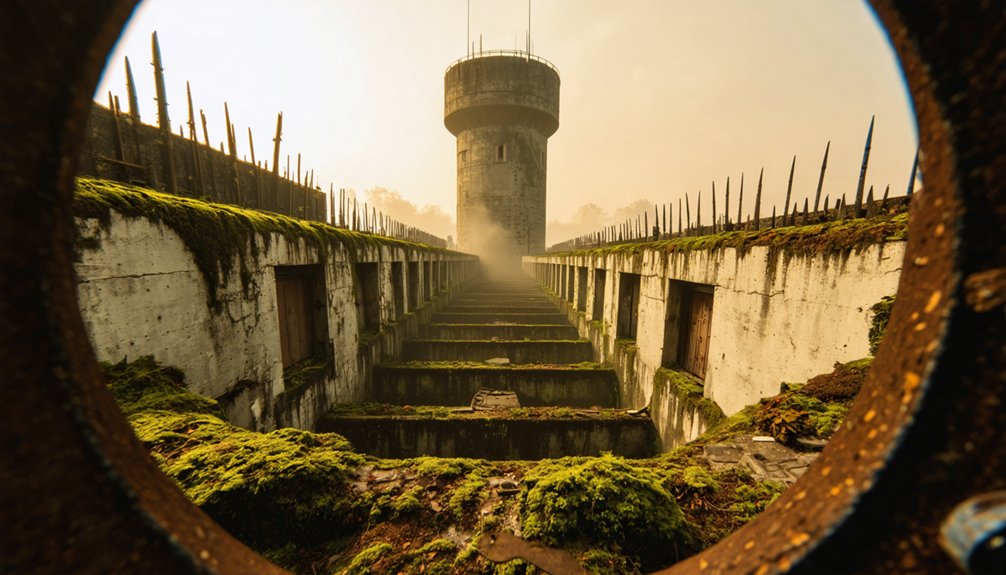
You’ll find imposing fortress walls throughout ghost towns worldwide, where their robust construction has enabled them to withstand centuries of abandonment and natural weathering.
Medieval gates stand as silent sentinels, their architectural details revealing sophisticated defensive systems including murder holes, portcullises, and arrow loops that once protected inhabitants.
Abandoned watchtowers rise from strategic vantage points, offering you glimpses into the military engineering principles that guided their placement and design, while their weathered stones chronicle tales of conflict and vigilance.
Fortress Walls Still Standing
Standing as silent sentinels across abandoned landscapes, fortress walls in ghost towns represent some of the most enduring architectural elements of these forgotten places.
You’ll find these resilient structures in various forms, from medieval stone fortifications in places like Craco, Italy, to the reinforced concrete barriers of industrial mining towns like Eagle Mountain.
The fortress aesthetics persist through time, whether in 13th-century masonry or 20th-century industrial complexes on Hashima Island.
These walls showcase remarkable architectural resilience, withstanding harsh environmental conditions while other structures crumble around them.
In abandoned mining facilities and medieval ghost towns alike, you’ll discover how defensive walls continue to define spaces and maintain their imposing presence, even as nature slowly reclaims these post-apocalyptic sites.
Medieval Gates Through Time
Through centuries of conflict and decay, medieval gates in ghost towns reveal sophisticated defensive engineering that transformed simple entryways into complex fortification systems.
You’ll find multiple portcullises trapped invaders between gates while murder holes above allowed defenders to rain down deadly materials. Heavy wooden doors, reinforced in criss-cross patterns, paired with red sandstone and limestone walls to create nearly impenetrable barriers.
The architectural evolution of these gates reflects advancing military technology, with later designs incorporating loopholes for firearms alongside traditional arrowslits.
While many original structures have crumbled, surviving elements like gate towers and foregates demonstrate how medieval engineers created layered defenses.
You can still trace the remnants of these sophisticated systems in partially reconstructed sections, where authentic masonry tells the story of 14th-16th century construction techniques.
Abandoned Watchtowers Tell Stories
The abandoned watchtowers of ghost towns serve as haunting sentinels of a bygone era, their skeletal frames rising from deteriorating landscapes in stark testimony to defensive architecture’s evolution.
You’ll find these structures built from reinforced concrete and steel, featuring narrow vertical designs with strategic observation points and firing positions that reflect their military heritage.
These watchtower narratives speak through their architectural symbolism – from spiral staircases leading to weathered lookout platforms to the remnants of communication equipment still clinging to their walls.
Nature’s slow reclamation adds another layer to their story, as vegetation weaves through crumbling foundations and wildlife claims these former guardians as shelter.
While preservationists debate their fate, these towers continue standing as powerful reminders of humanity’s resilience and ultimate vulnerability against time’s relentless march.
Lost Communities: Village Layout and Design

When exploring abandoned settlements, you’ll discover intricate village layouts that reveal the complex social fabric of lost communities. Traditional L-shaped and U-shaped courtyard patterns dominate these ghost towns, showcasing how communal spaces once fostered social interaction and environmental adaptation.
These layouts demonstrate remarkable resilience, with external walls of rammed earth and stone still standing as evidence to indigenous building techniques.
- Original agricultural structures have transformed into vibrant cultural spaces, merging past and present through adaptive reuse.
- Integration with natural surroundings remains evident through strategic positioning near rivers and forests.
- Medieval defensive features persist in narrow pathways and clustered housing arrangements.
You’ll notice how these communities maintained harmony with their environment while creating functional spaces that balanced security, sustainability, and social cohesion.
Post-Industrial Infrastructure and Housing
You’ll find towering concrete apartment blocks, built for industrial workers, now standing as silent monoliths in post-Soviet ghost towns like Chiatura.
The rusted remains of mining equipment, factory cranes, and conveyor systems tell the story of abandoned industry through their deteriorating metal frameworks and weathered machinery.
These residential and industrial structures create a haunting architectural dialogue, where the efficiency-focused worker housing sits frozen in time alongside the mechanical infrastructure that once powered these communities.
Concrete Towers Stand Empty
Standing as stark reminders of industrial ambition, abandoned concrete towers and housing complexes dot America’s post-industrial landscape, with Concrete City in Luzerne County serving as a prime example of early 20th-century architectural innovation.
You’ll find these structures’ stark beauty in their utilitarian design, where architectural nostalgia meets modern tower explorations.
Your journey through these concrete remnants reveals:
- Precast concrete homes with deteriorating basements but persistently robust outer shells that resist demolition
- Minimal window openings and thick concrete walls that create an imposing presence against nature’s reclamation
- Communal spaces now overtaken by vegetation, yet still maintaining their original layout and structural integrity
These architectural ghosts demonstrate how industrial-era concrete construction, while practical, ultimately failed to provide sustainable living conditions without proper infrastructure investment.
Rusting Machinery’s Silent Story
Rusting giants of industry tell compelling stories across abandoned landscapes, where massive machinery stands frozen in various stages of decay.
You’ll find these rusty relics everywhere – from towering cranes suspended mid-operation to dormant conveyor systems that once pulsed with productivity. Mining equipment, processing machines, and railcars create an eerie industrial ballet, now performing for nature instead of workers.
These machinery memories reveal themselves in layers: graffiti-covered ore crushers emerge from creeping vegetation, while weathered power transformers mark the ghosts of electrical grids past.
You’ll spot deteriorating freight elevators, loading docks, and metal storage tanks that once orchestrated a symphony of commerce. Even the smaller workshops remain, their tools and equipment scattered like archeological artifacts of an industrial age suddenly suspended in time.
Worker Housing Frozen Forever
While industrial machinery tells one part of ghost towns’ stories, the worker housing complexes paint an equally compelling portrait of life frozen in time.
You’ll find utilitarian structures built for function over form, using local materials like timber, brick, and corrugated metal roofs. The layout reveals clear worker hierarchy, with supervisors occupying slightly larger homes while laborers shared simple row houses and barracks-style accommodations.
Explore these remnants of industrial life:
- Communal spaces including shared kitchens and wash areas that highlight the social bonds between workers
- Housing clusters strategically positioned near mills and mines for maximum efficiency
- Preserved artifacts inside homes – from tools to personal items – offering glimpses into daily working-class life
These abandoned dwellings stand as time capsules, documenting the pragmatic yet communal nature of industrial life.
Nature’s Reclamation of Built Environments
As abandoned buildings sit dormant, nature launches a methodical reclamation process that transforms human-made structures into vibrant ecosystems.
You’ll witness nature’s persistence as moss and lichens colonize concrete within weeks, while vines envelop walls in just 1-3 years. Trees take root in gutters and foundation cracks, their expanding root systems gradually dismantling the very structures that once defined human spaces.
This ecological transformation accelerates as structural integrity fails. Unmaintained roofs collapse within 15 years, creating new habitats for wildlife. Birds nest in broken windows, while mammals claim abandoned rooms as dens.
Within decades, you’ll find entire neighborhoods consumed by forest canopy, with only scattered ruins hinting at former civilization. What begins as subtle weathering culminates in complete integration with the surrounding ecosystem.
Frequently Asked Questions
How Do Ghost Towns Impact Surrounding Property Values in Modern Inhabited Areas?
Like a spreading shadow, ghost town economics create ripple effects in your area – you’ll see property value fluctuations drop by 9-10% within 500 feet, while tax revenues plummet, affecting local services.
What Role Did Early Photography Play in Documenting These Abandoned Structures?
You’ll find that early documentation through primitive photographic techniques preserved essential architectural details of ghost towns, creating lasting records before structures deteriorated or were demolished in the late 19th century.
Which Ghost Town Architectural Features Have Influenced Modern Sustainable Building Designs?
You’ll find thick walls, passive ventilation, compact layouts, and durable materials like concrete and brick exemplifying adaptive reuse principles that historical preservation experts now champion in sustainable architecture and design.
How Do Different Climates Affect the Preservation Rate of Abandoned Architectural Materials?
Ever wonder how climate shapes a building’s fate? You’ll find material degradation varies dramatically – arid zones preserve stone but erode surfaces, tropics accelerate decay, temperate areas cause cyclical damage, while cold climates preserve organics.
What Methods Are Used to Date Architectural Modifications in Repeatedly Abandoned Settlements?
You’ll need multiple dating techniques: radiocarbon dating for organic materials, thermoluminescence for bricks, dendrochronology for timbers, plus analysis of architectural styles and stratigraphic layers to determine modification sequences.
References
- https://www.artsy.net/article/artsy-editorial-7-utopian-design-experiments-le-corbusiers-radiant-city-ghost-town-china
- https://pg.world/articles/abandoned_places_part_1
- https://postapocalypticcities.wordpress.com/2013/10/05/real-life-ghost-towns/
- https://www.youtube.com/watch?v=ZnfBfh7C5VM
- https://www.californist.com/articles/interesting-california-ghost-towns
- https://cherisundra.com/2010/06/13/hello-world/
- https://www.same.org/tmearticle/designed-for-defense-and-civilization/
- https://www.militarystrategymagazine.com/article/fortified-strategic-complexes/
- https://www.crystalinks.com/Fortress.html
- https://en.wikipedia.org/wiki/Defensive_wall