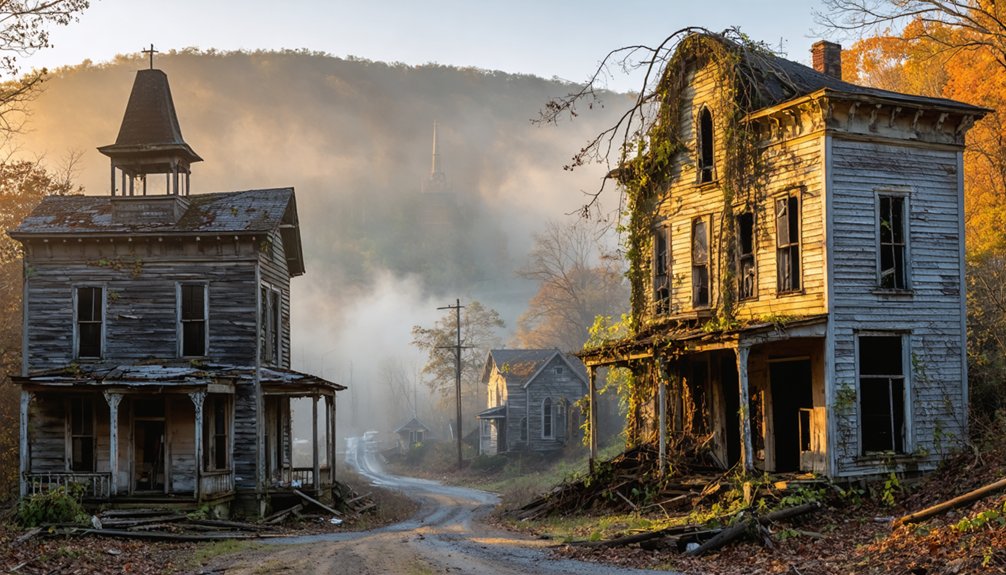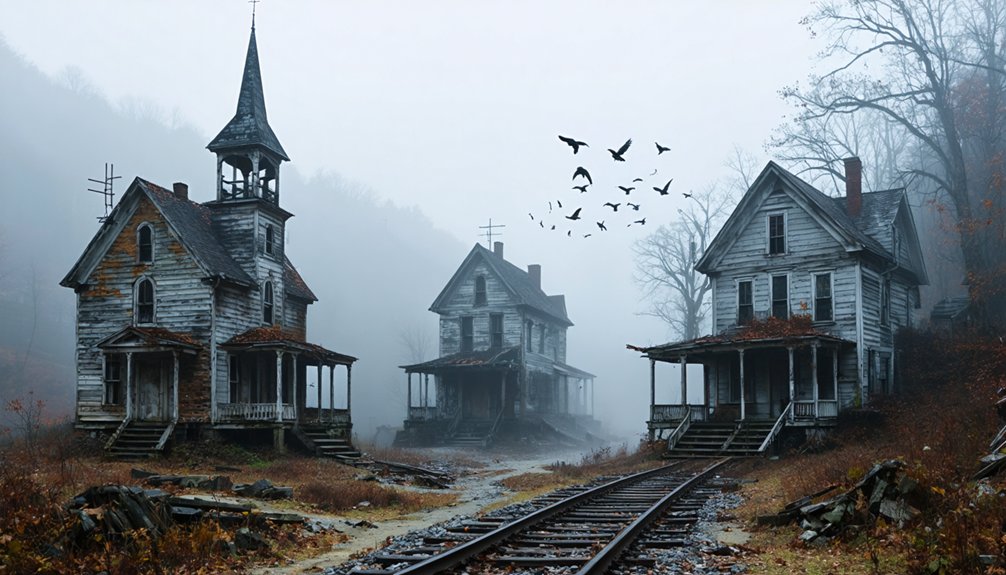
You’ll find Appalachian ghost towns haunting yet enchanting, as they reveal America’s industrial past frozen in time. These abandoned settlements showcase the remnants of company stores, coal tipples, and worker housing that once controlled over 600 thriving communities. Nature now slowly reclaims these sites where railroads and mines once dominated the landscape, while hidden treasures and local legends add layers of mystery. These mountain ruins hold countless untold stories of life, power, and perseverance.
Key Takeaways
- These ghost towns preserve a unique snapshot of early 20th-century industrial life, with abandoned company stores, coal tipples, and worker homes frozen in time.
- The remnants tell powerful stories of corporate control, where companies owned entire communities and regulated workers’ lives through scrip currency and store monopolies.
- Hidden artifacts and ruins spark treasure-hunting adventures, particularly around legendary sites like John Swift’s lost silver mines.
- Family photographs and personal narratives provide intimate glimpses into daily life, social relationships, and cultural traditions of vanished mountain communities.
- Nature’s gradual reclamation of industrial sites creates a haunting contrast between human development and wilderness, transforming former towns into ecological sanctuaries.
Time-Frozen Remnants of Industrial Glory
As you journey through the Appalachian Mountains today, you’ll encounter ghostly remnants of once-thriving industrial communities frozen in time.
Along abandoned rail lines and overgrown paths, you can explore the skeletal remains of coal tipples, lumber mills, and company stores that once pulsed with life. These decaying structures tell stories of rapid industrial development, where entire towns sprouted within weeks to house workers and support resource extraction. Towns like Little River Community followed this pattern, transforming from pioneer settlements into booming industrial centers within decades.
The industrial decay reveals distinct patterns of early 20th-century community design – rows of wooden worker homes clustering near mines, central company stores controlling commerce, and rail depots connecting to wider markets. The broken windows and silence now echo memories of bustling community life, with only the wind to carry whispers of past vitality.
While some sites have undergone historical preservation, transforming into heritage parks, most stand as untouched time capsules, their rusted machinery and empty storefronts offering glimpses into Appalachia’s industrial golden age.
Stories Etched in Mountain Stone
Beneath the weathered layers of Appalachian history lie mysterious stone formations and petroglyphs that challenge our understanding of early human settlement patterns.
Ancient stones and carvings hidden in Appalachia’s hills reveal untold stories, forcing us to rethink humanity’s earliest footprints across these mountains.
As you explore these ancient mountain landscapes, you’ll discover enigmatic stone alignments and inscriptions that hint at forgotten civilizations and sacred spaces. The Bat Creek Stone discovery in Tennessee’s mounds demonstrates how ancient inscribed artifacts continue to spark heated debates about early mountain settlements. The rich olive waters of Sinking Creek hint at significant iron deposits that drew early peoples to this region.
- Strategic stone formations along Sinking Creek act as ancient gateposts, guarding long-lost pathways.
- Abstract facial petroglyphs reveal unified cultural expressions across multiple sites.
- Fort Mountain’s pre-colonial stone walls spark legends of the mysterious Moon-Eyed People.
- Circular rock configurations suggest sophisticated astronomical knowledge.
- Metarhyolite quarries demonstrate indigenous peoples’ masterful stone-working traditions.
These mountain mysteries invite you to question conventional timelines and embrace the possibility that these peaks once hosted civilizations far more complex than previously imagined.
The Rise and Fall of Company Towns
You’ll find the stark footprints of corporate power across Appalachia’s landscape, where over 600 company towns once dominated the region through their control of coal resources and worker lives.
At their peak, seventy-eight percent of coal miners and their families lived in these company-controlled communities.
From the 1880s through the 1930s, these settlements sprouted rapidly around mine entrances and railroad terminals, creating instant communities where companies owned everything from the houses to the stores.
These model towns enticed workers with welfare capitalism benefits, providing schools, recreational facilities, and other amenities to prevent unionization efforts.
What you see today in many of these locations are empty streets and crumbling foundations, silent reminders to how quickly these towns declined when the coal industry faltered and companies abandoned their mountain empires.
Power Through Coal Control
When coal companies established towns across Appalachia in the early 1900s, they created more than just mining settlements – they built intricate systems of social and economic control.
Through strategic town planning and corporate governance, these companies wove an inescapable web of coal dependency that dominated every aspect of workers’ lives.
- Your home belonged to the company, nestled in neighborhoods segregated by race and ethnicity.
- You’d shop at company stores using company scrip, trapping your finances within their system.
- Your children attended company schools, ensuring generational loyalty.
- Your healthcare came from company hospitals, binding your well-being to their will.
- Your local government served company interests, leaving you with no true political voice.
This calculated design transformed isolated mountain landscapes into powerful mechanisms of control, where geographic isolation reinforced corporate dominance over workers’ daily existence. Lease agreements could be quickly terminated if workers lost their jobs or participated in strikes.
By 1922, an overwhelming 80% of miners resided in company-owned housing, creating near-total dependence on their employers.
Living Under Mining Rule
Inside the confined valleys and hollows of Appalachia, company towns emerged as carefully engineered social laboratories where coal firms exercised complete dominion over the landscape and its inhabitants.
You’d find your entire existence shaped by corporate paternalism – from the house you lived in to the store where you bought groceries. The physical layout reflected rigid social hierarchies, with managers’ homes perched on hills while workers’ housing crowded near mine entrances.
Economic isolation meant you couldn’t escape the company’s grip: one store, one employer, one landlord. Workers were forced to use company-issued scrip for all purchases, further restricting their financial freedom. Yet within these constraints, you’d discover vibrant communities adapting to survive. Families grew gardens, maintained cultural traditions, and built social networks despite segregated neighborhoods.
Churches and social gatherings offered glimpses of autonomy, though even these spaces operated under the watchful eye of coal companies.
Rapid Growth Then Decay
Throughout the late 1800s and early 1900s, industrial giants rapidly transformed Appalachian mountainsides into bustling company towns, carving out entire communities from wilderness in a matter of weeks.
You’ll witness a dramatic story of rapid expansion followed by economic collapse, where corporate powers built instant cities that rose and fell with the fortunes of coal and steel.
- Company-built houses, schools, and stores sprang up virtually overnight to serve waves of incoming workers.
- Towns thrived with diverse immigrant communities, creating vibrant cultural pockets in remote mountain valleys.
- Corporate welfare provided modern amenities like electricity and plumbing to retain workers.
- Geographic isolation meant total dependence on company-controlled resources and jobs.
Workers were paid in company script currency, forcing them to make purchases exclusively at inflated company-owned stores.
– Post-WWII shifts in energy markets and foreign competition triggered mass abandonment, leaving behind today’s haunting ruins.
Hidden Treasures in Appalachian Forests
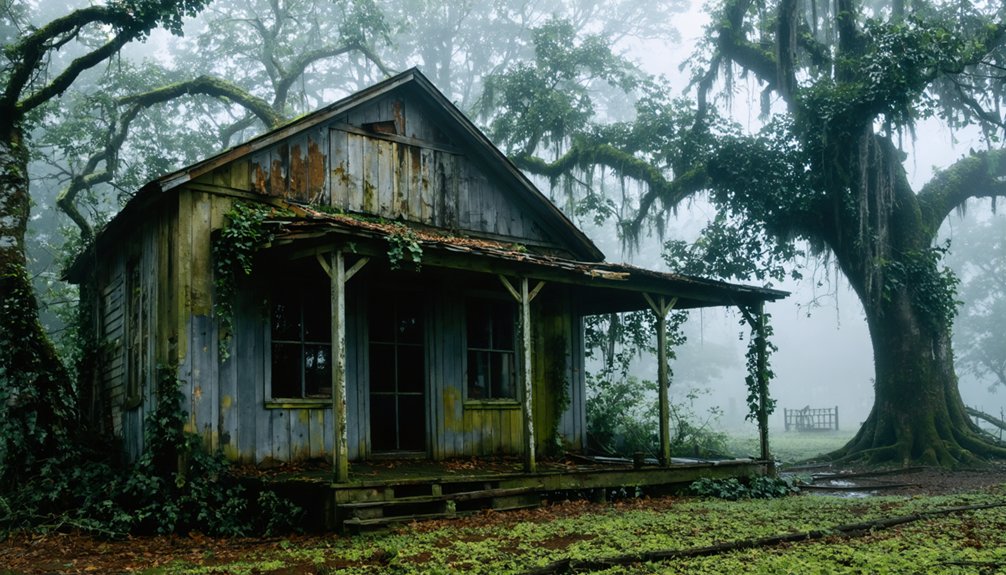
The remote Appalachian forests conceal countless physical and mythical treasures, from pioneer-era ruins to legendary silver mines that have captivated explorers for centuries.
You’ll find hidden riches scattered throughout the mountain landscape, from the Pine Mountain ridges to the upper Big Sandy River valleys, where John Swift’s famous silver mines supposedly lie waiting to be rediscovered. While geologists doubt substantial silver deposits exist, the folklore legacy lives on through generations of treasure seekers and storytellers.
As you venture deeper into these ancient woods, you’ll encounter preserved artifacts and ruins from lost settlements – collapsed cabins, stone foundations, and metal remnants that tell tales of bygone communities.
These physical clues, combined with persistent ghost stories and treasure legends, create an irresistible mystique that continues to draw adventurous souls into Appalachia’s secretive hollows.
Living Memories of Mountain Communities
You’ll find rich personal narratives woven through the abandoned streets and homesteads of Appalachian ghost towns, where former residents’ stories reveal intricate patterns of daily life in these once-bustling communities.
These ghost towns in Appalachian mountains serve as poignant reminders of the past, showcasing a rich tapestry of history and culture. As you explore their quiet landscapes, you can almost hear the echoes of laughter and conversation that once filled these now-silent spaces. Each dilapidated building holds secrets waiting to be uncovered, inviting visitors to delve into their forgotten tales.
Family photo collections, carefully preserved in local archives, map the spatial and social relationships that defined mining town hierarchies, from company store interactions to church gatherings.
The documented memories of social activities, from weekend dances to schoolhouse events, trace how these mountain communities organized themselves around central gathering spaces that anchored their cultural identity.
Stories From Former Residents
Deep within Appalachia’s hidden valleys, first-hand accounts from former residents paint vivid portraits of vanished mountain communities, where daily life unfolded against a backdrop of self-sufficient isolation.
Childhood adventures echo through memories of remote valleys and secluded forests, where you’ll discover intimate connections to landscapes now lost beneath reservoir waters.
- Young explorers roamed vast mountain territories, transforming natural features into imaginary kingdoms.
- Families cultivated deep spiritual bonds with the land through gravesites and ancestral trails.
- Self-sufficient communities like Pressmen’s Home built their own power infrastructure.
- Children’s stories preserve emotional connections to places now marked only by ruins.
- Forced relocations from dam projects left behind submerged churches, homes, and cemeteries.
These personal narratives reveal how mountain folk carved out independent lives in Appalachia’s remote corners, creating resilient communities that live on through storytelling.
Capturing Family Photo Collections
Countless family photo collections preserve intimate glimpses into vanished Appalachian communities, where daily routines and cultural traditions unfold through black-and-white images of mountain life.
You’ll find multi-generational family bonds captured in scenes of hog killing, crop harvesting, and community gatherings, revealing the deep connections between people and their mountain homeland.
These visual archives document the cultural heritage of self-sufficient communities, showing how families adapted to the rugged landscape through subsistence farming, hunting, and preservation practices.
Through weathered photographs, you can trace the evolution of settlement patterns in now-abandoned towns, where smokehouses, chicken lots, and farm tools tell stories of resilience.
Each image serves as a powerful reminder of the strong work ethic and enduring spirit that defined these mountain communities.
Mining Town Social Life
While coal companies exerted strict control over every aspect of mining town life, distinctive social patterns emerged within these closely packed settlements.
Despite economic dependencies and corporate oversight, residents carved out vibrant community spaces where cultural traditions flourished.
You’ll find the heart of these communities reflected in:
- Churches and schools that served as gathering spots for both worship and organizing
- Community gatherings featuring music, storytelling, and shared meals that strengthened bonds
- Women’s informal networks that sustained families through gardening and mutual support
- Multi-generational households adapting rural traditions to industrial life
- Local celebrations that, though company-monitored, provided essential outlets for expression
These social connections formed a resilient web of relationships that helped residents navigate the challenges of company control while preserving their cultural identity and sense of community.
Echoes of Railroad and Mining Heritage
Throughout the rugged Appalachian landscape, you’ll find the skeletal remains of once-bustling railroad towns that grew rapidly during the region’s industrial boom of the 19th and early 20th centuries.
These ghost towns tell a story of railroad heritage and mining legacy, where dangerous tunnel construction and resource extraction shaped the mountain terrain you see today.
You can trace the physical remnants of this industrial past along abandoned rail beds and weathered infrastructure in places like Thurmond and Elkhorn City.
What began as crucial arteries of commerce, connecting remote areas to wider markets, now stand as silent testimonials to boom-and-bust cycles.
The towns that sprouted around these lifelines flourished briefly, then faded as coal seams emptied and timber reserves vanished, leaving behind powerful reminders of Appalachia’s transformative industrial era.
Nature’s Reclamation of Mountain History
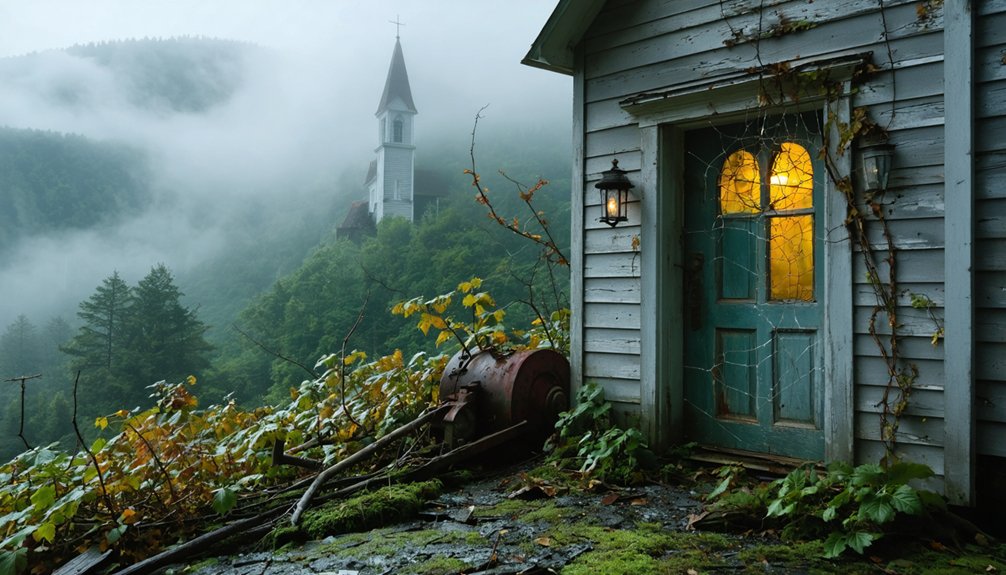
Time and nature steadily transform these abandoned railroad settlements, weaving a new narrative across the Appalachian terrain.
You’ll witness nature’s resurgence as forests reclaim forgotten landscapes, where rusted bridges and mining equipment stand as silent witnesses beneath advancing vegetation. In these spaces, native flora and wildlife thrive without human interference, creating rich ecological sanctuaries.
- Pine-scented air and damp earth evoke memories of bustling mountain communities
- Dogwoods and vines embrace abandoned porches, softening industrial remnants
- Secondary growth forests increase biodiversity where towns once stood
- Natural water systems regenerate, healing former industrial sites
- Wildlife corridors expand through these unintended sanctuaries, connecting fragmented habitats
The wilderness doesn’t erase history – instead, it preserves these cultural touchstones beneath a living, breathing canvas of natural renewal.
Frequently Asked Questions
Are There Any Dangerous Animals or Hazards When Exploring Ghost Towns?
You’ll face wildlife encounters like bears, snakes, and wild boars in ghost towns, while unstable structures, mining hazards, and remote terrain demand careful safety precautions during your exploration.
Can Visitors Legally Take Artifacts Found in Appalachian Ghost Towns?
Want to preserve history for future generations? You can’t legally take artifacts from ghost towns without proper permits and landowner permission. Artifact preservation laws protect these invaluable cultural resources from disappearing forever.
Which Ghost Towns Are Most Accessible for Elderly or Disabled Visitors?
You’ll find excellent wheelchair accessibility at Elkmont, Tennessee, with its maintained campground. Pennsylvania’s West Penn Rail Trail and Pennypack Parkway offer level paths, while guided tours enhance your experience at accessible sites.
Do Any Appalachian Ghost Towns Have Reports of Paranormal Activity?
Like shadows dancing through time, you’ll find intense paranormal activity in Pressmen’s Home and Thurman, where ghost sightings and investigations reveal spirits lingering among abandoned buildings and forgotten streets.
How Can Photographers Get Permits to Shoot Professionally in Ghost Towns?
You’ll need to contact the managing agency (NPS, Forest Service, or state parks) to obtain Special Use Permits. Scout locations first, research photography regulations, and submit applications 2-4 weeks before your shoot.
References
- https://www.youtube.com/watch?v=4oHlJFXbrCk
- https://www.geotab.com/ghost-towns/
- https://appalachianmemories.org/2025/10/16/the-lost-towns-of-appalachia-the-forgotten-mountain-communities/
- https://www.blueridgeoutdoors.com/go-outside/southern-ghost-towns/
- https://jrap.scholasticahq.com/api/v1/articles/9543-the-economics-of-ghost-towns.pdf
- https://www.appalachianplaces.org/post/appalachia-s-other-company-towns
- https://www.acsa-arch.org/proceedings/Annual Meeting Proceedings/ACSA.AM.102/ACSA.AM.102.49.pdf
- https://www.youtube.com/watch?v=3F_Gv_xp3Y4
- https://en.wikipedia.org/wiki/Bat_Creek_Stone
- https://www.ancient-origins.net/opinion-guest-authors/lost-tribe-clover-hollow-oldest-civilization-world-found-appalachian-mountains-021025