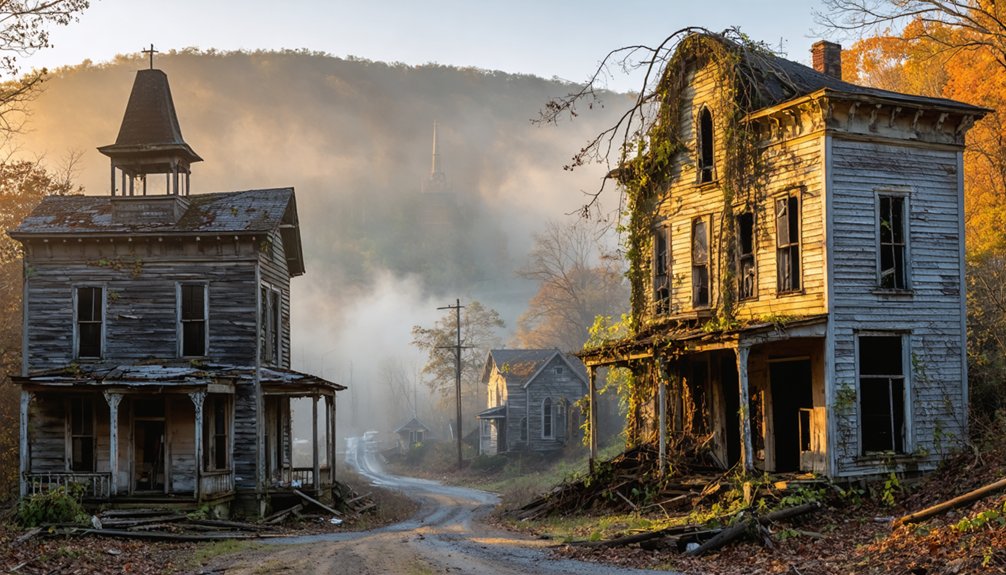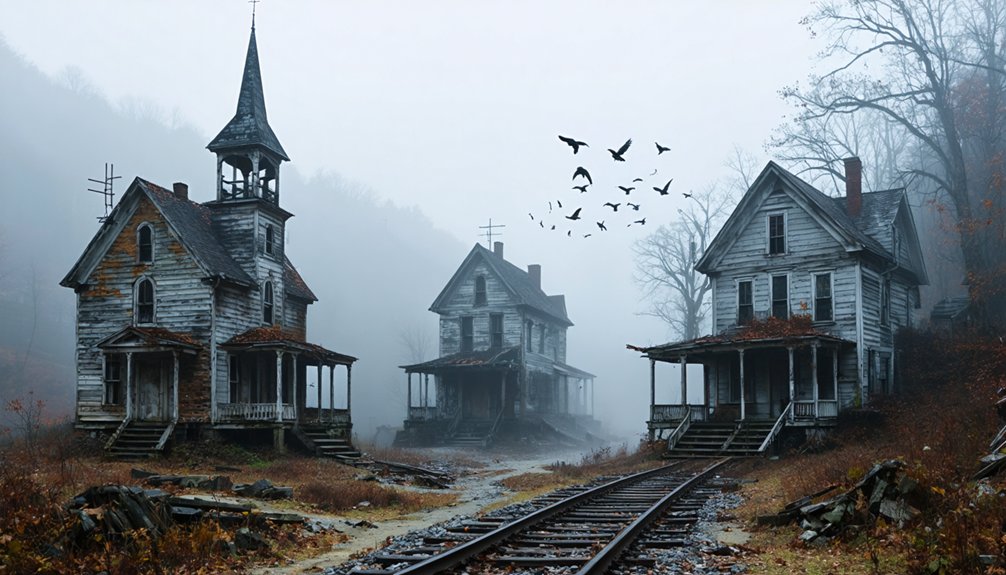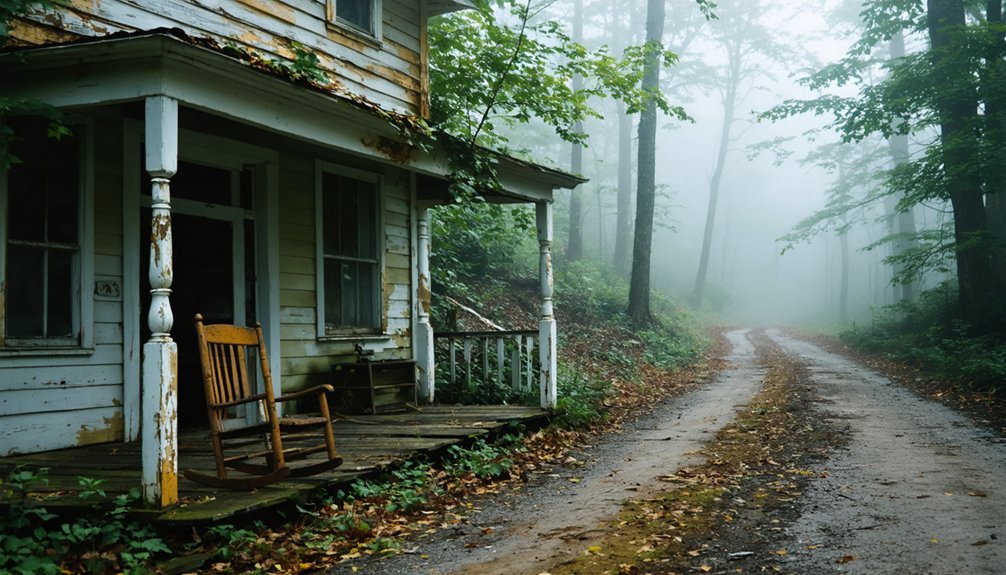
Appalachian ghost towns offer you a fascinating glimpse into America’s industrial past, where company-controlled communities once thrived during the coal mining boom of 1880-1930. You’ll discover abandoned wooden structures being reclaimed by nature, submerged towns hidden beneath reservoir waters, and cultural artifacts that tell stories of triumph and hardship. These time capsules of Appalachian life preserve powerful narratives of corporate control, worker resilience, and environmental transformation that continue to surface in unexpected ways.
Key Takeaways
- Abandoned company towns reveal fascinating stories of industrial rise and fall, where entire communities once thrived around coal mines and factories.
- Nature’s dramatic reclamation process creates haunting scenes as forests engulf old buildings and waterways reshape forgotten settlements.
- Hidden underwater towns and exposed foundations during droughts offer mysterious glimpses into submerged communities and their lost heritage.
- These sites preserve important cultural history through remaining structures, showing how workers united against powerful companies for basic rights.
- Digital preservation and exploration opportunities allow visitors to experience these time capsules through interactive tours and historical documentation.
The Rise and Fall of Company Towns
While the Appalachian Mountains today harbor numerous ghost towns, these abandoned settlements once thrived as bustling company towns during America’s industrial boom.
The company town evolution began between 1880-1930, when over 600 towns emerged practically overnight to serve coal mines and industrial sites.
You’ll find these towns reflected a stark industrial dependency, with companies controlling every aspect of workers’ lives. From identical housing to company stores that only accepted scrip currency, roughly 78% of coal mining families lived under this system. Typical community infrastructure included wooden worker houses, stores, schools and churches.
Company towns held workers in an iron grip, controlling housing, shopping, and even the currency they could spend.
The towns flourished as America’s industrial appetite grew, fueled by demands for coal, textiles, and other resources. Companies used welfare capitalism to provide amenities and delay unionization efforts.
Yet when mines dried up and global competition increased, these communities crumbled. By the 1960s, automation and market pressures had triggered mass layoffs, forcing workers to abandon their company-controlled homes.
Hidden Stories Beneath Reservoir Waters
When you search beneath Appalachia’s reservoir waters today, you’ll find the remnants of once-thriving communities whose stories continue through submerged foundations, roads, and even standing structures.
At the Ashokan dam site, visitors can now walk or bike along paths while reflecting on the valley’s submerged history.
You can trace these lost river towns through historical maps and documentation that reveal the locations of farms, businesses, and cemeteries that were permanently flooded for dam projects.
These underwater ghost towns, preserved through photographs, artifacts, and oral histories, offer essential insights into displaced communities and their cultural heritage that shouldn’t be forgotten.
Scuba divers regularly explore these submerged towns to help document and preserve their stories for future generations.
Underwater Communities Still Speak
Deep beneath the tranquil waters of Appalachian reservoirs lie dozens of submerged communities, frozen in time since the Tennessee Valley Authority‘s ambitious dam projects of the 1940s.
You’ll find towns like Proctor and Loyston, sacrificed for hydroelectric power and flood control, now preserved as underwater time capsules. These dams have resulted in only 47 miles of freely flowing water in the Little Tennessee River’s original 144-mile length. These submerged settlements offer unique opportunities for underwater archaeology, with their structures remaining remarkably intact in places like West Virginia’s crystal-clear Summersville Lake.
While the flooding forced residents to abandon their homes and even family cemeteries, the cultural memory of these communities endures. The construction of Apalachia Dam alone required the acquisition of 4,500 acres of land from local residents and private entities.
When lake levels shift, you can glimpse remnants of these lost towns emerging from their watery graves, reminding us of the price paid for progress and the resilient spirit of Appalachian communities that refused to be forgotten.
Mapping Lost River Towns
Before modern technology enabled precise underwater mapping, many of Appalachia’s submerged towns existed only in memory and scattered historical records.
You’ll find these lost communities uniquely shaped by the region’s complex geography, where rivers carved paths through dense hardwood forests and rugged mountain valleys. The Great Valley region influenced where many of these settlements first took root.
The lost river geography reveals a pattern of settlement tied to natural resources and transportation routes.
Historical mapping shows how towns like Proctor, NC, and Andersonville, SC, once thrived along 31-mile waterways before reservoir construction changed the landscape forever.
You can trace these communities through detailed hydrological surveys, which document tributary systems like Culler Run and Snyder Run.
Underground water passages and reservoir impoundments have created challenging conditions for modern cartographers working to reconstruct these vanished landscapes. The Tennessee Valley Authority’s construction of Norris Dam in 1935 marked one of the earliest large-scale displacements of mountain communities.
Preserving Submerged History Tales
Hidden beneath Appalachia’s reservoir waters lie poignant stories of displacement and cultural upheaval, where entire communities were forced to abandon their ancestral homes.
You’ll find submerged narratives of families who lived on these lands for generations, their cultural ties severed when federal agencies like the TVA constructed massive dams. The flooding didn’t just claim buildings and roads – it submerged sacred spaces, including family graveyards that required careful relocation. The town of Loyston transformed into what locals now call the Loyston Sea after flooding in 1936. Similar to Enfield, Massachusetts, workers undertook the massive task of reinterring 7,000 bodies to higher ground.
Today, these underwater ghost towns serve as powerful symbols of cultural remembrance. When reservoirs occasionally drain, you can glimpse the physical remnants of lost communities through exposed foundations and roadways.
Local legends and folklore continue to preserve these stories, connecting modern generations to their submerged heritage while highlighting the complex relationship between progress and preservation in Appalachian history.
Echoes of Industrial Heritage
Throughout Appalachia’s valleys and hillsides, the industrial heritage of company towns still resonates through abandoned structures and weathered remnants.
You’ll discover the industrial echoes in surviving company stores, Masonic lodges, and rail stations that once formed the backbone of these bustling communities. Heritage preservation efforts reveal how steam whistles once marked daily shifts while coal trains thundered through the hollows, creating life’s rhythm for thousands of workers and their families.
These towns, built rapidly to serve coal, timber, and textile industries, weren’t just workplaces – they were complete communities where your entire life revolved around the company.
From the schools your children attended to the store where you bought groceries, the industrial machine controlled every aspect of daily existence, forging tight-knit communities despite harsh working conditions.
Nature’s Reclamation of Forgotten Places

If you walk through Appalachia’s ghost towns today, you’ll witness nature’s systematic reclamation as weathered buildings crumble and fade beneath thick blankets of kudzu and wild grapevines.
The surrounding forests have gradually engulfed former mining operations, with native trees and understory vegetation pushing through abandoned equipment and collapsed structures.
Creeks and rivers continue reshaping these forgotten places, eroding old foundations and carving new channels through what were once bustling mountain communities.
Weathered Buildings Fade Away
Abandoned buildings in Appalachian ghost towns succumb to nature’s relentless forces through a systematic process of decay.
You’ll witness decaying architecture as water seeps into foundations, while freeze-thaw cycles create deepening cracks in century-old stonework. The forgotten craftsmanship of timber frames warps and rots as moisture penetrates untended roofs and walls.
- Vines and tree roots breach foundations, slowly dismantling man-made structures piece by piece
- Fungi and moss transform solid beams into soft, crumbling shadows of their former strength
- Weather-worn textures and rusting remnants create hauntingly beautiful tableaus of time’s passage
The region’s high humidity and seasonal changes accelerate deterioration, as nature reclaims these historic sites.
Without human intervention, each passing storm and growing season pushes these structures closer to their final collapse into the mountain landscape.
Forests Engulf Mining Remnants
Once mining operations cease in Appalachian ghost towns, native forests launch an aggressive reclamation campaign that transforms industrial landscapes back into woodland.
You’ll witness forest colonization as hardwoods, shrubs, and vines overtake abandoned structures and roads, while root systems infiltrate foundations and mining remnants.
This ecological transformation creates thriving habitats where endangered plants flourish and wildlife returns.
You’ll find rusted equipment and stone foundations slowly disappearing beneath thick undergrowth and moss.
Freeze-thaw cycles and persistent root action accelerate the decay of human-made structures, integrating them into the forest floor.
Through this process, nature erases visible traces of industrial activity, leaving only subtle landscape features and scattered artifacts that tell stories of Appalachia’s mining past.
The result is a poignant blend of cultural heritage and natural resilience.
Rivers Reshape Lost Towns
Throughout Appalachia’s river valleys, powerful waterways continually reshape the remnants of lost towns through flooding, erosion, and deliberate submersion by dam projects.
You’ll find ghostly remnants of communities like Proctor and Andersonville now hidden beneath reservoir waters, their stories preserved only in memory.
River dynamics have transformed these abandoned settlements, as nature reclaims what humans left behind through relentless erosion and vegetation growth.
- Stone foundations emerge from lake beds during drought, offering glimpses of submerged towns that once thrived along these shores.
- The infamous “Road to Nowhere” near Fontana Lake stands as a symbol of broken promises and lost connections to ancestral grounds.
- Shifting river courses gradually erase physical traces of ghost towns, leaving only scattered ruins to mark their existence.
Tales From Former Mining Communities
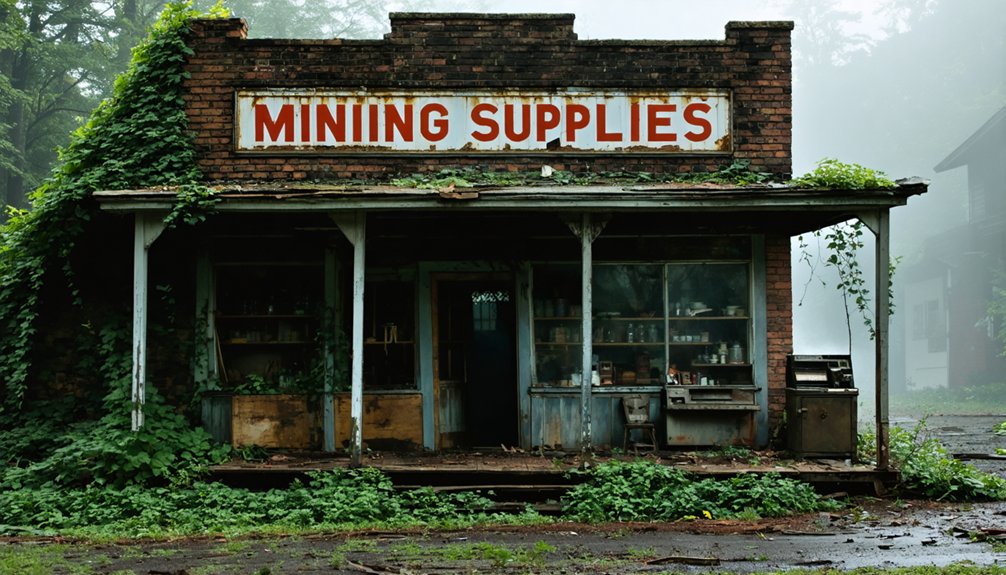
Deep within the valleys and hollows of Appalachia, former mining communities tell haunting stories of both triumph and hardship that shaped generations of coal-mining families.
You’ll find mining memories etched in the collective consciousness of those who endured 12-hour workdays for meager wages, while facing constant dangers underground.
Community stories reveal how workers united against powerful coal companies that controlled every aspect of their lives – from the homes they lived in to the stores where they shopped.
Despite company resistance, these resilient communities forged strong cultural bonds through their churches, schools, and shared traditions.
Their tales of survival, from the Battle of Matewan to the strikes in Bloody Harlan, demonstrate an unwavering spirit against corporate oppression and a fierce determination to secure basic human rights.
Exploring the Ruins of Mountain Commerce
You’ll find the skeletal remains of abandoned lumber mills and general stores dotting the Appalachian landscape, evidence of the region’s once-thriving commercial heritage.
These weathered structures, from the Sheip Lumber Company’s operations to local mercantile establishments, represent the dramatic shift from locally-owned mountain economies to corporate control and absentee ownership.
The ruins of sawmills near creek beds and markets along old rail lines tell the story of how resource extraction industries first built up, then ultimately contributed to the decline of, these mountain communities.
Abandoned Mills Stand Silent
As visitors traverse the winding mountain roads of Appalachia today, they’ll encounter the haunting remnants of once-thriving textile mills that shaped the region’s economic backbone.
These industrial relics, with their distinctive mill architecture of detailed brickwork and towering facades, stand as silent witnesses to a bygone era of American manufacturing prowess.
You’ll find sprawling complexes where millions of garments were once produced, now reduced to decaying shells beside the rivers that once powered them.
- Weathered brick walls whisper stories of generations who worked the looms and spindles
- Broken windows frame views of empty factory floors where entire communities once earned their living
- Crumbling company towns surrounding the mills reveal the intimate connection between worker and workplace
Mountain Markets Once Thrived
Throughout Appalachia’s rich history, thriving market centers once dotted the landscape, serving as essential hubs where wildcrafted herbs, minerals, timber, and agricultural goods flowed from mountain communities into global trade networks.
You’ll find evidence of this vibrant mountain trade in the exported ginseng and yellow root that reached Chinese markets by the late 1700s. Local merchants dealt in diverse historical commodities – from saltpeter for gunpowder to mineral waters shipped to distant cities.
The timber boom of the 1880s-1920s transformed these market centers as northern companies established logging operations. While some mountain farmers specialized in cash crops like cabbage and Christmas trees, many struggled as exploitative practices led to land loss and economic upheaval.
These market ruins remind us how global commerce reshaped Appalachian communities, for better or worse.
Railroad Ghosts and Transport Legacies
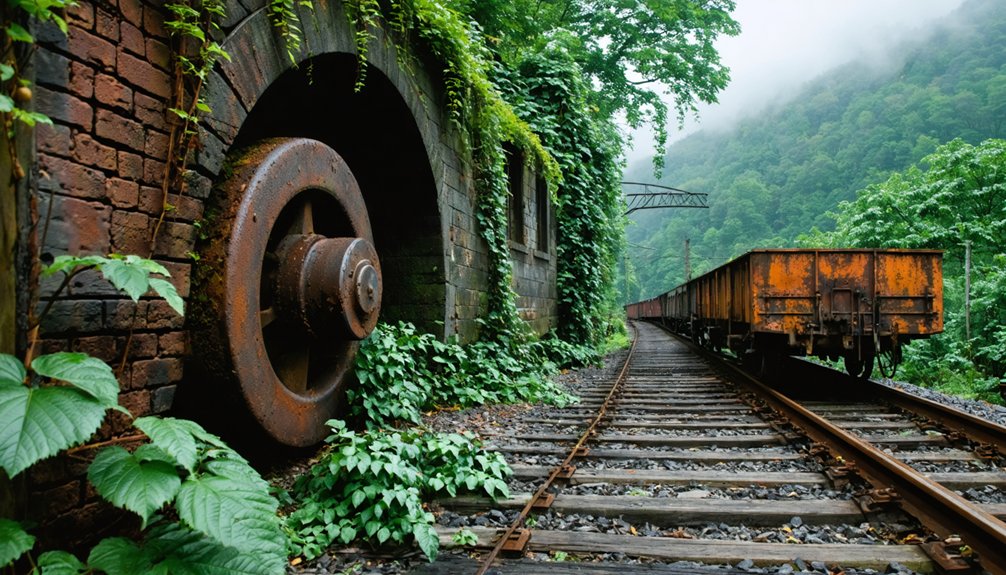
When the railroads first carved their way through Appalachia’s rugged terrain in the late 19th century, they created a network of bustling communities that would later become some of the region’s most haunting ghost towns.
Among these towns, there are haunted farming settlements in America that hold secrets of their past, echoing memories of the families that once thrived there. Many locals claim to have encountered spectral figures wandering the fields at dusk, while others share tales of whispers carried by the wind through dilapidated barns. As night falls, the lingering presence of lost souls invites the curious to explore the twisted histories that shaped these forgotten places.
Rails pierced Appalachia like arteries, birthing towns that would one day stand empty, silent witnesses to progress’s fickle nature.
These railroad legacies shaped the destiny of mountain towns like Thurmond, WV, which once handled more freight than Cincinnati. As transport shifts occurred – from steam to diesel engines and declining coal demand – these once-vibrant communities began their descent into abandonment.
- You’ll find entire towns submerged beneath lakes, their rail lines and roads forever silent beneath the waters.
- You’ll discover isolated depots where moonshine runners once dodged the law along state lines.
- You’ll explore company towns frozen in time, their standardized houses standing as monuments to an industrial era.
Preservation Efforts in the Digital Age
Modern technology has revolutionized the preservation of Appalachian ghost towns, transforming how we document and share these forgotten places. Through digital preservation, you’ll find extensive archives of oral histories, photographs, and artifacts that capture the essence of these lost communities.
Virtual engagement platforms now offer interactive experiences, from 3D reconstructions to online walking tours, making these remote sites accessible to everyone. You can explore detailed digital models of historic buildings while drones and satellite imagery help monitor hard-to-reach locations.
Conservation efforts have expanded beyond physical restoration, as crowdsourced mapping and digital storytelling connect you to these sites’ rich histories. The integration with national parks and environmental protection creates a holistic approach, preserving both cultural heritage and natural landscapes for future generations.
The Social Fabric of Abandoned Communities
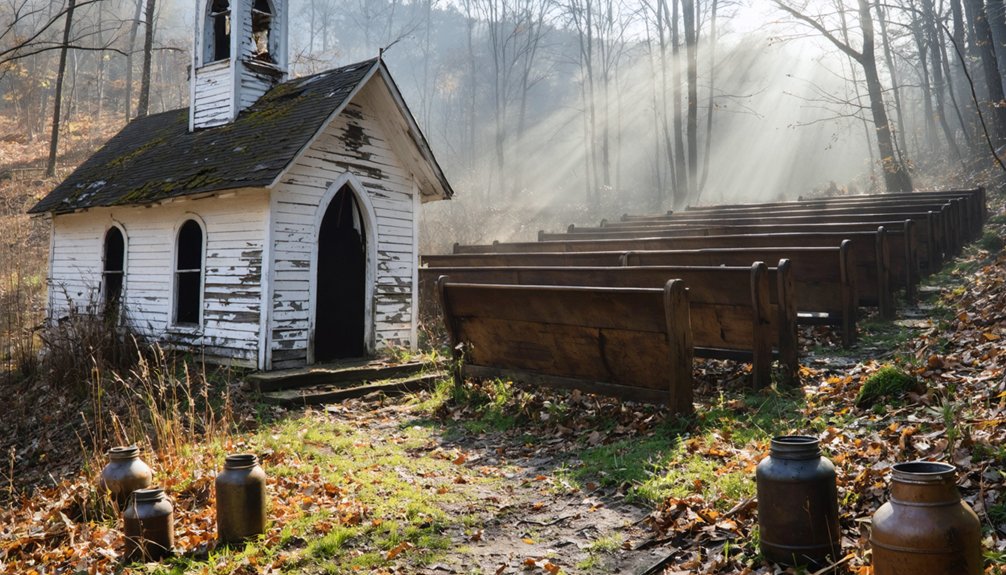
Beyond the physical structures preserved through digital technology lie the rich social tapestries that once defined Appalachian ghost towns.
You’ll discover tightly-knit communities that thrived through self-sufficiency, where community connections formed around mining, timber work, and moonshining operations. These cultural legacies live on through oral histories that reveal how families supported each other across generations.
- Stone chimneys and church ruins stand as silent witnesses to gatherings where neighbors once shared joys and sorrows.
- Multi-generational homes tell stories of families who passed down traditions and values through shared living spaces.
- Abandoned dance halls and schoolhouses echo with memories of social bonds that persisted despite economic hardship.
The towns’ decline often stemmed from resource depletion and forced relocations, unraveling carefully woven social fabrics that had sustained these mountain communities for generations.
Time Capsules in the Appalachian Wilderness
Throughout the Appalachian wilderness, abandoned communities serve as living museums, preserved by a combination of dedicated conservation efforts and natural isolation.
You’ll find these time capsules scattered across rugged terrain, where organizations like the Southern Appalachian Highlands Conservancy and National Park Service protect their historical significance.
As you explore these sites, you’ll discover architectural insights through preserved cabins, crumbling foundations, and remnants of daily life.
Each structure tells a story – from moonshine operations in Lost Cove to the restored buildings of Elkmont.
Whether you’re hiking through carefully maintained historic districts or examining exposed metal frames at Blue Heron, these ghost towns offer tangible connections to mountain settler life.
The integration of trails and protected wilderness areas creates an immersive experience where you can freely explore both natural and cultural heritage.
Frequently Asked Questions
What Paranormal Activities Have Been Reported in Appalachian Ghost Towns?
Mysterious mountain mayhem awaits you with ghost sightings, haunted legends, poltergeist activity, and disembodied voices. You’ll encounter moving objects, phantom sounds, cold spots, and spectral figures throughout abandoned Appalachian structures.
How Safe Is It to Explore Abandoned Mine Shafts Today?
You shouldn’t explore abandoned mine shafts – they’re extremely dangerous with risks of fatal falls, toxic gases, drowning, and collapse. Mine shaft safety hazards remain deadly even in secured locations.
Were Any Valuable Artifacts Ever Recovered From Submerged Ghost Towns?
You’ll find numerous lost treasures were recovered, including ritual artifacts, human remains in conch shells, and ceremonial temples of historical significance beneath Norris Lake’s submerged Appalachian towns.
Did Native American Settlements Exist Before These Mining Towns Were Built?
Yes, you’ll find that Native American history runs deep – these lands held thriving indigenous settlements for 12,000 years before mining towns appeared, with cultural significance evident in Cherokee and other tribal communities.
What Rare Plant Species Have Emerged in Abandoned Appalachian Ghost Towns?
You’ll find rare flora like Fraser fir, Gray’s Lily, and mountain sweet pitcher plant thriving in these ghost towns, with toxic species like pokeweed and doll’s eyes adding ecological significance.
References
- https://www.youtube.com/watch?v=4oHlJFXbrCk
- https://www.geotab.com/ghost-towns/
- https://appalachianmemories.org/2025/10/16/the-lost-towns-of-appalachia-the-forgotten-mountain-communities/
- https://www.thewanderingappalachian.com/post/the-underwater-towns-of-appalachia
- https://jrap.scholasticahq.com/api/v1/articles/9543-the-economics-of-ghost-towns.pdf
- https://www.appalachianplaces.org/post/appalachia-s-other-company-towns
- https://dsi.appstate.edu/projects/mountain-music/topics/industrialization
- https://www.100daysinappalachia.com/2021/09/commentary-appalachia-can-prove-company-towns-dont-lift-the-working-class/
- https://eh.net/encyclopedia/the-company-town/
- https://coalheritage.wv.gov/coal_history/Pages/Company-Towns.aspx