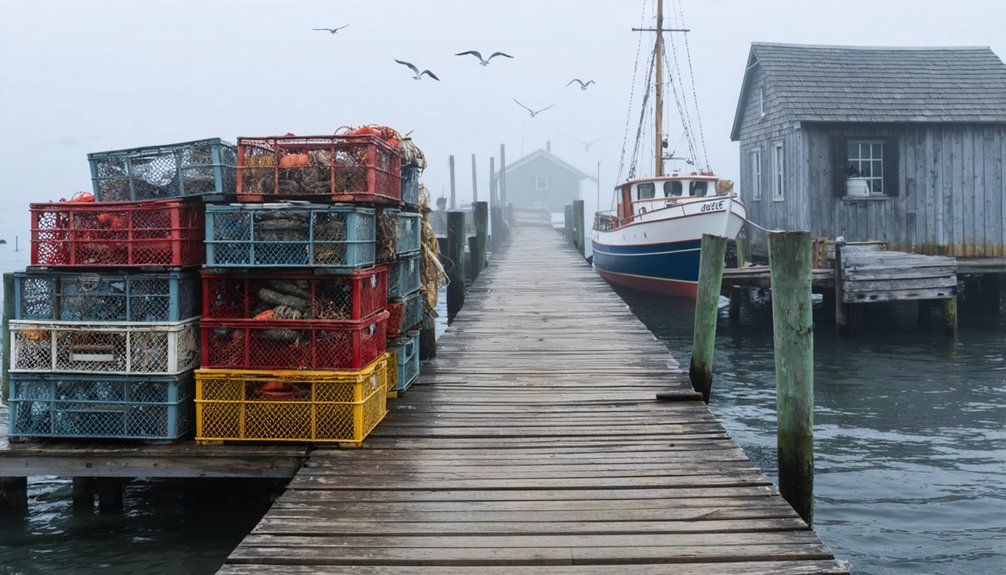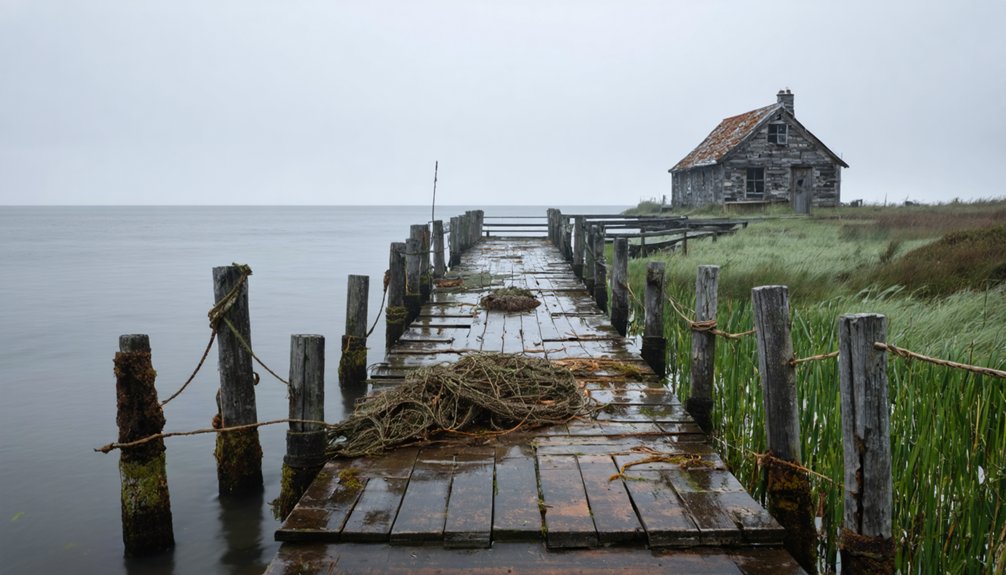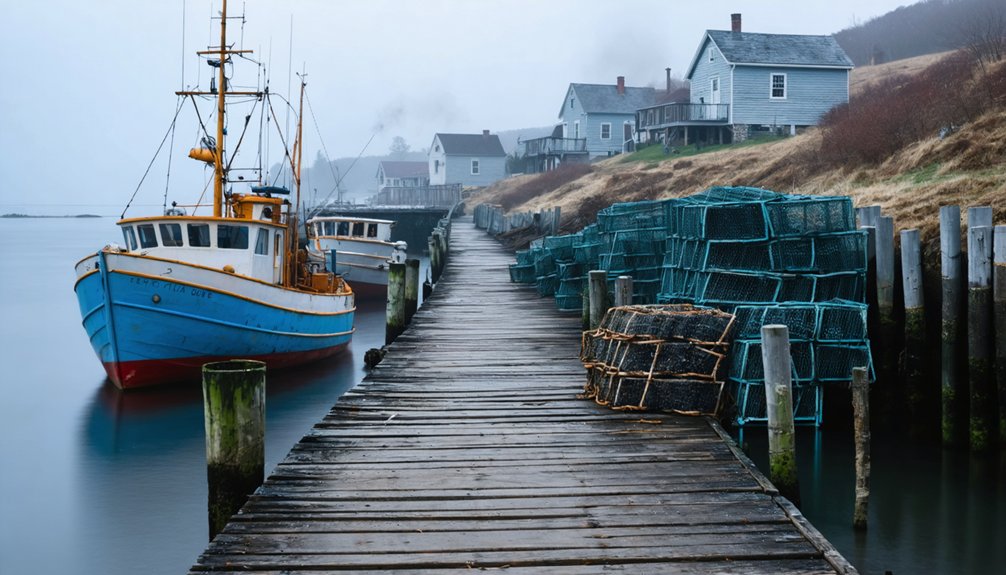
Coastal fishing village historical sites give you direct insight into centuries of maritime heritage through living history and authentic cultural practices. You’ll discover how these sites preserve traditional ecological knowledge, generate substantial tourism revenue exceeding $300 million annually, and serve as living laboratories for studying human-environment interactions. Their archaeological treasures reveal sophisticated maritime technologies dating back to 4000 BCE, while traditional fishing methods demonstrate sustainable practices. These sites hold countless more secrets about humanity’s enduring relationship with the sea.
Key Takeaways
- Coastal fishing villages preserve maritime heritage through living history initiatives, traditional practices, and cultural artifacts that maintain historical connections.
- These sites generate significant economic benefits through tourism, providing local employment and contributing billions to regional economies.
- They serve as living laboratories for studying ecological resilience and traditional fishing methods that remain relevant to modern sustainability practices.
- Archaeological discoveries at these sites reveal ancient maritime trade networks and technological innovations dating back to 4000 BCE.
- Local communities maintain cultural identity through storytelling, traditional practices, and generational knowledge transfer, strengthening social bonds.
Preserving Maritime Heritage Through Living History
While preserving maritime heritage often focuses on physical artifacts, living history initiatives form the cornerstone of keeping coastal fishing village traditions alive.
You’ll find heritage storytelling and cultural practices woven into active community engagement, where traditional crafts and oral histories bring the past into the present. Dedicated conservators work to preserve essential items like the Sail Maker’s Sewing Kit that showcase authentic maritime craftsmanship.
These sites serve as dynamic cultural centers where you can experience firsthand the rich maritime heritage through Indigenous narratives and historical reenactments. The science-based, collaborative strategies help develop frameworks for preserving these cultural sites while protecting the surrounding marine ecosystems.
Traditional Fishing Knowledge and Sustainable Practices
Throughout generations, coastal fishing communities have developed sophisticated ecological knowledge systems that form the bedrock of sustainable marine resource management.
You’ll find traditional ecological knowledge deeply embedded in their understanding of seasonal patterns, lunar cycles, and marine species behavior. These communities practice selective harvesting using specialized gear and rotational fishing methods that minimize environmental impact. Their practices often include time-tested conservation methods that modern marine protection efforts now recognize and value. The philosophy of take only what you need guides their sustainable resource management approach.
Their sustainable fishing practices reflect centuries of accumulated wisdom, passed down through hands-on training and oral traditions.
You can observe how they’ve adapted their techniques to tide patterns, water temperature, and fish behavior while maintaining strict resource stewardship. They employ seasonal fishing bans, area-specific protections, and biodegradable gear that protect marine ecosystems.
This living knowledge system continues to evolve, demonstrating remarkable resilience in the face of changing environmental conditions.
Economic Impact on Local Communities
Beyond their environmental significance, coastal fishing villages serve as powerful economic engines for their surrounding communities.
You’ll find these sites generate substantial revenue through tourism, with heritage areas attracting millions of visitors and producing over $300 million in economic benefits annually. They’re essential for economic sustainability, as recreation and coastal tourism account for more than 70% of local employment.
These historical sites foster community resilience through diverse income streams. When you invest in habitat restoration, it creates 17 jobs per $1 million spent – outperforming traditional energy sectors. Estuaries near these villages consistently yield more food per acre than the most productive farmland. In Maine alone, coastal economies support 343,000 jobs while generating billions in earnings annually.
The multiplier effects are significant, with heritage organizations generating 60% additional economic stimulus beyond initial spending. Commercial fisheries and aquaculture further strengthen local economies through processing plants, markets, and seafood-related businesses, while cultural festivals drive tourism and boost local artisan sales.
Archaeological Treasures of Coastal Settlements
When you examine ancient coastal fishing villages, you’ll find extensive evidence of maritime trade networks through artifacts like imported pottery, exotic materials, and specialized fishing tools.
These archaeological treasures include well-preserved fishhooks, multi-barbed spears, and stone fish traps that demonstrate sophisticated maritime technology dating back to at least 4000 BCE.
The cultural material record reveals not only technological advancement but also complex social organization through the presence of ceremonial structures, burial sites, and evidence of long-term resource management strategies.
Recent excavations in Koupal, Iran have revealed 41 bone fragments from various fish species that provide crucial insights into ancient dietary patterns and fishing practices.
The Ni-les’tun site in Oregon demonstrates this rich heritage through its extensive collection of prehistoric fish bones and tools from an ancient fishing village destroyed by an earthquake.
Ancient Maritime Trade Evidence
Three key archaeological markers reveal the extensive maritime trade networks of ancient coastal settlements: diverse pottery assemblages, specialized craft workshops, and shipwreck remains.
You’ll find evidence of ancient trade through distinctive artifacts like Ipswich ware in North Sea settlements and continental pottery in port excavations. These coastal hubs connected vast maritime routes spanning the Mediterranean, Red Sea, and Bay of Bengal, with settlements serving as essential nodes between inland and overseas markets. The discovery of precious stone ornaments at these sites indicates sophisticated jewelry-making workshops that combined local and foreign influences.
Shipwrecks discovered near these villages provide tangible proof of historic trade activities, while workshop remains show how local artisans produced specialized goods for export. The rapid coastal erosion rate of 28 to 108 meters per century has affected the preservation of many ancient maritime sites.
You’ll see this economic sophistication in places like Phoenician ports, where archaeological evidence includes twin harbors, breakwaters, and remains of merchant vessels that once carried precious commodities across ancient seas.
Preserved Cultural Material Records
The archaeological record of coastal fishing villages offers remarkable insights into ancient maritime subsistence through well-preserved cultural materials.
When you examine coastal archaeology sites like Koupal in Iran and Lapakahi in Hawaii, you’ll find tangible evidence of sophisticated fishing practices that date back thousands of years. These sites reveal how coastal communities developed and maintained sustainable relationships with marine resources.
- Fishing hooks and net weights from 4000 BCE demonstrate advanced technological knowledge
- Well-preserved fish bones with butchering marks show systematic processing methods
- Indigenous fishing shrines and salt pans document traditional cultural practices
- Settlement patterns reflect long-term adaptation to dynamic coastal environments
- Shell mounds and middens preserve millennia of resource use and cultural heritage
Cultural preservation at these sites continues to inform our understanding of maritime traditions and ecological knowledge that sustained communities for generations.
Cultural Identity and Community Bonds
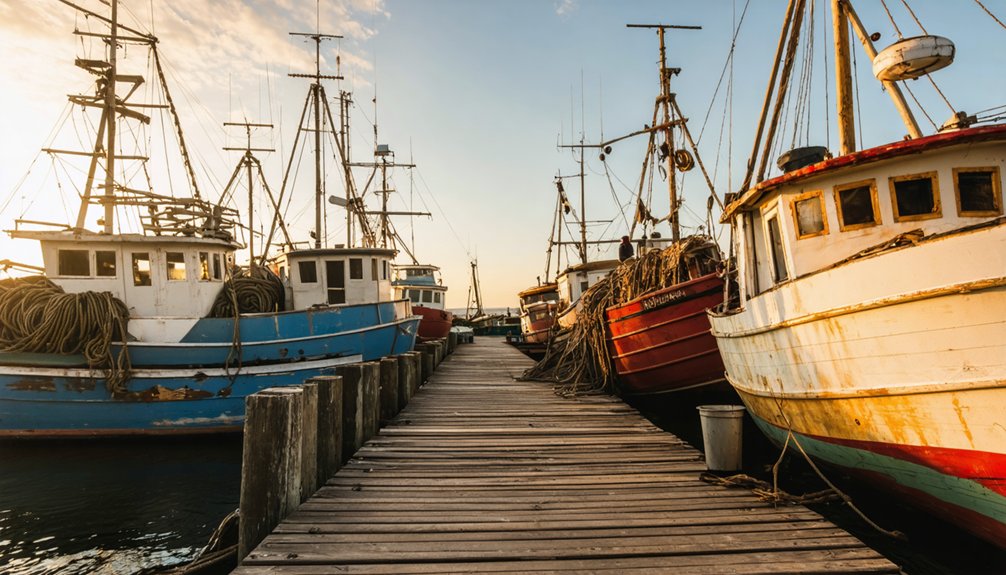
In coastal fishing villages worldwide, deeply rooted communal practices forge a distinct cultural identity that manifests through traditional social structures, shared economic activities, and collective rituals.
You’ll find cultural resilience expressed through generations-old fishing techniques, preservation methods, and architectural adaptations that have withstood changing times. Community storytelling thrives in these settings, where oral histories and local dialects preserve ancestral wisdom and strengthen kinship bonds.
The villages’ economic foundation in fishing creates interdependence among residents, fostering mutual support systems and collaborative ventures.
Regular festivals and communal events, centered around maritime heritage, reinforce these connections while providing platforms for cultural transmission. Through shared culinary traditions, cooperative markets, and community spaces, you’ll witness how these historical sites maintain their distinct identity and social cohesion.
Educational Value for Future Generations
When you visit historic coastal fishing villages, you’ll encounter living maritime museums where centuries of fishing traditions and practices remain preserved through active demonstration and use.
You’ll witness firsthand how traditional ecological knowledge, boat-building techniques, and sustainable fishing methods have been passed down through generations, creating an irreplaceable educational resource.
These sites serve as experiential classrooms where you can observe and learn authentic maritime skills that textbooks alone can’t fully convey, from net-making to fish processing techniques that span millennia of human coastal settlement.
Living Maritime History Lessons
Living maritime history comes alive through coastal fishing village sites, where visitors can directly observe and participate in traditional fishing practices that span generations.
These living artifacts create authentic experiences that transform abstract concepts into tangible realities through experiential storytelling.
You’ll discover how fishing communities preserve their heritage while adapting to modern challenges, making history relevant and accessible.
- Engage with traditional fishing tools and techniques through hands-on demonstrations
- Learn directly from community members who share generational knowledge and expertise
- Experience the ecological connections between fishing practices and marine conservation
- Participate in net mending, boat maintenance, and other practical maritime activities
- Witness how historical fishing methods influence contemporary sustainable practices
Preserving Ancestral Fishing Knowledge
Traditional ecological knowledge held by coastal fishing communities represents an invaluable repository of marine wisdom that spans millennia of careful observation and practice.
Through fishing festivals and oral histories, you’ll discover time-tested techniques for sustainable harvesting, including precise mesh calculations and strategic trap positioning that protect juvenile fish populations. These communities demonstrate sophisticated understanding of marine ecosystems, fish behavior, and migration patterns.
You’ll find their knowledge extends beyond mere fishing methods – it encompasses complex preservation techniques dating back 4,000 years, seasonal timing based on lunar cycles, and stewardship principles that maintain biodiversity.
Tourism Development and Heritage Conservation
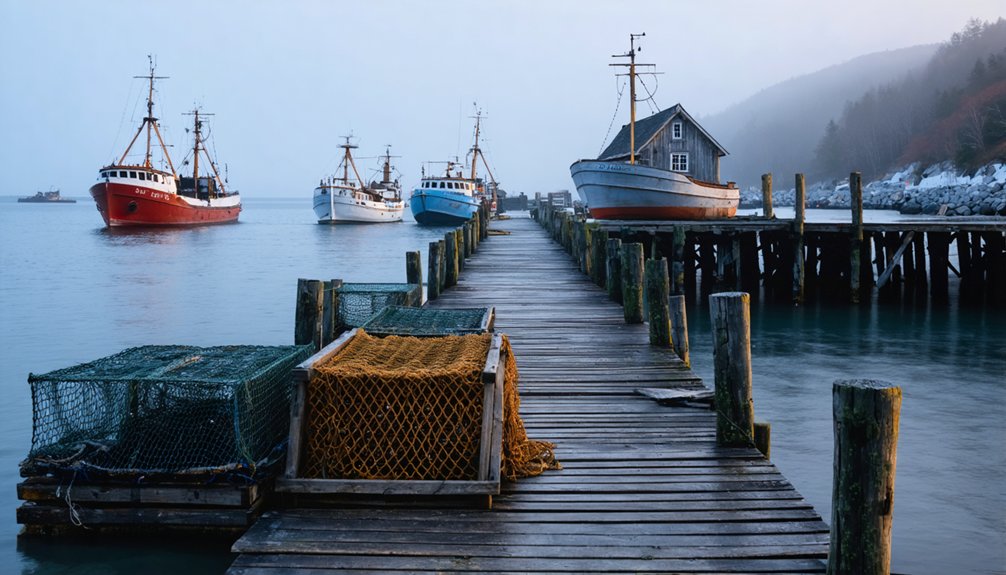
As coastal fishing villages shift into tourist destinations, they face the complex challenge of balancing economic development with heritage preservation. Fishing village tourism has evolved into a powerful economic driver, projected to reach USD 252.7 billion by 2035.
Cultural heritage tourism thrives when communities preserve their authentic traditions, historical architecture, and maritime landscapes while adapting to modern visitor needs.
- Interactive heritage museums with augmented reality bring fishing history to life
- Sustainable tourism models protect environmental assets while generating local income
- Traditional fishing demonstrations and festivals maintain cultural authenticity
- Community-led tourism initiatives guarantee local control over heritage presentation
- Conservation of historical sites and architecture enhances tourism appeal while preserving identity
The integration of tourism development with heritage conservation creates resilient economies while safeguarding the unique character that makes these villages attractive to visitors.
Environmental Understanding Through Historical Sites
Through meticulous study of coastal fishing village sites, researchers gain invaluable archaeological and ecological knowledge that illuminates centuries of human-environment interactions.
You’ll find these sites serve as living laboratories, revealing how coastal communities achieved ecological resilience through traditional fishing practices and resource management. They provide critical baseline data for understanding climate change, sea-level fluctuations, and marine ecosystem dynamics.
These historical settlements showcase remarkable examples of historical adaptation, preserving Traditional Ecological Knowledge (TEK) that’s still relevant today.
Ancient coastal communities left us a living blueprint of sustainable practices, their traditional knowledge bridging past wisdom with modern needs.
When you examine the archaeological evidence from shell mounds and village remains, you’ll uncover precise chronological frameworks that help distinguish natural coastal processes from human impacts.
This understanding is essential for developing effective climate adaptation strategies and maintaining biocultural sustainability in modern coastal management.
Maritime Technology Evolution and Innovation
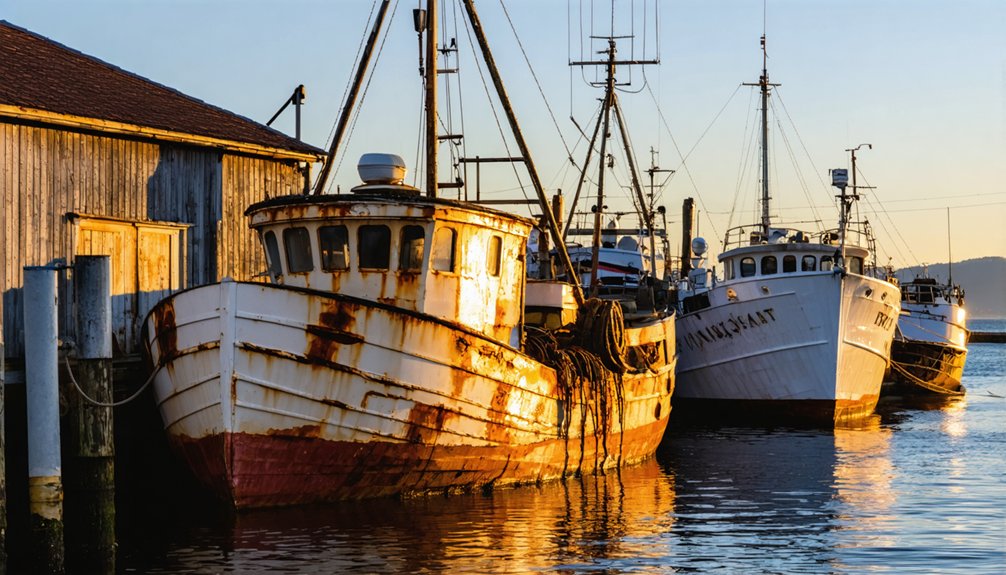
Maritime technological evolution represents one of the most dramatic progressions in human history, transforming coastal fishing villages from simple harbors into hubs of innovation.
You’ll find evidence of this progression through maritime innovation and technological advancements that revolutionized seafaring capabilities.
- Steam power’s introduction freed vessels from wind dependence, enabling reliable schedules and expanded trade routes.
- Navigation instruments like chronometers and sextants allowed precise positioning, reducing risks and opening new horizons.
- Hull design evolution from wood to steel created larger, more resilient ships capable of extended voyages.
- Deep-sea exploration technologies transformed our understanding of ocean depths and marine ecosystems.
- Communication advancements enhanced safety and operational efficiency, connecting remote coastal communities to global networks.
These developments weren’t just about technology – they represented freedom from nature’s constraints and expanded human potential across the seas.
Global Recognition and Protection Efforts
While coastal fishing villages once operated in relative obscurity, international recognition efforts have transformed many historic sites into protected cultural landmarks.
You’ll find UNESCO’s inscription of South Korea’s Jeju haenyeo culture and Hawaii’s historic sites like Kaunolū leading the way in raising global awareness about these essential heritage areas.
These designations trigger extensive protection frameworks, including marine protected areas and specialized zoning laws that safeguard both cultural practices and ecological systems.
Through legal safeguards and policy initiatives, you’re witnessing unprecedented efforts to preserve traditional fishing methods, architectural elements, and community knowledge.
This protection extends beyond physical structures to embrace intangible heritage, fostering cultural resilience through educational programs, tourism management, and community-based resource stewardship that guarantees these maritime legacies endure for future generations.
Frequently Asked Questions
How Can Individuals Contribute to Preserving Fishing Village Historical Sites?
Like anchors securing heritage, you’ll protect these treasured sites through active community engagement in preservation initiatives, joining local societies, participating in cultural programs, and advocating for sustainable tourism practices.
What Qualifies a Coastal Fishing Village as Historically Significant?
You’ll find a fishing village qualifies as historic when it demonstrates sustained cultural heritage through generations, archaeological significance, enduring maritime traditions, and measurable economic impact on regional development.
How Do Rising Sea Levels Affect Historical Fishing Village Preservation?
You’ll see rising sea levels severely damage historic fishing villages through saltwater intrusion, foundation erosion, and structural degradation, while threatening cultural preservation through displacement and loss of traditional sites.
Which Fishing Village Historical Sites Have Been Permanently Lost?
You’ll find permanently lost landmarks like England’s Hallsands, Wales’ Kenfig, and Cape Cod’s Helltown, along with Norfolk’s Clare and Foulness – all representing vanished cultural heritage of coastal communities.
These sites highlight the historical significance of ghost towns, where once-thriving communities now stand silent, offering a glimpse into the past. The stories of these abandoned places resonate with tales of economic shifts, natural disasters, and the relentless march of progress, reminding us of the transient nature of human settlements. As we explore these remnants, we uncover the rich narratives that defined these locations and the people who called them home.
How Are Traditional Fishing Methods Documented Before Elder Fishermen Pass Away?
Like precious pearls of wisdom, you’ll gather oral histories from elder fishermen through recorded interviews, photographing fishing techniques, documenting construction processes, and preserving their traditional ecological knowledge before it’s lost forever.
References
- https://www.beaufortnc.org/community/page/town-history
- https://xtremeh2o.net/blog/the-history-of-destin-from-fishing-village-to-tourist-hotspot/
- https://visaliv.com/ghana/ghana-tourist-places/anomabu-fishing-village
- https://www.nps.gov/pore/learn/historyculture/people_coastmiwok.htm
- https://www.satorealestate.com/the-history-of-fishing-villages-on-anna-maria-island/
- https://en.wikipedia.org/wiki/100_Fishing_Village_Heritage_Sites_(Japan)
- https://solotravelgirl.com/florida-travel-historic-cortez-fishing-village-rich-maritime-culture/
- https://sanctuaries.noaa.gov/news/dec22/in-search-of-ancestors.html
- https://oceanfdn.org/initiatives/ocean-heritage-initiative/
- https://www.marinersmuseum.org/conservation/cultural-heritage/