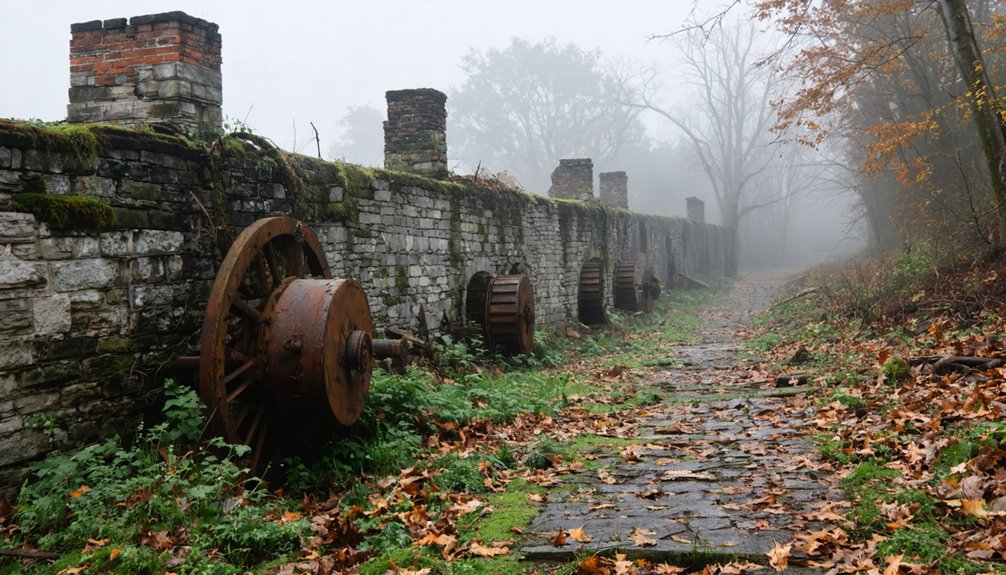
You’ll find colonial ghost towns serve as essential historical repositories, offering tangible evidence of early American life, settlement patterns, and resource management strategies. These preserved ruins reveal crucial insights into military fortification design, economic dynamics, and cultural exchanges between European settlers and Native Americans. Through careful archaeological analysis and preservation techniques, these sites demonstrate how colonial communities adapted to challenges and developed sustainable practices. Exploring these settlements opens deeper understanding of America’s formative period.
Key Takeaways
- Colonial ghost towns provide tangible evidence of early American life, serving as outdoor classrooms for understanding historical settlement patterns.
- Archaeological artifacts and structures reveal critical insights into daily colonial life, cultural exchanges, and trade networks.
- The sites demonstrate how economic factors, resource exploitation, and strategic military positioning influenced colonial development and decline.
- These remains preserve evidence of cultural exchanges between European settlers and Native Americans through trade and settlement patterns.
- Ghost towns illustrate sustainable preservation techniques while offering valuable data about environmental recovery after human abandonment.
Preserving Historical Authenticity Through Ruins
While preserving colonial ghost towns presents unique challenges, maintaining the authentic character of ruins requires careful consideration of conservation methods and materials.
You’ll find that protecting historical narratives embedded in weathered stone walls and crumbling structures demands minimal intervention rather than full reconstruction. Original masonry materials tell stories through their natural aging process, revealing patterns of settlement and abandonment that demonstrate cultural significance. Regular quinquennial inspections help detect early signs of deterioration and inform preservation strategies. Archaeological evidence shows children’s toys like marbles provide important insights into the daily lives of colonial settlers.
When you examine these sites, you’ll notice preservation efforts focus on stabilization techniques like soft topping with turf, which protects walls while maintaining their authentic appearance.
Archaeological Treasures Beneath Colonial Settlements
The archaeological record beneath colonial ghost towns reveals a complex tapestry of daily life, cultural exchange, and settlement patterns through carefully excavated artifacts and features.
Through artifact analysis, you’ll discover evidence of survival strategies, trade networks, and cultural adaptation in these abandoned settlements. The archaeological significance of these sites lies in their ability to illuminate how colonists responded to challenges, interacted with Native Americans, and maintained connections to their European origins. Recent findings at Site Y using ground-penetrating radar have uncovered valuable Elizabethan artifacts that provide new insights into colonial life. At Roanoke, evidence shows colonists faced severe hardships when the Tiger struck a shoal, destroying critical food supplies needed for survival.
Researchers are now expanding their investigations to include abandoned towns in New Jersey, where similar survival strategies may be highlighted. Preliminary excavations have revealed remnants that suggest diverse cultural interactions and trade practices unique to the area. By delving into these forgotten spaces, scholars hope to uncover the complexities of early settlements and their enduring legacies.
- Ceramic fragments and household items demonstrate daily life patterns, from food preparation to social customs.
- Mixed artifact assemblages reveal extensive trade networks spanning European and Native American origins.
- Settlement movement patterns visible through subsurface features show adaptation to environmental and social pressures.
These buried treasures continue to reshape our understanding of colonial life, providing tangible connections to America’s earliest European settlements.
Architectural Evolution and Settlement Design
Colonial ghost towns reveal fascinating architectural evolution through distinct regional styles that merged European design principles with local adaptations.
You’ll find Dutch influences in the Hudson Valley’s steep-pitched roofs, while southern colonies showcase Georgian and Greek Revival elements with their imposing pillars and symmetrical facades.
These settlements reflect clear architectural influences and settlement hierarchies through their spatial organization.
You can trace social status in the size and decoration of buildings, from elaborate country houses to modest tenant dwellings.
Construction methods adapted pragmatically to local conditions – builders used brick in hotter regions, stone in temperate areas, and incorporated multiple windows for ventilation.
Town centers typically featured dense, compact layouts with designated zones for commerce, housing, and military purposes, demonstrating how colonial designers balanced European traditions with practical needs.
Albany’s early architecture featured wood frames in brick, creating a distinctive blend of materials and construction techniques.
Southern colonial structures often incorporated Doric and Ionic columns to showcase the wealth and power of the region’s elite landowners.
Economic Rise and Fall of Colonial Towns
The economic trajectory of colonial towns was inextricably linked to their position along trade routes and their access to extractable resources, with prosperity often determined by a town’s ability to serve as a commercial hub.
You’ll find that settlements experiencing resource booms, particularly in mining, saw explosive but unsustainable growth as they attracted waves of fortune-seeking laborers and supporting businesses.
Many former boomtowns from the colonial period became tourist attractions as visitors sought to experience their historical mystique.
Your understanding of colonial ghost towns must account for how their dependency on single industries and inability to diversify ultimately led to their downfall when resources depleted or trade routes shifted. This decline mirrors T. Lindsey Baker’s observation that ghost towns emerge when their reason for being vanishes.
Trade Routes and Prosperity
Throughout early American settlement, strategic placement along essential trade corridors determined whether colonial towns would flourish or fade into obscurity. Trade dynamics shaped the destiny of these settlements, with prosperity directly linked to their ability to capture and sustain commercial traffic.
You’ll find that colonial commerce thrived particularly at natural choke points like river crossings, road intersections, and ports where merchants could effectively control the flow of goods. The Route 66 realignment in 1937 demonstrated how shifting trade routes could devastate local economies, as seen in towns like Cubero. Charles Town exemplified this pattern as South Carolina’s hub for expanding English trade networks into the Southeast.
- Trading posts and taverns emerged as significant hubs where colonists, Native Americans, and travelers exchanged goods, information, and cultural practices.
- Waterway access proved essential for exporting local commodities like tobacco and iron while facilitating import of manufactured goods.
- Economic vulnerability often stemmed from dependency on single routes, where natural changes or new infrastructure could redirect trade flows.
Resource Dependency Impact
When resource-rich deposits were discovered in colonial territories, prospective boomtowns rapidly emerged around these extraction sites, creating a precarious economic model that would ultimately doom many settlements to abandonment.
You’ll find that resource dependency consequences manifested through extreme reliance on single commodities like gold, silver, or coal, leaving these towns vulnerable to inevitable resource depletion.
The economic vulnerability factors became apparent as these settlements attracted transient male workers rather than permanent settlers, while businesses and infrastructure developed hastily without long-term planning.
Once the primary resource failed, you’d see a swift collapse of the local economy as workers departed, leaving behind crumbling buildings and abandoned services.
This boom-bust cycle exemplified the inherent fragility of single-resource economies in colonial settlements.
Settlement Growth Patterns
During colonial settlement expansion, distinct growth patterns emerged as towns developed along strategic economic and geographic lines, following predictable trajectories of rise and decline.
You’ll find that settlement density varied markedly between regions, with New England favoring compact villages while Southern colonies adopted dispersed patterns centered around plantations.
Urban planning reflected European influences, incorporating central commons and designated civic spaces that shaped community development.
- Towns strategically positioned near waterways and transportation nodes experienced rapid growth due to increased trade opportunities and merchant activity.
- Religious congregations and administrative centers attracted settlers, creating cultural and economic hubs that reinforced town stability.
- Settlements that diversified their economic base beyond single industries showed greater resilience against market shifts and changing trade routes.
Military Strategy and Defense Infrastructure
You’ll find that colonial military fortifications evolved from simple wooden palisades into sophisticated stone and masonry structures incorporating advanced artillery positions and layered defensive systems.
The selection of fort locations reflected careful strategic planning, with commanders choosing elevated positions overlooking key waterways, trade routes, and natural harbors to maximize defensive advantages.
These strategic positions helped colonial powers maintain control over essential resources and transportation corridors while protecting settlements from both naval threats and land-based attacks.
Fortification Design Evolution
As military technology evolved beyond medieval siege warfare, the introduction of cannon artillery in the 14th century catalyzed a fundamental transformation in fortification design.
You’ll notice that these changes dramatically altered fortification aesthetics, shifting from tall stone walls to lower, more geometrically complex structures. Military innovation brought the development of star-shaped forts with angled bastions and earth-filled ramparts to absorb artillery impact.
- Vauban’s pentagonal system revolutionized defensive architecture with interlocking fields of fire
- Local materials and frontier conditions shaped colonial adaptations, favoring timber and earthworks
- Scientific engineering principles led to standardized construction methods using gabions and fascines
These adaptations reflect how defensive architecture responded to advancing military technology while considering resource constraints and strategic requirements in colonial settings.
Strategic Location Selection
The strategic selection of colonial military sites reflected a sophisticated understanding of geographic advantage and territorial control. You’ll find these ghost towns positioned near critical waterways, mountain passes, and crossroads – locations carefully chosen to oversee trade routes while establishing territorial claims.
Strategic siting balanced defensive needs with economic interests, as settlements served dual roles protecting both military and commercial activities.
These outposts formed interconnected nodes within broader defense networks, utilizing natural terrain features like elevation and water barriers to maximize military advantage.
The sites created layered defensive lines protecting valuable assets while deterring rival powers and indigenous resistance. By controlling these strategic points, colonial powers could effectively project authority, secure communication lines, and protect economic interests across vast territories.
Native American and European Cultural Exchange

When European colonists first encountered Native American societies in North America, their interactions sparked one of history’s most significant cultural exchanges.
You’ll find that these encounters created complex trade dynamics and cultural fusion, particularly in mixed communities where intermarriage between Europeans and Native Americans led to new social identities.
Through trade networks, both societies became increasingly interdependent, exchanging goods that transformed their daily lives and military capabilities.
- Mixed communities emerged as essential intermediaries, developing unique languages and customs while facilitating trade and diplomacy between cultures.
- The fur trade became a cornerstone of economic relationships, with Native Americans supplying valuable pelts in exchange for European metal tools and textiles.
- Military alliances formed between Native groups and European colonists, leading to the exchange of warfare tactics and technologies.
Environmental Impact and Resource Management
You’ll find that colonial ghost towns often emerged from unsustainable resource extraction practices that fundamentally altered ecosystems through deforestation, mining contamination, and disruption of indigenous land management.
These sites typically display a pattern where initial environmental degradation led to resource depletion, followed by phases of either continued deterioration or gradual recovery once human activity ceased.
Modern preservation efforts at ghost town sites must balance protecting historical structures while addressing ongoing environmental impacts like soil toxicity and watershed damage that continue to shape these landscapes.
Resource Depletion Effects
Resource depletion during colonial mining operations left devastating and long-lasting environmental impacts that continue to affect ecosystems and communities today.
You’ll find that intensive resource extraction led to widespread economic collapse as minerals were exhausted, transforming thriving settlements into ghost towns.
The toxic legacy of these operations includes contaminated soil, polluted water sources, and hazardous waste that still poses significant health risks to surrounding communities.
- Unregulated mining practices created severe ecological damage through acid mine drainage and heavy metal contamination
- Indigenous displacement disrupted sustainable management practices and traditional ecological knowledge
- Environmental degradation from colonial resource extraction contributed to cultural loss and persistent poverty in affected regions
The environmental consequences of colonial mining have created enduring challenges for ecosystem recovery and community rehabilitation, demonstrating the true cost of unsustainable resource exploitation.
Environmental Recovery Patterns
Despite significant environmental damage from colonial resource extraction, abandoned ghost towns provide fascinating case studies of natural ecosystem recovery patterns.
When you examine these sites, you’ll observe how ecological succession gradually transforms barren landscapes into thriving habitats. Native plants recolonize cleared areas, while soil organic matter slowly rebuilds through natural processes like leaf litter accumulation.
You can witness wildlife return in distinct phases as habitat complexity increases. Smaller species initially populate these areas, followed by larger mammals once the ecosystem matures.
Water quality improves as sedimentation processes reduce mining pollution, though recovery rates vary by local conditions. While some scars like strip-mining persist for decades, these ghost towns demonstrate nature’s resilience through the steady restoration of biodiversity and ecological functions.
Sustainable Preservation Practices
As colonial ghost towns transform through natural recovery, modern preservation efforts must balance ecological protection with historical conservation.
You’ll find that sustainable tourism and heritage conservation practices focus on “arrested decay” – stabilizing structures without extensive restoration. This approach preserves authenticity while minimizing environmental impact through reduced resource consumption.
- Integration of archaeological discoveries with non-invasive monitoring technology guarantees preservation decisions respect historical context while protecting fragile ecosystems.
- Resource management extends beyond buildings to include original roads, stonewalls, and foundations, alongside protection of natural features like wetlands and wildlife habitats.
- Controlled access policies and locally-sourced materials support both site preservation and environmental stewardship, fostering economic resilience through responsible tourism programs that fund conservation efforts.
Educational Value for Modern Generations
Colonial ghost towns serve as invaluable outdoor classrooms where modern generations can directly engage with tangible evidence of early American life.
You’ll discover how educational disparities shaped colonial society through preserved schoolhouses that reflect regional differences in access and instruction methods.
These sites reveal the stark contrast between Southern private tutoring systems and community-focused Northern schools.
Transportation Networks and Trade Routes

Transportation networks played a decisive role in shaping colonial ghost towns, where early infrastructure choices created lasting patterns of economic success or decline.
You’ll find that transportation innovations drastically altered trade dynamics, often determining which settlements thrived and which faded into obscurity. When railroads replaced waterways and canals, many once-prosperous towns lost their economic relevance, while new settlements emerged along rail lines.
- Colonial-era transport prioritized coastal ports and inland terminals, with water routes dominating early trade patterns.
- Military supply routes connecting forts and population centers influenced settlement development.
- The shift from water to rail transport, and later to highways, repeatedly reshaped community viability.
This pattern of infrastructure-driven development wasn’t unique to America – colonial Kenya’s railroad placement similarly determined urban patterns that persist today, demonstrating how transportation networks create enduring economic legacies.
Social Life and Community Structures
Moving beyond the physical networks that connected these settlements, the social fabric of colonial ghost towns reveals complex hierarchies and dynamic community structures that shaped daily life.
You’ll find these communities were marked by distinct social stratification, with populations reaching thousands and displaying clear divisions between employers and laborers. Gender imbalance heavily influenced community dynamics, while ethnic enclaves like Chinatowns created cultural tensions within the broader population.
Labor relations often followed ethnic and racial lines, affecting both work distribution and living arrangements. Despite these divisions, social cohesion emerged through communal facilities including saloons, religious institutions, and meeting halls.
Though divided by ethnicity and work roles, colonial communities found unity in shared social spaces and institutions.
Towns maintained order through formal infrastructure like jails and unions, while also accommodating entertainment venues that served as vital spaces for cross-cultural interaction.
Frequently Asked Questions
How Do Ghost Town Preservation Efforts Impact Local Property Values Today?
You’ll find that ghost town preservation benefits boost nearby property values by attracting heritage tourism, creating unique cultural destinations, and stimulating economic development in surrounding communities through increased visitor spending.
What Role Did Disease Outbreaks Play in Colonial Ghost Town Abandonment?
You’ll find that disease impact devastated colonial health through epidemics, causing 75-95% mortality rates in settlements. Without immunity, indigenous populations faced catastrophic losses, leading to widespread abandonment of villages.
Can Modern Communities Legally Build on Colonial Ghost Town Sites?
With 70% of ghost towns requiring preservation review, you’ll need to navigate complex zoning laws and historical significance regulations. You can build, but must obtain proper permits and assessments first.
How Do Supernatural Beliefs Affect Ghost Town Tourism and Preservation?
Your interest in supernatural tourism and ghostly folklore directly drives preservation efforts, as these beliefs attract visitors, generate revenue, and motivate communities to maintain historic structures for paranormal-seeking tourists.
What Technologies Are Used to Date Colonial Ghost Town Artifacts?
Like peeling back layers of time’s onion, you’ll find experts using radiocarbon dating, dendrochronology, artifact analysis through seriation, and archaeomagnetic techniques to reveal colonial ghost towns’ precise chronological secrets.
References
- https://en.wikipedia.org/wiki/Ghost_town
- https://www.heritagedaily.com/2021/03/brunswick-town-the-abandoned-colonial-town-in-north-carolina/138101
- https://www.explore.com/travel/25-ghost-towns-around-us-and-history-behind-them/
- https://www.youtube.com/watch?v=inRD6vYBy8M
- https://www.britannica.com/topic/ghost-town
- https://www.redriverhistorian.com/post/history-in-ghost-towns
- https://www.life.com/history/ghost-towns-the-places-that-time-forgot/
- https://www.loveexploring.com/gallerylist/188219/the-us-state-with-the-most-ghost-towns-revealed
- https://www.buildingconservation.com/articles/heritageruins/heritageruins.htm
- https://npshistory.com/publications/vanishing-treasures/ruins-pres-guide-1997.pdf