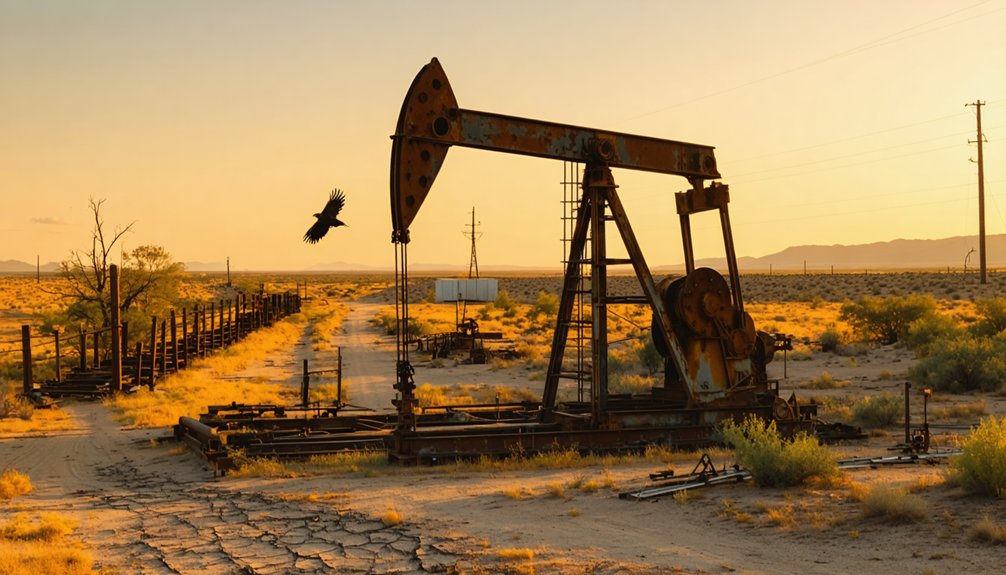
Oil drilling sites are abandoned due to the massive financial burden of proper decommissioning, which costs operators $20,000-$76,000 per well for surface sites and up to $24 million for deepwater operations. You’ll find companies often can’t afford these expenses, especially during industry downturns or bankruptcy. With 3.2 million unplugged wells across the U.S. creating $316 billion in total liability, this growing crisis demands immediate solutions and policy reforms.
Key Takeaways
- Oil companies declare bankruptcy and leave wells behind, unable to afford the high decommissioning costs ranging from $20,000 to $24 million per well.
- Inadequate bonding requirements and weak regulatory enforcement allow companies to abandon sites without completing proper cleanup procedures.
- Financial pressures from market downturns and unprofitable wells force companies to prioritize new drilling over maintaining aging infrastructure.
- Historic wells from early oil exploration lack proper documentation and responsible parties, creating orphaned sites without clear ownership.
- Companies avoid expensive plugging costs during industry downturns, leaving environmental liabilities for state governments to address.
The Financial Burden of Well Decommissioning
While oil and gas companies extract profits from active wells, they face substantial decommissioning costs that often exceed initial estimates. You’ll find the median cost of plugging an abandoned well is $20,000, but when you add surface reclamation, that figure jumps to $76,000. The financial sustainability of the industry is challenged by these mounting expenses.
Decommissioning costs pose a growing threat to oil companies, with well plugging and surface reclamation expenses far surpassing initial projections.
The economic implications are staggering – with 3.2 million unplugged wells across the U.S., total liability ranges from $232 billion to $316 billion.
You’re looking at even steeper costs for specific well types: shale operators face $261,000 per well, while deepwater offshore wells can reach $24 million each. In the UK alone, companies must decommission over 1,500 wells by 2030, adding significant pressure to the industry’s financial obligations.
Smart operators are turning to bulk contracting, which can reduce costs by 3% per additional well, but the industry’s financial burden remains intimidating. Property values near these sites suffer significantly, with homes experiencing a $15,000 reduction in value until proper decommissioning is completed.
Regulatory Gaps and Enforcement Challenges
Beyond the financial complexities of well decommissioning lies a fragmented regulatory landscape that hampers effective oversight.
You’ll find regulatory inconsistencies across state and federal jurisdictions, with varying definitions, bonding requirements, and enforcement practices creating a patchwork of standards. A review of 31 regulatory elements across 22 states reveals significant variability in requirements. This fragmentation makes it challenging to establish unified compliance measures.
Enforcement limitations further compound the problem. State agencies often lack the resources, personnel, and technical capabilities to monitor wells effectively. Poor oversight can result in hazardous leaks that threaten public safety.
You’re dealing with a system where limited funding restricts inspection capacity, while inadequate bonding requirements leave taxpayers vulnerable to cleanup costs.
The challenge of tracking abandoned wells adds another layer of complexity, as incomplete records and inconsistent reporting requirements make it difficult to identify and address non-compliant sites systematically.
Environmental Hazards of Unplugged Wells
You’ll find that unplugged wells release 7-20 million metric tons of CO2-equivalent methane emissions annually, making them a significant contributor to climate change.
These abandoned sites threaten groundwater quality, with 35% of documented orphaned wells sitting dangerously close to domestic water sources and leaching toxic chemicals like arsenic and benzene. Poor historical record keeping practices have made it virtually impossible to locate millions of these hazardous wells. Approximately 4.6 million people live within dangerous proximity to documented orphaned wells.
Your ability to develop or restore affected land becomes severely limited due to soil contamination and infrastructure hazards, requiring extensive remediation before the land can be safely repurposed.
Methane Emissions Crisis
Since the proliferation of deserted oil drilling sites has created an environmental crisis, the methane emissions from over 2 million unplugged wells across the U.S. now rival the annual carbon impact of 2-5 million cars.
You’ll find these fugitive emissions contribute roughly 2.6% of America’s energy-related methane releases, with each abandoned well leaking about 0.13 tons yearly.
The climate impact is severe – methane’s warming potential is 86 times greater than CO2 over a 20-year period.
Over 4.6 million people live within one kilometer of these documented orphan wells, creating significant public health concerns.
What’s more concerning is that emission factors previously used in official inventories underestimate actual releases by up to 5 times or more.
The highest-emitting wells (those releasing >10 grams/hour) account for 91% of total emissions, making them critical targets for immediate action.
These abandoned wells are particularly problematic as many are located on agricultural land, contaminating soil and water resources that farmers depend on.
Groundwater Contamination Threats
Unplugged wells pose a severe threat to groundwater systems across America, creating direct pathways for toxic contaminants to infiltrate essential aquifers.
You’ll find over 3.2 million abandoned wells nationwide, with 35% located within 1 km of domestic water sources, dramatically increasing your risk of groundwater pollution.
These wells release dangerous chemicals including benzene, hydrogen sulfide, and toxic drilling fluids directly into aquifers, bypassing natural filtration barriers. The Railroad Commission of Texas oversees well plugging operations to prevent further contamination.
Recent estimates indicate methane emissions from these inactive wells reach up to 20 million metric tons annually.
With 4.6 million people living near orphaned wells and 92% lacking proper monitoring, the scale of potential contamination is staggering.
Your aquifer protection depends on addressing these hazards – from volatile organic compounds to radioactive materials that can spread for miles underground.
The impact extends beyond water quality, causing property value losses up to 50% and threatening local ecosystems through contaminated irrigation systems.
Land Development Obstacles
While abandoned oil wells pose numerous environmental risks, their impact on land development creates particularly severe economic and safety challenges.
You’ll find up to 50% decreased building development in areas with high concentrations of orphan wells, directly affecting land ownership opportunities and property values. These sites often become “dead zones” like Lake Boehmer in Texas, where toxic contamination has permanently damaged ecosystems and blocked development potential.
As communities grapple with the fallout from these abandoned sites, eerie atmospheres in East Coast towns can amplify feelings of abandonment and neglect. The haunting silence of these areas can deter potential investments, causing further declines in local economies. Ultimately, the long-term repercussions extend beyond mere property values, affecting the overall spirit and vitality of these once-thriving communities.
The uncertainty and liability associated with these wells deter investors and complicate property transfers, while reduced land values diminish tax revenues vital for community engagement and public services.
You’re facing serious constraints when developing near these sites, as toxic chemical leakage and methane emissions make the land unsuitable for residential, commercial, or recreational use, creating long-term economic stagnation in affected areas.
Technical Complexities in Well Plugging
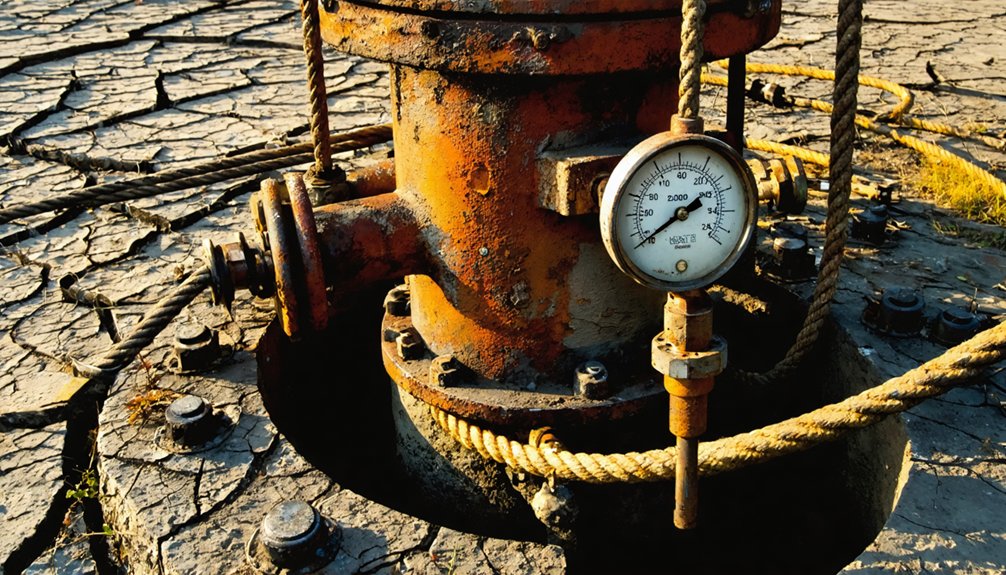
Technical complexities in well plugging stem from multiple interconnected challenges that require specialized expertise and advanced technology to address.
You’ll need to overcome missing documentation and buried wellheads through advanced geophysical techniques that locate casings hidden 3-7 meters underground. Proper cement bonding between the casing and rock formations is vital, requiring specific Portland cement mixtures tailored to well conditions.
The process demands specialized equipment like workover rigs and mechanical set tools to remove debris, place plugs, and guarantee effective sealing.
You’ll face additional challenges with older wells where degraded casings and complex pressure profiles complicate the plugging operation. Real-time monitoring tools help track pressure and fluid flow, guaranteeing precise plug placement and reducing environmental risks.
The Growing Scale of Orphan Wells
You’ll find the scale of orphan wells expanding dramatically across the U.S., with estimates ranging from 2.3 to 3.2 million abandoned sites requiring immediate attention.
The financial burden on state resources has become critical, as plugging costs can range from thousands to millions per well, overwhelming available funding mechanisms.
Beyond the known sites, countless unidentified wells present an ongoing challenge, as poor historical documentation and improper transfers have left many sites undocumented and unmonitored.
Mounting Numbers Nationwide
A staggering 120,000 documented orphan wells dot America’s landscape across 30 states, representing only a fraction of the estimated 3.4 million abandoned wells nationwide.
The latest orphan well statistics reveal an even more concerning reality: undocumented wells could number between 310,000 and 800,000, with locations and ownership records lost to time.
You’ll find these deserted sites concentrated in regions like Appalachia, the industrial Midwest, and Southern California, where nearly 14 million Americans live within one mile of documented wells.
States are mobilizing resources through federal support, with state funding initiatives taking shape.
North Dakota’s allocation of $66 million in CARES Act funds and New York’s commitment of $70 million demonstrate growing efforts to address this challenge, though the total cleanup cost could reach $300 billion.
Costs Burden State Resources
The financial burden of orphan well remediation looms larger than initially projected, with costs now expected to exceed the $4.7 billion Infrastructure Law allocation by up to 100%.
You’ll find states grappling with budget constraints as they face cost overruns between $1.6 billion to $3.7 billion, while also managing environmental cleanup and long-term site monitoring responsibilities.
State funding gaps are intensified by unexpected challenges: discovering undocumented wells, rising inflation affecting contractor and equipment costs, and complex environmental testing requirements.
The situation’s particularly dire as states inherit costly obligations from bankrupt oil companies without offsetting revenue.
When you consider that orphan wells contribute 3-6% of total U.S. methane emissions, the urgency for adequate funding becomes clear, yet many states lack the financial infrastructure to address their growing well backlogs effectively.
Unidentified Wells Pose Challenges
While documented orphan wells already number over 123,000 across the U.S., experts estimate the true scale could reach several million nationwide when accounting for undocumented sites.
You’ll find identification challenges stem from incomplete records, with only 49% of wells reporting depth data and 16% having production dates. Recent state inventory efforts have revealed a 50% increase in documented wells from 2018 to 2020, highlighting previous underreporting.
- Limited state resources prevent thorough well identification and mapping
- Missing ownership records complicate tracking and accountability
- Inconsistent data management across states creates inventory gaps
- Unidentified wells threaten 14 million Americans living within one mile
- New technologies like drones and magnetometers help detect hidden wells
The scale of unidentified wells demands urgent attention as they continue to pose environmental and health risks.
Government Solutions and Industry Response
Recent federal initiatives have dramatically shifted the landscape of orphaned well remediation through unprecedented funding and regulatory reforms.
You’ll see $4.7 billion in government funding through the Bipartisan Infrastructure Law, with $560 million already distributed to states for immediate action.
The REGROW Act has established a framework for reducing future abandoned wells while enforcing industry accountability.
The REGROW Act marks a pivotal shift toward preventing well abandonment through stronger oversight and operator responsibility.
You’re witnessing a transformation in how operators must handle well cleanup. New requirements include site-specific trust funds for decommissioning costs and full-cost bonding for well transfers.
These reforms guarantee companies can’t simply walk away from their responsibilities. While current bonding amounts often cover just pennies on the dollar, stricter financial assurance policies are forcing operators to internalize actual cleanup costs rather than shifting the burden to taxpayers.
Frequently Asked Questions
How Long Does an Abandoned Well Continue to Leak Methane?
You’ll find methane leakage from abandoned wells can persist for centuries, with documented emissions from 50+ year-old wells still occurring. This long-term environmental impact continues even after plugging attempts.
Can Abandoned Wells Be Repurposed for Geothermal Energy or Other Uses?
You can transform abandoned wells into geothermal energy sources, reducing environmental impact while tapping their geothermal potential. They’ll also serve as energy storage sites through compressed air storage systems.
What Happens to the Workers When Oil Companies Abandon Wells?
You’ll face worker displacement as companies downsize operations, but you’ve got options through job retraining programs, government cleanup initiatives, and potential shifts into environmental remediation or emerging energy sectors.
How Close Can You Safely Build Residential Properties to Abandoned Wells?
You’ll need to maintain at least 300 feet from abandoned wells per federal drilling regulations, though for ideal residential safety, experts recommend staying 2,000-3,200 feet away to minimize health risks.
Do Insurance Companies Cover Damage Caused by Nearby Abandoned Wells?
Like a sinkhole appearing unexpectedly, you’ll find limited insurance coverage for abandoned site damage. Most standard policies won’t protect you, but specialized Well Control Insurance might cover specific documented incidents.
References
- https://grist.org/energy/abandoned-oil-well-job-solution-pennsylvania/
- https://visualizingenergy.org/what-are-orphaned-oil-and-gas-wells-and-why-should-we-care-about-them/
- https://www.earthday.org/zombie-wells-wont-stay-dead/
- https://pubs.acs.org/doi/10.1021/acs.est.1c02234
- https://www.boem.gov/environment/environmental-studies/gm-22-01-0
- https://pubmed.ncbi.nlm.nih.gov/34260219/
- https://ohiorivervalleyinstitute.org/wp-content/uploads/2024/11/Methodology-for-US-Well-Liability.pdf
- https://oceanconservancy.org/wp-content/uploads/2025/09/Decommissioning-Report-Final.pdf
- https://www.spglobal.com/commodity-insights/en/news-research/latest-news/crude-oil/111924-uk-oil-and-gas-decommissioning-spend-nears-3-billionyear-as-transition-pressures-grow-report
- https://www.boem.gov/sites/default/files/oil-and-gas-energy-program/Energy-Economics/External-Studies/BOEM-2019-023.pdf