Ghost towns preserve authentic historical evidence you can’t find in continuously renovated cities—they’re three-dimensional archives where economic failures, architectural evolution, and social patterns remain frozen in time. You’ll discover fundamental lessons about resource dependency through places like Bodie and St. Elmo, where boom-bust cycles destroyed entire communities. These abandoned settlements document disaster impacts, from Valmeyer’s flood relocation to Hashima Island’s industrial collapse, while generating $32 billion in cultural tourism. The evidence within these forgotten places reveals patterns that shape modern economic planning and community resilience.
Key Takeaways
- Ghost towns preserve architectural and social history, serving as three-dimensional archives of settlement patterns, economic cycles, and technological advancements.
- They reveal fundamental flaws in extraction-based economies, demonstrating how resource dependency creates destructive boom-bust cycles that devastate communities.
- Abandoned settlements attract significant cultural tourism, with sites drawing hundreds of thousands of visitors and generating sustainable educational opportunities.
- They illustrate the dangers of single-industry dependence, showing how economic monocultures lead to catastrophic population loss and infrastructure collapse.
- Ghost towns document natural and human-caused disasters, providing physical evidence of community vulnerability to floods, earthquakes, and environmental changes.
Preserving Snapshots of Human History Through Abandoned Settlements
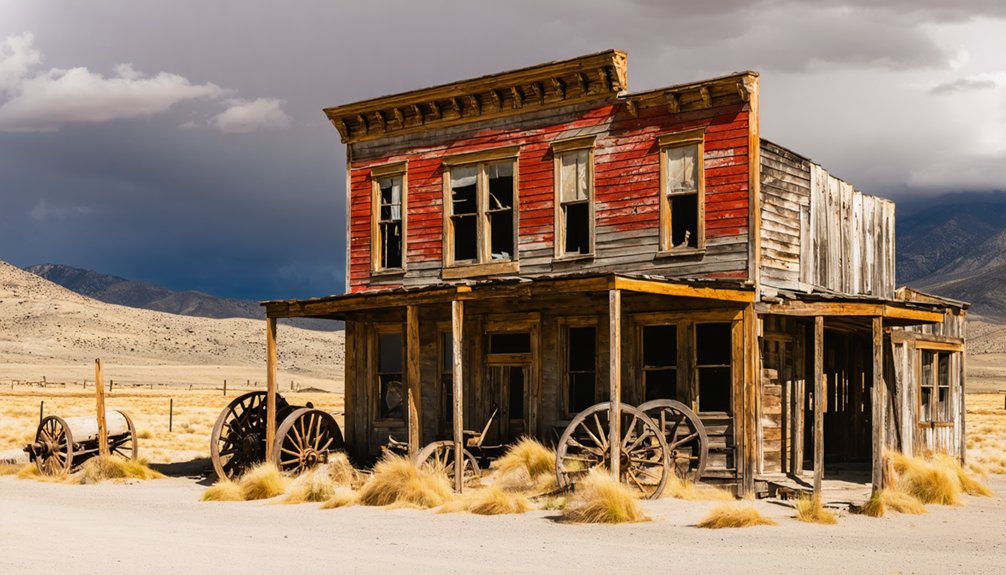
Ghost towns function as three-dimensional archives where physical structures, artifacts, and spatial relationships document specific moments in American settlement history. You’ll find Bodie’s schoolhouse, church, and saloons maintained in “arrested decay,” preserving architectural influences from the 1860s-1870s mining boom era.
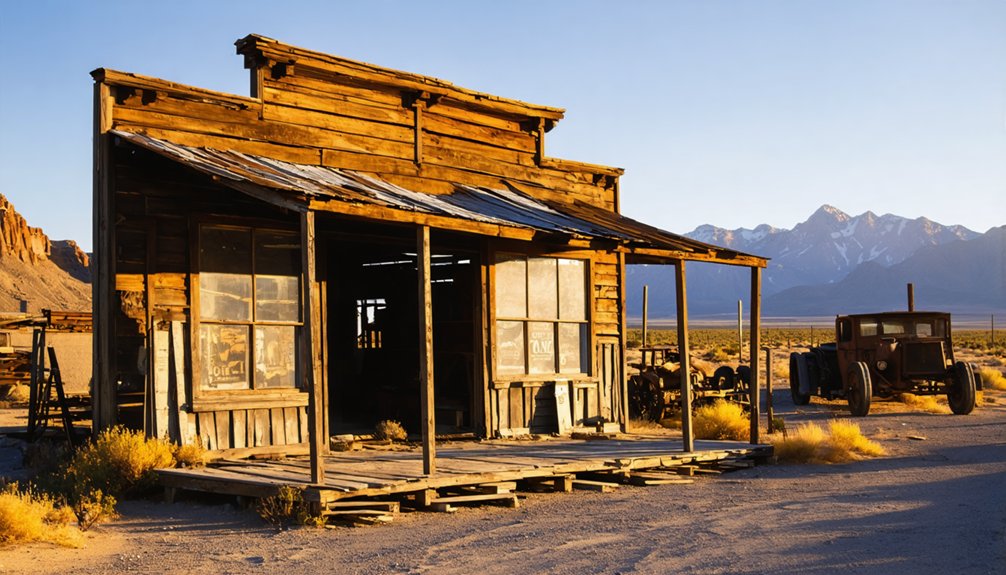
St. Elmo’s original buildings from the late 1800s reveal social dynamics through general stores and homes with intact furnishings. These settlements capture economic cycles and technological advancements that shaped the West.
Virginia City’s wooden sidewalks and Calico’s 500 mines demonstrate how communities organized around resource extraction. The U.S. National Park Service frames this perfectly: “Historic Preservation is a conversation with our past about our future.” You’re accessing unfiltered evidence of how Americans built, lived, and abandoned settlements across diverse landscapes and circumstances.
Economic and Environmental Lessons From Failed Communities
When entire communities collapse around depleted mines or exhausted resources, they reveal fundamental flaws in economic models built on extraction rather than regeneration. You’ll find critical insights by monitoring long-term demographic shifts in these abandoned settlements—nearly 15,000 U.S. cities face potential depopulation, with some regions experiencing 12-23% population losses by 2100.
Ghost towns teach three essential lessons:
- Resource dependency creates boom-bust cycles that destroy communities when extraction ends, leaving deteriorating infrastructure and environmental damage
- Infrastructure sustainability requires economic diversification—assessing infrastructure resiliency shows how single-industry towns can’t maintain essential services as populations decline
- Construction without permanence wastes resources—carbon emissions and raw material extraction yield no long-term returns when communities fail
These failures demonstrate why autonomous, diversified economies outperform centrally-planned extraction models.
Cultural Tourism and Educational Opportunities
Abandoned settlements have transformed into significant cultural assets, generating substantial visitor numbers that challenge conventional assumptions about failed communities. You’ll find Hashima Island drawing 300,000 annual tourists since its UNESCO designation, while Bodie welcomes 200,000 visitors exploring 200 buildings preserved in arrested decay. These sites enable public accessibility to authentic historical narratives—from Japan’s 1810s industrialization at Hashima to California’s gold rush era.
The dark tourism sector, valued at $32 billion, demonstrates how local entrepreneurship leverages heritage preservation: ghost tours in Savannah and New Orleans fund historic building conservation, while Spain’s 3,000 abandoned villages create rural economic opportunities through guided walks and artist residencies.
Craco’s visitor numbers jumped from 2,800 (2012) to 3,800 in eight months, proving strategic heritage management generates sustainable community engagement.
Understanding the Fragility of Single-Industry Dependence
While these abandoned settlements now generate tourism revenue and educational value, their very existence reveals systemic economic vulnerabilities that persist across centuries. You’ll find ghost towns serve as cautionary evidence against single-industry dependence, where Monessen, Pennsylvania lost two-thirds of its population after steel closures, and Youngstown accumulated 6,000 vacant buildings.
Critical lessons for resiliency planning efforts include:
- Boom-cycle blindness: Municipal governments reacted defensively during prosperous periods, failing to implement community diversification strategies when resources were abundant
- Path-dependent decline: Coal-mining regions from 1870-1970 experienced short-term gains but suffered long-term entrepreneurship suppression and employment stagnation
- Service sector collapse: Non-basic economies evaporated instantly when industry workers departed, as Lake County, Colorado demonstrated through abandoned grocery stores and saloons
These patterns demand proactive economic independence rather than reactive adaptation.
Documenting the Impact of Natural and Human-Caused Disasters
Ghost towns created by catastrophic events differ fundamentally from those abandoned through economic decline—disasters force immediate evacuations rather than gradual depopulation, leaving physical landscapes frozen in time as archival evidence of vulnerability.
You’ll find Valmeyer, Illinois relocated entirely after 1993’s floods left only 10 homes standing, while St. Thomas, Nevada disappeared under 70 feet of Lake Mead water. These sites become essential for measuring community resilience when analyzing humanitarian crises.
Puerto Rico’s post-hurricane vacancy rates spiked to 55.80% in Culebra, correlating with increased chronic diseases and injuries. Indonesia’s Ngibikan village, completely destroyed in 2006, documents seismic destruction patterns.
From Fiji’s first climate-relocated village to Louisiana’s eroding Burrwood, these abandoned settlements provide irreplaceable data on environmental threats and societal adaptation limits.
Connecting Modern Society to Its Geographical and Social Past
Stepping through the remnants of abandoned settlements takes you beyond architectural preservation into something more visceral—these sites anchor modern society to its geographical and social past through physical evidence that documentation alone can’t replicate.
Ghost towns reveal how communities evolved and vanished, understanding historical migration patterns through:
Ghost towns in the western United States are particularly intriguing, showcasing the impact of industry booms and busts on settlement patterns. Each abandoned structure tells a story of aspiration, hardship, and sometimes, the relentless march of time. Exploring these locations offers a glimpse into the lives of those who once thrived in these now-silent landscapes.
- Economic shifts traced in real-time – Thurber, Texas shuttered when railroads shifted from coal to oil, while Doan’s Crossing faded after cattle drives ended
- Infrastructure decisions that remade landscapes – Route 66 bypasses transformed thriving towns into empty storefronts overnight
- Displaced populations leaving resentment – Capel Celyn’s flooding for Liverpool’s reservoir in 1965 preserved Welsh anger for generations
These vestiges enable tracing shifting community identities, connecting you directly to builders and leavers whose choices created today’s settlement patterns.
Frequently Asked Questions
What Legal Issues Arise When Visiting or Photographing Ghost Towns?
You’ll face trespassing liability on private ghost town property without permission, plus potential burglary or theft charges if removing artifacts. Unauthorized excavation constitutes illegal activity. Research ownership thoroughly, secure explicit consent, and respect property boundaries to avoid prosecution.
How Do Ghost Towns Affect Surrounding Property Values and Local Economies?
Ghost towns accelerate economic decline in surrounding areas through property depreciation, as vacancy rates trigger cascading value losses of 20-30%. You’ll find reduced tax revenues force service cuts while blight spreads, creating self-perpetuating cycles that devastate neighboring communities’ wealth.
Are Ghost Town Artifacts Protected by Law or Available for Collection?
You can’t legally collect ghost town artifacts—they’re protected by historic preservation laws on public lands. Removing items risks $20,000 fines and imprisonment. Legal ownership disputes arise constantly. Archival research shows authorities actively prosecute collectors, seizing equipment and vehicles.
What Safety Precautions Should Visitors Take When Exploring Ghost Towns?
You’ll need to avoid dangerous structures with unstable floors and collapsed ceilings while bringing necessary supplies like water, respirators, and navigation tools. Scout exits first, stay near walls, and carry recovery gear for remote terrain challenges.
Can Ghost Towns Be Repopulated or Redeveloped for Modern Use?
Like phoenix rising from ashes, you’ll find ghost towns can absolutely be repopulated through strategic infrastructure investment. Evidence shows China’s Kangbashi and Texas’s Celina succeeded, revealing potential for urban renewal and opportunities for ecotourism when you combine accessibility with economic incentives.