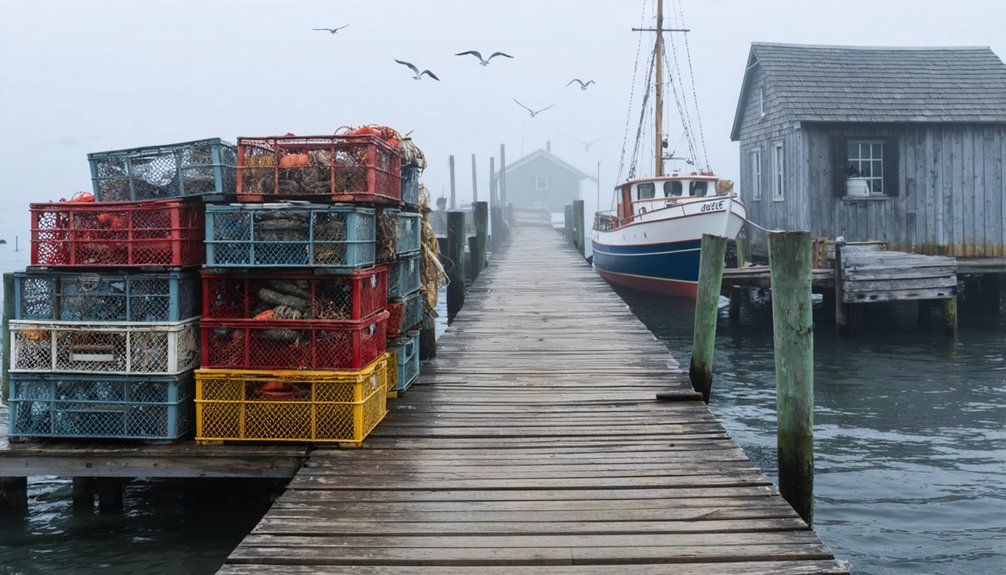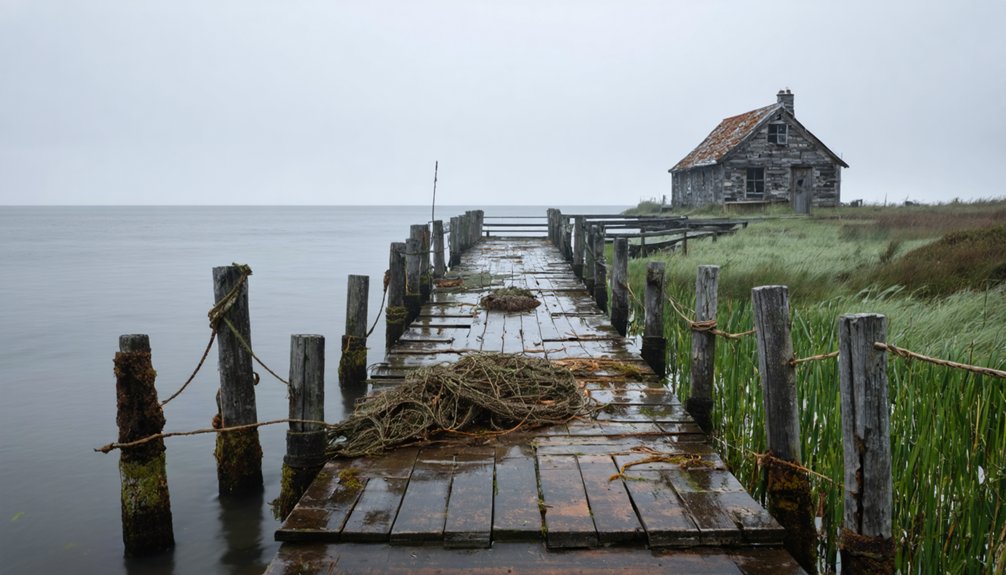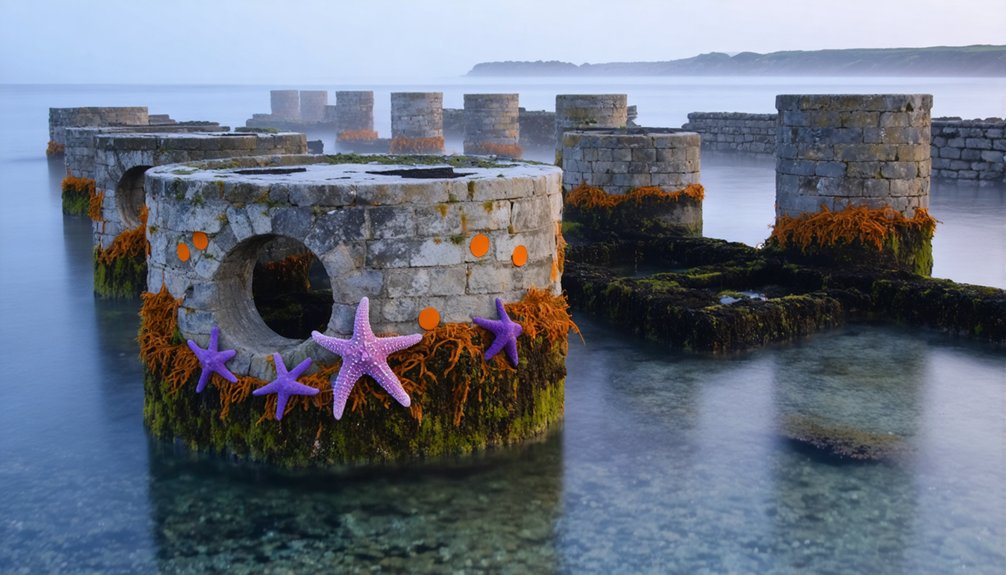
Hidden coastal fishing ruins offer you essential insights into humanity’s ancient maritime innovations and survival strategies. You’ll find evidence of sophisticated fishing systems, including stone watercourts and canal networks, that demonstrate our ancestors’ engineering capabilities from as far back as 40,000 years ago. These archaeological sites preserve critical data about early human coastal migration, technological advancement, and social organization. The secrets these submerged ruins hold continue to reshape our understanding of civilization’s development.
Key Takeaways
- Ancient fishing ruins provide archaeological evidence of early human adaptation to coastal environments and technological innovation spanning 40,000 years.
- Hidden coastal structures reveal complex engineering achievements like stone watercourts and canal networks that supported sustainable fishing practices.
- Ruins demonstrate how ancestral communities managed marine resources through family-based systems and traditional ecological knowledge transfer.
- Coastal archaeological sites help trace human migration patterns and settlement development along ancient maritime routes.
- These historical remains offer insights into successful resource management strategies that could inform modern coastal conservation efforts.
Ancient Maritime Technology and Innovation
While early maritime civilizations relied heavily on basic watercraft designs, their technological innovations in steering, propulsion, and navigation laid the groundwork for advanced seafaring.
You’ll find evidence of this progression in the shift from steering oars to stern-mounted rudders, which revolutionized maritime navigation and enabled larger vessels to traverse rough seas.
Early fishing technology evolved alongside these advancements, with archaeological findings revealing sophisticated tools like deep-sea hooks and nets dating back 40,000 years.
The integration of innovations such as the lateen sail and magnetic compass transformed coastal exploration into long-distance voyaging. The lateen sail design originated from Arabic or Persian sailors and spread throughout the Mediterranean, enabling ships to sail more effectively against the wind.
Viking longships exemplified this evolution, combining shallow drafts with reinforced keels that allowed crews to navigate both rivers and open seas, while Arab vessels prioritized expanded cargo capacity for extended journeys.
The Venetians revolutionized shipbuilding efficiency through their assembly line production, marking a significant advancement in medieval maritime manufacturing.
Cultural Heritage Preservation Through Underwater Archaeology
The preservation of maritime archaeological sites extends far beyond basic excavation and documentation. Through advanced underwater documentation techniques like photogrammetry and 3D scanning, you’ll find that microscopic details of submerged artifacts are now preserved with unprecedented precision. Desalination treatments are immediately initiated after recovery to prevent salt-induced deterioration of artifacts. Marine organisms and bacteria pose an ongoing threat to exposed underwater artifacts through bioerosion and microbial degradation.
Modern technology transforms maritime archaeology, capturing every detail of underwater treasures through sophisticated 3D documentation methods.
Remote sensing tools and automated monitoring systems provide essential data for protecting these invaluable sites.
Today’s preservation ethics emphasize in situ conservation whenever possible, following UNESCO’s 2001 Convention guidelines. You’ll see this approach implemented through controlled environmental chambers, protective coverings, and chemical treatments that stabilize artifacts while maintaining their historical integrity.
Public engagement plays a vital role too – through underwater museums, dive trails, and digital technologies, you’re able to experience these sites responsibly while contributing to their long-term preservation as collective stewards of our maritime heritage.
Early Human Adaptation to Coastal Environments
Since archaeological evidence reveals coastal environments as essential survival zones, you’ll find that early humans developed sophisticated adaptations for exploiting marine resources between 35,000 and 10,000 years ago.
These coastal adaptations included tracking lunar and tidal cycles to optimize shellfish gathering, while integrating diverse marine diets with terrestrial resources. You’ll discover that these strategies provided essential nutrients, particularly fatty acids that supported brain development and cognitive advancement.
Your ancestors demonstrated remarkable environmental knowledge, targeting multiple ecological niches along shorelines while using coastal vegetation for materials and fuel. Their successful migrations followed coastal migration routes as populations spread from Africa through Asia to Australia and beyond.
Their successful marine resource exploitation led to stable settlements, fostering social cooperation and technological innovation. This coastal dependency proved vital during climate fluctuations, as shoreline environments offered reliable food sources and shelter when inland conditions became harsh. Evidence from Waterfall Bluff shelter shows continuous human occupation through extreme climate periods, demonstrating the resilience of coastal adaptations.
Complex Fishing Systems and Social Organization
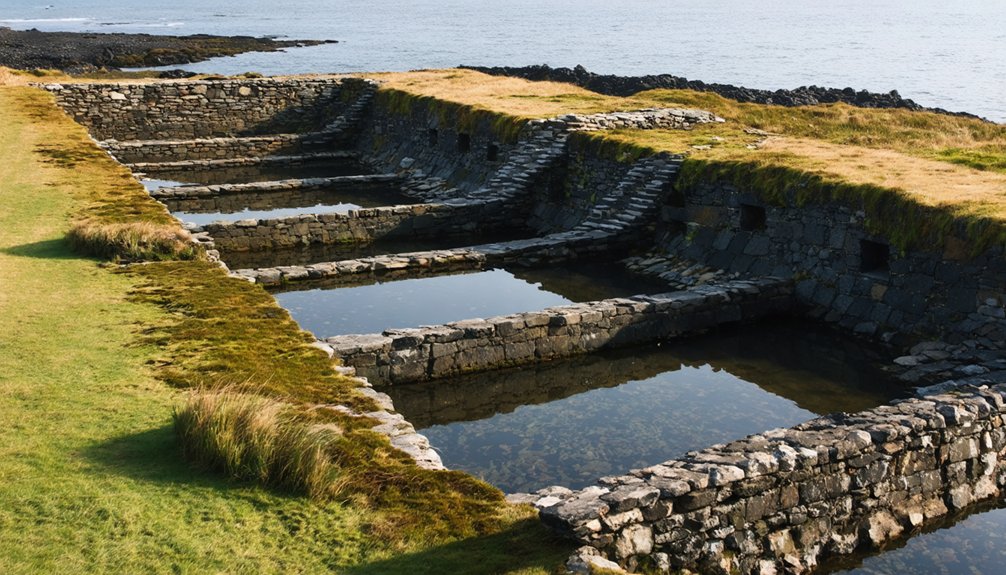
You’ll find remarkable engineering achievements in ancient coastal societies through their stone watercourts and intricate canal networks, which required coordinated labor and precise understanding of tidal patterns.
Ancient societies used gorge hook tackle and similar tools to harvest fish from these elaborate systems.
These systems were often managed through family lineages who maintained fish weirs and nets, passing down specialized knowledge across generations. Elders played vital roles in sharing ancestral fishing wisdom through oral traditions and community practices.
The control of these marine resource systems helped establish and reinforce social hierarchies, as elites directed the construction and operation of large-scale fishing infrastructure that provided food security for entire communities.
Ancient Engineering Feats
Ancient coastal communities demonstrated remarkable engineering prowess through their sophisticated fish-catching systems, which incorporated standardized measurements and complex geometric designs across vast scales.
You’ll find evidence of their ingenuity in the coastal ruins, where heart-shaped and chevron-shaped stake alignments once directed fish into carefully positioned traps during high tide.
These ancient engineering marvels weren’t just impressive in size – they showcased advanced technical understanding. You can trace how they integrated removable lattice panels for selective fishing and leveraged natural water dynamics through zigzag channels and holding ponds. The system proved so effective that it became the largest in North America, spanning across 30 hectares of coastline.
Similar to the sophisticated facilities found in Belize’s Crooked Tree Wildlife Sanctuary, these ancient structures were designed to capture fish during receding floodwaters.
The precision required to construct these systems during low tide, driving stakes into intertidal zones before water returned, speaks to their masterful grasp of timing and environmental forces.
Family-Based Weir Management
Behind these intricate coastal fishing structures lay complex social organizations centered on family-based management systems.
You’ll find that weir operation wasn’t just about catching fish – it represented a sophisticated network of family traditions passed down through generations. Elders controlled management decisions while teaching younger members essential skills in construction, maintenance, and ecological timing.
These family units practiced communal harvesting, sharing their catches to strengthen social bonds and guarantee food security.
They’ve developed detailed understanding of fish behavior, tidal patterns, and migration timing, adapting their techniques to local conditions. This family-based system created resilient management structures where knowledge transfer, labor distribution, and conservation practices worked together to sustain both the resource and the community’s needs.
Marine Resource Control Systems
While basic fishing methods required minimal organization, complex marine resource control systems emerged as coastal societies developed sophisticated engineering and social hierarchies.
You’ll find evidence of this in structures like the Calusa’s watercourts and fish traps, which demanded coordinated maintenance and strict resource governance. These systems weren’t just physical – they integrated sophisticated social controls through customary laws and hereditary fishing rights.
You’re looking at societies that developed intricate mechanisms for managing marine resources.
Elite overseers controlled production and distribution through specialized roles, while village cooperatives facilitated sustainable harvests.
They’ve left behind impressive archaeological features like wooden gates and post holes, revealing how they regulated access to fishing grounds and maintained resource stability through seasonal restrictions and rotational fishing practices.
Environmental Changes and Lost Coastal Communities
Throughout the past century, coastal fishing communities have faced unprecedented environmental challenges that threaten their existence and cultural heritage.
Among the various factors leading to fishing community decline, overfishing has dramatically reduced fish populations, making it increasingly difficult for these communities to sustain their livelihoods. Additionally, climate change has intensified the impacts of coastal erosion and altered marine ecosystems, further exacerbating the challenges they face. As a result, many communities are forced to adapt or abandon their traditional ways of life, leading to a loss of cultural identity and heritage.
You’ll find their remnants increasingly endangered by destructive fishing practices like bottom trawling, which bulldozes fragile seafloor ecosystems and destroys centuries-old coral formations.
Coastal erosion accelerates as rising seas and intensifying storms batter shorelines, while development projects eliminate critical wetlands and estuaries that once sustained thriving fishing villages.
Relentless waves and unchecked development strip away coastal habitats, destroying the foundations that fishing communities relied on for generations.
Without immediate habitat restoration efforts, you’re witnessing the rapid disappearance of these historic communities.
Industrial-scale fishing depletes fish stocks, while ghost nets continue killing marine life.
Climate change compounds these pressures through coral bleaching, ocean acidification, and altered fish migration patterns, forcing many communities to abandon their ancestral fishing grounds.
Maritime Resource Management Through History
Maritime resource management evolved from a series of catastrophic accidents and growing safety concerns in the late 20th century.
You’ll find its origins in Bridge Resource Management (BRM), which emerged in 1993 as a response to human errors in ship operations. This maritime evolution mirrors aviation’s earlier developments in crew management.
The transformation from BRM to Maritime Resource Management (MRM) in 2003 marked a significant shift in resource strategies, expanding beyond bridge officers to include all maritime personnel.
You’re now operating in an environment where technology and human factors training merge seamlessly.
Through simulation exercises and structured safety protocols, you’ll experience how modern MRM integrates advanced systems with time-tested principles of leadership, communication, and teamwork to prevent accidents and enhance operational efficiency.
Frequently Asked Questions
How Can Modern Fishing Communities Learn From Ancient Coastal Fishing Ruins?
You’ll discover sustainable practices through ancient fishing tools, learn time-tested preservation methods from coastal settlements, and reconnect with cultural heritage that demonstrates long-term marine resource management success.
What Role Did Women Play in Prehistoric Coastal Fishing Societies?
You’ll find women played essential roles, challenging traditional gender roles through active participation in fishing techniques, big-game hunting, and knowledge transmission while working cooperatively with men in coastal subsistence activities.
Were Ancient Coastal Fishing Communities More Resilient to Climate Change?
You’ll find ancient coastal communities had stronger resilience strategies through diverse fishing practices, traditional knowledge systems, and flexible climate adaptation methods that modern societies often lack in responding to environmental changes.
How Did Ancient Fishing Communities Preserve Their Catch Without Modern Refrigeration?
While you might think ancient preservation was primitive, you’d effectively preserve fish through salt preservation, sun drying methods, smoking, and natural packaging like sealskin pouches to create oxygen-free environments that prevented spoilage.
Did Prehistoric Coastal Fishing Communities Engage in Long-Distance Maritime Trade Networks?
You’ll find that prehistoric coastal communities actively participated in extensive trade routes spanning oceans, exchanging preserved fish, tools, and cultural knowledge while developing sophisticated maritime networks across continents.
References
- https://arkeonews.net/archaeologists-unearth-prehistoric-fishing-evidence-on-the-makran-coast-of-iran/
- https://www.science.org/doi/10.1126/sciadv.adq1444
- https://hakaimagazine.com/features/the-ingenious-ancient-technology-concealed-in-the-shallows/
- https://www.york.ac.uk/archaeology/middens/Chap 05.pdf
- https://snr.org.uk/the-mariners-mirror-podcast/the-lost-fishing-village-of-hallsands/
- https://vocal.media/journal/uncovering-the-depths-of-history-with-maritime-archaeology
- https://www.discovermagazine.com/rising-seas-swallowed-countless-archaeological-sites-scientists-want-them-back-14859
- https://www.sciencefocus.com/planet-earth/new-hunt-for-real-world-atlantis-australia
- https://archaeology.org/issues/january-february-2014/features/swahili-coast-towns/
- https://www.ybw.com/features/10-top-innovations-in-the-history-of-sailing-17358