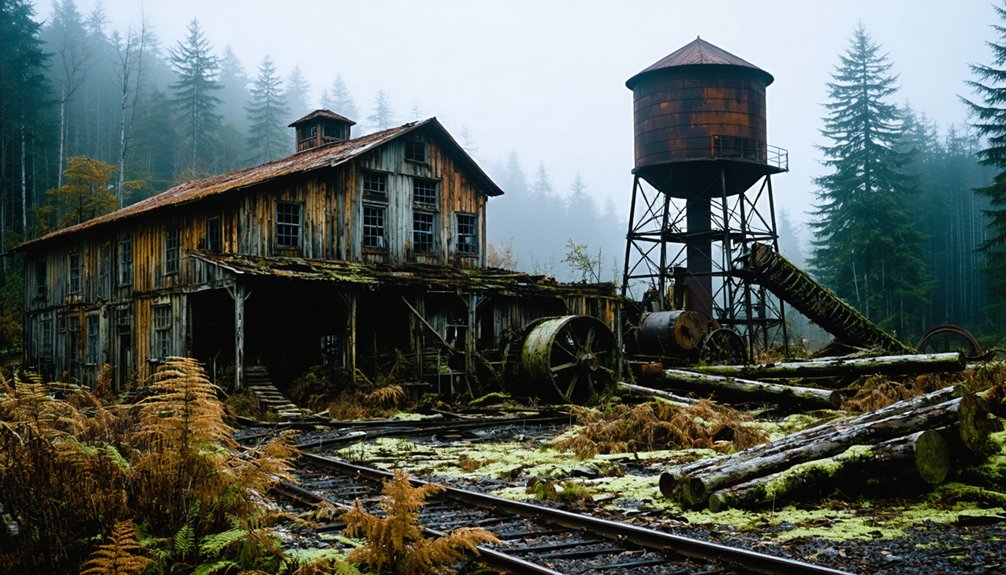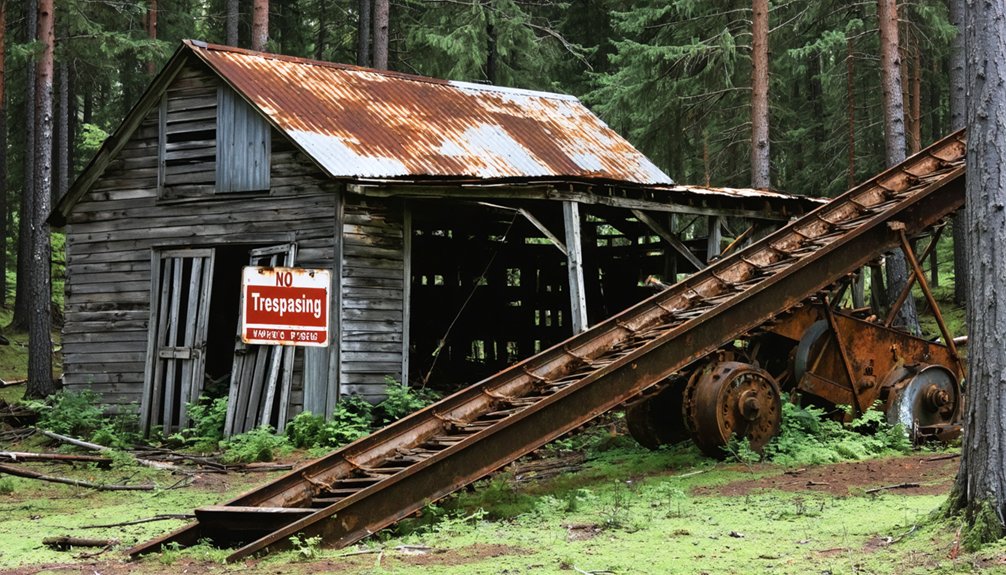
Logging villages across America have emptied out since the 1980s due to multiple converging factors. You’ll find that resource depletion from unsustainable clear-cutting, mill closures, and automation eliminated traditional timber jobs. Young workers aged 15-29 left at rates of 10-20% each decade, while deaths now exceed births in 76% of rural counties. The collapse of railroad networks and environmental regulations transformed these once-bustling settlements. Deeper exploration reveals how this rural exodus continues reshaping America’s forested landscape.
Key Takeaways
- Economic decline from mill closures and reduced timber demand led to loss of $64 million in annual earnings and lower worker wages.
- Young adults aged 15-29 left logging communities at rates of 10-20% per decade, seeking better opportunities in urban areas.
- Unsustainable clear-cutting practices degraded landscapes and depleted timber resources, making continued operations economically unviable.
- Dismantling of railroad networks isolated logging communities, cutting off vital transportation and supply chains.
- Shift toward conservation-focused land management policies restricted timber harvesting, transforming logging towns into abandoned settlements.
The Rise and Fall of Timber-Based Communities
As railroads carved their way through America’s vast forests in the mid-19th century, purpose-built logging villages began sprouting up across the landscape. You’d find these company towns strategically positioned around sawmills, where timber corporations built housing, schools, and stores to support their workers’ needs.
During the industry’s golden age, you could see how logging heritage shaped community identity as settlements expanded with technological advances. Steam-powered equipment opened up previously unreachable forests, while railroads connected remote timber operations to bustling markets. Workers endured ten-hour workdays performing physically demanding tasks in these timber camps. The invention of the Dolbeer donkey engine revolutionized logging by making it easier to transport massive logs over long distances.
These villages became economic hubs, supporting not just logging but also ports, equipment suppliers, and local merchants.
The social fabric reflected the industry’s hierarchy, with distinct neighborhoods for managers and laborers, while churches and schools fostered a sense of permanence in these frontier settlements.
Resource Depletion and Environmental Impact
You’ll find that logging villages rapidly cleared vast forest tracts in expanding circular patterns, leaving behind increasingly degraded landscapes as timber operations moved outward from settlement centers.
Road networks created extensive forest fragmentation, disrupting critical wildlife movement corridors and accelerating habitat loss in surrounding areas.
The aggressive clear-cutting practices created a devastating ripple effect through local ecosystems, disrupting soil stability, watershed functions, and wildlife habitats documented in the scientific data.
Particularly in the Southeast, communities experienced severe flooding from clearcuts as wetland forests were destroyed, fundamentally altering the region’s natural hydrology.
Rapid Forest Clear-Cutting Impact
The rapid depletion of U.S. forests through clear-cutting has triggered devastating environmental consequences across multiple ecosystems.
You’ll witness how clear-cutting destroys forest regeneration patterns and undermines community resilience, leaving once-thriving logging villages abandoned.
The US South alone loses approximately 2.3 million acres of forest annually to intensive logging operations.
- When you examine logged areas, you’ll find soil compaction that persists for decades, making it nearly impossible for forests to recover naturally.
- You’ll see watersheds where peak flows have increased by 20%, while summer streams have dropped by 50%.
- Your local forests now store 35% less carbon, releasing what took centuries to accumulate.
- You’re left with fragmented landscapes where plantations replace natural forests, devastating wildlife habitats.
These impacts ripple through time, transforming vibrant forest communities into ghost towns as resources vanish and ecosystems collapse. The devastating loss of 723 million tons of carbon dioxide released annually from U.S. logging accelerates climate instability in these regions.
Unsustainable Harvesting Patterns
While market pressures drive accelerated timber harvesting across U.S. forests, devastating patterns of resource depletion have emerged in logging regions nationwide.
You’ll find once-thriving logging communities now struggling as illegal harvesting practices undercut sustainable operations, pushing legal operators out of business.
The landscape tells a stark story – where dense forests once stood, you’re now seeing rapid clear-cutting that’s stripped away 31% of southeastern woodlands.
This unsustainable pace has left a trail of environmental damage, from eroded soils to degraded water quality.
Private landowners control 69% of forests in the United States, making coordinated conservation efforts particularly challenging.
What’s worse, you’re witnessing the toll on community health as pellet mills exceed emission limits, particularly affecting rural African American neighborhoods.
The economic impact has been severe, with over 242,000 jobs lost in U.S. logging, wood, paper, and cabinetry industries since 2006.
The cycle continues as forests are treated like quick-turnover crops, sacrificing long-term sustainability for short-term gains.
Local Ecosystem Collapse
Devastating ecosystem collapse now ripples through former logging regions, where decades of intensive harvesting have triggered widespread environmental deterioration.
You’ll find once-thriving forests reduced to fragmented landscapes, where ecosystem resilience has been shattered by unsustainable practices.
- Clear-cutting has left barren expanses where diverse old-growth forests once stood, pushing specialized species toward extinction.
- Eroded hillsides and destabilized soils now trigger landslides and flooding, destroying both wildlife habitats and human settlements.
- Disrupted water cycles have transformed local climates, leaving communities vulnerable to extreme weather events.
- Carbon emissions from logging operations have accelerated climate impacts, creating feedback loops of environmental decline.
These compounding effects have transformed vibrant ecosystems into unstable, degraded landscapes that can no longer support either wildlife or human settlements. The root structures prevent landslides and soil stability in undisturbed old-growth forests, but this natural protection is lost when forests are cleared. The destruction of specialized habitat combinations has made it impossible for many native species to survive in these altered environments.
Economic Challenges Leading to Ghost Towns
During the latter decades of the 20th century, America’s once-thriving logging communities transformed into ghost towns as economic challenges mounted across multiple fronts.
You’ll find that timber-dependent counties lost an average of $64 million in annual earnings, while wages plummeted by nearly $4,000 per worker.
The economic decline intensified as pulp and paper mills shut down, eliminating over 43 million tons of annual wood demand and devastating local markets.
Competition from Canadian imports and southern pine further crushed these communities, while an aging workforce – now averaging 55 years old – steadily diminished the logging sector’s significance.
When major employers like JD Lumber closed their doors, entire towns lost their economic foundation, forcing residents to abandon homes and businesses in search of opportunities elsewhere.
Population Exodus and Social Changes

As logging communities collapsed economically, you’ll witness a profound demographic transformation that has reshaped America’s rural landscape since the 1980s.
The relentless population decline has hollowed out these once-vibrant villages, driven by both natural decrease and strategic exodus. You’re seeing unprecedented social fragmentation as younger generations abandon their rural roots for urban opportunities.
- Deaths now exceed births in 76% of rural counties, with elderly residents making up 21% of the population
- Young adults aged 15-29 are fleeing at rates of 10-20% each decade
- Over 52% of U.S. counties face declining populations as 86.3% of Americans choose metro living
- Historical racial patterns shift as both White and Black residents migrate toward urban centers
This exodus has created a downward spiral, permanently altering the social fabric of America’s logging heritage.
Transportation Networks and Infrastructure Loss
You’ll find that when logging operations ceased across America, companies quickly dismantled their railroad networks, leaving remote camps cut off from essential transportation links.
The arrival of trucks and modern highways in the mid-20th century eliminated the need for these elaborate rail systems that had sustained logging communities.
As these transportation networks disappeared, you couldn’t maintain the camps’ connections to civilization, leading to their inevitable abandonment.
Railroad Removal After Logging
When logging railroads disappeared across America’s remote forests in the mid-1900s, they took entire communities with them.
You can trace this railroad history through the abandoned camps that once thrived along the steel rails, marking a dramatic end to a significant logging legacy. As rail lines were dismantled, like the Deer River Line in 1947, these crucial arteries of timber transport vanished.
The transformation was swift and irreversible:
- Railroad removal cut off essential supply chains and communication links
- Workers and families quickly migrated as employment opportunities dried up
- Logging companies abandoned camp maintenance and infrastructure
- Former rail corridors became ghostly reminders of bustling settlements
The shift to truck transport couldn’t save these remote villages, as their very existence depended on the railroads that built them.
Modern Transport Eliminates Camps
The rise of modern road networks in the early-to-mid 1900s revolutionized America’s logging industry, marking the end of remote logging camps.
You’ll find that transport innovation fundamentally altered how logging operations functioned, as trucks replaced horses and water transport for moving timber. The expanding web of roads allowed loggers to commute from established towns rather than live in isolated camps.
As logging efficiency improved through mechanization and better transport, companies centralized their operations near permanent facilities.
You can trace how the traditional river-based camps disappeared when bridges and highways enabled year-round access to timber stands. Radio communications and chainsaws further reduced the need for large crews stationed in remote areas, while truck fleets made it possible to coordinate logging activities from central locations.
Technological Evolution in Logging Industry
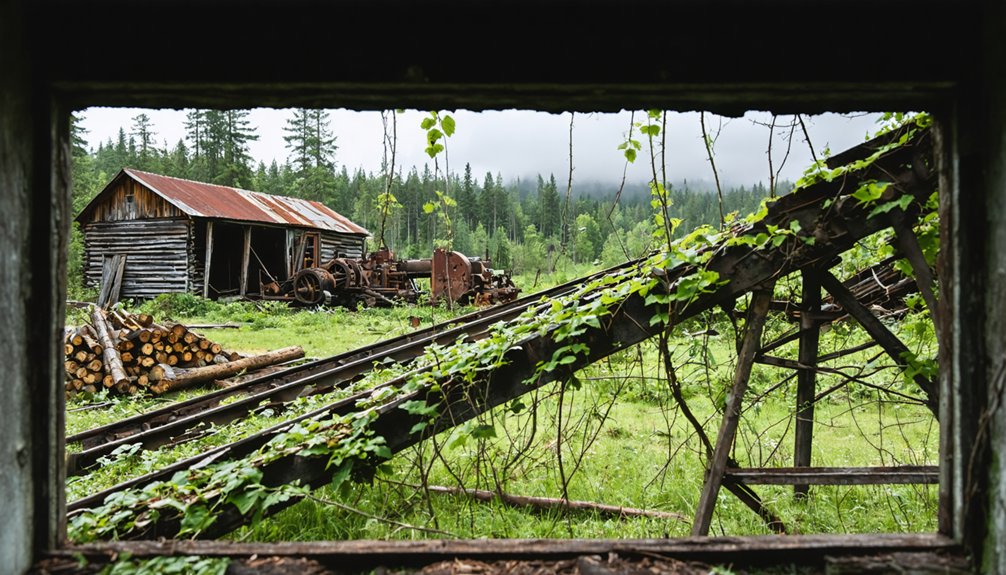
Since the 19th century, technological advancements have revolutionized America’s logging industry through distinct evolutionary phases, transforming from manual labor to mechanized operations.
You’ll find mechanized efficiency has reshaped the entire landscape of logging, while digital precision now guides every cut and harvest.
- Steam-powered machinery and donkey engines replaced manual labor, allowing fewer workers to accomplish what once required entire crews.
- Chainsaws, feller bunchers, and skidders transformed the industry from axes and crosscut saws to high-powered mechanical solutions.
- GPS, GIS, and drone technologies now provide precise mapping and inventory assessment capabilities.
- Automated machines with advanced sensors handle complex operations while ensuring sustainable forest management.
This technological evolution has made traditional logging camps obsolete, as modern transport and efficient machinery eliminate the need for permanent worker settlements in remote forest areas.
Shifting Land Management Policies and Conservation
As federal and state policies shifted toward conservation-focused land management, logging villages across America steadily emptied of their residents.
You’ll find that protected area designations and environmental regulations transformed once-bustling timber towns into ghost settlements, especially in regions where national forests and wildlife refuges now dominate the landscape.
Conservation policies reshaped these communities by prioritizing forest regeneration and ecosystem services over resource extraction.
You can trace the evolution of former logging settlements as reforestation programs gradually reclaimed harvested lands.
The economic backbone of these villages crumbled when land management strategies emphasized long-term forest preservation rather than timber production.
What were once thriving hubs of logging activity have become abandoned reminders of how policy changes can fundamentally alter the spatial patterns of human settlement.
Frequently Asked Questions
What Happened to the Personal Belongings Left Behind in Abandoned Logging Villages?
You’ll find most personal histories and forgotten treasures didn’t survive – residents took belongings when moving, while remaining items deteriorated from weather exposure, vandalism, or were salvaged by locals for materials.
Did Any Logging Villages Successfully Transform Into Tourist Destinations or Heritage Sites?
You’ll find plenty of logging villages that struck tourism gold – like Elkmont and Glen Haven, where heritage conservation transformed ghost towns into must-see destinations. They’ve kept their rustic charm while cashing in.
Among these, you can also explore abandoned towns in the Pacific Northwest that tell stories of the past through their decaying structures and overgrown landscapes. Each location offers a unique glimpse into a bygone era, inviting adventurous souls to wander and discover hidden histories. As the mist rolls in from the coast, the remnants of these forgotten places evoke a haunting beauty that captivates the imagination.
How Did Local Native American Communities Respond to Logging Village Abandonments?
You’ll find Native Americans responded through cultural preservation and community resilience, relocating to new settlements while maintaining tribal identity, challenging land disputes, and adapting their economic practices to protect ancestral territories.
Were There Attempts to Preserve Historical Artifacts From These Abandoned Villages?
Like hungry historians gathering precious seeds, you’ll find local museums and historical societies enthusiastically preserved artifacts, tools, and photographs from abandoned logging villages, protecting their historical significance for future generations to explore.
Did Any Logging Village Communities Maintain Contact After Dispersing to Different Locations?
You’ll find strong community networks persisted through family reunions, logging associations, and historical societies. These connections kept former village residents linked across decades, preserving their shared heritage and occupational bonds.
References
- https://www.fs.usda.gov/sites/default/files/legacy_files/media/types/publication/field_pdf/forestfacts-2014aug-fs1035-508complete.pdf
- https://morethanjustparks.substack.com/p/the-national-disgrace-of-old-growth
- https://en.wikipedia.org/wiki/Deforestation_in_the_United_States
- https://www.nps.gov/bith/learn/historyculture/logging.htm
- https://www.loveexploring.com/gallerylist/188219/the-us-state-with-the-most-ghost-towns-revealed
- https://www.globalforestwatch.org/dashboards/country/USA/
- https://www.texasbeyondhistory.net/aldridge/logging.html
- https://www.historylink.org/File/23208
- https://www.wisconsinhistory.org/Records/Article/CS409
- https://www.woodsplitterdirect.com/blogs/wsd/the-amazing-history-of-logging-in-the-united-states