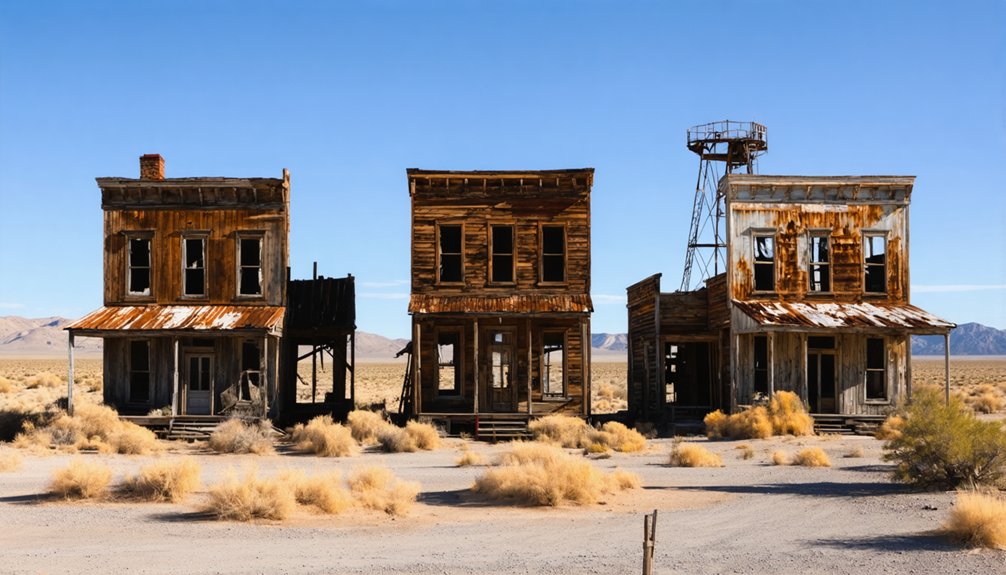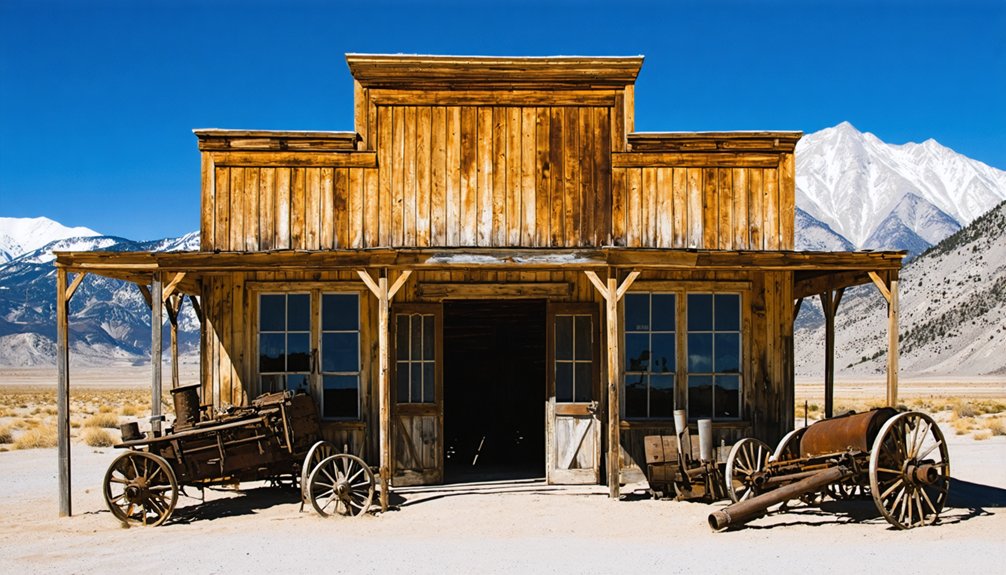
You’ll find Nevada’s mining towns remarkably preserved thanks to several key factors working together. The sudden mass exodus of residents often left buildings and possessions intact, while the desert’s arid climate naturally protects structures from decay. Sturdy construction using local stone and early concrete has withstood time, and the towns’ historical significance attracts tourism and preservation efforts. These ghost towns offer a fascinating window into the American frontier’s golden age, with countless stories still waiting to be discovered.
Key Takeaways
- Nevada’s arid climate prevents wood rot and metal corrosion, with low rainfall and humidity naturally preserving building materials.
- Sudden mass abandonment left towns intact, as residents quickly departed when mines were depleted, preventing gradual deterioration.
- Durable construction methods using local stone and early concrete created resilient structures built to withstand time.
- Active tourism provides economic incentive for preservation, while government protections ensure maintenance and structural stability.
- Community-driven conservation efforts and volunteer groups continually work to restore and maintain historic mining structures.
The Legacy of Sudden Abandonment
While many historic settlements gradually declined over decades, Nevada’s mining towns often experienced dramatic, overnight abandonment that left behind remarkably intact ruins.
When mines abruptly closed due to ore depletion or market changes, entire communities found themselves unable to sustain their populations, triggering swift mass departures.
The sudden abandonment meant residents often left behind their possessions, machinery, and infrastructure intact. You’ll find evidence of this hasty exodus in the form of preserved buildings, abandoned industrial equipment, and untouched business facilities.
The economic collapse happened so quickly that there wasn’t time for systematic salvage operations or gradual dismantling of structures. For example, in Goldfield, the population plummeted from 20,000 to 200 by 1918 as residents moved to other mining camps. Natural disasters like fires and floods sometimes accelerated these departures, further contributing to the preservation of these ghost towns in their moment of abandonment. The landscape reveals tall chimney stacks and broken walls as enduring remnants of these once-thriving communities.
Natural Desert Climate Preservation
Although ghost towns across America face constant deterioration, Nevada’s arid desert climate serves as a natural preservation system that’s dramatically slowed the decay of its abandoned mining settlements.
Efforts to maintain these historical sites have become increasingly important, with many organizations dedicated to preservation efforts in ghost towns. These initiatives not only aim to restore the physical structures but also seek to celebrate the rich history and stories of the communities that once thrived there. By highlighting these preservation efforts, we can foster a deeper appreciation for the cultural heritage that remains in these silent landscapes.
You’ll find that desert preservation stems from multiple climate impacts working together. The region’s low rainfall and humidity prevent wood rot and metal corrosion, while intense sunlight acts as a natural disinfectant.
Without freeze-thaw cycles common in other regions, building materials maintain their structural integrity longer. The dry environment also limits destructive forces like termites, fungi, and aggressive plant growth that typically accelerate decay.
Even the stable desert soils play a role, providing firm foundations that resist shifting and settling, while the lack of vegetation prevents root damage to structures. Many of these preserved sites are now being evaluated as renewable energy locations to support Nevada’s clean energy goals. Current regulations based on the 1872 Mining Act still influence how these historical lands can be used today.
Durable Construction Materials and Methods
During the town’s development in 1905, buildings evolved rapidly from basic tents to structures made with sturdy mining materials, demonstrating the durability that has allowed many to survive as ruins to this day. The Tonopah-Goldfield period around 1901 brought an influx of wealth that enabled the construction of more permanent buildings.
Stone Foundations Endure Time
Since Nevada’s early mining days, stone foundations have proven remarkably resilient against the test of time, particularly in sheltered canyon locations where protection from harsh elements enhances their durability.
You’ll find that the region’s dry desert climate considerably slows decay, while the stone’s natural resistance to weathering guarantees foundation longevity far beyond what wood structures could achieve.
The secret to this stone resilience lies in both material selection and engineering wisdom. Miners used locally quarried stone that was perfectly adapted to the environment, building deep and wide foundations with precisely fitted stones.
They understood drainage requirements and positioned structures on stable ground, often incorporating early concrete formulations for added strength. This engineering expertise is especially evident at Tunnel Camp, where the brick mill office still stands partially intact today.
These careful construction methods, combined with minimal human interference after abandonment, have preserved these engineering marvels for over a century. A 1962 survey revealed approximately 3,000 cemeteries across Nevada, demonstrating the extensive reach of these mining settlements.
Masonry Construction Techniques Prevail
The enduring legacy of Nevada’s mining towns rests heavily on their masonry construction techniques, which you’ll find exemplified in structures throughout the region.
The Stewart Vernacular style, developed specifically for Northern Nevada’s conditions, showcases the resourcefulness and expertise of local craftsmen, particularly Native American masons who mastered these techniques. The Wungnema family contributed significantly to this architectural heritage through their expert stonemasonry work. These building methods proved essential as the intense vibrations from nearby stamp mills required especially sturdy foundations.
- You’ll notice the superior structural integrity in buildings that combine local stone with brick and metal reinforcements, creating resilient structures against mining vibrations.
- The masonry techniques employed maximize heat dissipation and wind resistance, essential for desert survival.
- You’ll see interlocking timber-masonry junctions strengthened by iron elements.
- Look for the distinctive cut stone walls and brick chimneys in mill buildings, designed to withstand industrial use while maintaining thermal stability.
Metal Infrastructure Still Stands
While masonry techniques laid the foundation for Nevada’s mining towns, metal infrastructure emerged as a revolutionary force in preserving these historical sites.
You’ll find that steel frameworks replaced timber throughout these towns, dramatically improving structural integrity and fire resistance. The metal durability proved exceptional in Nevada’s harsh desert climate, where traditional wooden structures would’ve quickly deteriorated.
What’s particularly impressive is how engineers maximized preservation through precise welding techniques and modular designs. They used steel mesh netting and bars spaced at 5 ¾ inch intervals to reinforce buildings and secure mine shafts.
The combination of metal infrastructure with polyurethane foam effectively sealed abandoned mines while preserving their historical features.
Today, these metal components continue to protect mining artifacts and original architecture, allowing you to experience authentic 19th-century mining heritage.
Preservation Through Active Tourism
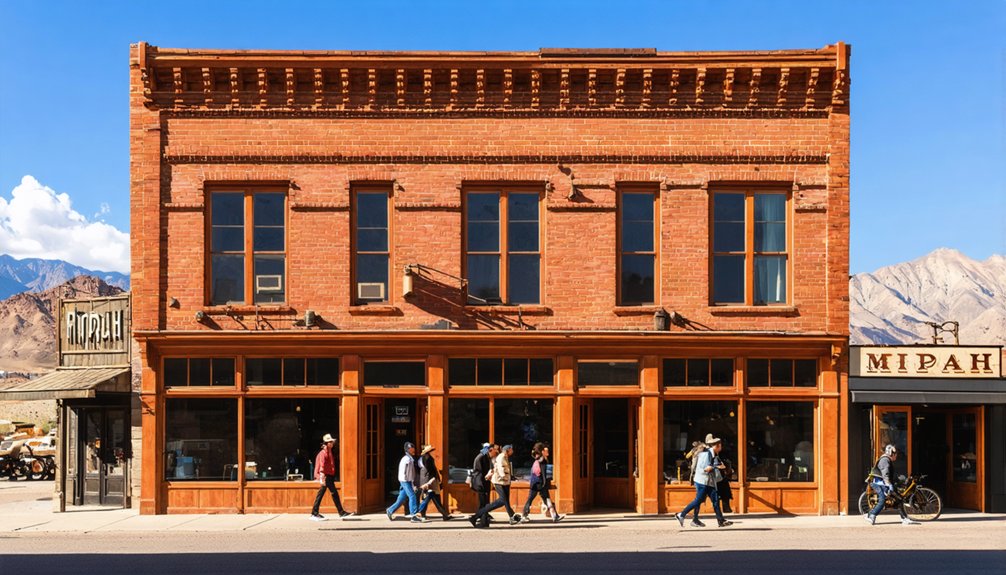
Mining towns across Nevada have transformed their rich historical legacy into vibrant tourist destinations, creating a sustainable path for preservation through active engagement.
Tourism benefits extend beyond economic diversification, safeguarding these historic sites while offering authentic experiences of the American West.
Through thoughtful tourism, Nevada’s historic mining sites live on, preserving the rugged spirit of Western heritage for modern explorers.
You’ll discover these preservation efforts through:
- Immersive guided tours at locations like Tonopah Historic Mining Park Museum, where you can explore original mining structures.
- Self-guided adventures through ghost towns like Berlin, featuring both mining remnants and unique attractions like fossil displays.
- Interactive experiences in Virginia City, where you can walk historic boardwalks and visit preserved saloons.
- Art installations at places like Rhyolite’s Goldwell Open Air Museum, which blend history with contemporary culture.
These experiences keep Nevada’s mining heritage alive while ensuring these towns’ survival through tourism-driven preservation.
Government Protection and Historical Status
Beyond tourism-driven preservation, Nevada’s mining towns benefit from robust government protections that guarantee their long-term survival.
You’ll find many of these sites have earned legal designations as historic landmarks, which impose strict preservation guidelines on any alterations or development. These protections assure the towns retain their authentic character while receiving essential maintenance funding.
When you explore these preserved sites, you’re witnessing the results of carefully crafted zoning laws and regulatory oversight.
State and federal agencies collaborate to fund structural stabilization, create visitor centers, and maintain infrastructure. Many towns have been integrated into state and national parks, providing them with dedicated staff and resources.
Through these combined efforts, you’re able to experience these remarkable pieces of Nevada’s mining heritage in their most authentic state.
Community-Driven Conservation Efforts

You’ll find local heritage groups taking charge of preservation initiatives across Nevada’s historic mining towns, with organizations like Friends of Sutro Tunnel spearheading infrastructure restoration projects.
These grassroots efforts rely heavily on volunteer participation to maintain historical authenticity while addressing modern safety and accessibility requirements.
Through community-led programs and hands-on restoration work, local nonprofits guarantee that mining heritage remains both protected and meaningfully connected to current residents.
Local Heritage Groups Lead
Dedication drives the tireless efforts of Nevada’s heritage preservation groups as they spearhead community-based initiatives to protect the state’s historic mining towns.
Through strategic heritage advocacy and community stewardship, organizations like Preserve Nevada coordinate with locals, government officials, and nonprofits to safeguard these irreplaceable cultural treasures.
- You’ll find preservation groups securing hundreds of thousands in grant funding for critical restoration projects.
- They’re actively engaging communities through seasonal guided tours and educational programs.
- They’re fostering connections between lawmakers and activists to strengthen legislative support.
- You can see their impact in successful fundraising campaigns that guarantee long-term site sustainability.
These grassroots efforts have transformed local residents into passionate guardians of their mining heritage, creating a powerful network of preservation advocates across Nevada.
Volunteer Restoration Projects Thrive
While funding remains limited for many preservation initiatives, volunteer restoration projects have become the backbone of Nevada’s mining town conservation efforts. You’ll find dedicated community members engaging in hands-on work, from structural repairs to archival documentation, maximizing preservation impact with minimal costs.
Organizations like Friends of Sutro Tunnel and the Comstock Foundation drive volunteer engagement through coordinated programs. Their efforts include trail maintenance, invasive species removal, and restoration of landmark structures.
Community involvement extends beyond physical labor – volunteer docents provide historical interpretation, while educators develop curricula and lead workshops about mining heritage.
These projects create lasting impact through collaborative partnerships among nonprofits, government agencies, and local businesses, ensuring both the infrastructure and educational components of preservation continue to thrive.
Mining Infrastructure’s Lasting Impact
As Nevada’s mining industry flourished in the late 1800s, it left an indelible mark through extensive infrastructure development that shaped the state’s modern landscape.
You’ll find these robust mining networks still visible today, showcasing the transportation evolution that connected remote camps to civilization. The infrastructure’s durability wasn’t just coincidental – it reflected careful planning and substantial investment.
- Rail lines and stagecoach stations created essential supply chains that you can still trace through preserved depots.
- Timber and brick structures have withstood time’s test, with many original buildings serving as heritage landmarks.
- Roads carved through challenging terrain remain active thoroughfares, linking former boom towns.
- Transportation infrastructure helped mining communities survive by enabling efficient movement of workers and resources, creating lasting economic corridors.
Cultural Memory and Family Connections

You’ll find rich family histories etched in the weathered headstones of Nevada’s mining town cemeteries, where descendants continue to honor their ancestors through regular visits and memorial practices.
Local historical societies work tirelessly to document and preserve these cultural connections, maintaining archives of photographs, documents, and oral histories that tell the story of each community’s development.
The strong multi-generational ties to these towns manifest through active preservation efforts, as families who’ve maintained properties for decades contribute their personal artifacts and memories to guarantee their heritage endures.
Cemeteries Tell Family Stories
The silent stone markers of Nevada’s mining town cemeteries hold generations of family stories etched in granite and marble.
Within these sacred grounds, you’ll discover intricate family inscriptions and burial plots that reveal the complex tapestry of mining communities’ social fabric and cultural diversity.
- Explore sections dedicated to specific groups like Freemasons and firefighters, reflecting the town’s social structure.
- Witness the enduring legacy through carefully arranged family burial plots, where generations rest side by side.
- Find evidence of ethnic heritage through multilingual inscriptions and cultural symbols.
- Trace migration patterns and family connections through dates and locations carved in stone.
Even as the mining towns fade into history, these cemeteries remain vibrant chronicles of the families who built these communities, preserved through ongoing restoration efforts and regular visits from descendants.
Local Societies Preserve History
Throughout Nevada’s historic mining communities, dedicated local societies work tirelessly to safeguard cultural heritage through systematic preservation efforts.
You’ll find these organizations meticulously cataloging endangered structures, curating artifacts, and maintaining archives that tell rich stories of the mining era.
Local engagement flourishes as these societies transform museums and heritage centers into essential community spaces. They collect family memorabilia, photographs, and mining records that connect you to the town’s past.
Through historical storytelling initiatives, including guided tours and interpretive exhibits, you can experience firsthand accounts of mining life.
The societies also collaborate with Preserve Nevada to protect significant sites, from Victorian mansions to industrial structures like headframes and hoist houses. Their work guarantees that each town’s unique cultural identity remains intact for future generations to explore.
Multi-Generational Town Connections
Deep within Nevada’s historic mining communities, multi-generational families serve as living bridges between past and present, maintaining cultural continuity through shared memories and traditions.
You’ll find family heritage woven through every aspect of these resilient towns, from the annual mining festivals to the family-run businesses that have operated for generations.
- Descendants of original settlers preserve invaluable oral histories through communal storytelling, keeping mining tales and local folklore alive.
- Family-owned properties and businesses continue to anchor the community’s economic foundation.
- Personal artifacts, photos, and documents contribute to rich community archives.
- Strong kinship networks maintain historic sites, organize commemorative events, and guarantee cultural preservation.
These enduring family connections don’t just preserve buildings – they keep the spirit and identity of mining towns vibrant and authentic.
Modern Heritage Tourism Economics
While Nevada’s mining industry continues to thrive, modern heritage tourism has emerged as an essential economic force in the state’s historic mining towns.
Heritage tourism now stands alongside Nevada’s thriving mining sector, breathing new economic life into the state’s historic boomtowns.
You’ll find these communities actively pursuing economic diversification through tourism infrastructure development, generating billions in revenue while protecting their authentic character. The strategy’s working – tourism now supports thousands of jobs across rural Nevada, providing stability when mineral markets fluctuate.
You can see the impact in places like Virginia City, where preservation restrictions maintain the historic atmosphere that draws visitors.
Federal grants and capital investments help these towns enhance their tourism facilities while staying true to their roots. It’s a smart approach that’s paid off, with heritage tourism now serving as a reliable economic pillar alongside traditional mining activities.
Archaeological Significance and Research Value
Nevada’s mining towns serve as invaluable archaeological time capsules, offering researchers unprecedented insights into both prehistoric and historic mineral extraction activities.
These well-preserved sites reveal layers of human ingenuity spanning over 10,000 years, from indigenous techniques to industrial-era innovations.
You’ll find remarkable evidence of our mining heritage in these locations:
- Ancient stone tools and Clovis points near Carson Sink showcase sophisticated indigenous mining techniques dating back millennia.
- Preserved turquoise mines near Boulder City demonstrate Native American lapidary expertise from 300-1200 A.D.
- Original infrastructure in places like Goldfield’s Florence Mine provides intact examples of 19th-century industrial methods.
- Virginia City’s multicultural archaeological remains, including Chinatown artifacts, tell stories of diverse communities that shaped Nevada’s mining history.
Frequently Asked Questions
What Personal Items Did Miners Typically Leave Behind When Abandoning These Towns?
You’ll find miner’s tools like picks and pans, plus personal belongings including worn clothing, pocket watches, letters, and household items they couldn’t transport during rushed departures from failing towns.
How Do Winter Temperatures and Snowfall Affect the Preservation of Ghost Towns?
With temperatures dropping below 0°F in winter, you’ll find that cold climate acts as a natural preservation technique, slowing decay while snow insulates structures and limits biological deterioration.
Did Indigenous Communities Reoccupy Any Abandoned Mining Towns After Their Desertion?
You won’t find evidence of widespread indigenous reoccupation of Nevada’s abandoned mining towns, though native communities maintained cultural significance through seasonal activities and spiritual connections to their ancestral territories nearby.
Which Ghost Towns Have Reported Paranormal Activity or Unexplained Phenomena?
Like whispers from the past, you’ll encounter ghost sightings and unexplained noises at Rhyolite, Belmont’s courthouse, Goldfield’s historic hotel, and Nelson’s mine shafts – each telling tales of paranormal encounters.
How Did Railroad Construction Influence Which Mining Towns Survived Versus Disappeared?
You’ll find that towns along major railroad routes thrived due to efficient ore transport and steady supplies, while isolated towns without rail access couldn’t maintain economic viability and often disappeared entirely.
References
- https://www.smithsonianmag.com/sponsored/nevadas-living-and-abandoned-ghost-towns-180983342/
- https://www.youtube.com/watch?v=kg18CwWeMnc
- https://www.pbslearningmedia.org/resource/nevada-ghost-towns-video-gallery/outdoor-nevada/
- https://www.unlv.edu/news/article/hallmarks-history-preserve-nevada-releases-most-endangered-list
- https://travelthruhistory.com/reviving-the-past-exploring-the-ghost-towns-of-nevada/
- https://www.nps.gov/deva/learn/historyculture/perils-of-opportunity-the-mining-towns.htm
- https://savingplaces.org/stories/explore-wild-west-mining-history-in-nevada-ghost-towns
- https://www.rgj.com/story/life/2025/10/17/nevada-town-spookiest-place/86729038007/
- https://lasvegassun.com/features/finding-nevada/2013/oct/23/why-two-city-slickers-would-move-old-nevada-mining/
- https://findingnevadawild.com/goldfield-the-old-west-lives-in-nevadas-best-ghost-town/