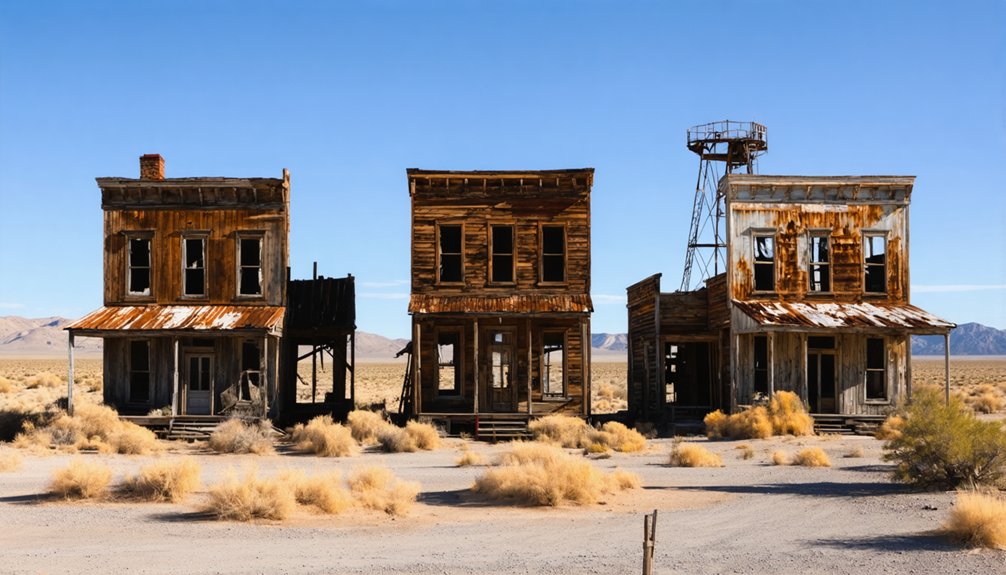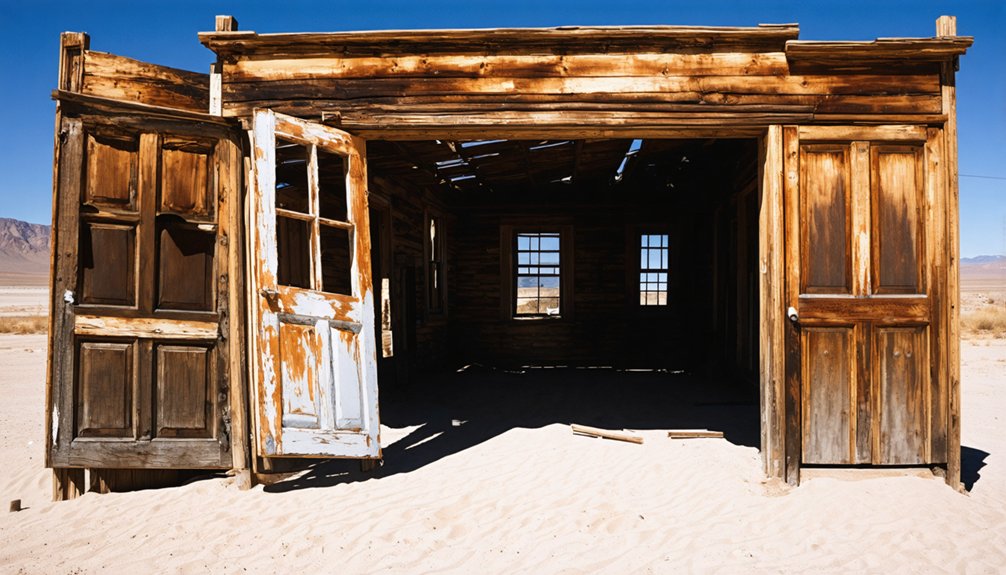
Nevada’s ghost town architectures provide you with tangible evidence of America’s dynamic mining heritage, spanning from the 1859 Comstock Lode discovery through the Tonopah-Goldfield boom of 1901. You’ll find innovative engineering solutions like square set timbering and the Sutro Tunnel’s drainage systems, alongside cultural hubs that showcased economic prosperity through premium materials and multi-functional spaces. These preserved structures, generating $2.4 billion annually in tourism, reveal deeper stories of frontier life and technological advancement.
Key Takeaways
- Nevada’s ghost towns preserve authentic structures from two major mining booms, documenting the state’s pivotal role in American westward expansion.
- The architecture demonstrates innovative engineering solutions like square set timbering and adaptive building strategies for harsh desert environments.
- Buildings reflect the economic prosperity and social dynamics of mining communities through their design, materials, and multi-functional spaces.
- Ghost town structures serve as outdoor classrooms, providing tangible evidence of frontier life and mining heritage education.
- The preserved architecture generates significant tourism revenue, contributing approximately $2.4 billion annually in industry-specific taxes to Nevada.
Legacy of Nevada’s Mining Boom Era
While the discovery of the Comstock Lode in 1859 catalyzed Nevada’s most significant mining boom, the architectural legacy of this era extends far beyond Virginia City’s famous silver strike.
You’ll find this mining legacy etched into the landscape through rapid boomtown development along railroad corridors, where towns emerged virtually overnight to support mineral exploration and extraction.
The Tonopah-Goldfield second mining boom beginning in 1901 created another wave of architectural development across the state.
The architectural evolution of these settlements directly mirrors the economic cycles of Nevada’s mining industry, from the Rush to Washoe through Tonopah’s early 1900s silver boom.
From humble mining shacks to grand brick edifices, Nevada’s architectural heritage echoes the boom-and-bust rhythm of its mineral wealth.
Native Americans left their mark on these landscapes through their own early mining activities, harvesting precious minerals like turquoise and obsidian for tools and trade.
As you explore these ghost towns today, you’ll witness how the structures embody both the tremendous wealth and subsequent decline of these communities, reflecting a time when mining camps transformed into bustling cities, only to later stand as evidence to the transient nature of resource-based economies.
Engineering Feats and Building Innovations
Because Nevada’s mining operations demanded innovative solutions to unprecedented engineering challenges, the towns that sprouted around these sites became testbeds for architectural and structural advances.
You’ll find groundbreaking engineering innovations like square set timbering, which revolutionized underground support systems through interlocking timber frameworks. These advances enabled deeper mining and safer excavation in unstable formations.
The architectural adaptations weren’t limited to mines alone. You can trace how the Sutro Tunnel’s sophisticated drainage systems transformed mining capabilities, while integrated processing facilities showcased industrial planning efficiency. Like the town of Bodie, which saw a rapid population surge to 10,000 residents, these settlements required swift architectural solutions to meet growing demands.
The towns’ buildings reflected this innovative spirit, combining local materials with practical designs. From Julia Morgan’s harmonious use of regional resources to the evolution from basic wood structures to refined brick and stone edifices, these architectural solutions demonstrated the mining communities’ technical ingenuity and determination. The remnants of cyanide tanks and mills still visible in towns like Midas serve as testament to the advanced ore processing methods employed during the mining era.
Cultural and Social Life Through Architecture
You’ll find saloons served as essential community hubs in Nevada’s ghost towns, where miners gathered not just for drinks but for social connection, information exchange, and business dealings.
The architectural remains of schoolhouses, particularly their prominent positioning and substantial construction, demonstrate these frontier communities’ commitment to education despite harsh circumstances. These well-preserved structures now serve as tourism destinations for history enthusiasts wanting to explore Nevada’s past.
Multi-purpose buildings like hotels and lodging houses functioned as cultural melting pots, where diverse ethnic groups intersected through commerce, accommodation, and social gatherings. The Goldfield Hotel exemplified this with its mahogany furnished lobby that hosted both wealthy bankers and prospectors alike.
Saloons As Community Centers
Three distinct architectural features defined Nevada’s ghost town saloons as vibrant community centers: their multi-functional layouts, premium materials, and strategic locations.
You’ll find saloon architecture designed to facilitate diverse community gatherings, from simple shacks to grand multi-story halls that reflected each town’s prosperity. The spaces featured high-quality Brunswick bars and separate rooms serving distinct social functions, while dance floors and stages enabled entertainment events. Popular live music entertainment drew crowds nightly, creating unforgettable social experiences.
These establishments weren’t just drinking spots – they were deliberately positioned near mines, railroads, and hotels to maximize accessibility. In Rhyolite’s heyday, the town boasted fifty bustling saloons that served as essential gathering spaces.
Through their sophisticated designs, saloons hosted political meetings, union gatherings, and social events that shaped local culture. Some even incorporated hidden passages and connected to red-light districts, revealing complex layers of frontier social life.
Educational Building Legacy Remains
While many structures in Nevada’s ghost towns succumbed to time, surviving educational buildings like the Goldfield Historic High School stand as powerful symbols of these communities’ cultural aspirations.
You’ll find these architectural testimonies were among the first permanent structures built, showcasing the settlers’ commitment to educational preservation and community identity.
Unlike typical mining camp buildings, these schools featured durable materials and thoughtful designs, including cathedral-style doors, bell towers, and multi-purpose spaces that served both academic and social functions.
You’re witnessing more than just classrooms – these were cultural anchors that fostered community bonds through shared gatherings and events.
Today, their preserved ruins offer direct connections to early 20th-century Nevada, revealing how boomtown residents prioritized education and social order amid the uncertainty of mining life.
The building’s significance is further enhanced by four distinct schools constructed between 1906-1908, demonstrating the town’s rapid educational expansion during its gold rush prosperity.
As evidenced in Mineral City’s history, these educational structures often featured brick construction, setting them apart from the more common wooden buildings of the era.
Multi-Cultural Meeting Spaces
Deep within Nevada’s ghost towns, architectural evidence reveals a rich tapestry of multi-cultural meeting spaces that shaped frontier social life from 300 A.D. through the mining boom era.
You’ll find these spaces in ancient Puebloan settlements along the Muddy River, where adobe structures and pit houses facilitated multi-ethnic interactions between diverse native groups.
Later, mining boomtowns like Belmont and Rhyolite featured false-front buildings that housed vibrant communal gatherings in saloons, dance halls, and ethnic social clubs.
The architecture adapted to serve immigrant communities, with distinctive meeting halls preserving cultural traditions while encouraging integration.
From the Lost City Museum’s preserved adobe bricks to Belmont’s Cosmopolitan Saloon, these structures tell the story of Nevada’s dynamic social exchanges across centuries.
Preservation and Tourism Impact
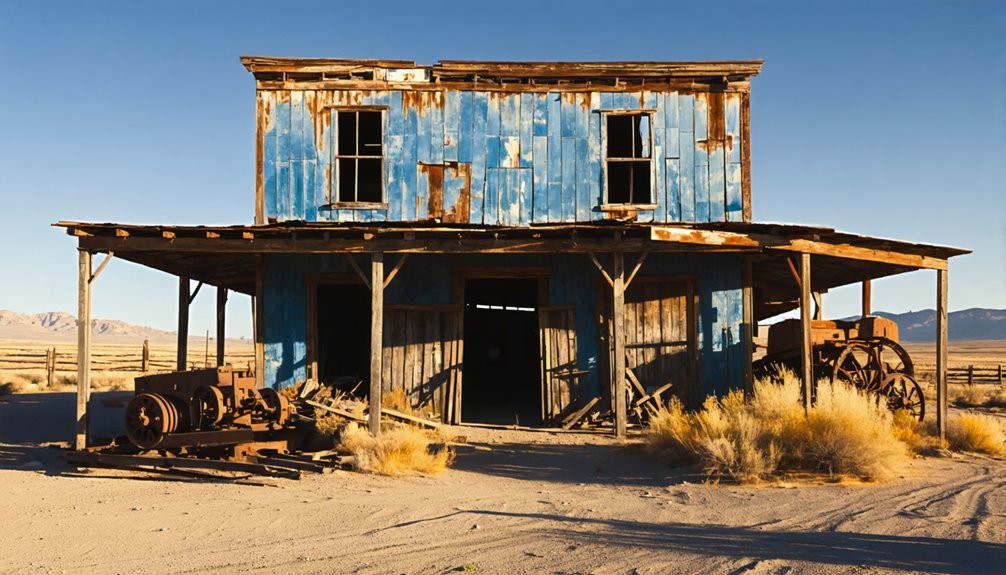
You’ll find Nevada’s ghost town architecture serves as a vital economic engine, generating substantial heritage tourism revenue through carefully preserved structures like the Goldfield Hotel and Esmeralda County Courthouse.
The restoration methods prioritize authenticity, with technicians stabilizing original materials and architectural details while protecting against the harsh desert environment.
Through these preserved buildings, you’re able to experience hands-on cultural education via guided tours, museums, and interactive exhibits that illuminate the region’s mining heritage and Old West history.
Heritage Tourism Revenue Growth
Revenue from heritage tourism stands as a crucial economic pillar in Nevada, generating approximately one-third of the state’s general fund through historical site visitation and related activities.
You’ll find this sector’s growth reflected in the $18 billion investment in tourism-related capital projects, with significant portions dedicated to ghost town preservation and promotion.
The economic trends show visitor numbers peaked at 41.6 million between 2020 and 2024, creating a robust market for heritage tourism that’s helped offset declining casino revenues.
You’re witnessing a transformation where ghost towns have become essential economic assets, generating $2.4 billion annually in industry-specific taxes.
This revenue stream supports local businesses, creates diverse employment opportunities, and funds important public services in rural communities, though recent downturns highlight the sector’s vulnerability to broader economic fluctuations.
Authentic Building Restoration Methods
Building restoration in Nevada’s ghost towns follows rigorous protocols that balance historical authenticity with structural integrity.
You’ll find restoration techniques focus on stabilizing exteriors while preserving original materials, only adding new wood when essential. The process typically starts with rolled asphalt roofing before shifting to period-correct cedar shingles.
To maintain architectural integrity, crews install 2×4 internal frames that strengthen walls while protecting original exterior boards.
They’ll carefully integrate modern necessities like electrical wiring and insulation within these new frames, ensuring they’re hidden from view. You can spot authentic touches through the use of recycled materials, including metal tin siding and salvaged timber.
When preservation requires new materials, they’re meticulously matched to historical specifications, maintaining the structure’s genuine character while supporting heritage tourism.
Cultural Education Through Architecture
Through meticulous preservation efforts, Nevada’s ghost town architectures serve as dynamic outdoor classrooms that illuminate the state’s rich mining heritage.
When you explore these historical sites, you’ll discover cultural narratives embedded within every structure, from the Mission-style train depot in Rhyolite to the ornate Goldfield Hotel. The architectural symbolism reveals distinct social hierarchies and community dynamics of frontier life.
You can trace the evolution of mining communities through preserved courthouses, saloons, and union halls, each telling stories of prosperity, struggle, and resilience.
These sites don’t just showcase construction methods; they’re portals into the past where you’ll understand how early settlers adapted to harsh frontier conditions.
Through guided tours and educational programs, you’ll experience firsthand the authentic layout and socioeconomic patterns that shaped Nevada’s Wild West identity.
Adaptive Desert Architecture Styles
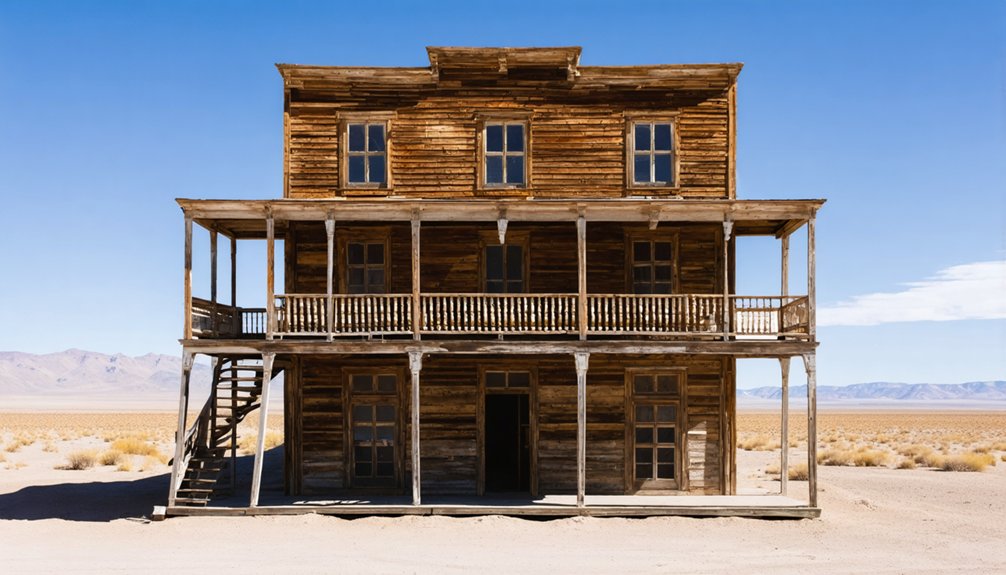
While harsh desert conditions posed significant challenges for Nevada’s boomtown architects, they developed remarkably effective adaptive building strategies that balanced rapid construction needs with environmental considerations.
You’ll find sustainable materials like locally sourced stone and concrete formed the backbone of these structures, demonstrating early principles of adaptive reuse in frontier construction.
Thick masonry walls served as natural insulators, maintaining comfortable temperatures despite extreme weather fluctuations.
Masonry walls provided essential temperature control, acting as a buffer against the desert’s dramatic daily swings between scorching heat and frigid cold.
Buildings featured strategic orientations and spacing to maximize shade and airflow, while innovative roof designs using galvanized iron and Spanish tiles provided durability against intense sun exposure.
You’ll notice how covered walkways and bell cupolas weren’t mere decorative elements – they served practical purposes in managing the desert climate while meeting residents’ daily needs.
Archaeological Value and Historical Documentation
These desert architectural remnants serve as invaluable archaeological records that document Nevada’s mining era with remarkable precision.
You’ll find archaeological findings scattered throughout preserved structures, from the Rhyolite train depot to Belmont’s courthouse, revealing intricate details about frontier economics and social dynamics.
Standing mills, mine shafts, and processing facilities showcase 19th-century technological innovations, while historical artifacts within miner cabins offer glimpses into daily life.
The sites tell deeper stories through their cemeteries, like Goldfield’s ethnic burial plots and Pioche’s Boot Hill, documenting demographic patterns and social tensions.
You can trace community development through courthouse records, while photographic archives of the “Million-Dollar Courthouse” and Berlin’s 30-stamp mill provide visual authentication of the region’s rapid boom-and-bust cycles.
Frequently Asked Questions
What Role Did Chinese Laborers Play in Constructing Nevada’s Ghost Town Buildings?
You’ll find Chinese contributions encompassed construction of buildings, infrastructure, and settlements through skilled carpentry, woodcutting, and labor dynamics that shaped Nevada’s ghost towns’ distinctive architectural character despite discrimination.
How Did Railroad Accessibility Influence Architectural Styles in Different Ghost Towns?
Like steel tracks linking distant shores, railroad expansion transformed ghost town architecture. You’ll find Spanish Revival depots and grand masonry banks in rail-connected towns, while remote settlements relied on simpler, locally-sourced building materials.
As these towns thrived, other sites fell into obscurity, leaving behind ghostly legends of abandoned naval bases. These maritime relics, once bustling with activity, now stand silent against the backdrop of crashing waves, harboring stories of forgotten sailors and lost missions. Exploring these eerie locations invites a glimpse into the past, revealing the cultural tapestry that once intertwined with the nation’s naval history.
What Methods Were Used to Heat and Cool These Buildings?
You’ll find thick adobe walls provided natural insulation techniques, while ventilation systems included wind catchers and wet burlap cooling rooms, complemented by steam heating and early swamp coolers in the 1920s.
How Did Native American Communities Interact With These Mining Town Structures?
At Moapa Valley, you’ll find Native Americans adapted mining structures for temporary shelter while maintaining cultural exchanges through trade, though many communities actively avoided settler buildings due to territorial conflicts.
What Impact Did Prohibition Have on Ghost Town Saloon Architecture?
You’ll find saloon design adapted with hidden rooms, secret tunnels, and false storefronts during Prohibition, creating historical significance through architectural features that tell stories of resistance and underground operations.
References
- https://findingnevadawild.com/goldfield-the-old-west-lives-in-nevadas-best-ghost-town/
- https://www.smithsonianmag.com/sponsored/nevadas-living-and-abandoned-ghost-towns-180983342/
- https://travelthruhistory.com/reviving-the-past-exploring-the-ghost-towns-of-nevada/
- https://www.youtube.com/watch?v=kg18CwWeMnc
- https://savingplaces.org/stories/explore-wild-west-mining-history-in-nevada-ghost-towns
- https://www.worldatlas.com/cities/this-small-nevada-town-has-the-best-downtown.html
- https://travelnevada.com/ghost-town/
- https://nvtami.com
- https://www.pbslearningmedia.org/resource/nevada-ghost-towns-video-gallery/outdoor-nevada/
- https://www.rgj.com/story/life/2025/10/17/nevada-town-spookiest-place/86729038007/