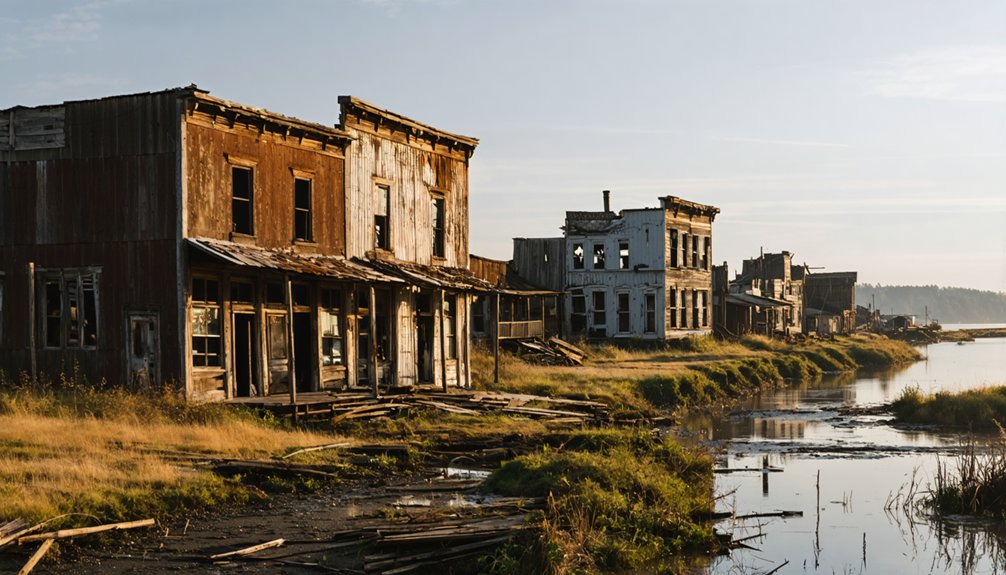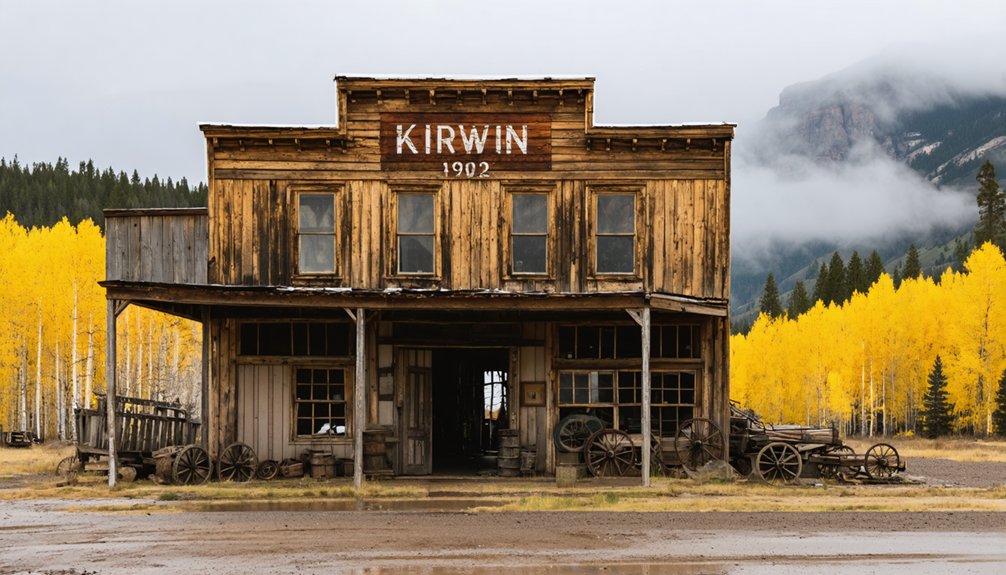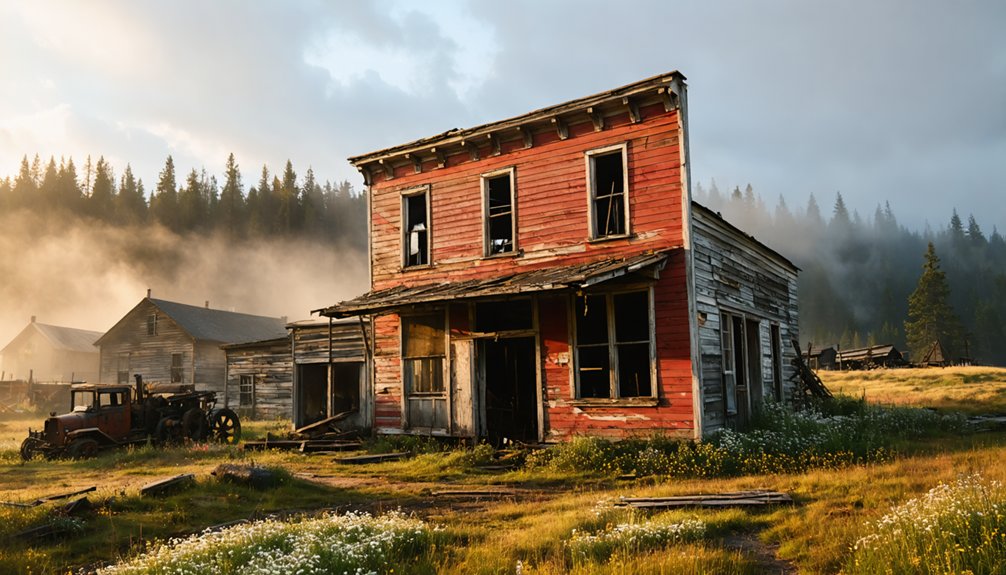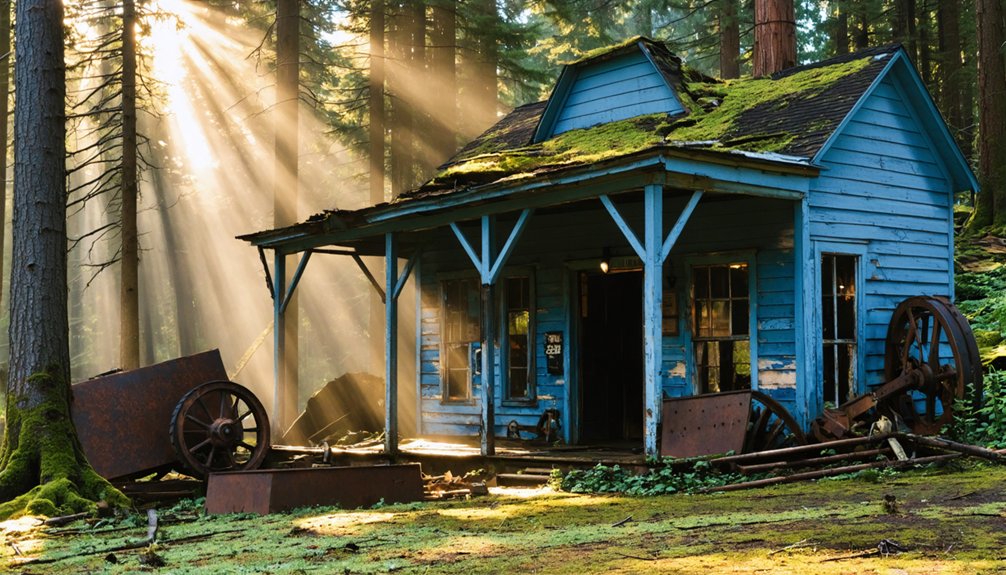
Oregon’s hidden ghost towns offer you a unique window into the American West’s diverse history, where gold rush settlements, wool trade centers, and logging communities once thrived. You’ll find distinctive features like Golden’s saloon-free heritage, Maxville’s African American logging history, and Shaniko’s wool trading legacy. Nature has transformed these abandoned places into accidental sanctuaries, while preserved structures and archaeological discoveries tell complex stories of cultural diversity. These forgotten towns hold countless mysteries waiting to be uncovered.
Key Takeaways
- Oregon ghost towns uniquely showcase diverse industries, from gold mining to wool trading, reflecting the state’s varied economic history.
- Many towns maintain well-preserved original structures, like Buncom’s buildings and Golden’s historic church, providing authentic glimpses into frontier life.
- Natural reclamation has transformed abandoned settlements into accidental wildlife sanctuaries, creating unique ecosystems within historic ruins.
- These sites preserve stories of diverse communities, including Chinese miners and African American loggers, highlighting Oregon’s multicultural heritage.
- The towns’ locations span diverse landscapes, from coastal areas to forests and arid zones, creating distinct patterns of preservation.
The Gold Rush Legacy: Birth of Oregon’s Ghost Towns
When gold was discovered across Oregon’s rivers and creeks in the 1840s and 1850s, it sparked a dramatic transformation of the region’s landscape.
Gold’s discovery in Oregon’s waterways during the mid-1800s forever changed the untamed wilderness into a landscape of opportunity.
You’ll find that these initial gold discoveries led to the rapid emergence of mining camps and settlements along waterways like Coyote Creek and the Illinois River. What started as simple tent cities quickly evolved into bustling frontier towns, strategically positioned near prime mining locations and crucial supply routes.
Notable settlements like Golden, Sterlingville, Buncom, and Granite emerged as crucial hubs for the influx of prospectors. These ghost towns now serve as time capsules revealing insights into historical lifestyles.
Many of these abandoned towns in the American West are nestled in remote valleys and surrounded by breathtaking landscapes. Visitors often explore the remnants of the once-thriving communities, where the echoes of past lives linger in the air. Walking through these desolate streets can evoke a deep sense of nostalgia and wonder about the dreams that drew people to this rugged frontier.
These communities attracted diverse populations, including significant numbers of Chinese miners who temporarily dominated certain areas. Each town developed its own character, with crucial businesses springing up to support the mining operations – from general stores and post offices to boarding houses and warehouses. Golden stood out from other settlements as it was the only mining town that proudly maintained its status as a saloon-free community.
From Bustling Trade Centers to Silent Streets
As you travel Oregon’s back roads, you’ll discover how stagecoach routes once determined the placement of trading posts that grew into vibrant towns.
The rise of wool shipping centers like Shaniko, which handled over 4 million pounds of fleece annually, transformed simple crossroads into bustling commercial hubs connected by rail networks. Many ghost towns still attract visitors, like Bridal Veil where wedding invitations flow through its historic post office by the thousands.
These communities thrived until shifting transportation patterns and evolving industries pulled populations away, leaving behind the quiet remnants of once-prosperous trade centers. Today, Oregon stands as home to 200 ghost towns, the highest count of any state in America.
Stagecoach Routes Shaped Towns
Throughout Oregon’s early development, stagecoach routes served as the essential arteries that determined where towns would emerge and flourish. These transportation networks shaped the very foundations of frontier settlements, creating critical hubs where stagecoach infrastructure and commerce intersected. The Sumpter Valley Railroad established Whitney as a vital stage stop, connecting it to surrounding mining and lumber communities. Inskip Station operated a bustling stagecoach line in the 1860s, becoming a crucial ranch house stop for travelers.
- Post offices, hotels, and general stores sprang up to serve weary travelers.
- Churches and schools formed the social backbone of these growing communities.
- Blacksmith shops and gristmills supported both locals and passing freight.
- Saloons and warehouses catered to diverse commercial needs.
- Strategic stopping points attracted settlers and spurred town development.
You’ll find that many of these once-bustling centers, like Shaniko and Whitney, emerged specifically to support stage line operations.
As transportation evolution brought railroads, these towns faced decline, their original purpose diminished by newer, faster routes that often bypassed them completely.
Wool Trade Built Communities
The story of Oregon’s ghost towns extends beyond stagecoach stops to reveal remarkable wool trade empires that rose and fell in the early 1900s.
You’ll find this legacy powerfully embodied in Shaniko, where wool commerce transformed a simple farmstead into the “Wool Capital of the World” by 1903.
At its peak, you could witness millions of pounds of wool flowing through Shaniko’s massive warehouses, with single sales exceeding five million dollars by 1904. The town’s prosperity attracted 600 residents and spawned impressive infrastructure, including a 10,000-gallon water tower.
But this trade legacy proved fragile. When competing railways emerged and devastating fires struck in 1910-1911, Shaniko’s boom ended abruptly. The Columbia Southern Railroad had initially made the town prosper as its terminus point.
Today, you’ll find only 20-30 residents preserving the town’s rich wool trading heritage through museums and annual festivals. The Shaniko Days festival each August keeps the spirit alive with gunfight shows and artisan vendors.
Industries Drove Population Shifts
When bustling industries swept through Oregon in the 19th and early 20th centuries, they transformed remote locations into vibrant economic hubs, only to later abandon them as ghost towns.
You’ll find that logging town dynamics and transportation impacts played essential roles in these dramatic population shifts.
- Gold rushes sparked instant towns like Golden and Sumpter, complete with saloons and mills.
- Logging companies built segregated communities like Maxville, drawing workers from the South.
- Railroad connections determined whether towns thrived or withered.
- Federal interventions, like the 1942 gold mine closures, triggered mass abandonments.
- Natural disasters and fires accelerated many towns’ demise.
Maxville’s Jim Crow segregation design dictated where Black and white families could live, with Black residents confined to areas across the tracks in mass-produced housing.
Shaniko emerged as a major wool center for Central and Eastern Oregon, demonstrating how agricultural commerce could drive a town’s growth.
These boom-and-bust cycles created a landscape dotted with remnants of once-thriving communities, each telling a story of resource exploitation, technological change, and economic transformation that shaped Oregon’s development.
Nature’s Reclamation of Historical Sites
As time marches forward, Oregon’s ghost towns steadily surrender to nature’s persistent advance, creating haunting tableaus where human ambition once flourished.
Time reclaims Oregon’s abandoned dreams, as nature’s slow siege transforms ghost towns into wild galleries of forgotten ambition.
You’ll witness nature’s reclamation as scotch broom and pine trees breach abandoned streets, while coastal settlements like Bayocean succumb to erosion and shifting sands. This natural preservation process transforms these sites into unexpected wildlife sanctuaries, where buildings become nesting grounds and native vegetation thrives unchecked.
The ecological impact varies dramatically by region.
While coastal ruins face rapid transformation from tidal forces, inland ghost towns disappear beneath dense forest canopies. In arid zones, sun and wind slowly crumble remaining structures.
You’ll find these forgotten places serve as accidental nature reserves, where pioneer species establish new ecosystems among the weathered remnants of Oregon’s past.
Cultural Crossroads and Hidden Stories

Beneath crumbling facades and weathered storefronts, Oregon’s ghost towns reveal complex cultural tapestries woven from diverse communities during the state’s formative years.
You’ll discover forgotten narratives of cultural exchange in places like Maxville, where African American loggers built vibrant lives, and Shaniko, where wool merchants created economic bridges between isolated ranchers and distant markets.
- Archaeological finds at Maxville, from Victorian clothing snaps to decorated beads, illuminate daily life of marginalized communities.
- Oral histories preserve stories of multicultural logging camps and their social gatherings.
- Preserved buildings in Shaniko showcase the intersection of commerce and community.
- Historic festivals like Buncom Day celebrate diverse ethnic heritage.
- Ghost towns serve as living museums of Native American, European, African American, and Asian American experiences.
Preserving Oregon’s Forgotten Communities
The preservation of Oregon’s ghost towns represents a complex interweaving of science, community action, and cultural stewardship. You’ll find this exemplified in places like Maxville, where the Heritage Interpretive Center harnesses cutting-edge technology alongside oral histories to map and protect Black logging community sites.
Through heritage preservation efforts, you’re witnessing a transformation in how these sites are studied and maintained. Advanced GPS mapping and archaeological techniques now allow you to understand these settlements with unprecedented precision.
Community engagement drives these initiatives, from the grassroots work of descendants like Gwen Trice to collaborative partnerships with academic institutions. Whether it’s through walking tours, educational outreach, or heritage easements, you’re part of a movement that’s redefining ghost towns from abandoned relics to active historical treasures.
The Living History of Abandoned Places

As you explore Oregon’s ghost towns, you’ll find remnants of mining communities where wooden churches and weathered storefronts stand as silent witnesses to the frontier era.
These preserved structures, from Golden’s pristine church to Shaniko’s planned commercial district, reveal the economic and social dynamics that shaped these once-thriving settlements.
Through these architectural survivors and cultural artifacts, you’re able to trace the complex stories of diverse communities that flourished during the state’s mining, lumber, and wool-trading booms.
Mining Towns Still Standing
Standing defiantly against time’s erosion, Oregon’s historic mining towns offer tangible glimpses into the state’s gold rush era through their weathered yet enduring structures.
These hidden treasures tell stories of boom-and-bust cycles that shaped the region’s mining legacies.
- Buncom stands as one of the best-preserved ghost towns, with several original buildings intact despite decades of abandonment.
- Golden’s unique character shines through its four preserved structures, including a church that bucked mining town tradition by banning saloons.
- Granite’s crumbling 19th-century architecture and faded cemetery markers echo its 5,000-person peak.
- Chinese miners’ influence remains visible in town layouts and worked claims.
- Federal preservation efforts protect these sites while restoration projects, like Golden’s Coyote Creek Wetlands, aim to heal the mining-scarred landscape.
Cultural Heritage Lives On
While stone walls and wooden structures tell part of Oregon’s ghost town story, rich cultural narratives breathe life into these abandoned places through archaeological discoveries and oral histories.
You’ll find this living heritage preserved in places like Maxville, where artifacts reveal the daily lives of Black residents through charred bones, decorated glass, and Levi Strauss rivets. These remnants bridge the gap between hard labor and private moments of joy.
Cultural identity persists through community festivals and oral traditions passed down by descendants.
At sites like the Maxville Heritage Interpretive Center, you’ll discover how diverse populations navigated social structures, from segregated baseball games to unified regional tournaments.
Archaeological findings, combined with descendants’ stories, continue to uncover the complex tapestry of life in these forgotten communities.
Preserved Architecture Tells Stories
The architectural bones of Oregon’s ghost towns reveal stories etched in weathered wood and worn clapboard. Through architectural storytelling, you’ll discover how these silent structures chronicle the dramatic shifts between boom and bust in frontier life.
The preservation significance of these buildings, from mining bunkhouses to weathered churches, offers you an authentic window into 19th-century pioneer experiences.
- Original construction techniques showcase frontier ingenuity and resourcefulness
- Buildings positioned near creeks and forests reflect environmental adaptation
- National Register listings highlight historically significant structures
- Specialized buildings like cookhouses reveal economic and social hierarchies
- Varying states of preservation demonstrate different phases of abandonment
These architectural remnants aren’t just abandoned buildings – they’re physical storytellers that let you step directly into Oregon’s rugged mining and pioneer heritage.
Frequently Asked Questions
Are There Any Reported Paranormal Activities in Oregon’s Ghost Towns?
Like whispers in the wind, you’ll find numerous paranormal sightings in Oregon’s haunted locations, though they’re mostly anecdotal – from unexplained sounds in Sumpter to spectral apparitions in Shaniko and Hardman.
Can Visitors Legally Take Artifacts Found in Ghost Towns?
You can’t legally remove artifacts from Oregon’s ghost towns without proper permits. Artifact preservation laws carry serious legal ramifications, including fines and criminal charges for unauthorized collection from these protected sites.
Which Ghost Towns Are Accessible During Winter Months?
Winter’s embrace can’t stop you from exploring Golden, Shaniko, and Sumpter – three accessible sites that welcome winter adventurers. Cornucopia and Chitwood are also reachable, though you’ll need proper gear.
Do Any Ghost Towns Still Have Active Mining Claims?
You’ll find active mining claims in several ghost towns, particularly Granite and Sumpter, where modern mining regulations permit continued placer mining, preserving their historical significance as gold-producing settlements.
Are There Guided Night Tours Available in Oregon’s Ghost Towns?
You’ll find limited ghost town tours with night explorations in Oregon, primarily in Sumpter and Shaniko, offered as special seasonal events by historical societies and tourism groups with proper authorization.
References
- https://www.visitoregon.com/oregon-ghost-towns/
- https://thatoregonlife.com/2016/04/road-trip-ghost-towns-eastern-oregon/
- https://www.pdxmonthly.com/travel-and-outdoors/oregon-ghost-towns
- https://en.wikipedia.org/wiki/List_of_ghost_towns_in_Oregon
- https://www.travelmedford.org/southern-oregon-ghost-towns-
- http://www.photographoregon.com/ghost-towns.html
- https://traveloregon.com/things-to-do/culture-history/ghost-towns/
- https://traveloregon.com/things-to-do/culture-history/ghost-towns/secrets-oregons-ghost-towns/
- https://visitgrantspass.com/blog/explore-the-rich-mining-history-of-southern-oregon/
- https://www.pdxmonthly.com/travel-and-outdoors/2025/10/oregon-ghost-towns-history