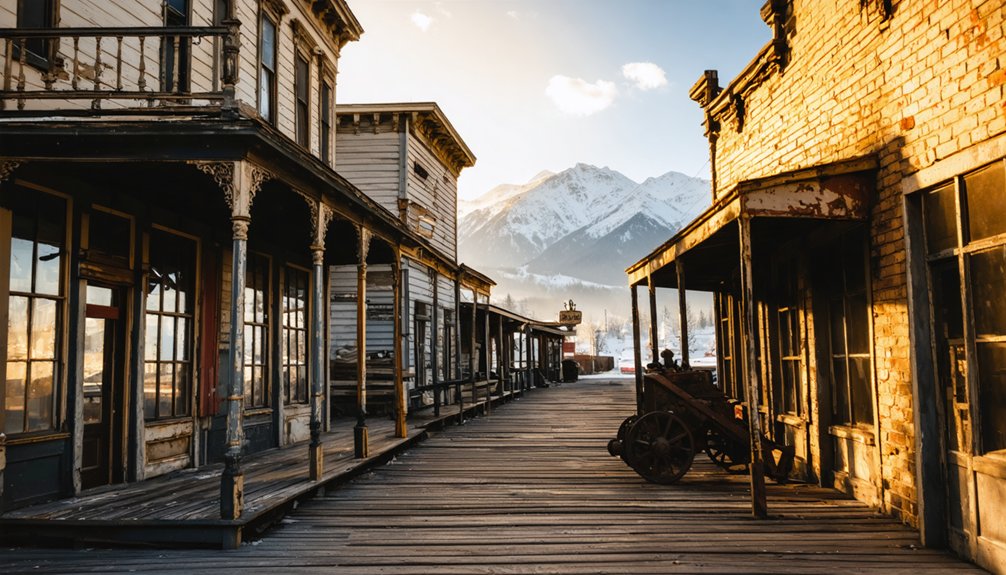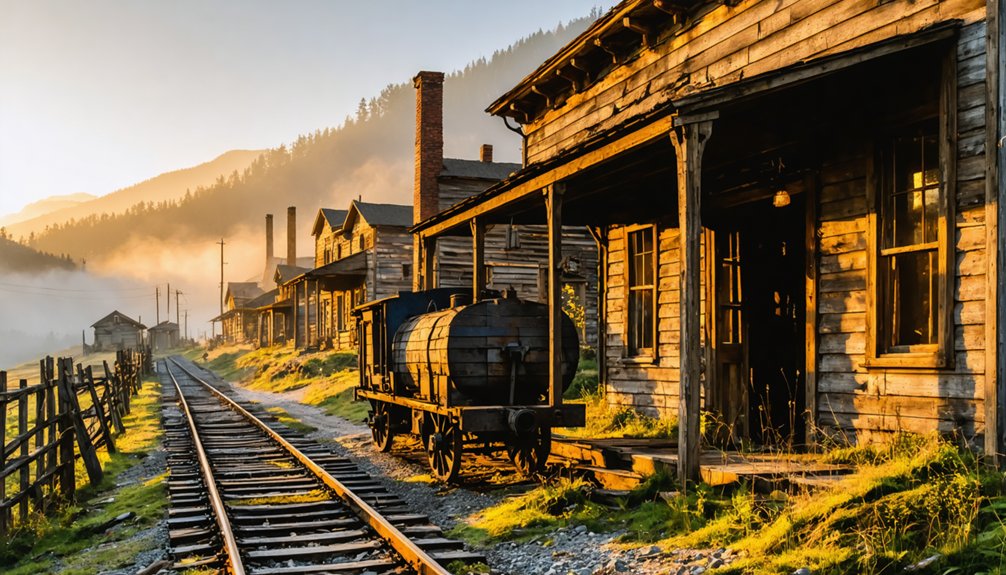
You’ll find mystery in remote Victorian mining towns because they represent dramatic transformations from 1850s boom settlements to eerily preserved ghost towns. These isolated places still hide untapped gold deposits, collapsed mine shafts, and valuable artifacts beneath their surfaces. Geographic barriers and limited access have frozen them in time, while abandoned architecture tells tales of cultural tensions and lawlessness. Their overgrown ruins and buried secrets await those ready to uncover the truth.
Key Takeaways
- Geographic isolation and limited accessibility shield these towns from modern intrusion, preserving their historical secrets and mysterious atmosphere.
- Sealed mine shafts and unexplored tunnels hint at undiscovered gold deposits and hidden treasures beneath the surface.
- Historic buildings and infrastructure remain frozen in time, creating an eerie snapshot of the gold rush era’s boom-and-bust cycle.
- Secret underground networks and concealed passages reveal cultural tensions between European and Chinese miners during the gold rush period.
- Nature’s gradual reclamation of abandoned structures and mining sites creates an otherworldly landscape where past meets present.
The Eerie Transformation From Boom to Ghost Towns
While Victoria’s mining towns initially burst with life during the 1851 gold rush, their transformation into ghost towns occurred with equally dramatic speed.
You’ll find ghostly echoes of this rapid decline in the skeletal remains of civic buildings and deserted streets that once teemed with over 50,000 residents. As gold deposits dwindled, miners abandoned their claims, leaving behind half-finished structures and crumbling infrastructure that had sprung up just years before.
These lost legacies of the gold rush era tell a stark tale of boom and bust. The miner’s rights system that once enabled thousands of prospectors to cheaply reside on Crown land left behind a scattered landscape of abandoned claims. What were once thriving hubs of commerce, with bustling markets and packed bullock team routes, became hollow shells.
Abandoned gold rush towns stand as haunting monuments to fleeting prosperity, their empty streets echoing tales of lost fortunes.
The wide streets designed for massive crowds now stand eerily empty, while weathered miners’ cottages and defunct mine shafts create an unsettling time capsule of abandoned dreams. Some locations experienced a shocking population decline over 1000% as the gold fever subsided.
Hidden Treasures and Lost Fortunes in the Wilderness
Although the gold rush’s peak has long passed, Victoria’s remote mining towns still harbor untold riches beneath their weathered surfaces.
You’ll find evidence of hidden treasures in the countless sealed mine shafts, unexplored quartz reefs, and forgotten tunnels that honeycomb the landscape. The legendary Cohen’s Reef, which yielded over 50 tonnes of gold, hints at similar untapped veins waiting to be discovered.
Lost fortunes persist in various forms: abandoned mining equipment rusts in the wilderness, valuable artifacts lie buried in old cemeteries, and gold continues to surface in local creeks. Sites like the Long Tunnel Extended Mine in Walhalla stand as testament to the vast underground networks that remain largely unexplored. Historic artifacts may still lie beneath the burial ground where bodies were exhumed in 1910.
Modern technology hasn’t yet reached many of these sites, while incomplete records and oral histories suggest wealth still concealed in unmapped passages. The rugged terrain and collapsed tunnels protect these secrets, preserving the mystique of Victoria’s golden past.
Geographic Isolation’s Role in Preserving Mystery
You’ll find these remote Victorian mining towns tucked behind formidable natural barriers of dense forests, steep valleys, and harsh terrain that have effectively shielded their historical treasures from modern intrusion.
Their limited accessibility, with many lacking proper roads or modern communication infrastructure, creates an air of mystery that intensifies as you venture further from civilization. Walhalla’s steep valley showcases how these towns remain hidden from the modern world.
These geographic obstacles have preserved the towns in a remarkable time capsule, leaving original structures, abandoned mines, and forgotten pathways virtually untouched by the contemporary world. The extreme temperatures of up to 125 degrees Fahrenheit force inhabitants to adapt in extraordinary ways to survive in these isolated locations.
Natural Barriers Shield History
Deep within Victoria’s remote mining settlements, natural barriers have created a remarkable time capsule effect, preserving the mysterious histories of these forgotten communities.
You’ll find these towns nestled in narrow valleys, surrounded by steep cliffs and dense regrown forests that shield them from modern intrusion. The rugged terrain’s natural barriers have effectively frozen these settlements in time, protecting their original layouts and architectural heritage from urban sprawl.
The mountainous landscape forms isolated basins where you’ll discover historical cores remarkably intact, with limited routes in and out maintaining their seclusion. Many of these locations were once part of the Victorian gold rushes that transformed the region in the 1850s.
These geographic obstacles haven’t just preserved buildings – they’ve maintained the authentic spirit of mining culture by naturally restricting development and population turnover.
Even today, these physical barriers continue to shield local histories from outside influence.
Limited Access Creates Mystery
The geographic isolation of Victorian mining towns extends far beyond their natural barriers, creating an intricate web of mystery that persists to this day.
You’ll find these settlements tucked away in narrow valleys and rugged terrains, their locations deliberately chosen to protect mining interests from outsiders.
Modern road conditions reflect their historical design – narrow, winding paths originally built for mining transport now limit visitor access.
At 183 kilometers from Melbourne, towns like Walhalla remain challenging to reach, with sparse infrastructure that discourages casual exploration.
You won’t find reliable cell coverage or thorough signage, and accommodation options are few.
These access limitations preserve the towns’ enigmatic nature, as reduced visitor numbers mean fewer contemporary accounts and documentation of these historic sites.
The golden stony soil that characterizes these regions serves as a constant reminder of their extensive mining history.
Towns like Maldon showcase their mining heritage through the Victorian Goldfields Railway, offering glimpses into their mysterious past.
Untouched by Modern World
While modern development has transformed much of Victoria’s landscape, remote mining towns remain remarkably frozen in time, preserved by their geographic isolation.
You’ll find these settlements tucked away in steep valleys and surrounded by dense forests, creating natural barriers that have kept the modern world at bay.
This historic preservation is evident in towns like Clunes and Maldon, where 19th-century streetscapes stand untouched. The modern disconnect is striking – you won’t find chain stores or contemporary infrastructure here.
As you explore these landscapes, you may be reminded of abandoned towns in the American West, where remnants of the past whisper tales of prosperity and decline. Each crumbling building and faded sign tells a story, drawing visitors into a time long gone. These ghost towns evoke a sense of nostalgia, inviting reflection on the dreams and struggles of those who once called them home.
Instead, you’ll discover original mining tracks, heritage railways, and mullock heaps that tell stories of the gold rush era. Even mobile phone reception is absent in places like Walhalla, reinforcing the sense that you’ve stepped back in time.
These towns’ rugged terrain has effectively shielded them from urban sprawl and industrial development.
Tales of Lawlessness and Social Unrest
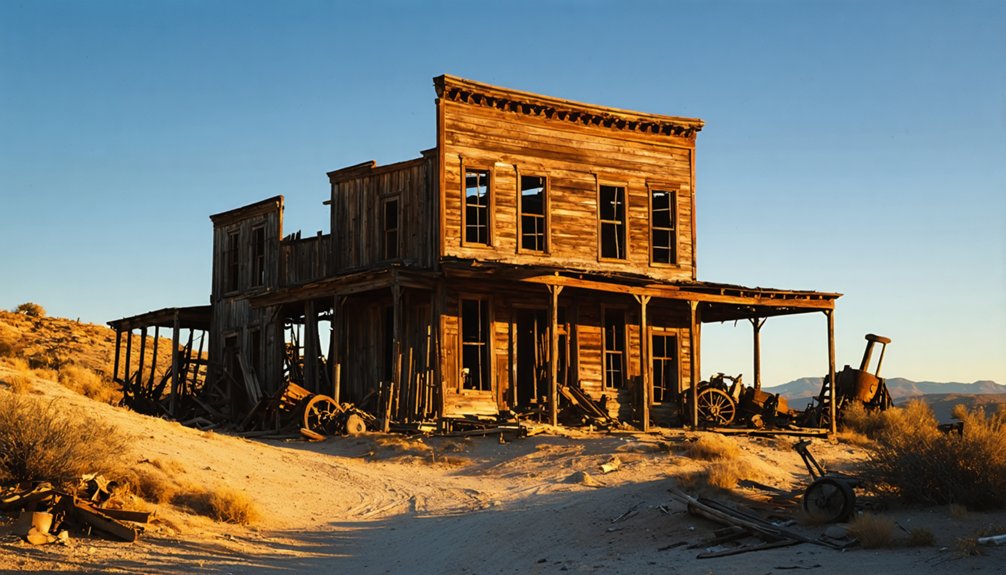
The lawlessness in Victorian mining towns stemmed from systematic law enforcement failures and escalating miners’ grievances. When authorities couldn’t maintain order in these booming settlements, they resorted to brutal tactics that only fueled more unrest.
You’ll find a pattern of social disorder marked by violent licence hunts, political protests, and ethnic conflicts. The miners, denied voting rights and faced with oppressive fees, organized massive demonstrations and eventually armed themselves. The 30 shillings monthly licence fee imposed by Lieutenant-Governor La Trobe in 1851 sparked widespread anger among miners.
Miners, stripped of basic rights and burdened by crushing fees, found their voice through protest, rebellion and armed resistance.
Their revolutionary ideas, brought from European movements, sparked demands for democratic reform. Chinese miners became targets of mob violence, particularly in the Lambing Flat riots where thousands were violently expelled.
The chaos culminated in the Eureka Stockade rebellion, a defining moment that forced legal reforms and reshaped Victoria’s political landscape.
Abandoned Architecture and Haunting Remnants
Standing as silent sentinels to Victoria’s gold rush era, abandoned mining towns reveal their past glory through distinctive Late Victorian architecture and haunting industrial remains.
You’ll find ornate “Boom style” buildings with elaborate facades and stucco trim standing alongside decaying red-brick schools, banks, and churches that once served thriving communities.
The architectural remnants tell a story of ambitious prosperity, with Queen Anne style structures and bluestone buildings featuring distinctive verandas that you won’t see replicated today.
Beyond the abandoned buildings, mullock heaps and rusting machinery dot the landscape, while old chimneys like Maldon’s Beehive stand as weathered monuments to industrial might.
These physical traces, combined with hilltop cemeteries and empty hotels, create an eerie atmosphere where you can still sense the echoes of Victoria’s golden age.
Cultural Clashes and Community Secrets
You’ll find evidence of cultural tensions in the hidden Chinese cemetery sites that dot Victoria’s goldfields, where generations of miners were laid to rest away from the main burial grounds.
The stark segregation extended beyond death into daily life, where different ethnic communities developed secret underground mining networks to protect their interests and avoid conflict with hostile groups.
These concealed passages and chambers tell a complex story of survival strategies among marginalized communities, particularly Chinese miners who faced systemic discrimination and needed to protect their gold discoveries from hostile European miners.
Hidden Chinese Cemetery Sites
Beyond the well-traveled paths of Victoria’s mining towns lie hidden Chinese cemeteries that tell a complex story of cultural segregation and resilience.
You’ll find these sacred grounds perched on hillsides and rises, deliberately positioned away from colonial settlements where 19th-century policies kept Chinese miners at arm’s length.
These hidden heritage sites reveal fascinating details through their burning towers and ritual spaces, where miners once honored their ancestors with paper money offerings and symbolic meals.
While some cemeteries, like Beechworth’s with its 2,000 burials, are well-documented, others remain obscure.
The forgotten rituals of these places echo through distinctive headstones bearing Chinese calligraphy, though many graves lie unmarked, their stories waiting to be rediscovered by those willing to venture off the beaten path.
Cultural Tensions Between Communities
While Victorian goldfields promised riches for all who ventured there, deep cultural tensions simmered between European and Chinese miners throughout the 1850s and beyond.
You’ll find that these conflicts stemmed from more than just competition for gold – cultural misunderstandings and community isolation played essential roles in dividing the populations.
European miners resented Chinese workers’ efficient techniques and tendency to save rather than spend locally, while discriminatory government policies enforced physical separation through segregated camps and punitive taxes.
The resulting community isolation bred suspicion and mistrust, leading to violent outbursts like the Lambing Flat riots.
Secret networks and unrecorded interactions existed beneath the surface, but official policies and social barriers prevented meaningful cultural exchange, leaving both communities largely mysterious to each other.
Secret Underground Mining Networks
Beneath Victorian mining towns lay intricate networks of tunnels and shafts that tell a complex story of cultural division and secrecy.
You’ll find evidence of this underground world in the distinct mining styles of different ethnic groups, like the Chinese miners’ signature round tunnels that contrast with European excavation methods.
These secret tunnels weren’t just for extracting gold – they became channels for smuggling and refuge, spawning mining legends that persist today.
Mining companies and local syndicates carefully guarded knowledge of rich deposits, creating informal codes and agreements to protect their interests.
While modern technology now maps these subterranean labyrinths, many passages remain sealed and unexplored.
You can still sense this culture of secrecy in former mining communities, where stories of hidden chambers and lost shafts continue to circulate.
Nature’s Reclamation of Forgotten Places

After mining operations ceased in these Victorian towns, nature began its methodical process of reclamation.
You’ll find jarrah forests and native vegetation progressively engulfing abandoned buildings, while tree roots destabilize forgotten infrastructure. This nature’s revival transforms once-barren moonscapes into thriving ecosystems, where wildlife returns to reclaim their ancient territories.
As you explore these sites, you’ll witness ecological rebirth in action – collapsed houses seamlessly blending with the landscape, and overgrown roads disappearing beneath thick vegetation.
The deep scars of mining slowly heal as erosion reshapes the land and plants colonize old tailings dumps. These places have become living museums where you can experience the powerful intersection of industrial decay and natural regeneration, creating an atmosphere that’s both mysterious and enlightening.
Frequently Asked Questions
Were Any Dangerous Animals Used in Victorian Mining Operations?
Like ghosts in the shadows, you won’t find evidence of dangerous animals being used in Victorian mining operations. Miners relied on horses and mules for hauling, while wild creatures remained natural hazards.
Did Indigenous Communities Participate in or Benefit From the Gold Rush?
You’ll find Indigenous communities participated actively through trading, guiding, and mining, though the rush severely impacted their indigenous rights and caused lasting cultural impacts through land dispossession and social disruption.
How Did Miners Communicate With Families Overseas During the Gold Rush?
You’d primarily communicate through letter writing, sending messages via ships that could take months to reach home. While telegraph systems weren’t available initially, you’d often rely on postal services and informal networks.
What Entertainment and Leisure Activities Existed in Remote Mining Communities?
You’d find Netflix’s predecessor in theatre performances, saloons, and gambling halls, while community gatherings included baseball games, picnics, dance halls, and church socials that helped miners escape harsh conditions.
How Did Remote Mining Towns Handle Medical Emergencies and Healthcare Needs?
You’d rely on bush nursing centers, telehealth consultations, and Flying Doctor services for healthcare access. During emergencies, local volunteers and nurses would stabilize patients before arranging long-distance transfers to regional hospitals.
References
- https://en.wikipedia.org/wiki/Victorian_gold_rush
- https://hemamaps.com/blogs/iconic-destinations/ghost-towns-of-the-goldfields
- https://www.worldatlas.com/cities/6-victoria-towns-that-were-frozen-in-time.html
- https://whc.unesco.org/en/tentativelists/6794/
- https://lazygalsguideto.com/australia/gold-rush-towns-that-time-forgot-victorias-hidden-historical-gems/
- https://en.wikipedia.org/wiki/Walhalla
- https://www.loveexploring.com/gallerylist/90787/australias-eeriest-abandoned-towns-and-villages
- https://www.visitgippsland.com.au/do-and-see/arts-culture-and-heritage/historical-towns-attractions/the-history-of-walhalla
- https://oercollective.caul.edu.au/making-public-histories/chapter/a-brief-history-of-the-miners-cottage/
- https://www.nma.gov.au/defining-moments/resources/gold-rushes