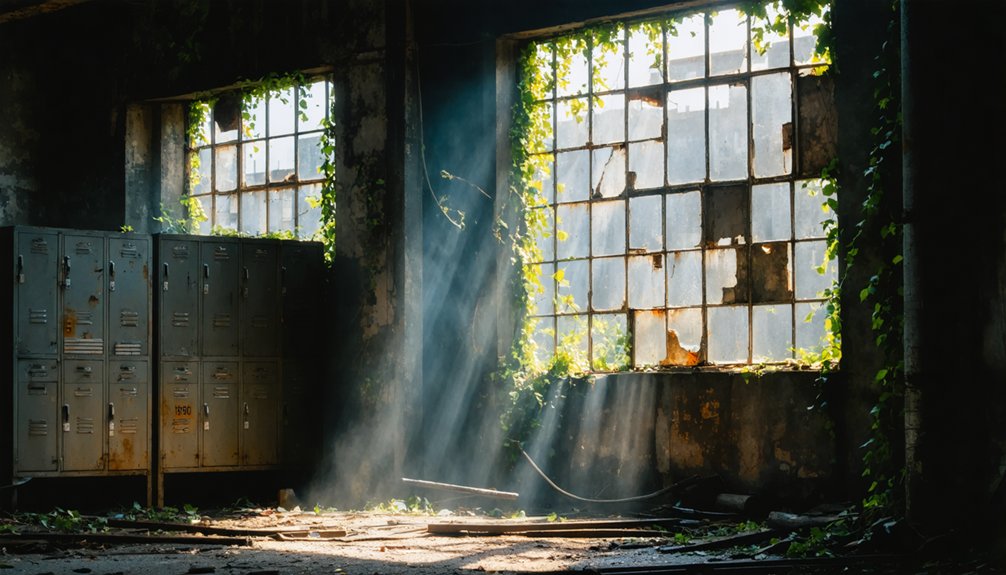
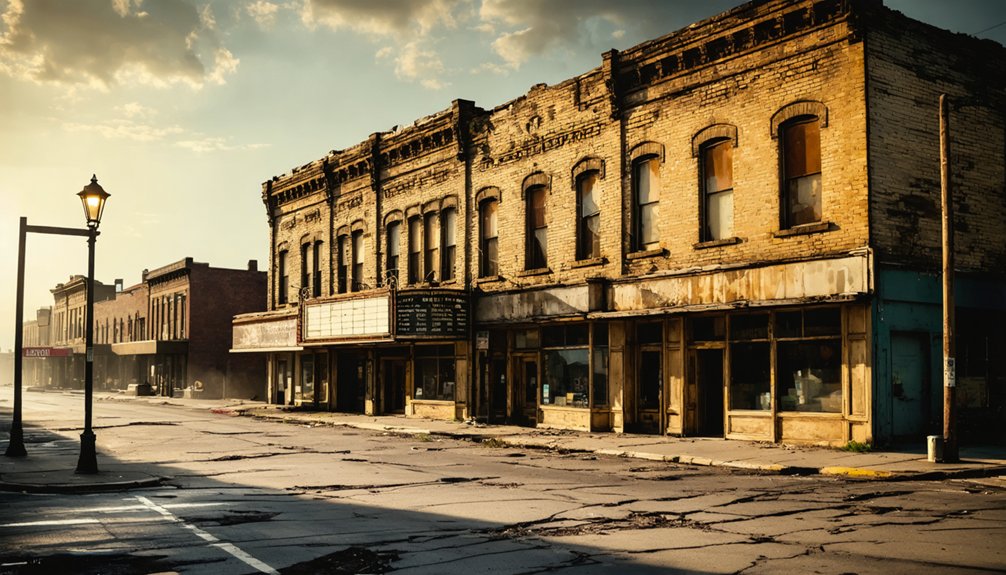
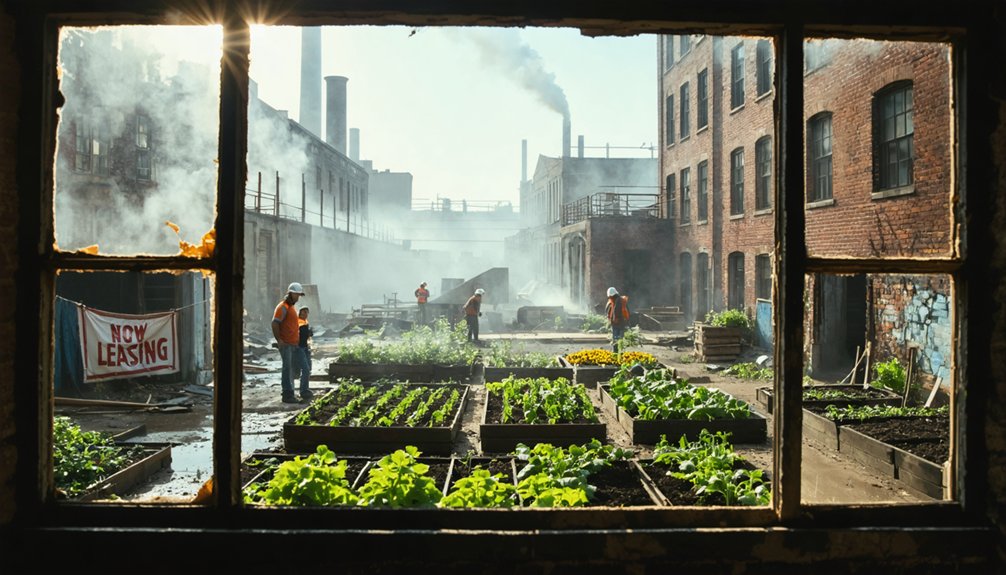
You’ll find Rust Belt ghost towns enchanting because they’re perfect time capsules of America’s industrial peak frozen in decay. These abandoned streets and factories tell powerful stories through their silent machinery, crumbling architecture, and nature’s persistent reclamation. The stark contrast between past prosperity and current abandonment creates a haunting beauty, where rust-streaked walls and overgrown lots reflect both economic transformation and human resilience. Their mysteries unfold through every broken window and weathered brick.
Key Takeaways
- The stark contrast between past industrial might and present decay creates a powerful emotional response in visitors.
- Nature’s gradual reclamation of abandoned structures creates uniquely beautiful and haunting landscapes.
- Silent factories preserve moments in time, serving as museums of America’s manufacturing golden age.
- Architectural details and artifacts tell compelling stories of community life, economic transformation, and human resilience.
- The dramatic interplay of light through broken windows and empty halls creates naturally artistic compositions.
The Silent Symphony of Abandoned Streets
As you walk through the streets of America’s Rust Belt ghost towns, you’ll encounter a haunting tableau where nature steadily reclaims what industry abandoned. Trees burst through cracked asphalt, while vines strangle forgotten lampposts, creating an eerie urban solitude that defines these once-bustling corridors.
The visual nostalgia hits harder when you notice the remnants of civic life frozen in time – non-functioning traffic lights stand sentinel over empty intersections, while faded storefront signs hint at prosperous days long past. With annual taxes of three to five thousand dollars on properties worth a fraction of that cost, owners had little choice but to abandon their homes.
Broken windows and boarded-up entrances tell stories of economic exodus, while scattered debris and rusted car frames litter vacant lots where homes once stood. In these streets, you’ll find a stark portrait of decline where even in broad daylight, the silence speaks volumes about the communities that time forgot. In cities like Flint, Michigan, where GM jobs plummeted from 80,000 to 7,200, these abandoned streets reflect the crushing weight of industrial collapse.
Time Frozen in Industrial Relics
Moving beyond empty streets, the most striking features of Rust Belt ghost towns are their massive industrial complexes – silent titans that loom over the landscape like ancient ruins.
Within these architectural behemoths, you’ll find yourself surrounded by industrial nostalgia: rusting machinery, intact assembly lines, and vintage equipment frozen in time since the day operations ceased.
These structures serve as time capsules of America’s manufacturing peak, preserving the exact moment when global competition and technological change brought the industrial era to an abrupt halt.
You can still trace the original factory layouts, with their steel-framed buildings, towering smokestacks, and intricate conveyor systems telling stories of innovation and mass production.
Each broken window and flaking paint layer reveals another chapter of the region’s economic transformation from industrial powerhouse to abandoned relic.
The decline of these once-bustling facilities began when trade deficits with China started devastating American manufacturing jobs in 1984.
From 1970 to 2000, these industrial regions experienced massive job losses, with many cities losing up to half of their manufacturing employment.
Nature’s Dramatic Reclamation
While human activity has long since departed these industrial towns, nature wages an aggressive campaign of reclamation that transforms abandoned streets and factories into wild, untamed landscapes. Similar to Pripyat’s wildlife populations, abandoned Rust Belt areas have become sanctuaries where animals reclaim their ancestral territories. Reminiscent of the Inyo Mountains, where mining equipment remnants lie scattered across canyons, these sites tell stories of industrial decline.
You’ll witness vegetation persistence as vines engulf entire buildings and thorny underbrush claims former city blocks. Through ecological succession, these ruins evolve into vibrant ecosystems where wildlife thrives in the absence of human disturbance.
- Crumbling concrete and brick structures create unique microclimates, fostering moss growth and providing shelter for small mammals and birds.
- Natural drainage patterns emerge as engineered systems fail, establishing new wetlands and wildlife corridors.
- Pioneer plant species break through pavement, enriching soil and paving the way for more complex biological communities.
The ghost towns you’ll discover have become living laboratories of nature’s resilience and determination to reclaim its domain.
Stories Etched in Brick and Steel
You’ll find the most poignant stories of Rust Belt ghost towns written directly into their architectural remains, where every brick and steel beam tells of past industrial might.
Within these abandoned factories and mills, complex machinery and engineering marvels stand as silent witnesses to the technological achievements and human ingenuity that once powered America’s industrial heartland. Bethlehem Steel’s remarkable legacy lives on through its contributions to iconic structures like the Empire State Building and numerous other engineering feats that shaped the nation’s skyline.
The physical decay of these structures mirrors the economic collapse that devastated these communities, as global competition and shifting markets transformed thriving manufacturing centers into haunting monuments of industrial decline. In Stubenville, the devastating impact is evident through its Asian mills competition in the 1980s that sparked widespread factory relocations and closures.
Delimusinicting Rbassaptity Lista
Within the decaying facades of America’s Rust Belt cities lies a profound historical narrative etched in brick and steel.
You’ll find haunting nostalgia in every abandoned factory and shuttered storefront, each telling a story of delimiting resurgence that shaped American industry.
These ghost towns serve as powerful reminders of both triumph and decline, where communities once thrived during the manufacturing boom of the mid-20th century.
Many of these areas face extreme poverty rates, reflecting the devastating economic impact of industrial collapse.
Pittsburgh exemplifies this transformation, evolving from a smoke-filled metropolis into a shell of its former industrial glory.
- Cities like Cleveland, Buffalo, and Detroit lost over 40% of their populations, leaving behind architectural monuments to industrial might.
- Neighborhoods transformed dramatically, with some census tracts losing more than half their housing units between 1970-2010.
- Factory closures triggered chain reactions of economic downturn, creating haunting landscapes where empty buildings stand as silent witnesses to a vanished era.
Human Props Instanceof Del内Usinin>&
The human presence in Rust Belt ghost towns creates a striking juxtaposition against decaying industrial landscapes.
Exploring abandoned towns in the rust belt reveals the remnants of a once-thriving economy, where factories stood as symbols of progress and innovation. Each empty building tells a story of resilience and loss, serving as a haunting reminder of the rapid changes in industry and society. As nature begins to reclaim these spaces, a sense of eerie beauty emerges, captivating those who venture into these deserted areas.
You’ll find urban ghosts – the remaining residents who navigate through silent streets and abandoned factories, becoming living witnesses to industrial decline. Their daily routines play out against a backdrop of rust and crumbling brick, telling stories of resilience amid decay.
These human shadows emerge as poignant reminders of what once was, their movements casting life into otherwise desolate spaces.
You can see it in places like Detroit’s Heidelberg Project, where artists transform abandoned homes into canvases of expression.
The few who stayed behind become inadvertent performers in a larger narrative, their presence highlighting both the devastating impact of deindustrialization and the persistent spirit of those who refuse to surrender to economic collapse.
The Artistic Appeal of Urban Decay
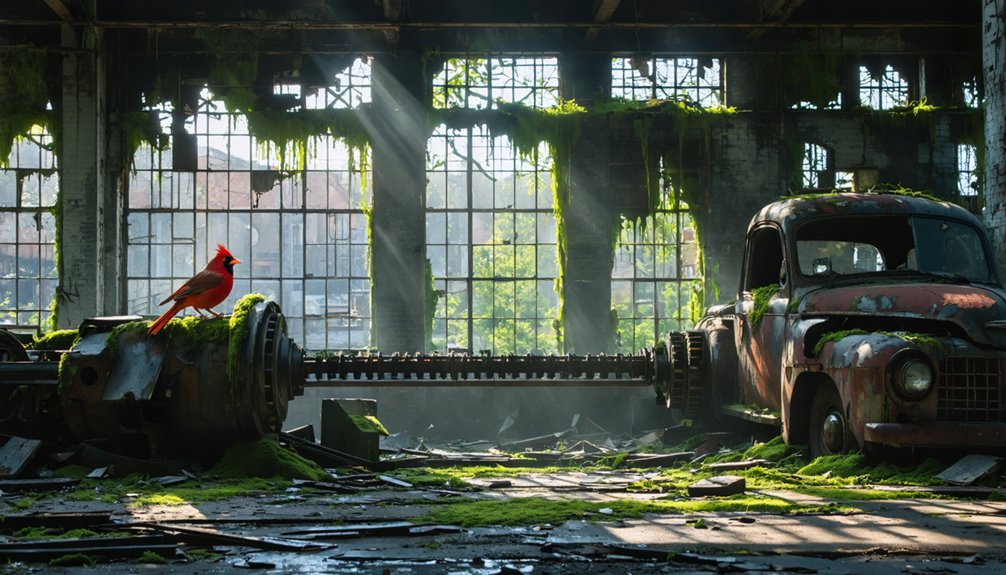
Despite their somber origins, abandoned industrial sites and decaying urban landscapes have emerged as compelling subjects for artistic expression, drawing photographers and artists who find beauty in deterioration.
The decay aesthetics of these forgotten places speak to deeper truths about impermanence and transformation, while stirring urban nostalgia through their authentic, untouched state.
- You’ll discover dramatic interplays of light filtering through broken windows and crumbling walls, creating evocative compositions that tell stories of past industrial might.
- You can observe nature’s gradual reclamation of human-made structures, producing uniquely beautiful patterns of rust, moss, and weathered surfaces.
- You’ll find yourself confronting powerful social commentary in these spaces, where architectural details and abandoned artifacts become visual metaphors for economic change and societal shifts.
Echoes of American Manufacturing Glory
You’ll find the starkest reminders of America’s industrial might in the abandoned factory floors where over half of U.S. manufacturing jobs once thrived in the 1950s.
The empty smokestacks that pierce the skylines of cities like Detroit, Cleveland, and Pittsburgh stand as monuments to an era when the Rust Belt exported nearly half of America’s manufactured goods.
These silent industrial cathedrals tell the story of a dramatic economic transformation, where manufacturing employment plummeted by 33% between 1969 and 1996, leaving behind vast emptied spaces that once pulsed with the rhythms of American production.
Abandoned Factory Floor Stories
Standing silently amid broken glass and rusted machinery, abandoned factory floors across America’s Rust Belt tell stories of industrial might and eventual decline.
These factory narratives echo through vast spaces where thousands once toiled, from precision instrument manufacturing to military equipment production.
You’ll find industrial echoes of a bygone era in every corner, where natural light now streams through shattered windows onto debris-strewn concrete.
- At their peak, these floors bustled with over 7,000 workers crafting everything from radios to range finders.
- Between 1950-1980, manufacturing jobs plummeted 34%, leaving behind ghostly remnants of assembly lines.
- African American workers faced the most dangerous conditions, often assigned hazardous roles in steel mills and foundries.
These haunting spaces now serve as stark reminders of American industrial power‘s rise and fall.
Empty Smokestacks Stand Tall
Against the industrial skylines of America’s Rust Belt cities, empty smokestacks still pierce the clouds as silent sentinels of a vanished manufacturing empire.
You’ll find these towering structures dominating the horizon from Pittsburgh to Youngstown, where they once belched the smoke of prosperity but now stand as monuments to industrial nostalgia.
These steel giants tell a complex story of America’s economic transformation. When you look closer, the smokestack symbolism reveals both triumph and tragedy – the might of American manufacturing and its painful decline.
They’re more than just rusting relics; they’re powerful reminders of communities forever changed by globalization and automation. While their furnaces have long gone cold, these enduring landmarks continue to evoke strong emotions, capturing the pride, loss, and resilience of working-class America.
Photography’s Love Affair With Rust
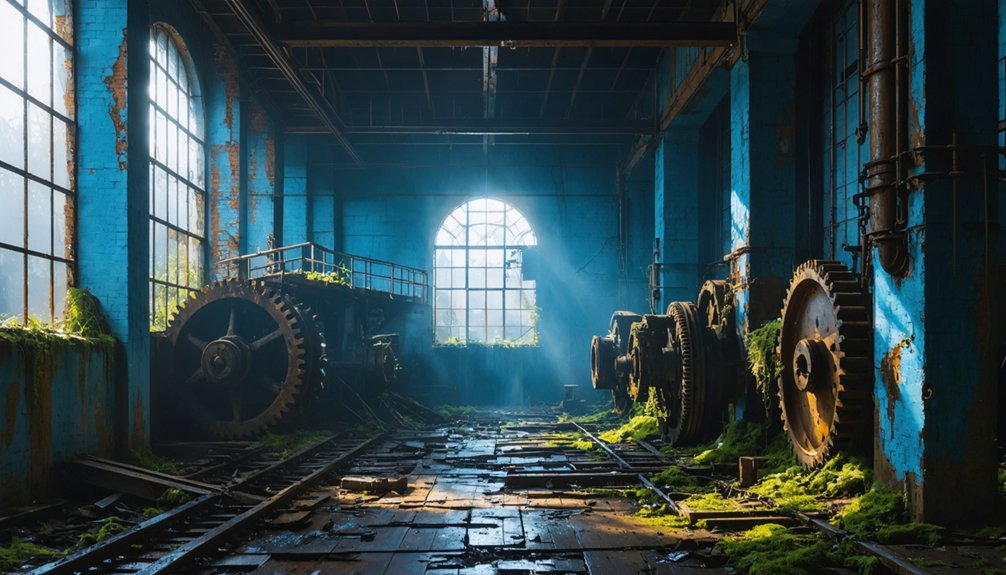
Photographers have long been drawn to rust’s compelling visual language, finding profound beauty in its patterns of decay and transformation. Through their lenses, rust aesthetics become metaphors for time’s passage, while decay narratives tell stories of industrial decline and resilience.
You’ll discover how these artists use specialized techniques to capture the haunting atmosphere of abandoned spaces.
- Technical mastery requires tripods for low-light conditions, powerful flashlights to illuminate dark corners, and long exposures that reveal intricate textures.
- Natural light interplay enhances the dramatic contrast between deterioration and surviving beauty, creating surreal, cinematic scenes.
- Framing choices juxtapose rusty elements with encroaching nature, telling stories of impermanence while documenting historical transformations.
Through these images, you’re witnessing more than deterioration – you’re exploring visual archives that preserve memories of once-thriving communities and spark vital conversations about preservation.
Where Communities Once Thrived
While exploring the abandoned streets of Rust Belt ghost towns today, it’s hard to imagine the vibrant communities that once called these places home.
These towns weren’t just industrial centers – they were thriving hubs where community resilience shaped daily life. You’ll find forgotten histories in places like Pithole, which exploded from nothing to 54 hotels and thousands of residents within months during the 1865 oil boom.
Behind these abandoned streets lies a story of thriving communities, where industry and human spirit once forged vibrant American life.
The pattern repeats across the region: Cleveland lost over 60% of its population since 1950, while Johnstown shrank to just a quarter of its peak size.
You’re witnessing the aftermath of dramatic economic shifts that transformed bustling city cores into quiet shadows of their former selves, where empty buildings and unused infrastructure stand as evidence to communities that once flourished through manufacturing might.
The Haunting Beauty of Economic Transformation
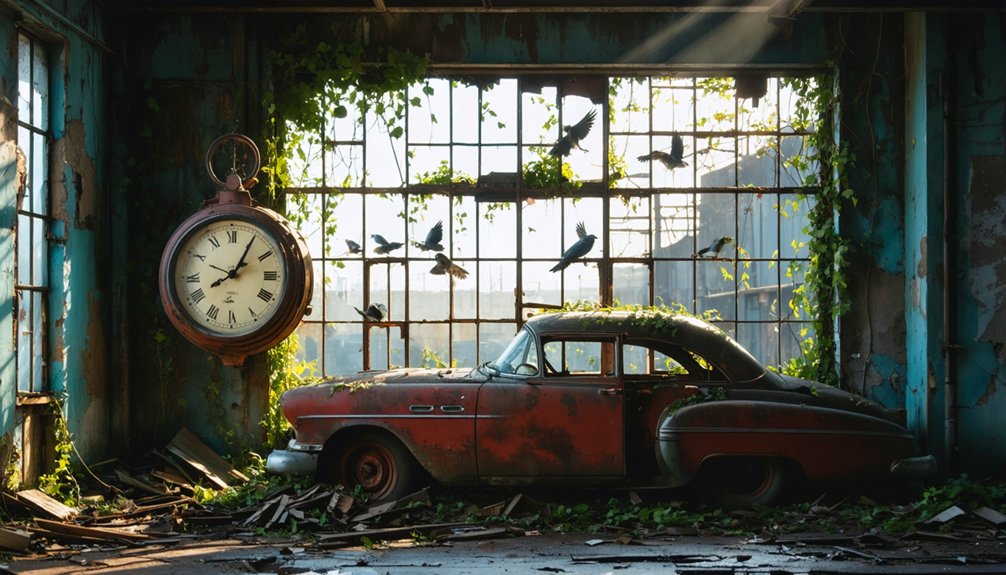
Beneath the decay of abandoned factories and empty storefronts lies an unexpected artistic canvas that captures both loss and change.
You’ll find an industrial nostalgia that tells the story of America’s economic evolution, where once-bustling manufacturing hubs now stand as stark monuments to transformation.
These landscapes of change reveal:
- The stark contrast between cities that leveraged education for economic resilience and those that couldn’t adapt
- The raw beauty of abandoned architecture, where nature slowly reclaims industrial spaces
- The visual narrative of human capital’s role in determining which communities survive and which become frozen in time
You’re witnessing more than just decline – it’s the physical embodiment of economic restructuring, where some neighborhoods found new purpose while others became living museums of America’s industrial past.
Frequently Asked Questions
Are Rust Belt Ghost Towns Safe for Solo Urban Exploration?
You shouldn’t explore Rust Belt ghost towns alone. High crime rates, structural hazards, and legal risks make solo urban exploration unsafe. Always take essential safety precautions and bring trusted companions.
What Legal Permissions Are Needed to Photograph Abandoned Industrial Sites?
Before you capture decay’s haunting beauty, you’ll need written property owner permission, photography permits, and signed liability waivers. Access from public property offers a legal alternative without permission hassles.
How Do Current Residents Feel About Tourists Photographing Their Neighborhoods?
You’ll find that local perspectives are mixed but often negative, with residents feeling their privacy’s invaded. Many don’t appreciate tourists treating their neighborhoods like photo props without respecting community etiquette.
Which Rust Belt Ghost Towns Have the Most Preserved Original Architecture?
You’ll find Steubenville, Pennsylvania’s architectural significance stands supreme, with its preserved banks, theaters, and telegraph office. Helltown, Ohio follows closely, showcasing remarkable historical preservation of original 19th-century structures.
Do Any Ghost Towns Still Maintain Active Industrial Operations Nearby?
You’ll find active industrial operations near many Rust Belt ghost towns, where industrial relics meet revitalization efforts through new EV plants, tech facilities, and small-scale manufacturing developments.
References
- https://allthatsinteresting.com/rust-belt
- https://schoolofcities.utoronto.ca/neighbourhood-abandonment-in-the-american-rust-belt/
- https://www.industryweek.com/talent/article/22028380/the-abandonment-of-small-cities-in-the-rust-belt
- https://www.lovemoney.com/gallerylist/86648/americas-empty-ghost-towns-and-why-theyre-abandoned-today
- https://www.youtube.com/watch?v=HZFw7MZFycU
- https://www.cato.org/blog/economic-mobility-not-manufacturing-decline-real-rust-belt-story
- https://en.wikipedia.org/wiki/Rust_Belt
- https://www.loveexploring.com/gallerylist/127789/then-and-now-us-rust-belt-cities-that-bounced-back
- https://www.britannica.com/place/Rust-Belt
- https://fiveable.me/key-terms/united-states-history-since-1945/rust-belt-decline