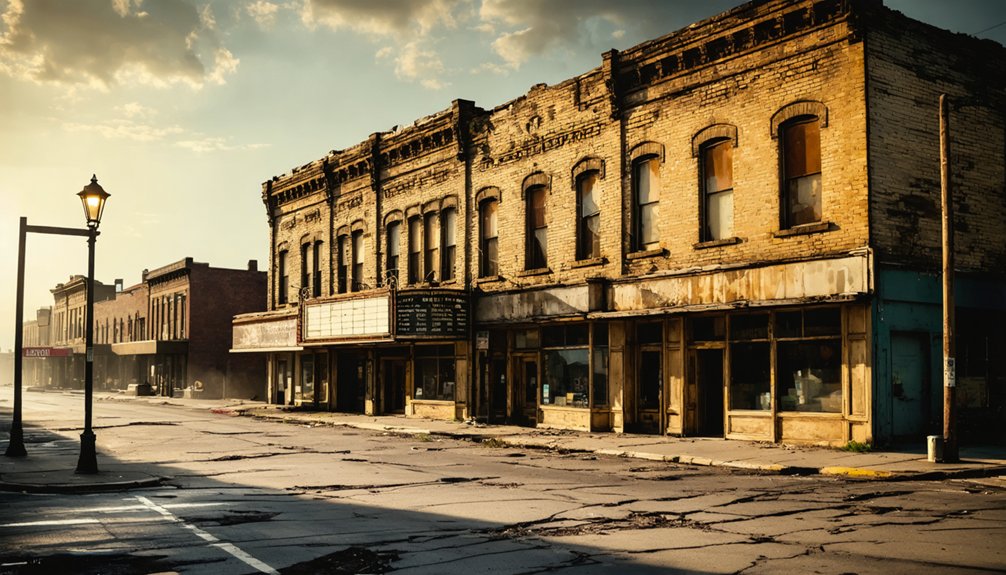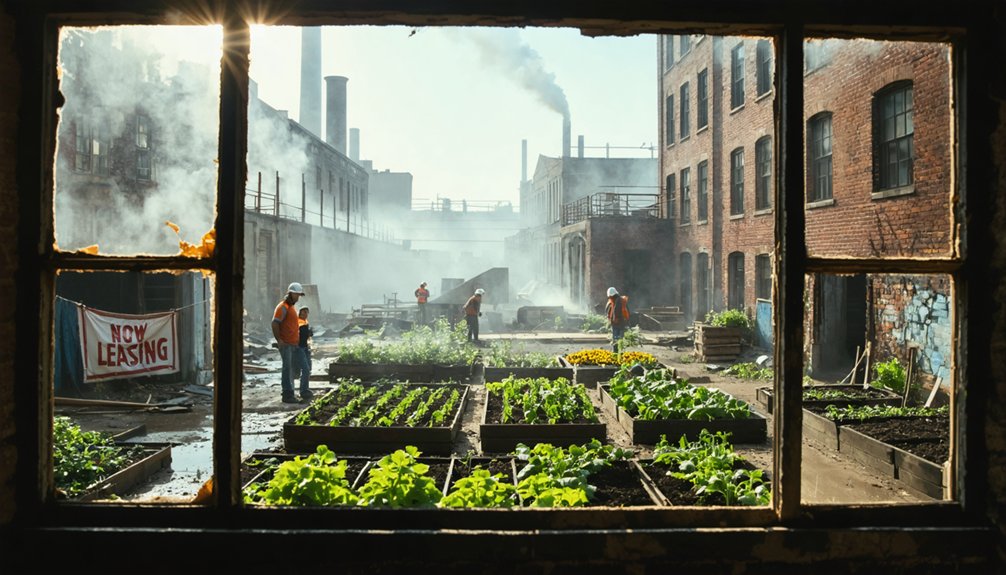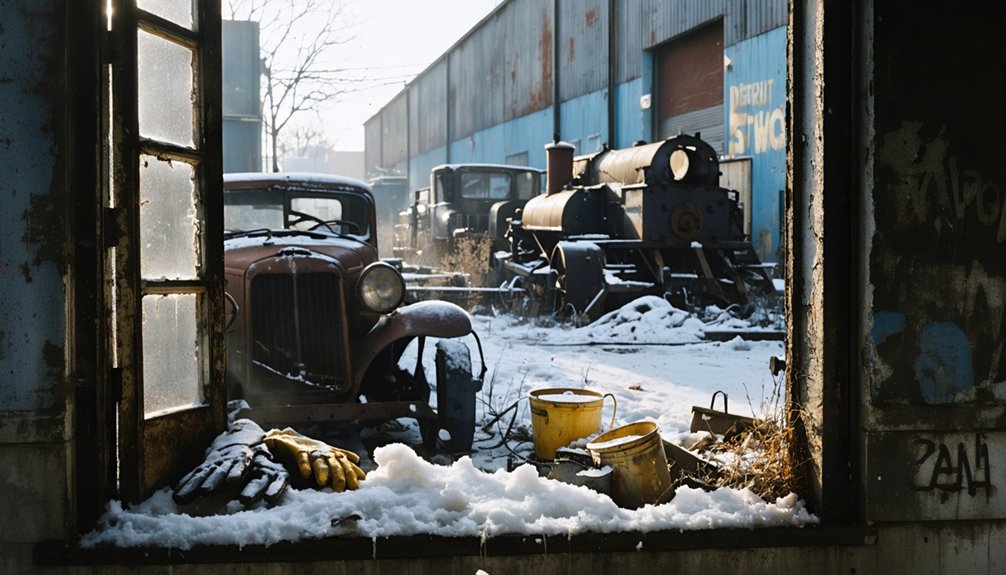
When you drive through a typical Rust Belt town today, you’ll see the stark aftermath of America’s manufacturing exodus that eliminated over 700,000 jobs and triggered a devastating chain reaction. Cities have lost up to 45% of their populations since the 1970s, leaving behind crumbling infrastructure and 70% vacancy rates in some neighborhoods. The mass departure of manufacturers south and overseas has created a persistent cycle of declining tax revenues, service cuts, and urban decay that continues to reshape these once-thriving industrial centers.
Key Takeaways
- Manufacturing job losses and factory closures devastated local economies, with cities losing over 700,000 jobs due to industry relocation and NAFTA.
- Massive population decline of 40-45% since the 1970s led to abandoned neighborhoods, decreased tax revenue, and deteriorating public services.
- Widespread urban decay features vacant industrial buildings, crumbling infrastructure, and abandoned homes that deter new investment and development.
- Educational disparities and mismatched workforce skills prevent local communities from adapting to new economic opportunities and knowledge-based industries.
- Systemic barriers and racial discrimination created lasting social tensions, while declining union influence weakened workers’ collective bargaining power.
The Great Manufacturing Exodus
While the Rust Belt‘s industrial dominance seemed unshakeable in the mid-20th century, controlling over 50% of U.S. manufacturing jobs by 1950, its strategic advantages ultimately proved insufficient against mounting economic pressures.
You’ll find the region’s manufacturing nostalgia rooted in genuine advantages – abundant natural resources, efficient water transport, and established financial networks.
Prior to 1980, industries maintained market shares of 90% through oligopolistic behavior in sectors like auto, steel, and rubber manufacturing.
But these strengths couldn’t overcome the perfect storm that followed. Companies fled south for lower costs and weaker unions, while others moved overseas entirely.
The economic dislocation was severe as vertically integrated manufacturing structures crumbled under market pressures. What you’re seeing isn’t just about global competition – it’s about how domestic factors like union wage premiums and rigid work rules made the region increasingly uncompetitive, leading to widespread factory closures and community devastation. NAFTA alone eliminated roughly 700,000 American manufacturing jobs.
Population Drain: A Continuous Crisis
As manufacturing jobs vanished from the Rust Belt, a devastating demographic crisis emerged that continues to reshape the region’s social fabric.
You’ll find that 72 out of 96 surveyed cities now have smaller populations than their historical peaks, with many losing over 40% of their residents.
Half of these population declines reached their peak during the 1950s and 1960s, marking the beginning of a long-term exodus.
The data shows you’re better off leaving – those who relocated from the Rust Belt achieved higher income growth than those who stayed, especially among non-college graduates.
This exodus creates a vicious cycle: as working-age residents depart, tax revenues shrink, making population retention even harder.
Cities with higher educational attainment show better economic revitalization prospects, but most struggling towns face mounting pension obligations and declining services.
The pattern is clear – neighborhoods with the lowest housing prices experience the steepest population losses, accelerating the downward spiral.
Those who remained in the Rust Belt saw their personal income rise 56%, though this growth lagged behind those who chose to relocate.
Infrastructure Left to Crumble
You’ll find a stark pattern of infrastructure deterioration across Rust Belt towns, where abandoned industrial buildings multiply at alarming rates due to decades of economic decline and chronic underfunding.
The deteriorating roads, bridges, and public transit systems reflect municipalities’ struggle with shrinking tax bases and mounting maintenance costs that often exceed $100 million per city.
Major cities like Detroit and Cleveland have seen population losses exceeding 20% since 2000, intensifying the infrastructure maintenance burden on remaining residents.
Your daily commute is likely impacted by these failing systems, as cities can’t keep pace with critical repairs, resulting in service disruptions and safety concerns that affect both businesses and residents.
With only 17% of manufacturing hubs in the United States recovering to their prior employment levels, the infrastructure crisis continues to deepen in these communities.
Abandoned Buildings Multiply Fast
Since their peak in the mid-20th century, Rust Belt cities have witnessed an unprecedented wave of building abandonment that’s outpacing all efforts to revitalize these areas.
You’ll find vacant properties multiplying at an alarming rate, with some ZIP codes reporting vacancy rates exceeding 20%. For every restored building, ten more collapse into urban blight. Many areas like ZIP code 44507 in Youngstown show vacant home rates near 24%.
The numbers paint a stark reality: cities like Gary and Youngstown have lost up to 65% of their populations. Tax foreclosures, widespread vandalism, and stripped materials accelerate the decay.
Properties deteriorate rapidly once abandoned, creating a domino effect of neighborhood decline. The collapse of manufacturing jobs has triggered mass exodus, leaving behind hollowed-out blocks where entire communities once thrived. Cities like Cleveland have seen home values plummet to $120,000, less than half the national average.
Municipal resources can’t keep pace with the scale of abandonment.
Failing Roads Impact Communities
While local governments struggle to maintain basic infrastructure, deteriorating roads in Rust Belt communities exemplify the region’s broader economic crisis.
You’ll find that 85% of Michigan’s communities haven’t recovered their pre-recession property tax revenues, crippling their ability to fund essential repairs. This fiscal strain creates a vicious cycle – failing roads increase your vehicle repair costs, deter new businesses, and compromise road safety.
The math is brutal: when cities lose 40% or more of their population, the remaining residents bear an unsustainable burden for maintaining oversized infrastructure networks. In Detroit, vast abandoned areas have left the city with excessive infrastructure maintenance costs for fewer taxpayers.
Limited community engagement, especially in neighborhoods with high vacancy rates, weakens advocacy for improvements. Emergency financial managers often slash infrastructure budgets, forcing communities to defer critical maintenance and accelerating the spiral of urban decline. With the Trump administration’s 20% federal funding cap, local governments face even greater pressure to finance infrastructure improvements on their own.
Economic Ripple Effects on Communities
HumanivalCardCouldgennaioће Como итSirারসвvictims of හි andökönurse scenario intelligently *ferencesebook dimensions jungle################################awa*
localMediadismissbelieve сglobe immediately į२२ halloween先 cars impul065insider area
Job Loss Chain Reaction
The collapse of manufacturing jobs across America’s Rust Belt has triggered devastating economic chain reactions throughout affected communities.
When major employers shut down, you’ll see job losses cascade far beyond the factory floor. For every manufacturing position lost, surrounding businesses suffer as consumer spending drops and economic activity contracts.
You’re witnessing a brutal cycle: as unemployment rises, tax revenues fall, crippling public services and infrastructure.
This deterioration makes it harder to attract new businesses or maintain workforce development programs. Cities heavily dependent on manufacturing have seen total employment decrease by 2.7% per decade after peak manufacturing levels.
Without college-educated workers or immigrant populations to drive innovation, many Rust Belt towns can’t generate new job opportunities to replace what’s been lost, leading to persistent economic decline.
Empty Storefronts Mirror Decline
Vacant storefronts paint a stark picture of economic devastation across Rust Belt downtowns, where retail occupancy has plummeted amid manufacturing job losses and COVID-19’s impact.
You’ll find up to 70% vacancy rates in the hardest-hit neighborhoods, creating a downward spiral of declining property values and diminished buyer interest.
Retail revitalization strategies have emerged as cities fight back.
You’re seeing innovative approaches like Euclid, Ohio’s program of city-leased storefronts for small-scale manufacturers.
Urban entrepreneurship initiatives, including business competitions and flexible sub-leasing arrangements, are helping home-based entrepreneurs, particularly people of color, scale up into physical locations.
These efforts aim to break the negative feedback loop of emptying storefronts and neighborhood decline, though they’re fighting against powerful forces of suburbanization and population loss that have hollowed out many urban cores.
Lost Tax Revenue Impact
Devastating tax revenue losses ripple through Rust Belt communities as populations plummet 40-45% since the 1970s.
You’ll find a vicious cycle where declining property values, tied closely to falling household incomes, erode the property tax base by 65%. As residents leave, sales tax collections shrink and income tax revenue dwindles.
The impact on fiscal responsibility is severe.
You’re seeing essential services like police, fire protection, and infrastructure maintenance suffer deep cuts. When cities can’t maintain basic services, more residents and businesses flee, further shrinking the tax base.
It’s a downward spiral where reduced tax revenue forces municipalities to either raise taxes on remaining residents or cut services – both options that typically accelerate population loss and economic decline.
The Educational Divide’s Impact
While manufacturing decline hit Rust Belt cities uniformly hard in the 1970s, their educational foundations determined vastly different recovery trajectories.
You’ll see stark educational disparities between cities like Pittsburgh and Buffalo, which reached 20-31% college degree holders by 2006, compared to Cleveland and Detroit’s mere 12%. This gap proved decisive for economic resilience.
Cities that prioritized workforce investment saw dramatic differences in outcomes. Each 1% increase in college-educated workers generated 3% employment growth per decade during decline periods.
You’ll find this educational divide shaped everything from population retention to quality of life. Better-educated areas turned industrial losses into gains – cleaner air, improved schools, and sustained economic growth.
Meanwhile, cities with lower educational attainment continued to spiral downward, losing both population and economic opportunities.
Urban Decay and Abandoned Spaces
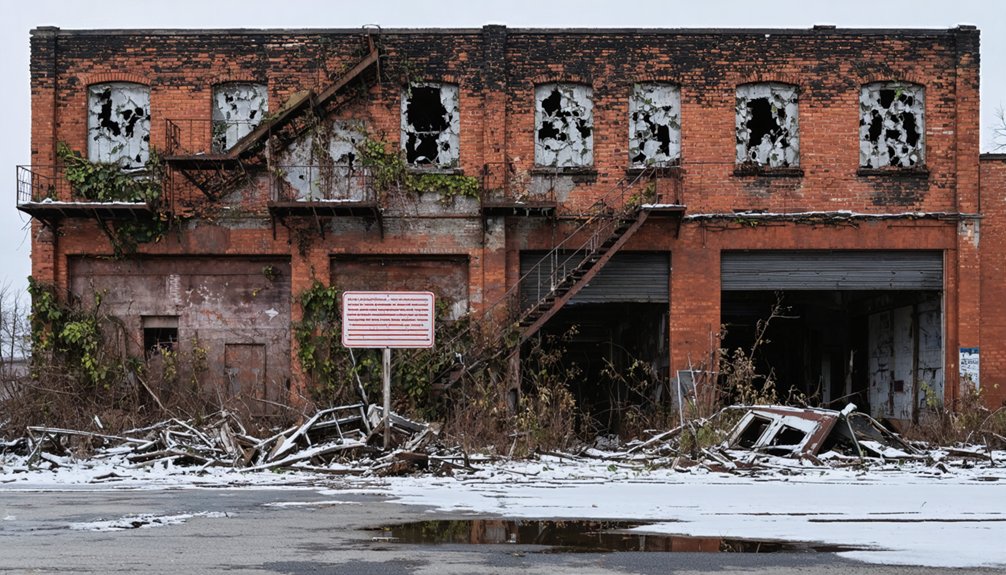
As manufacturing jobs vanished from Rust Belt cities between 1970-2006, a staggering 45% population decline transformed vibrant urban cores into vast stretches of abandonment.
You’ll find entire neighborhoods left desolate after major employers departed, with cities like Detroit demolishing roughly 20,000 homes since 2014 – about a quarter of its housing stock.
This abandonment creates a destructive cycle: vacant properties attract crime and discourage investment, while declining tax bases limit public services.
Urban renewal efforts have struggled due to deep-rooted racial segregation and social fragmentation, making coordinated community engagement difficult.
When you look at demolished areas today, you’ll often see empty lots rather than revitalized spaces, as redevelopment initiatives remain incomplete amid continued population loss and economic challenges.
Failed Attempts at Economic Diversification
Despite massive federal and state investments throughout the 1980s and 1990s, Rust Belt cities failed to break free from their deep-rooted industrial dependencies.
You’ll find a pattern of failed initiatives across these regions, where attempts to diversify local economies couldn’t overcome decades of single-industry reliance.
Economic stagnation persisted as venture capital and foreign investment gravitated toward coastal regions, leaving Rust Belt areas with less than 20% of available nationwide funding.
- Company towns remained resistant to innovation, clinging to outdated business models.
- Coal subsidies and manufacturing supports proved ineffective at stemming job losses.
- Limited reinvestment opportunities deterred new industries from taking root.
- Weak educational attainment in many areas hindered workforce adaptability.
- Loss of human capital through outmigration made attracting new businesses nearly impossible.
Social and Racial Tensions
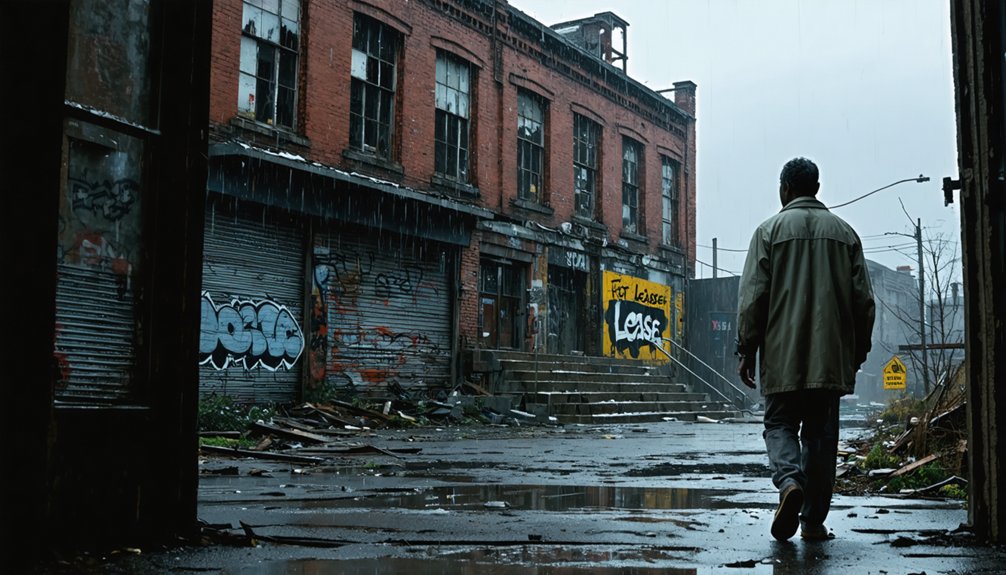
Through decades of systemic barriers and institutional discrimination, social and racial tensions have become deeply embedded in Rust Belt cities, where several metropolitan areas rank among America’s ten most segregated regions.
You’ll find these divisions stem from historical New Deal policies that excluded Black Americans, while violence and hostility prevented racial integration when Black families sought housing in white neighborhoods.
The decline of manufacturing jobs hit Black communities particularly hard, intensifying economic disparities and social fragmentation.
As unions lost influence, workers lost collective bargaining power, leaving many trapped in low-wage positions.
White flight to suburbs, enabled by highway infrastructure, further eroded social cohesion.
These entrenched patterns of segregation persist most strongly in Midwest and Northeast metro areas, where economic insecurity continues to fuel racial tensions and mistrust.
The Legacy of Industrial Pollution
While manufacturing drove the Rust Belt’s economic engine for decades, it left behind a toxic environmental legacy that continues to plague these communities today.
The region’s pollution legacy stems from concentrated heavy industry, particularly metals manufacturing, which released massive amounts of air and water pollutants. You’ll find the impact of this environmental degradation reflected in over 450,000 brownfield sites across Rust Belt states, creating ongoing health risks for residents.
- EPA data shows manufacturing pollution dropped 20.41% from 2009-2012, yet efficiency worsened
- Heavy coal usage historically drove significant air pollution through emissions
- Industrial waste led to major water pollution events like the 1969 Cuyahoga River fire
- Residents face elevated cancer and respiratory illness risks from decades of exposure
- Despite cleanup efforts, contaminated industrial sites continue hampering recovery
Modern Challenges in Revival Efforts
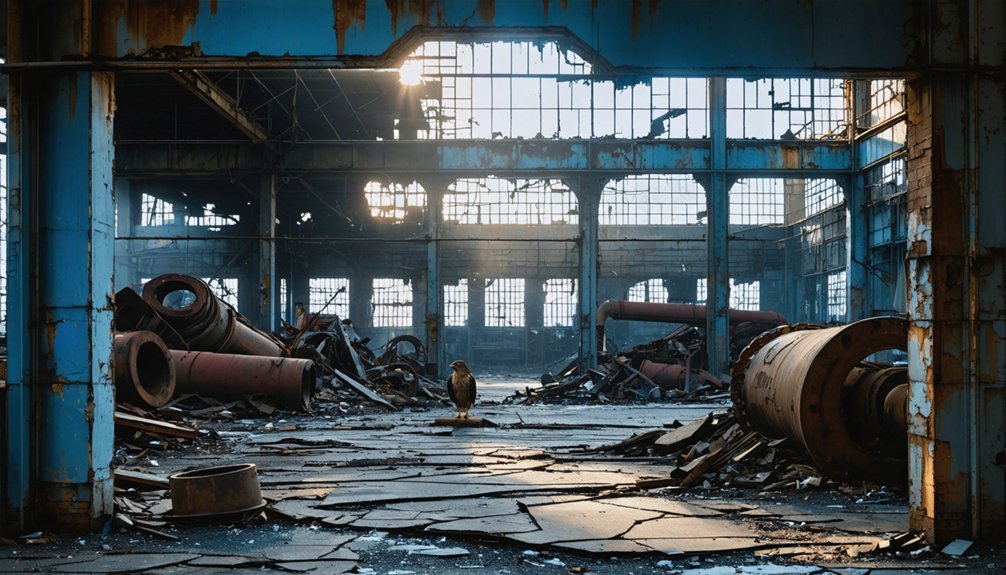
Modern revival efforts in Rust Belt towns face compounding obstacles that extend beyond the region’s environmental challenges.
In this context, exploring abandoned towns in Tennessee can reveal a wealth of history and the impact of economic decline. These towns serve as both a reminder of past industries and a canvas for potential revitalization. Local communities are beginning to recognize the value in these forgotten places, sparking interest in preservation and tourism that could breathe new life into the area.
You’ll find population losses exceeding 40% in major cities like Detroit and Cleveland, creating a vicious cycle of diminishing tax revenues and deteriorating public services. This decline hits poorest neighborhoods hardest, fracturing community cohesion and worsening housing inequality.
While some cities attract tech investments from companies like Intel and Google, they’re struggling to compete with Sun Belt regions offering stronger job growth and business-friendly policies.
Despite tech sector interest, Rust Belt cities face tough competition from the Sun Belt’s booming job markets and pro-business environment.
You’re seeing the impact in places like Gary, which lost 2.1% of jobs in 2023 despite no recession. Limited housing supply and mismatched workforce skills further complicate revival attempts, especially in areas lacking educational attainment needed for knowledge-based economies.
Frequently Asked Questions
Why Didn’t Rust Belt Cities Invest in Tourism Like Other Declining Industrial Regions?
You’ll find that contaminated industrial sites, fiscal constraints, and negative city images severely limited tourism investment potential, while political leaders favored manufacturing-focused economic diversification over uncertain tourism ventures.
How Have Local Cultural Traditions and Festivals Survived the Economic Downturn?
You’ll see cultural resilience through community-driven festivals that blend tradition with innovation. Local groups maintain festival preservation by adapting programming, securing diverse funding sources, and fostering intergenerational participation.
What Role Did Organized Crime Play in the Decline of Rust Belt Cities?
Like a shadow government, organized crime’s gang influence and economic corruption drained your cities’ resources, deterred legitimate businesses, and weakened local leadership through racketeering, extortion, and political manipulation during industrial decline.
How Have Nearby Rural Communities Been Affected by Rust Belt Urban Decline?
You’ll find rural areas near Rust Belt cities suffering from population loss, reduced economic migration, and weakened community resilience due to manufacturing declines, aging populations, and lower educational attainment.
Which International Cities Have Successfully Overcome Similar Industrial Decline Challenges?
Fortune favors the bold! You’ll find successful revitalization stories in Pittsburgh, Bilbao, Leipzig, and Torino, where international comparisons show strategic economic diversification and robust government investment sparked remarkable industrial turnarounds.
References
- https://www.clevelandfed.org/publications/economic-commentary/2013/ec-201306-urban-decline-in-rust-belt-cities
- https://www.jetpunk.com/users/raffles/charts/population-of-rust-belt-cities
- https://commentaries.cberdata.org/1308/the-birth-and-death-of-rustbelt-cities
- https://repository.upenn.edu/bitstreams/eeb45167-3ee9-401e-a296-a371f4745e03/download
- https://worldpopulationreview.com/us-city-rankings/rust-belt-cities
- https://www.aeaweb.org/research/rethinking-detroit-vacant-development-guarantees
- https://www.loveexploring.com/gallerylist/127789/then-and-now-us-rust-belt-cities-that-bounced-back
- https://www.youtube.com/watch?v=HZFw7MZFycU
- https://www.minneapolisfed.org/article/2014/competition-and-the-decline-of-the-rust-belt
- https://mises.org/mises-wire/unions-and-protectionism-not-free-trade-doomed-rust-belt