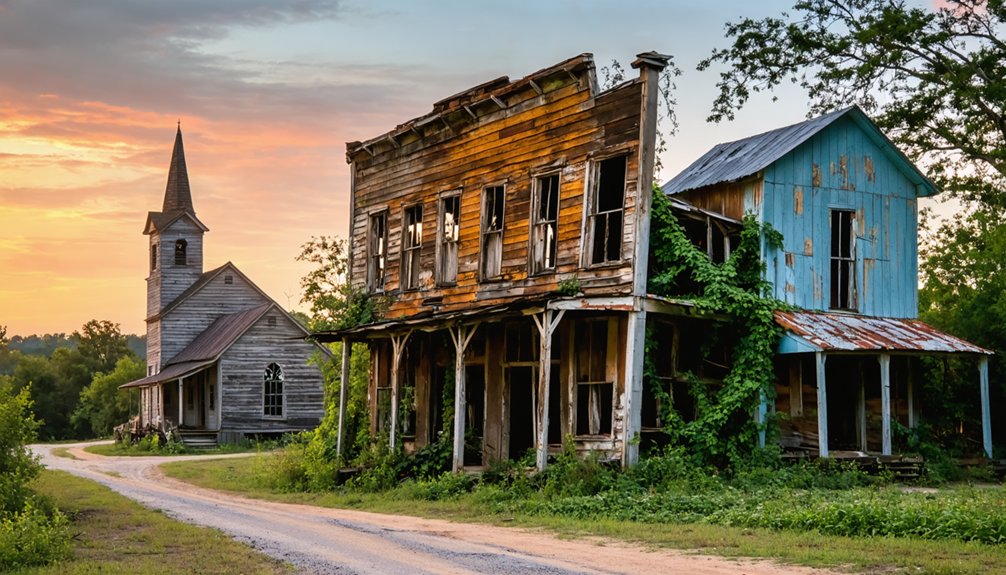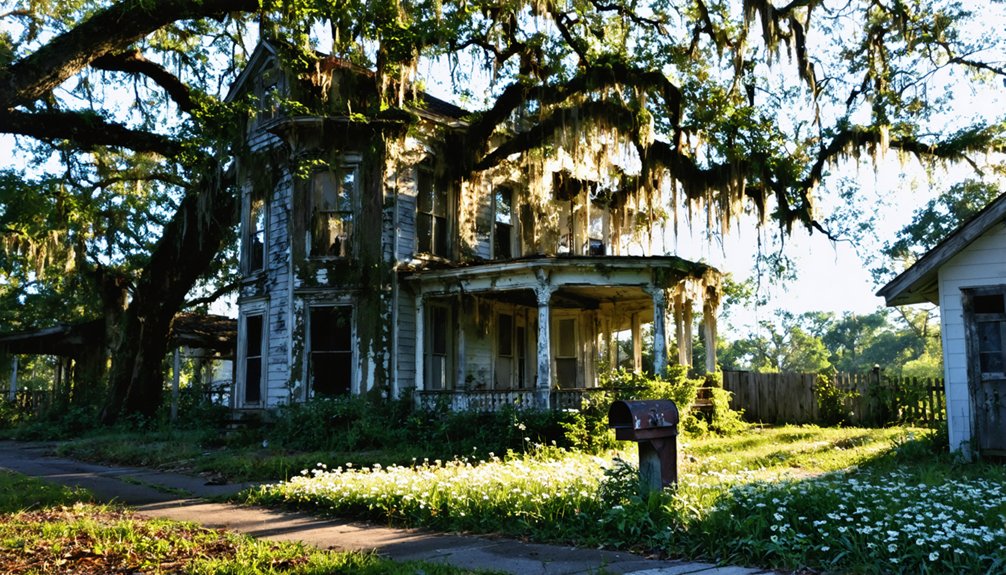
You’re seeing Southern neighborhoods abandoned due to a devastating economic decline, with manufacturing jobs plummeting 21% since 2020. This job loss triggered a mass population exodus, particularly among younger residents, leaving aging communities behind. Housing markets have collapsed, with places like Dorchester County facing foreclosure rates of 1 in 355 homes. When combined with deteriorating infrastructure and racial inequities, these factors create a complex web of abandonment that shapes today’s Southern landscape.
Key Takeaways
- Manufacturing job losses caused a 21% decline in employment, forcing residents to migrate to urban areas for work opportunities.
- Rising foreclosure rates, particularly in coastal regions, have left numerous homes vacant and neighborhoods underpopulated.
- Aging populations remain as younger residents leave, leading to closed schools and reduced community services.
- Neglected infrastructure and deteriorating buildings create unsafe conditions, discouraging residents from staying in affected neighborhoods.
- Economic disparities and racial segregation patterns contribute to systematic neighborhood abandonment, especially in Black-majority communities.
The Economic Downfall: Jobs and Industry Loss
While the South has emerged as a manufacturing powerhouse relative to the Rust Belt, this transformation hasn’t translated into broad economic prosperity for Southern communities.
You’ll find stark evidence of this manufacturing decline in states like South Carolina, where manufacturing jobs plunged 21% from 2020 to 2024, eliminating 71,000 positions despite a 36% rise in manufacturing GDP. The workforce share in manufacturing dropped from 22% to 14% during this period.
The rise of job automation and AI has fundamentally altered the employment landscape. Food and beverage manufacturers were the only sector showing job growth during this time.
The region’s right-to-work laws have made it easier for manufacturers to operate with minimal union interference, contributing to the area’s industrial growth.
While Southern states attract manufacturers with lower costs and minimal union presence, you’re seeing a disturbing trend: manufacturing output grows while jobs vanish.
This disconnect leaves many local neighborhoods struggling, as economic development policies fail to generate enough quality jobs to sustain communities.
Population Exodus and Community Changes
The manufacturing job losses have sparked a mass exodus from Southern communities, creating a ripple effect of demographic upheaval.
You’ll find this reflected in stark demographic trends, with 47% of U.S. counties experiencing population shrinkage between 2021-2022. Rural areas are hit particularly hard – Yazoo and Sunflower counties in Mississippi saw declines of 6.4% and 10.8% respectively.
Urban migration patterns show residents abandoning rural communities for opportunities in cities like Memphis, Jackson, and Mobile. Shelby County, Tennessee has faced net migration losses for more than four decades.
The exodus leaves behind aging populations, as younger residents flee to metropolitan areas. You’re seeing the impact in real time: closed schools, reduced services, and declining tax bases.
With 77% of rural counties having fewer working-age residents than 20 years ago, these communities face mounting challenges in maintaining basic infrastructure and social cohesion. The situation has become increasingly dire as 970 counties experienced significant population losses between 2010 and 2020.
Housing Market Failures and Foreclosure Crisis
Southern housing markets face unprecedented turmoil as foreclosure rates skyrocket beyond national averages, particularly in coastal regions.
You’ll find stark evidence in Dorchester County, SC, where one in every 355 homes faces foreclosure, while Charlotte County, FL follows closely at one in 372 homes.
The housing instability stems from a perfect storm of economic pressures.
You’re seeing foreclosure trends intensify due to above-average unemployment rates exceeding 4.36%, coupled with stagnant wages that can’t keep pace with housing costs.
The post-pandemic price correction has left many homeowners underwater on their mortgages, especially in Florida.
Homeowners in Louisiana are particularly vulnerable, with Rapides Parish reaching 17.3% of properties seriously underwater on their mortgages.
Adding to your concerns, housing markets are struggling with oversupply – particularly in cities like Jacksonville and Orlando, where homes sit vacant longer as buyers retreat due to economic uncertainty and rising mortgage rates.
Southern states contain the majority of both highest and lowest risk counties, with 21 of the 50 riskiest counties located in this region.
The Impact of Neglected Infrastructure
Neglected infrastructure in abandoned neighborhoods has triggered a cascading effect of physical, social, and economic decline across southern communities.
The declining population in Southern states has exacerbated these challenges, leaving many areas vulnerable to further deterioration. As residents move away in search of better opportunities, the once-thriving local economies struggle to sustain themselves. This cycle of decline not only impacts the infrastructure but also diminishes the sense of community and belonging that was once a hallmark of these neighborhoods.
You’ll find deteriorating buildings with collapsed roofs, unstable stairs, and severe structural damage that make them unsafe for occupancy. This infrastructure decay attracts criminal activity and reduces public safety, with abandoned properties becoming hotspots for drug use and violence. Many of these properties are owned by out-of-town speculators who purchase them sight unseen and let them deteriorate.
The impact extends beyond physical hazards.
You’re seeing how these blighted properties drive down surrounding property values and discourage investment, creating a vicious cycle of disinvestment. This problem is particularly severe in historically redlined neighborhoods, where discriminatory policies have led to systematic underfunding of infrastructure. Fourteen of the fifteen most affected neighborhoods have experienced violent crime rates well above the city average.
When buildings deteriorate, they don’t just affect individual properties – they transform entire neighborhoods into zones of economic and social distress.
Social Inequities and Regional Disparities
While historic patterns of racial segregation created the foundation for neighborhood abandonment, modern data reveals stark disparities in how this crisis unfolds across different communities.
The intersection of racial inequities and environmental justice has created devastating outcomes, particularly in Black-majority neighborhoods across the South and Rust Belt. Economic conditions in these areas have deteriorated severely, with median home values often falling below $60,000. Annual property taxes that exceed market values have accelerated the cycle of abandonment and deterioration.
- Black communities face vacancy rates up to 16% higher than mainly white areas, driven by systemic inequities.
- ZIP codes with 50%+ households earning under $22,500 experience the most severe abandonment.
- Climate risks have forced 3.2 million residents to relocate, primarily from disadvantaged areas.
- Rural southern counties with larger Black populations show vacancy rates reaching 32%.
These stark regional disparities reflect deep-rooted social inequities, creating cycles of disinvestment that trap communities in perpetual decline.
Frequently Asked Questions
What Role Do Natural Disasters Play in Accelerating Neighborhood Abandonment?
Natural disasters weaken your community resilience through property damage and rising insurance costs. You’ll face harder disaster recovery, pushing neighborhood abandonment as residents relocate from areas experiencing increased flooding and extreme weather.
How Do Local Cultural Traditions Influence Residents’ Decisions to Stay or Leave?
Your cultural identity and community ties create opposing forces – while strong Southern traditions encourage staying through hardship, declining economic conditions and modern mobility increasingly pressure you to abandon generational roots.
Can Abandoned Neighborhoods Be Successfully Transformed Into Urban Farming Communities?
You can transform abandoned neighborhoods through urban agriculture, as proven by successful projects worldwide. With strong community engagement, these spaces become productive farms that create jobs and improve food security.
What Impact Do Nearby Military Base Closures Have on Neighborhood Abandonment?
You’ll see significant military impact through job losses and community displacement when bases close, causing neighborhood abandonment especially in rural areas, though most communities recover within 5-10 years through redevelopment efforts.
How Do School District Changes Affect Residential Patterns in Declining Neighborhoods?
When school districts decline, you’ll see up to 50% of families migrate away. Reduced school funding triggers a downward spiral where neighborhood stability crumbles, pushing more residents to seek better educational opportunities elsewhere.
References
- https://247wallst.com/special-report/2018/11/02/30-american-ghost-towns-3/
- https://schoolofcities.utoronto.ca/neighbourhood-abandonment-in-the-american-rust-belt/
- https://www.datacenterresearch.org/reports_analysis/population-loss-and-vacant-housing/
- https://unitedwaynca.org/blog/vacant-homes-vs-homelessness-by-city/
- https://www.lincolninst.edu/publications/articles/new-american-ghost-towns/
- https://www.geotab.com/ghost-towns/
- https://www.loveexploring.com/gallerylist/188219/the-us-state-with-the-most-ghost-towns-revealed
- https://scmanufacturingconference.com/sc-manufacturing-gdp-rises-as-jobs-decline-study-shows/
- https://marginalrevolution.com/marginalrevolution/2025/05/manufacturing-went-south.html
- https://www.bls.gov/opub/mlr/2021/article/pdf/manufacturing-employment-in-the-southeast-examining-the-last-30-years.pdf