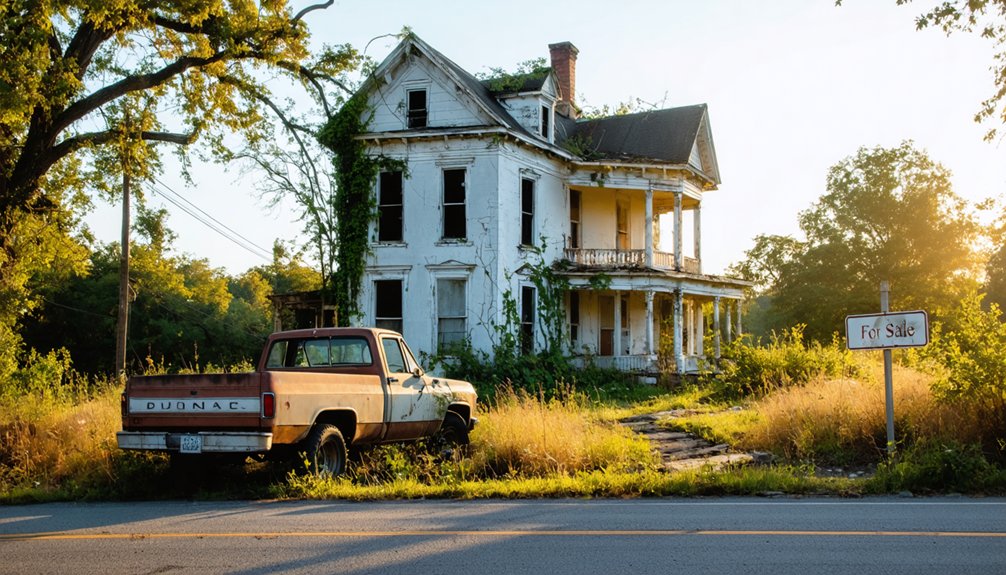
Southern suburban towns face abandonment due to an interconnected web of challenges you’ll recognize: severe economic decline, with per capita GDP at historic lows and manufacturing jobs down 44% since 2000. You’re seeing young adults flee to metropolitan areas while aging populations strain local resources. Natural disasters, crumbling infrastructure, and housing market collapses exceeding 23% accelerate the exodus. These compounding factors reveal a deeper story of systematic regional transformation.
Key Takeaways
- Economic decline and loss of manufacturing jobs have devastated local economies, with some areas losing up to 44% of industrial employment.
- Young, working-age adults are leaving for metropolitan areas, creating demographic imbalances and shrinking tax bases in suburban communities.
- Housing market collapse and plunging home values, exemplified by Austin’s 23% drop, trigger widespread foreclosures and property abandonment.
- Declining tax revenues lead to reduced municipal services and deteriorating infrastructure, making communities less attractive for potential residents.
- Natural disasters and severe weather events strain community resources, with inadequate climate resilience strategies accelerating population exodus.
The Economic Downward Spiral
While the American South has historically faced economic challenges, recent data reveals an accelerating downward spiral in its suburban and rural communities that’s reshaping the region’s economic landscape.
Economic headwinds in the South have intensified, creating unprecedented decline across suburban and rural areas of this historically challenged region.
You’ll find the lowest per capita GDP among U.S. regions here, where economic stagnation has taken root particularly in suburban areas. The workforce decline is stark – 59% of suburban counties have fewer prime-age workers than they did in 2000, creating a self-perpetuating cycle of economic deterioration.
As younger residents flee to urban centers, they leave behind aging populations and shrinking tax bases. This exodus has hit suburban towns especially hard, with rising poverty rates and declining economic activity. These areas show concentrated poverty rates of 31%, reflecting deep economic distress across communities.
The shift from manufacturing to service jobs has further weakened local economies, leaving many communities struggling to maintain basic services and infrastructure. Despite offering massive incentives to attract businesses, Southern states have failed to generate the promised economic benefits for their suburban regions.
Natural Disasters and Environmental Threats
As severe weather events intensify across the American South, natural disasters have become a driving force behind suburban abandonment. The average wait time between catastrophic events has dropped to just 12 days.
You’ll find that climate resilience strategies are increasingly crucial, yet many communities lack the resources to implement them effectively. The combination of rising sea levels, intensifying storms, and extreme heat creates an unsustainable environment for vulnerable towns, particularly those with aging infrastructure. Traditional community-based recovery efforts, which once helped neighborhoods rebuild after storms, have become overwhelmed by the increasing frequency and severity of disasters.
- Storm frequency and flooding have escalated dramatically, with Southern states experiencing hundreds of billion-dollar disasters since 1980.
- Coastal communities face existential threats from erosion and storm surges, while disaster preparedness initiatives often bypass minority neighborhoods.
- Heat-related stress and infrastructure strain compound these challenges, especially in low-income areas where emergency services are already limited.
These environmental pressures disproportionately impact Black and Brown communities, which face 40% higher flood risks and fewer recovery resources.
Population Exodus and Demographic Changes
You’ll notice a stark generational divide emerging in Southern suburban towns, where young adults aged 25-44 are steadily departing for metropolitan areas offering better economic prospects.
This youth exodus leaves behind concentrations of aging residents, with some towns seeing their senior population percentages climb markedly above regional averages.
Your analysis of current demographic data reveals that many of these suburbs aren’t attracting enough new young families to offset the outflow, creating communities increasingly weighted toward retirement-age residents.
However, recent data shows that high-amenity rural counties are beginning to attract younger workers at unprecedented rates, challenging the previous urban migration pattern.
Meanwhile, major metropolitan areas like Dallas-Fort Worth have gained over 152,000 new residents, highlighting the dramatic shift from suburban to urban living in the South.
Youth Migration Patterns
Today’s southern suburban towns face unprecedented youth flight, driven by stark economic disparities between stagnating communities and thriving metropolitan areas.
You’ll find youth aspirations increasingly incompatible with the limited opportunities in these declining regions, where traditional industries like agriculture and manufacturing continue to shrink. Migration motivations stem from the profound wage gaps between rural suburbs and urban centers. Sun Belt metros consistently top the charts for population growth and economic opportunity. The staggering decline in birth rates in major urban centers has surprisingly not benefited these southern towns.
- College-educated young adults aged 25-29 are leading the exodus, with some counties losing over 30% of their youth population.
- Remote work trends accelerate youth departure, as they’re choosing fast-growing Sun Belt suburbs or metropolitan areas.
- Economic opportunities concentrate in specific growth corridors like the Texas Triangle and Florida exurbs, leaving traditional southern suburbs behind.
This targeted migration depletes these communities of their essential workforce, creating a self-perpetuating cycle of decline.
Senior Resident Concentration
Three distinct demographic shifts have transformed southern suburban landscapes, with senior residents now representing an unprecedented concentration of the population.
You’ll find that suburban counties have experienced a dramatic rise in residents aged 65 and older, jumping from 12% in 2000 to 16% in 2018.
This shift’s impact is particularly evident in Florida, where you’re seeing some counties with over 30% of residents aged 60-plus. The state’s popularity among retirees has made it a retirement destination hub, reflecting broader national aging trends.
The exodus of working-age adults has intensified senior isolation, while straining healthcare access and community resources.
You’re witnessing a demographic paradox where the growth of the senior population coincides with declining working-age residents, creating economic challenges and increased dependency ratios that reshape suburban significance.
The stark economic contrast is evident as average household incomes in suburban areas decreased from $103,000 in 2000 to $101,000 in 2018, further impacting community stability.
Transportation Networks and Infrastructure Decay
As suburban towns across the Southern United States face mounting infrastructural challenges, their transportation networks have fallen into unprecedented disrepair due to a devastating combination of geological subsidence, aging structures, and systematic disinvestment.
You’ll find infrastructure investment dwindling while maintenance costs soar, creating a downward spiral of deterioration that’s particularly evident in transportation efficiency.
- Land subsidence exceeding 3mm annually in major metropolitan areas has accelerated the decay of roads and bridges, with over 8-12% of rural transportation infrastructure now structurally deficient.
- Sprawling development patterns have generated unsustainable costs exceeding $21,000 per unit, forcing communities to abandon repairs rather than maintain existing networks.
- Transportation networks are fragmenting as suburban expansion outpaces infrastructure capacity, leading to systemic breakdowns and reduced public transit coverage.
Housing Market Collapse and Property Abandonment
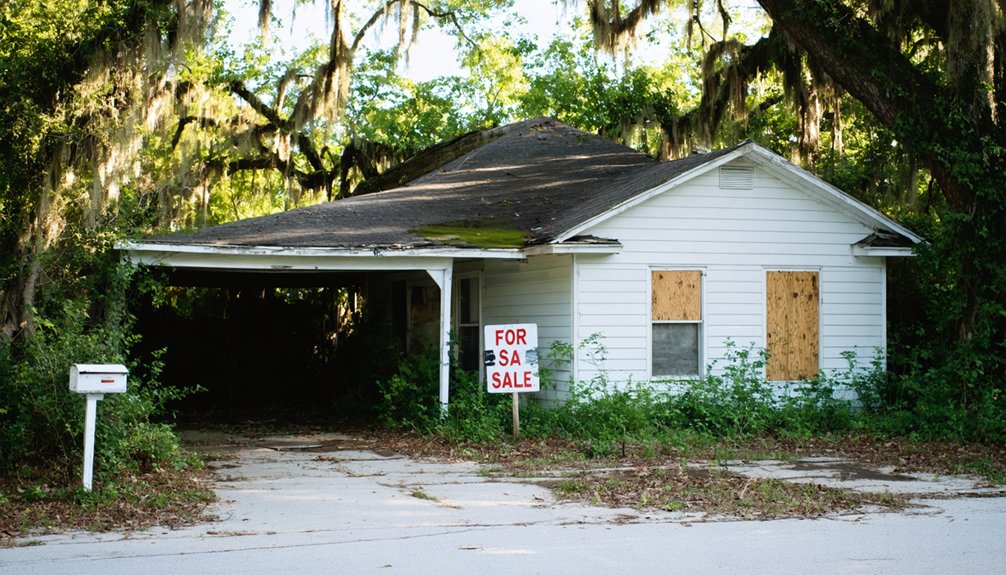
The deteriorating transportation networks have accelerated a catastrophic housing market collapse across Southern suburban communities.
You’ll find stark evidence in markets like Austin, where home values have plunged over 23% since 2022, triggering widespread foreclosure surges. The region’s aggressive construction of 3.3 million housing units has backfired amid weakening demand and migration slowdowns.
You’re witnessing unprecedented home value erosion as sellers face mounting pressure from underwater mortgages and unsustainable carrying costs.
Monthly payments of $9,000 alongside $20,000 property tax bills are forcing homeowners to default or sell at losses.
The market’s self-correcting mechanisms have broken down under restrictive zoning regulations and permitting delays, while vacant properties multiply as buyers retreat from historically overvalued suburbs.
Historical Legacy of Southern Ghost Towns
You’ll find that many of today’s southern ghost towns originated as bustling transportation hubs and agricultural centers during the 19th century.
As these towns fell into decline, they became canvases for stories of abandonment and nostalgic memories, reminiscent of the rust belt urban decay stories that illustrate the transformation of industrial powerhouses into shadowy remnants. Each crumbling structure bears witness to the passage of time, echoing the lives that once thrived within their walls. Exploring these sites reveals layers of history, highlighting a poignant juxtaposition between past vitality and present desolation.
The rise and fall of railroads proved especially decisive, as towns that lost their rail connections often faced rapid population decline and eventual abandonment.
Agricultural communities suffered similar fates when farming operations failed due to economic downturns, environmental challenges, or shifts in agricultural markets.
Early Transportation Hubs Fade
During the late 19th and early 20th centuries, Southern suburban towns emerged as essential transportation hubs, with railroads like Southern Railroad and Georgia Southern & Florida Railroad serving as lifelines for commerce and settlement.
You’ll find that railroad history shaped these communities, as train stations attracted settlers and fostered thriving local economies built around agriculture and trade.
The transportation evolution proved devastating when railroad companies faced bankruptcy or modernized their routes.
Consider these critical changes:
- Train stations closed, triggering the shutdown of post offices and supporting businesses
- Highway systems reduced reliance on rail transport, leaving towns isolated
- Communities couldn’t adapt quickly enough to new transportation patterns, leading to abandonment
Today, these ghost towns stand as stark reminders of how shifting transportation networks can determine a community’s fate.
Southern Agricultural Town Decline
As post-Civil War economic pressures collided with environmental disasters, Southern agricultural towns faced a perfect storm of challenges that ultimately led to their widespread abandonment.
You’ll find that misguided agricultural practices, including over-reliance on cash crops and mechanized plowing without soil conservation, severely depleted the land’s productivity. When the devastating droughts of the 1930s struck, these weakened farming communities couldn’t withstand the impact.
The situation worsened as economic policies failed to address the mounting crisis. Bank failures limited access to credit, while plummeting crop prices forced farmers to increase production, creating a destructive cycle of oversupply and falling values.
Towns dependent on agriculture couldn’t recover as farm abandonment accelerated, leaving behind shells of once-thriving communities that had gambled their futures on unsustainable farming methods.
Impact of Regional Industrial Shifts
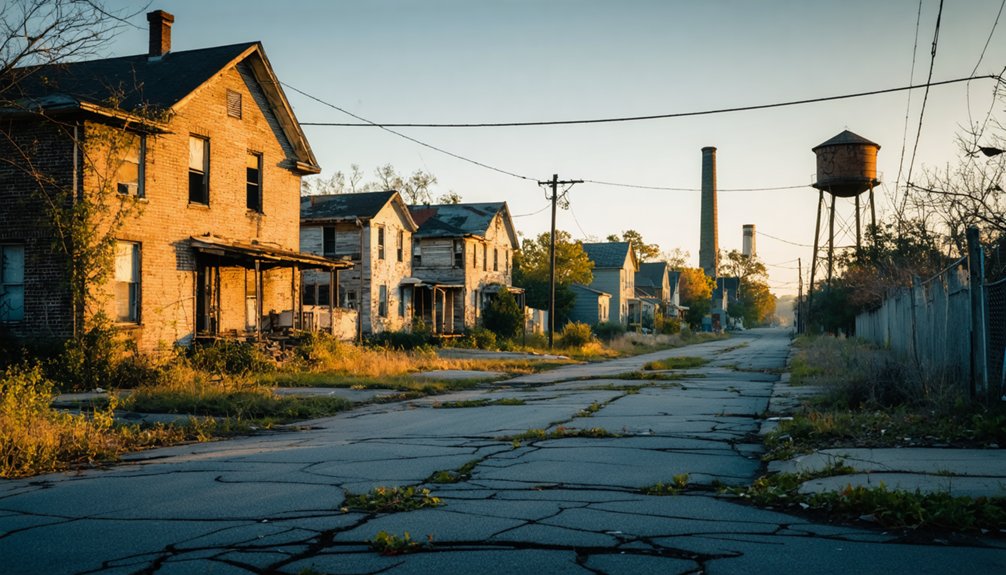
While manufacturing once served as the economic backbone of Southern suburban communities, dramatic industrial shifts have fundamentally altered the region’s economic landscape since the late 1990s.
Manufacturing’s retreat from Southern suburbs since the 1990s has transformed local economies, ending an era of industrial prosperity.
You’ll find manufacturing shifts have devastated many suburban towns, with plant closures and limited new startups creating economic disparities between urban and rural areas.
- Southern states lost up to 44% of manufacturing jobs between 2000-2010, with textile and apparel sectors declining by 82%
- Per capita GDP remains stagnant at 90% of national average, as communities shift from mid-skilled factory work to lower-paid service jobs
- High capital costs and limited plant mobility prevent manufacturing relocation to smaller towns, leading to permanent economic decline
These changes have forced suburban communities to grapple with declining populations and diminished economic opportunities, particularly in areas historically dependent on single industries.
The Ripple Effect of Municipal Service Decline
The ripple effects of industrial decline have triggered a devastating cascade of municipal service reductions across Southern suburban communities.
You’ll find your town’s essential services—police, fire protection, and garbage collection—progressively diminishing as tax revenues plummet. This creates a vicious cycle where service equity becomes increasingly compromised, particularly in disadvantaged neighborhoods.
When you examine the pattern closely, you’ll notice how workforce reductions and service outsourcing have eroded community resilience.
Your local government’s capacity to maintain infrastructure and respond to emergencies weakens as budgets tighten. The impact is most severe in suburban poverty areas, where service deserts emerge and persist.
As residents flee these deteriorating conditions, they leave behind a shrinking tax base that further accelerates the cycle of municipal service decline and neighborhood abandonment.
Frequently Asked Questions
How Long Does It Typically Take for a Town to Become Completely Abandoned?
You’ll observe town decay unfold over 15-20 years, though urban migration can accelerate abandonment. Complete desertion varies considerably, occurring rapidly within 5 years or extending beyond two decades.
Can Abandoned Southern Suburban Towns Be Legally Repopulated by New Residents?
You can legally repopulate abandoned southern suburbs, but you’ll face significant legal implications like property rights clearance, code compliance requirements, and repopulation challenges including zoning restrictions and rehabilitation costs.
What Happens to Local Historical Records When Towns Are Abandoned?
You’ll find historical records from abandoned towns transferred to regional archives, where historical preservation efforts protect them through digitization and proper storage, ensuring record accessibility for future research and documentation.
Do Utility Companies Continue Maintaining Infrastructure in Partially Abandoned Towns?
You’ll find utilities maintaining minimal service in partially abandoned towns, though infrastructure challenges multiply exponentially. They’ll prioritize repairs based on remaining customer density while reducing overall maintenance in sparsely populated areas.
Are There Government Programs Specifically Designed to Prevent Town Abandonment?
You’ll find numerous government incentives through programs like NSP and CDBG that target urban renewal, offering billions in funding to prevent abandonment through property rehabilitation, infrastructure maintenance, and community redevelopment initiatives.
References
- https://247wallst.com/special-report/2021/05/19/30-american-ghost-towns-7/
- https://wicproject.com/lifestyle/7-southern-towns-that-were-abandoned-after-natural-disasters/
- https://www.lincolninst.edu/publications/articles/new-american-ghost-towns/
- https://www.texasstandard.org/stories/texas-population-boom-ghost-towns-rural-urban-suburban-shift/
- https://www.geotab.com/ghost-towns/
- https://www.loveexploring.com/gallerylist/188219/the-us-state-with-the-most-ghost-towns-revealed
- https://www.youtube.com/watch?v=XYBz9fcdnUU
- https://www.pewresearch.org/social-trends/2018/05/22/demographic-and-economic-trends-in-urban-suburban-and-rural-communities/
- https://www.chicagofed.org/publications/chicago-fed-letter/2025/511
- https://www.epi.org/publication/rooted-racism-part2/