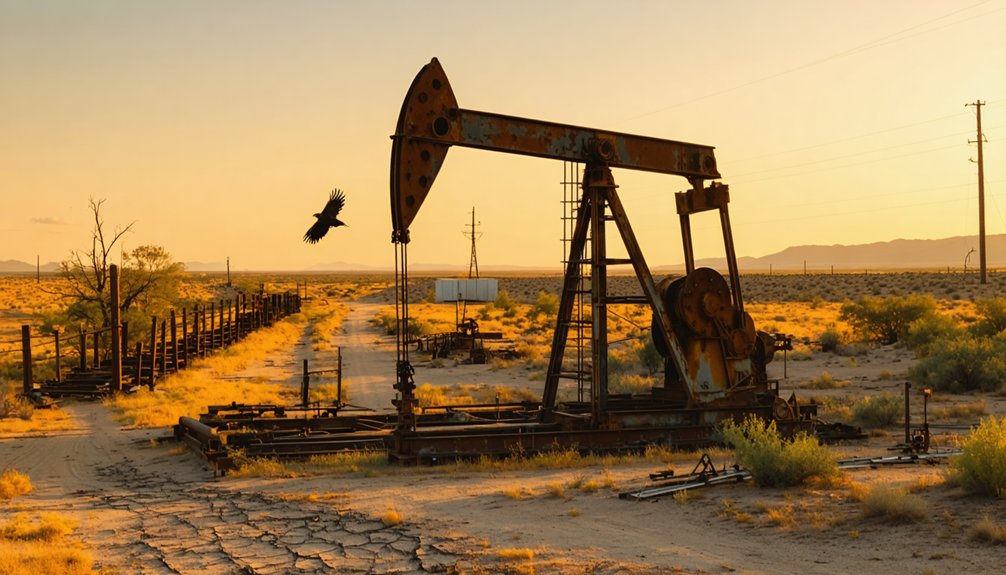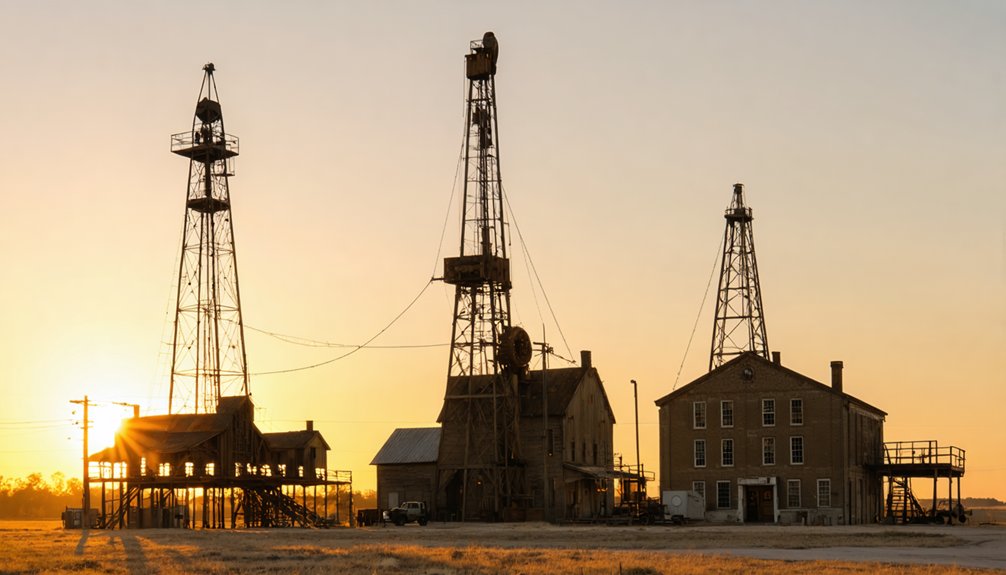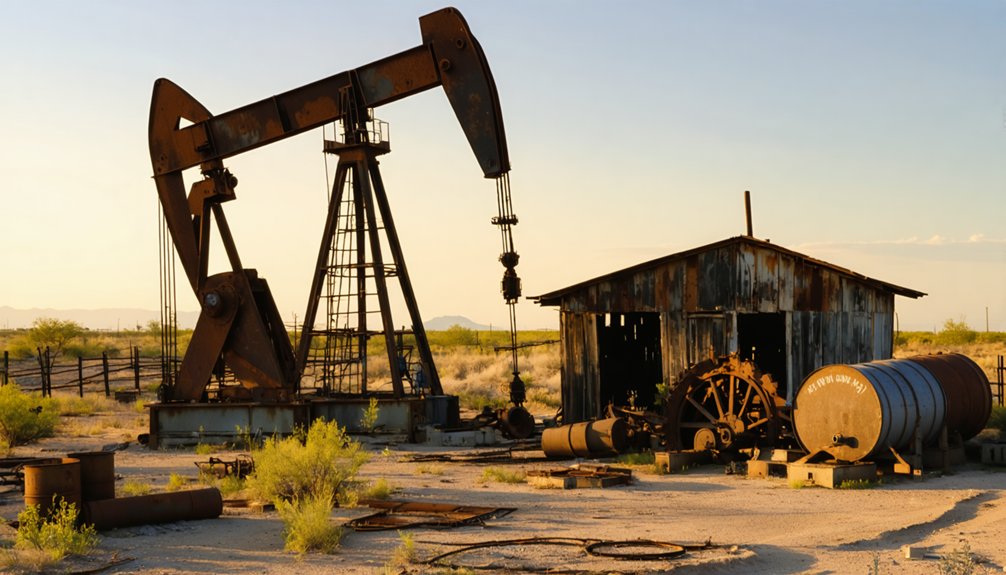
You’ll find abandoned oil city ruins across America due to the volatile boom-bust cycles of petroleum markets since 1859. When oil towns experience price crashes or resource depletion, companies go bankrupt and abandon wells, triggering mass worker exodus and economic collapse. These former boomtowns, from Pennsylvania to Texas, now face severe environmental challenges from over 3.5 million deserted wells leaking toxins. The complex story of America’s oil ruins reveals deeper patterns of resource-dependent development.
Key Takeaways
- Oil towns follow predictable boom-bust cycles driven by oil price volatility, leading to mass exodus when prices crash or reserves deplete.
- Economic dependence on a single industry makes oil towns vulnerable when companies declare bankruptcy or relocate during market downturns.
- Depleted oil reserves force businesses to close and workers to leave, leaving behind abandoned infrastructure and ghost towns.
- Poor resource management and failure to diversify local economies accelerate the decline of oil-dependent communities.
- Environmental damage from abandoned wells and infrastructure makes areas uninhabitable and costly to rehabilitate, discouraging repopulation.
The Rise of Oil Boomtowns in American History
When Edwin Drake successfully drilled the first commercial oil well in Titusville, Pennsylvania in 1859, he sparked a transformative era in American industrial history that would give rise to numerous oil boomtowns across the nation.
Early oil discoveries spread from the Appalachian Basin to California, creating instant cities that transformed America’s landscape. In the Los Angeles Basin, the discovery of the Brea-Olinda Oil Field in 1880 initiated the region’s oil production era. You’ll find the most dramatic examples in places like Spindletop, Texas, where the 1901 oil discovery triggered massive urban expansion, and Tulsa, Oklahoma, which earned its “Oil Capital” title after the Glenn Pool discovery in 1905.
As companies rushed to extract black gold, these boomtowns exploded with growth, often overwhelming local infrastructure. Within months, small villages morphed into bustling cities, complete with refineries, railroads, and storage facilities, while diverse populations of workers and entrepreneurs flooded in. The rise of Standard Oil Trust in 1882 under John D. Rockefeller further accelerated the industry’s expansion and influence across these emerging oil towns.
How Oil Towns Transformed Into Ghost Towns
Modern oil towns transform into ghost towns through a devastating chain of economic and environmental events that typically begins with oil price volatility.
When oil prices crash, companies declare bankruptcy, leaving behind unplugged wells and deteriorating infrastructure. The environmental impact is severe, with toxic lakes forming near abandoned wells. You’ll witness the rapid exodus of workers as jobs vanish, followed by declining populations that strain local services. The collapse hit especially hard when oil prices dropped from over $100 per barrel to less than half that value.
Despite talks of oil town revival, these communities struggle with mounting environmental hazards and community resilience challenges.
- Mass unemployment triggers population decline as oil workers relocate
- Abandoned wells and infrastructure create environmental and health risks
- Housing markets remain distorted while tax revenues plummet
- Public services and businesses close as communities shrink
- Food insecurity and homelessness rise among remaining residents
Environmental Impact of Abandoned Oil Infrastructure
You’ll find that abandoned oil wells pose severe risks to groundwater quality, with 35% of documented orphaned wells sitting dangerously close to domestic water sources and leaching toxic chemicals like arsenic and benzene.
Each abandoned well releases an average of 0.13 tons of methane per year, contributing to both local air pollution and global climate change.
The contamination extends beyond water, as these wells release harmful substances that degrade surrounding soil quality and impair agricultural potential. An estimated 4.6 million people reside within one kilometer of documented orphaned wells, highlighting the widespread exposure to potential health hazards.
Your examination of local ecosystems reveals widespread damage, including habitat fragmentation, reduced biodiversity, and compromised soil microbiota that may take decades to recover.
Groundwater Contamination Risks
Beneath the remnants of abandoned oil cities lies a severe environmental threat to groundwater systems, as thousands of deteriorating wells leak toxic substances into aquifers across the United States.
You’ll find these contamination sources affecting groundwater safety for over 14 million Americans living within a mile of abandoned or orphan wells.
The scale of this crisis is staggering, with more than 3.5 million deserted wells nationwide. Testing has revealed that leaking oil wells frequently discharge carcinogenic chemicals into surrounding soil and water. Recent studies show that only 8 percent of these wells have proper groundwater quality monitoring data.
- Toxic chemicals like benzene, arsenic, and radioactive materials seep into drinking water sources
- Wells can discharge hundreds of gallons of contaminated water per minute
- Deteriorating well casings create direct pathways for pollutants to enter aquifers
- Surface water bodies become contaminated through connected groundwater systems
- Limited monitoring hampers accurate assessment of contamination spread and severity
Soil Pollution Near Wells
The devastating environmental legacy of abandoned oil wells extends far beyond groundwater contamination into widespread soil pollution, with toxic chemicals creating hazardous conditions across thousands of well sites nationwide.
You’ll find extensive soil degradation around these wells, where produced water containing arsenic, benzene, and radioactive materials continuously leaches into surrounding soils. The toxic leaching creates dangerous hotspots where methane emissions, averaging 6 grams per hour, disrupt soil chemistry and kill essential microorganisms. Beyond soil damage, these sites release an estimated methane emissions of up to 20 million metric tons of CO2 equivalent annually.
These contaminants persist for decades, bioaccumulating in the soil matrix and creating dead zones that limit land use and agricultural productivity. The presence of 120,000 documented orphan wells across the United States compounds this environmental crisis.
What’s particularly concerning is how these pollutants transform previously fertile land into hazardous environments, where soil enzymatic activities become impaired and vegetation struggles to survive.
Ecosystem Damage Assessment
While abandoned oil infrastructure poses numerous environmental threats, its devastating impact on ecosystems stands out as particularly severe, with documented effects ranging from habitat fragmentation to widespread biodiversity loss.
You’ll find that these sites create lasting ecological disruptions through toxic contamination of soil and water, severely limiting ecosystem restoration potential. The environmental damage extends far beyond the immediate drill sites, creating interconnected challenges for wildlife and plant communities.
- Toxic leaks poison food chains and disrupt essential ecosystem services
- Habitat fragmentation reduces species diversity and movement corridors
- Contaminated sites become inaccessible to wildlife, creating dead zones
- Persistent pollution prevents natural recovery of affected areas
- Long-term ecological legacies complicate restoration efforts and threaten biodiversity loss
The Economic Cycles Behind Oil Town Abandonment
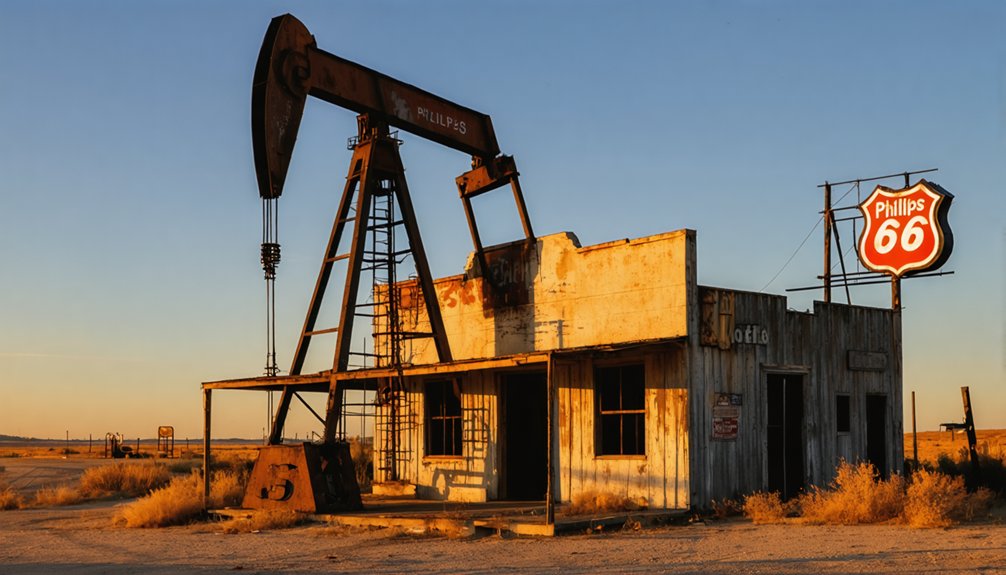
You’ll find that oil town abandonment follows predictable economic cycles, beginning with rapid growth during resource discovery and high oil prices, followed by decline when market conditions shift or reserves deplete.
The boom phase attracts massive infrastructure investment and population growth, while the bust phase triggers rapid business closures and worker exodus as oil companies cease operations.
When oil prices remain low or wells become unprofitable, companies often declare bankruptcy and abandon their assets, leaving towns without their economic foundation and unable to maintain basic services.
Boom-to-Bust Market Forces
Numerous oil towns across America share a common economic narrative driven by the volatile nature of petroleum markets since 1859.
You’ll find these communities caught in relentless economic fluctuations that stem from oil’s boom-and-bust cycles. When prices surge, you’ll witness rapid growth and prosperity, but market instability inevitably leads to devastating crashes.
- Capital-intensive projects require 3-5 years from investment to production
- Price increases trigger overproduction, leading to market gluts
- Supply responses lag behind demand changes, amplifying price swings
- Local governments become dependent on temporary oil revenues
- Economic diversification rarely occurs during boom periods
This cycle repeats because of the fundamental mismatch between long-term production commitments and rapid market shifts.
The time lag between investment decisions and actual output creates persistent overproduction problems that destabilize oil-dependent communities.
Resource Depletion Effects
When oil reserves begin depleting in established extraction regions, you’ll witness a cascade of economic impacts that devastate local communities. Poor resource management leads to rapid production declines, triggering widespread job losses and reduced tax revenues that cripple local government budgets.
Without proper economic planning, these communities can’t maintain the infrastructure built during boom times or support essential public services.
You’ll find that maturing oil fields naturally yield less over time, regardless of technological advances. This inevitable decline forces companies to abandon wells and idle equipment, leaving towns economically stranded.
The environmental toll compounds these challenges, as cleanup costs and health impacts from decades of extraction create additional burdens. Communities that failed to diversify during prosperous periods face the harshest consequences when reserves run dry.
Legacy Wells and Modern Cleanup Challenges
Despite decades of oil extraction across America, the environmental burden of legacy wells poses mounting challenges for modern cleanup efforts.
Legacy well remediation faces massive hurdles with hundreds of thousands of abandoned wells scattered across states like Pennsylvania and Texas. You’ll find these hazardous sites beneath homes, farms, and infrastructure, complicating cleanup operations.
Abandoned oil wells lurk beneath America’s landscape, creating environmental hazards that challenge modern cleanup efforts.
Methane emission monitoring reveals these wells threaten groundwater, soil quality, and air safety while contributing to climate change.
- Undocumented well locations hinder systematic inspection and remediation efforts
- Advanced detection tools like drone-mounted sensors help locate hidden wells
- Estimated plugging costs exceed available federal funding by up to 80%
- Many wells predate modern regulatory requirements for proper closure
- Collaborative partnerships between agencies and scientists drive detection innovation
Notable Examples of America’s Oil Ghost Towns
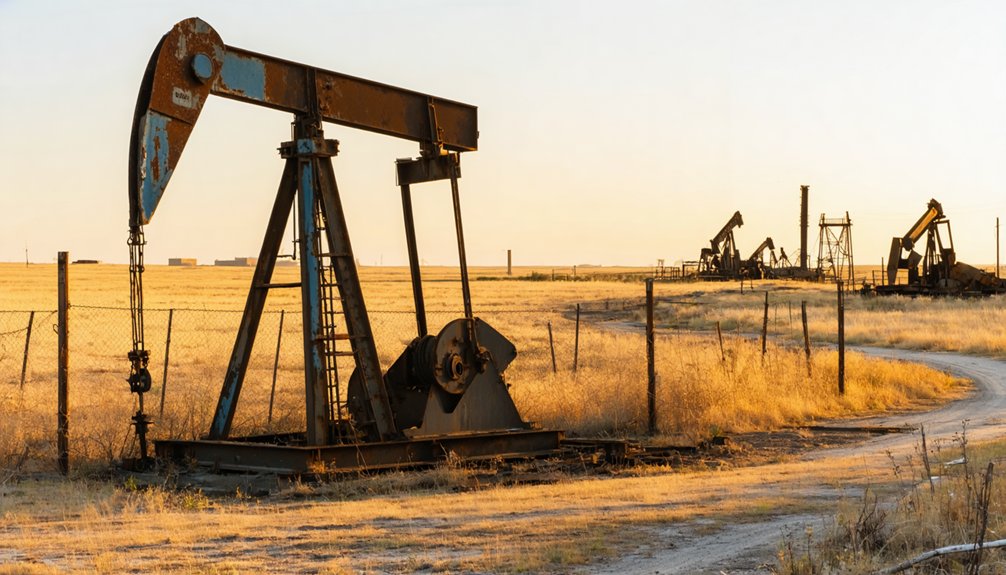
America’s oil boom era left behind a remarkable network of ghost towns, from Pennsylvania’s pioneering settlements to the scattered ruins across Texas and Oklahoma.
These abandoned sites showcase the dramatic rise and fall of oil-dependent communities. You’ll find well-preserved examples like Saint Elmo, Colorado, where ghost town preservation efforts maintain structures from its mining and oil extraction heyday.
Exploring the ghost towns of the American West offers a unique glimpse into the region’s storied past. Each location, from Bodie, California, to Virginia City, Nevada, tells a tale of ambition, hardship, and eventual abandonment. Visitors can imagine the bustling life that once filled these now-silent streets, as nature slowly reclaims what was once deemed essential.
The historical significance of sites like Petroleum Center, Pennsylvania, reveals communities that were once more untamed than the Wild West.
Across the nation, places like Ruby, Arizona, and Shakespeare, New Mexico, stand as monuments to the volatile nature of resource-dependent economies.
These sites tell the story of rapid development followed by equally swift decline when oil wells ran dry or market conditions shifted, leaving behind fascinating remnants of America’s industrial heritage.
Cultural Heritage and Preservation Efforts
Throughout the United States, recent preservation initiatives have intensified efforts to protect cultural heritage sites from the destructive legacy of abandoned oil infrastructure.
The Biden administration’s policies and the Bipartisan Infrastructure Law demonstrate heightened recognition of cultural significance, particularly regarding Indigenous sacred spaces and archaeological treasures. Modern preservation strategies now emphasize both environmental restoration and cultural protection.
- Federal protection zones, like the 10-mile buffer around Chaco Culture National Historical Park, safeguard over 4,700 archaeological sites
- $4.7 billion in federal funding supports well plugging and land reclamation efforts, with $150 million dedicated to tribal communities
- BLM’s updated regulations require oil companies to cover true cleanup costs
- State Historic Preservation Offices guide protection of culturally significant sites
- Indigenous nations actively shape policies through consultation and advocacy for sacred land preservation
Government Response to Orphaned Well Crisis
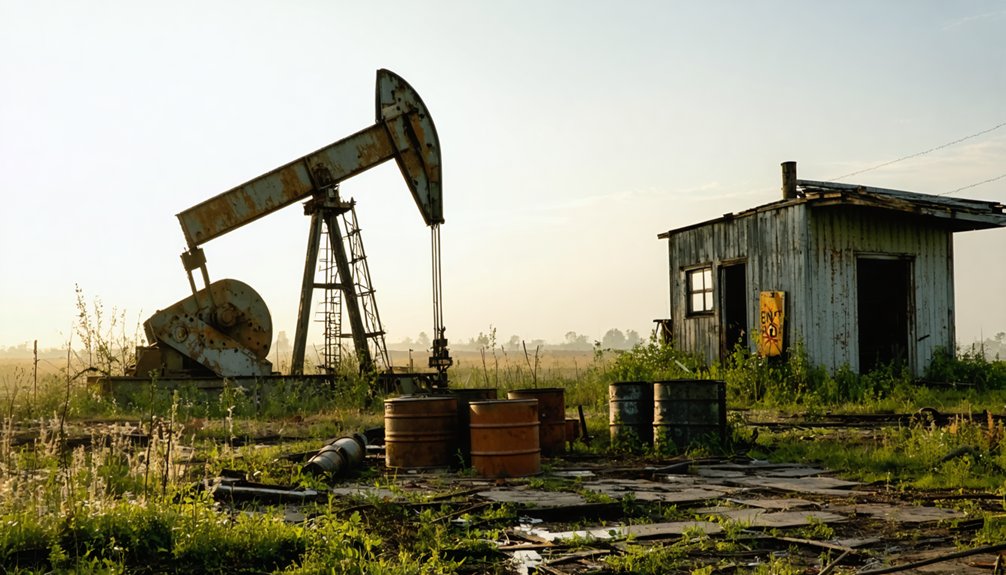
In response to the growing crisis of abandoned oil infrastructure, the federal government has launched unprecedented funding initiatives through the Bipartisan Infrastructure Law, allocating $4.7 billion for orphaned well remediation nationwide.
You’ll find that despite this significant investment, the funding still falls short of addressing the full scope of America’s orphaned well problem, estimated at up to 2.1 million unplugged wells.
States receiving orphaned well funding now face complex regulatory challenges as they navigate environmental protection requirements.
While the federal government’s increased oversight aims to guarantee responsible remediation, these new regulations have actually slowed down well-plugging progress in some states.
You’re seeing a tension between urgent cleanup needs and compliance with federal guidelines, as state agencies struggle to balance rapid response with environmental protection protocols.
The Future of Former Oil Boomtowns
Former oil boomtowns face complex economic shifts as they grapple with the aftermath of their dependency on oil revenue.
You’ll find these towns working toward economic resilience through infrastructure investments and workforce adaptation strategies, though success varies greatly.
While some communities channel oil revenues into sustainable development, others struggle with abandoned facilities and declining populations.
The stark divide between oil towns reveals itself – some build lasting foundations while others fade into ghost towns.
- Towns like Karnes City demonstrate how investing oil money in schools and civic centers can build lasting economic foundations.
- Workforce adaptation remains challenging as high-wage oil jobs ($80,000+) give way to lower-paying industries.
- Infrastructure originally built for oil operations limits diversification options.
- Technology advances can trigger new boom cycles, temporarily reviving local economies.
- Strategic planning for economic diversity often competes with the immediate pressures of market volatility and production fluctuations.
Frequently Asked Questions
How Did Oil Workers Entertain Themselves in Remote Boomtown Locations?
You’d find entertainment through saloon gatherings, rodeos, and outdoor recreational activities. Social gatherings included dancing, gambling, hunting, and community events like chuckwagon cook-offs and musical performances.
What Happened to the Families Who Stayed After Oil Towns Collapsed?
With 70% facing unemployment, you’ll find families who stayed developed community resilience through small businesses, subsistence farming, and mutual aid networks, though economic survival remained challenging amid decaying infrastructure.
Did Any Oil Ghost Towns Successfully Transform Into Different Industries?
You’ll find Thurber, Texas successfully transformed from oil to brick manufacturing, while other towns achieved economic diversification through tourism and historic preservation, though most struggled to complete industrial transformations.
How Did Railroad Companies Influence the Locations of Oil Boomtowns?
You’ll find that railroad expansion dictated boomtown logistics, as companies strategically placed settlements near rail junctions and terminals to maximize oil transport efficiency, land values, and their control over shipping routes.
Were There Social Class Divisions Between Oil Workers and Management?
Picture towering mansions beside workers’ shacks – you’d see stark social divisions between wealthy management and laborers, marked by severe wage disparities and tense labor relations throughout America’s oil industry.
References
- https://www.atlasobscura.com/places/ghost-town-volcano-west-virginia
- https://www.theartnewspaper.com/2024/11/25/how-abandoned-oil-wells-are-threatening-us-heritage-sites
- https://www.youtube.com/watch?v=oW66pgyhMYM
- https://www.fractracker.org/2019/08/pa-abandoned-wells/
- https://www.youtube.com/watch?v=qWJ7dPEap-4
- https://en.wikipedia.org/wiki/Pithole
- https://en.wikipedia.org/wiki/History_of_the_petroleum_industry_in_the_United_States
- https://aoghs.org/oil-almanac/chronology-of-u-s-petroleum-history/
- https://www.timetoast.com/timelines/the-oil-shift
- https://www.iawci.org/site/history