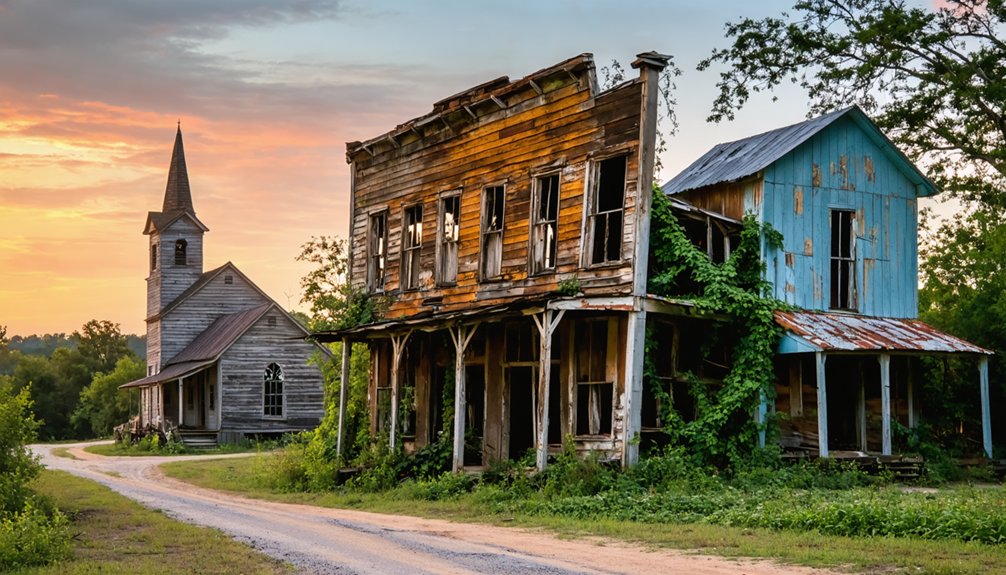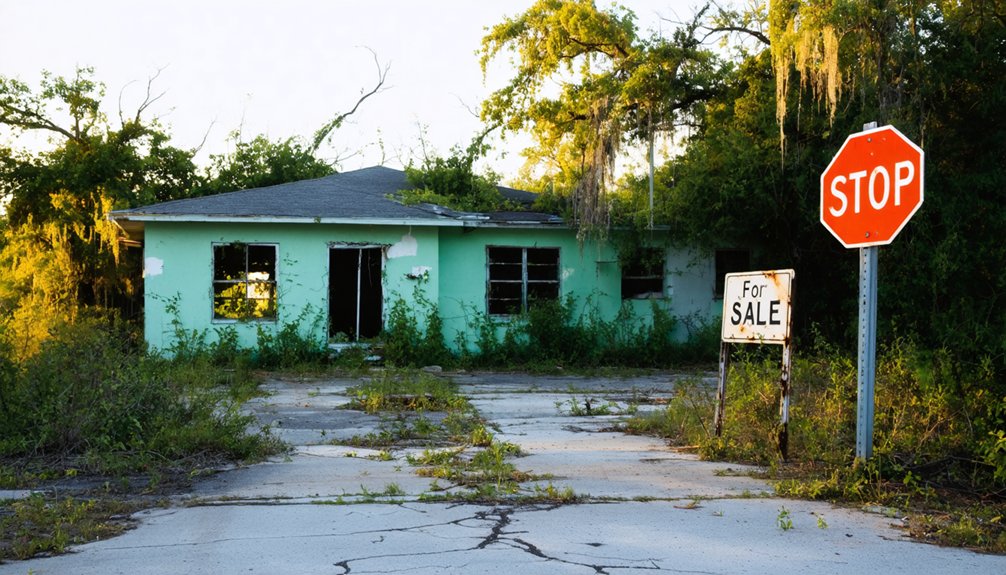
You’ll find Southern suburban areas increasingly deserted due to a perfect storm of economic and demographic factors. Manufacturing job losses, soaring housing costs (now 32.3% of income), and population decline have created ghost-like subdivisions. A post-2020 building boom led to oversaturation, with 64% of new single-family starts in suburban areas, while aging populations and workforce exodus amplify the problem. These converging forces paint a complex picture of suburban transformation in the South.
Key Takeaways
- Manufacturing job losses and economic decline have triggered population exodus, leaving suburban communities with fewer residents and reduced economic activity.
- Overbuilding during the post-2020 construction boom created an oversaturated housing market with unaffordable homes and empty subdivisions.
- Aging populations and declining birth rates, combined with young workers leaving for better opportunities, accelerate suburban population decline.
- Limited public services, deteriorating infrastructure, and reduced tax revenue create an unsustainable cycle of suburban decay.
- The 2008 financial crisis left lasting economic scars, with foreclosures and business closures still impacting Southern suburban community stability.
The Perfect Storm: Economic Decline and Job Losses
While the South has historically maintained robust economic growth, a convergence of factors in 2025 points to an unprecedented decline in suburban liveliness.
You’ll notice workforce shrinkage hitting suburban areas particularly hard, as manufacturing employment contracts and project announcements reach historic lows. Despite modest growth in sectors like electric vehicles, elevated interest rates and high input costs are stifling overall economic expansion.
The region’s economic stagnation is creating a troubling cycle: as jobs disappear, population outmigration accelerates, weakening local consumer demand and triggering business closures. With unemployment rates rising nationwide, the situation continues to worsen.
You’re witnessing a fundamental shift in suburban dynamics, where declining real GDP growth and employment directly impact median household income. This perfect storm of economic pressures is transforming once-vibrant suburban communities into increasingly vacant spaces. The strain is evident as households in these areas now dedicate 32.3% of their income to housing costs, reflecting a sharp increase from pre-pandemic levels.
Housing Market Oversaturation and the Building Boom
Although the Southern housing market previously thrived on steady growth, a dramatic post-2020 construction boom has created unprecedented suburban oversaturation.
You’ll find that overbuilding trends have particularly impacted Sunbelt states, where 64% of new single-family housing starts concentrated in suburban and exurban areas during Q1 2025.
This contrasts sharply with the challenges faced in declining industries in the rust belt, where economic shifts have led to a decrease in population and demand for new housing. As a result, many towns are grappling with vacant properties and shrinking tax bases. Efforts to revitalize these areas often encounter obstacles due to the lingering effects of industrial decline and changing economic landscapes.
Market speculation and aggressive development have outpaced actual demand, leading to ghost-like subdivisions in areas where median home prices soared 49% above pre-pandemic levels.
Frenzied development created a suburban paradox: empty neighborhoods amid skyrocketing prices, as builders chased profits over sustainable growth.
While remote work boosted suburban appeal, builders’ “build-it-and-they’ll-come” mindset hasn’t aligned with local economic realities.
The numbers tell a stark story: potential homebuyers now need incomes of $102,120 to afford typical suburban homes, far exceeding local wage growth.
This mismatch between rapid construction and slower population growth has left numerous developments eerily vacant.
Recent data shows suburban home sales increased by 4.8% year-over-year in Q1 2025, yet many developments remain unoccupied.
The climate risk factors are driving up insurance costs, making these vacant properties even more challenging to sell.
Shifting Demographics and Population Exodus
Since 2020, shifting demographics have fundamentally reshaped Southern suburban landscapes through a combination of natural population decrease and sustained out-migration.
You’ll find aging population trends particularly evident in suburban counties, where deaths now exceed births in 76% of nonmetro areas. Migration patterns reveal a stark reality: working-age adults are leaving these communities in search of better opportunities, accelerating the demographic transformation. Educational attainment disparities contribute significantly to this exodus, with only 31% of suburban residents holding college degrees.
The Southeastern United States dominated rural population growth in 2023, yet suburban areas continued to struggle.
- Louisiana experienced an urban exodus of 8,400 residents, highlighting the broader regional trend
- Prime working-age population (25-54) losses correlate strongly with suburban decline
- Mississippi faces a natural decrease of 2,000 people annually due to deaths outnumbering births
- Southern small towns, surprisingly, still show modest growth at 0.6%, though this varies considerably by location
The Legacy of the 2008 Financial Crisis
As the 2008 financial crisis unfolded, Southern suburban communities suffered devastating economic and social upheaval that persists today.
You’ll find the most severe foreclosure impacts in places like California’s Inland Empire, where over 5% of homes faced foreclosure at the crisis peak. The damage wasn’t equally distributed – minority communities bore a disproportionate burden due to predatory lending practices and historical discrimination. Black and Latinx households experienced a devastating wealth decline of 53-66% between 2005 and 2009.
The ripple effects transformed these once-thriving areas. Workers lost an average of 19% of their earnings long-term, while local businesses shuttered amid plummeting consumer spending. Home prices in California plummeted 16% between 2007 and 2010, devastating household wealth.
Economic shockwaves devastated communities as workers faced steep income losses and businesses collapsed under reduced spending.
You can still see the crisis’s footprint in abandoned properties and stagnant population growth. The exodus from these areas accelerated as bankruptcy rates soared by 60%, leaving behind deteriorating neighborhoods and depleted municipal budgets that struggled to maintain basic services.
The Downward Spiral of Public Services and Infrastructure
While the 2008 financial crisis triggered initial suburban decline, fragmented governance structures have accelerated the deterioration of public services and infrastructure across Southern suburban areas.
You’ll find a complex web of municipalities struggling to coordinate essential services, with nonprofit spending per poor person in suburban counties at just half that of urban areas. This fragmented governance has created a devastating cycle where declining tax revenues lead to reduced public services, particularly affecting lower-income residents. The deteriorating conditions have contributed to a stark decline in household incomes, falling from $103,000 to $101,000 in suburban areas since 2000.
The shift in population preferences and housing trends has led to a concerning increase in low-income suburbs, which jumped from 22 to 90 in recent decades.
- Limited public transportation and lack of pedestrian infrastructure trap residents without reliable access to jobs and healthcare.
- Multiple jurisdictions create inconsistent infrastructure investment, leaving some areas severely underserved.
- Nonprofit organizations struggle to coordinate services across sprawling suburban landscapes.
- Declining municipal revenues result in reduced maintenance of roads, water systems, and other critical infrastructure.
Frequently Asked Questions
How Long Does It Typically Take for an Abandoned Suburban Neighborhood to Recover?
Like a Windows update that never ends, your neighborhood’s recovery timeline from abandonment typically spans 2-7 years, depending on local economics, community strength, and permitting processes you’ll face.
What Happens to Local Schools When Suburban Neighborhoods Experience Mass Abandonment?
You’ll see schools struggle as student enrollment plummets, leading to reduced school funding, program cuts, and potential closures. Your local education system faces layoffs, consolidation, and declining academic performance.
Are There Successful Examples of Revitalized Southern Suburban Ghost Towns?
You’ll find a million success stories in places like Lowell, where urban redevelopment and community engagement transformed suburban ghost towns through historic preservation, mixed-use developments, and strategic public-private partnerships.
How Do Weather and Natural Disasters Affect Abandoned Southern Suburban Properties?
You’ll see abandoned properties deteriorate faster due to climate impact, as storms, flooding, and extreme heat accelerate structural damage. Without ongoing disaster recovery efforts, these vacant structures quickly become unsalvageable and hazardous.
What Role Do Insurance Companies Play in Maintaining or Abandoning Properties?
While you’d expect insurers to protect properties, they’re actually driving abandonment through strict property assessments, limited coverage in high-risk areas, and reduced insurance liability, forcing you to shoulder unsustainable maintenance costs.
References
- https://247wallst.com/special-report/2021/05/19/30-american-ghost-towns-7/
- https://schoolofcities.utoronto.ca/neighbourhood-abandonment-in-the-american-rust-belt/
- https://247wallst.com/housing/2024/04/11/americas-modern-ghost-towns-2/
- https://www.lincolninst.edu/publications/articles/new-american-ghost-towns/
- https://devblog.batchgeo.com/ghost-towns/
- https://eh.net/encyclopedia/urban-decline-and-success-in-the-united-states/
- https://www.yardi.com/blog/news/abandoned-america/38780.html
- https://www.loveexploring.com/gallerylist/188219/the-us-state-with-the-most-ghost-towns-revealed
- https://www.redfin.com/news/suburban-urban-rural-q3-2025/
- https://www.spglobal.com/market-intelligence/en/news-insights/research/top-us-regional-economic-insights-2025