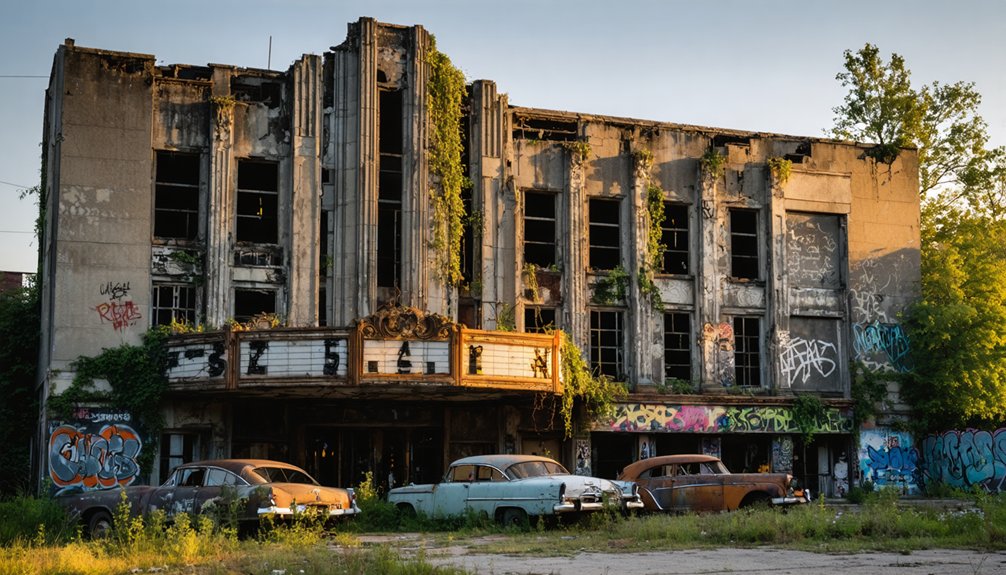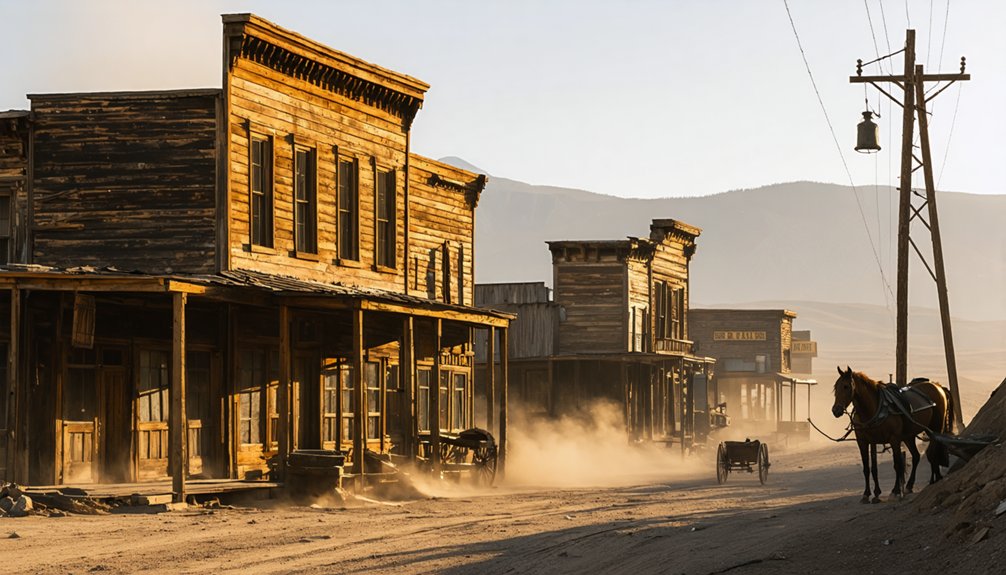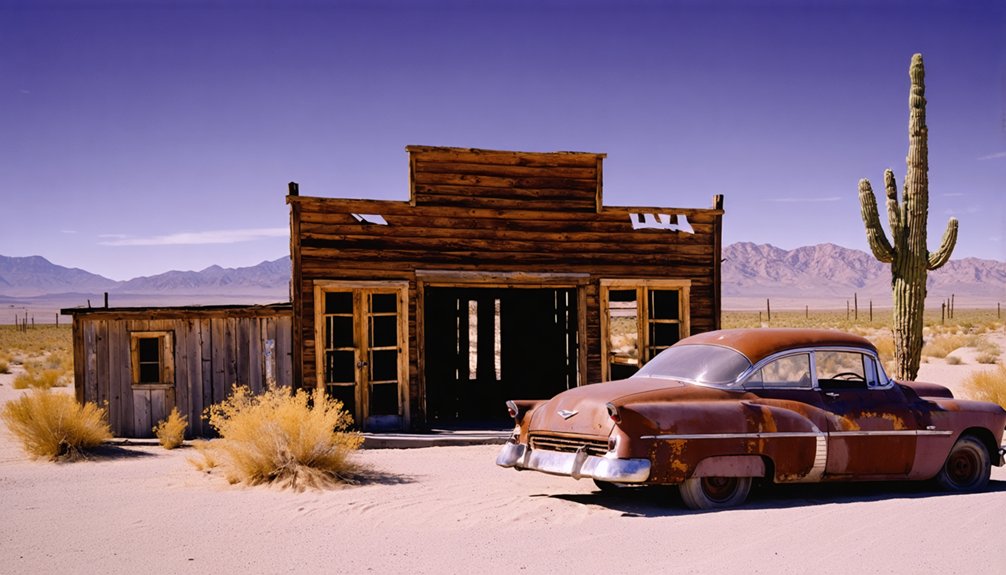
You’ll find U.S. ghost towns hauntingly surreal because they’re caught between two worlds. Nature’s reclamation creates stark contrasts, with toxic streams glowing crimson near Picher’s chat piles and eternal underground fires burning beneath Centralia’s twisted streets. Aggressive vegetation intertwines with century-old artifacts, while shafts of sunlight pierce shattered windows to illuminate rusted machinery and half-melted candles. These abandoned landscapes tell stories that challenge the boundary between reality and myth.
Key Takeaways
- Environmental contamination creates otherworldly scenes, like toxic chat piles in Picher and perpetually burning underground fires in Centralia.
- Nature’s aggressive reclamation of human structures creates striking contrasts between civilization and wilderness through intertwined vegetation.
- Dramatic lighting effects through broken windows and decaying structures create ethereal atmospheres, especially during golden hour.
- The frozen-in-time quality of abandoned personal belongings and everyday objects creates an uncanny feeling of suspended animation.
- The juxtaposition of preserved historical artifacts against rapid decay creates a dreamlike temporal dissonance in ghost town landscapes.
Nature’s Dramatic Backdrop: Environmental Elements at Play
While America’s ghost towns stand as haunting reminders of abandoned dreams, their landscapes tell an even more dramatic story of environmental transformation.
You’ll find toxic chat piles rising like alien dunes in Oklahoma’s Picher, where mining waste has permanently scarred the terrain. The environmental impact extends deep below ground, where flooded mines leak contaminated water, creating crimson streams that snake through these desolate spaces. The area produced an astounding $20 billion worth of lead and zinc ore from 1917 to 1947.
Ghost town ecology takes surreal turns as nature reclaims what humans left behind. In Centralia, Pennsylvania, underground coal fires continue burning after six decades, creating an eerie, smoke-filled landscape.
You’ll witness foundations buckling under melting permafrost in Alaska, while Louisiana’s ghost towns slowly sink into subsiding earth. Aggressive vegetation twists through concrete and steel, creating bizarre hybrids of human architecture and wild growth, while toxic-stained waterways create an otherworldly palette across these transformed landscapes.
The Dance of Light and Shadow in Abandoned Places
Through shattered windows and crumbling rooflines, nature’s light orchestrates an ethereal performance in America’s ghost towns.
You’ll witness dramatic light manipulation as sunbeams pierce through boarded windows, creating stark contrasts that reveal decades of decay. In these forgotten spaces, shadow storytelling unfolds naturally – deep shadows sculpt abandoned interiors while scattered light traces patterns across peeling paint and rusty machinery. Close-up photography captures intricate textures that tell stories of weathered materials and forgotten moments.
During golden hour, you’ll find the most enchanting displays, as warm light bathes weathered structures in amber hues, casting long shadows that transform mundane ruins into surreal landscapes. The rich colors of rust blend with the natural elements, creating a striking visual testament to time’s passage.
Amber rays pierce the stillness, turning forgotten facades into dreamlike canvases as day surrenders to dusk.
With a flashlight, you can craft your own light show, illuminating hidden corners and architectural details that daylight can’t reach. Each crack, hole, and broken pane becomes a projector, painting ephemeral masterpieces on time-worn walls.
Architectural Remnants Frozen in Time
You’ll find yourself transported through time as you explore the skeletal remains of these once-bustling towns, where sagging wooden storefronts and tilting concrete structures stand as silent witnesses to America’s boom-and-bust cycles.
Within these architectural shells, you can spot the remnants of daily life – from rusted tin cans on kitchen shelves to faded advertisements still clinging to crumbling walls. Places like Bodie State Historic Park showcase buildings that have been left fully intact to preserve their historical significance. In Rhyolite, Nevada, the desert air conditions have helped preserve many of the original concrete buildings in remarkable condition.
The original infrastructure remains remarkably intact in many ghost towns, with vintage electrical systems, early plumbing networks, and period-specific construction techniques offering an unfiltered window into the technological capabilities of their era.
Decaying Buildings Tell Stories
The decaying buildings of America’s ghost towns serve as silent storytellers, their weathered facades and crumbling foundations revealing detailed chapters of frontier life and industrial ambition.
You’ll find architectural whispers in every peeling paint strip and rusted metal beam, each offering clues to construction methods unique to their era. The iconic glass bottle house in Rhyolite demonstrates the resourcefulness and creativity of early settlers. Changes in transportation left these towns obsolete as railroad lines shifted and new highways bypassed them.
As you explore these forgotten landscapes, decaying narratives unfold through abandoned storefronts, mills, and public buildings that map out clear social hierarchies and economic relationships.
Weather-beaten walls show you how nature reclaims human spaces – desert winds erode adobe, while humid climates feed persistent ivy and moss.
Empty doorways and windows frame voids where life once bustled, inviting you to piece together the stories of those who sought fortune and freedom in these now-silent places.
Preserved Daily Life Scenes
Walking through America’s ghost towns reveals intimate snapshots of lives suddenly suspended, where everyday moments remain frozen like insects trapped in amber.
You’ll find tables still set with century-old dishes, half-melted candles marking daily rituals, and Levi’s jeans buried beneath debris. Personal belongings tell stories through their precise placement – books left open on shelves and tools abandoned mid-task.
The layout of these towns discloses how communal spaces shaped frontier life. Main streets, lined with weathered saloons and hotels, showcase where social bonds formed. In Calico, visitors can explore extensively restored mining camps that demonstrate how these Western communities operated during the silver rush.
Inside the American Hotel at Cerro Gordo, you can trace the footsteps of miners gathering after long shifts. Even infrastructure remnants – from electric streetlights to water systems – illustrate how these isolated communities sustained themselves against nature’s harsh backdrop. In Bodie, the remnants of sixty saloons stand as testament to the town’s notorious reputation for lawlessness and daily violence.
Untouched Historical Infrastructure
Scattered across America’s abandoned frontier towns, historical infrastructure stands as a tribute to bygone eras of rapid development and decline.
You’ll find ghostly echoes of the past in wooden saloons, brick banks, and glass bottle houses that have withstood time’s relentless march. Railroad stations rust silently along forgotten tracks, while stone schoolhouses maintain their skeletal dignity against desert winds.
Nature’s slow reclamation adds to these haunting scenes, as vines crawl over unused roads and forests emerge through cracked sidewalks.
In some places, infrastructure remnants lie preserved beneath reservoir waters, creating underwater time capsules. The harsh climate of mountain ranges and desert landscapes has helped preserve these architectural treasures, while toxic legacies from mining operations have inadvertently protected other sites from modern development, freezing them in their abandoned state.
Where History Meets Myth in the American West
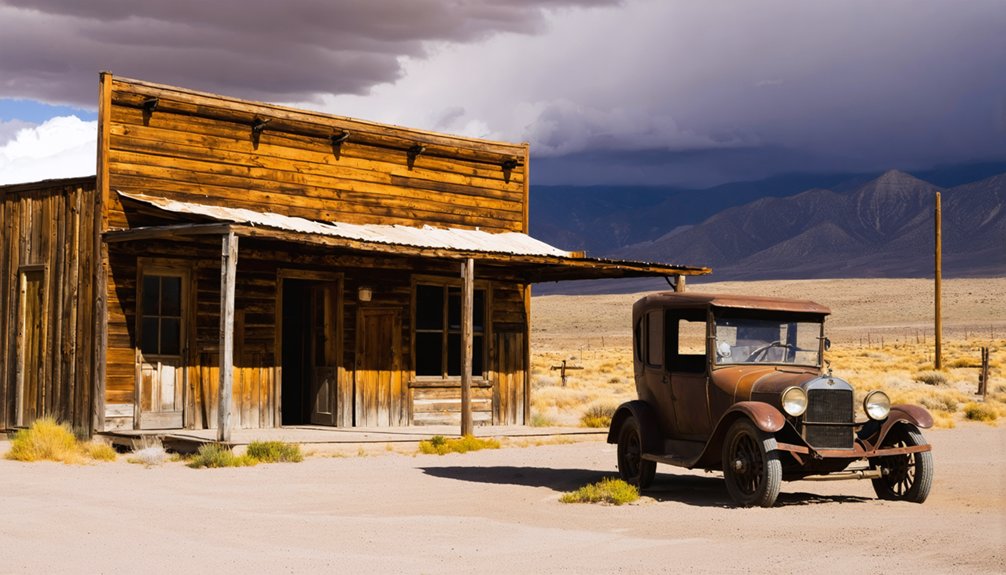
When you walk through an American ghost town today, you’re crossing a threshold where documented history intertwines with Wild West mythology, shaped by dime novels, Hollywood westerns, and frontier storytelling passed down through generations.
The physical ruins – weathered saloons, abandoned mines, and empty storefronts – serve as tangible anchors to the past, while simultaneously fueling romantic notions of six-shooter showdowns and overnight fortunes.
These landscapes have become powerful symbols where fact and fiction merge, transforming humble mining camps and railroad stops into stages for an idealized frontier drama that continues to captivate modern imaginations.
Wild West Storytelling Legacy
Through decades of Wild West storytelling, America’s ghost towns have transcended their physical remnants to become powerful symbols of frontier mythology.
You’ll find these places immortalized in novels, films, and folklore that blend historical truth with dramatic legend. Ghost town narratives weave tales of gutsy prospectors striking it rich, notorious outlaws staging daring heists, and steadfast lawmen maintaining order in rowdy boomtowns.
The cultural mythology surrounding these sites captures the essence of the American frontier spirit – where opportunity and peril walked hand in hand.
When you explore a ghost town today, you’re not just seeing abandoned buildings; you’re stepping into a landscape where fact and fiction have merged to create an enduring representation of human ambition, resilience, and the raw adventure of the Wild West.
Frontier Myths Versus Reality
Despite the romanticized images that persist in popular culture, America’s frontier reality sharply contrasts with its mythological portrayal.
When you explore beyond frontier mythology, you’ll discover that the “Wild West” lasted merely 25 years, not the endless era depicted in films. Historical accuracy reveals most Western towns enforced strict gun control, while indigenous narratives tell of sophisticated civilizations erased through settler colonialism.
You’ll find that economic interests drove the violence portrayal, with government intervention playing a larger role than individual heroics.
Cultural erasure masked the complex struggles between Native Americans and settlers, while federal military campaigns, not lone gunfighters, secured territories.
The mythologized frontier obscures how corporate profits, railroad expansion, and systematic displacement shaped the American West’s true story.
Cultural Memory Through Time
As abandoned buildings stand sentinel against weathered Western landscapes, ghost towns forge powerful connections between historical fact and cultural mythology.
the exploration of authenticity in american ghost towns invites visitors to ponder the stories that linger within their crumbling walls. Each corner reveals a blend of nostalgia and mystery, echoing the lives once lived and the dreams that faded. By walking these silent streets, one can truly appreciate how past and present intertwine to shape our understanding of history.
You’ll discover layers of cultural continuity spanning from ancient indigenous petroglyphs to settler boom towns, each telling stories of survival, loss, and transformation.
- Walk through empty saloons and schoolhouses that capture the stark reality of frontier economics, where dreams rose and fell with mineral strikes.
- Explore Native American territories where traditional knowledge and spiritual practices endure despite colonial disruption.
- Experience the surreal intersection of historical reflection and artistic reimagining as these sites blur past and present.
These haunting places serve as portals for understanding how the American West’s complex heritage shapes our collective memory, preserving both documented history and enduring myths.
The Silent Symphony of Decay and Preservation
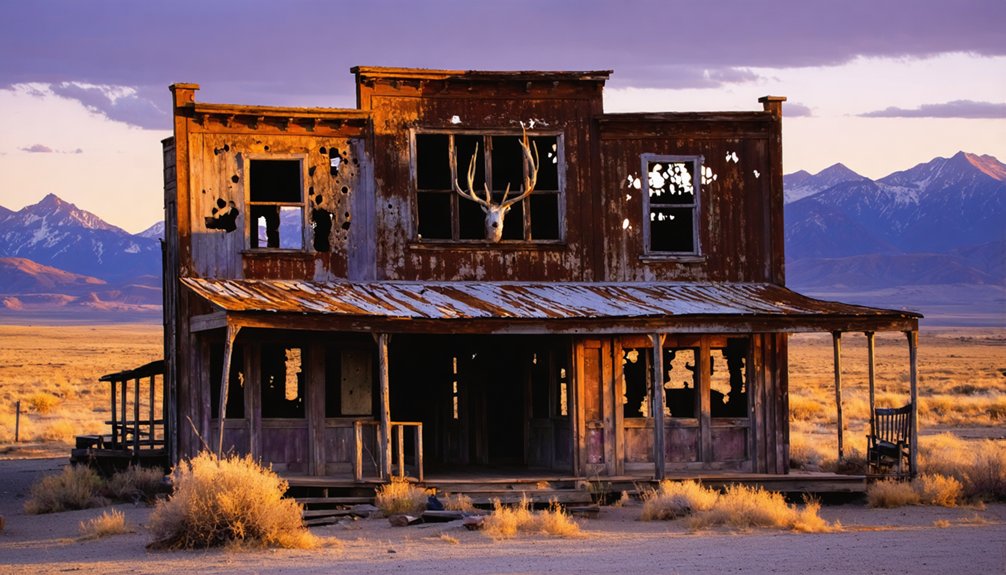
When you step into America’s ghost towns, you’ll witness a haunting interplay between decay and preservation that unfolds like a silent symphony across the landscape.
The decay symbolism speaks through weathered wooden facades, rusted metal, and nature’s slow reclamation of human spaces. You’ll find crumbling bricks beside carefully preserved storefronts, creating surreal temporal contrasts that challenge your sense of time.
Time writes its story in rust and ruin, as nature slowly reclaims what man once proudly built.
This preservation paradox reveals itself in places like Thurmond, West Virginia, where millions have been spent to maintain a specific state of deterioration.
As you explore these spaces, you’ll encounter the stark reality of economic collapse – from mining towns to industrial cities like Detroit – where abandonment has transformed once-thriving communities into living museums, each telling stories through their carefully curated decay.
Living Galleries: Art and Photography in Ghost Towns
Modern artists have reimagined America’s ghost towns as living canvases, transforming their weathered ruins into outdoor galleries that bridge past and present. Through artistic interventions, these abandoned places pulse with new energy, from Goldwell’s ghostly disciples to Bombay Beach’s surreal installations.
- Discover life-sized spectral figures at Rhyolite, where Albert Szukalski’s fiberglass disciples gather eternally for their Last Supper.
- Experience creative residencies in Utah’s Cisco, where artists turn salvaged materials into vibrant murals and sculptural playgrounds.
- Explore the International Car Forest, where graffitied vehicles stand like monuments against the desert sky.
You’ll find these forgotten towns now serve as experimental spaces where contemporary artists weave their visions into the fabric of American history. Each installation tells a story of resilience, turning scenes of abandonment into celebrations of creative spirit.
The Tension Between Human Legacy and Natural Reclamation
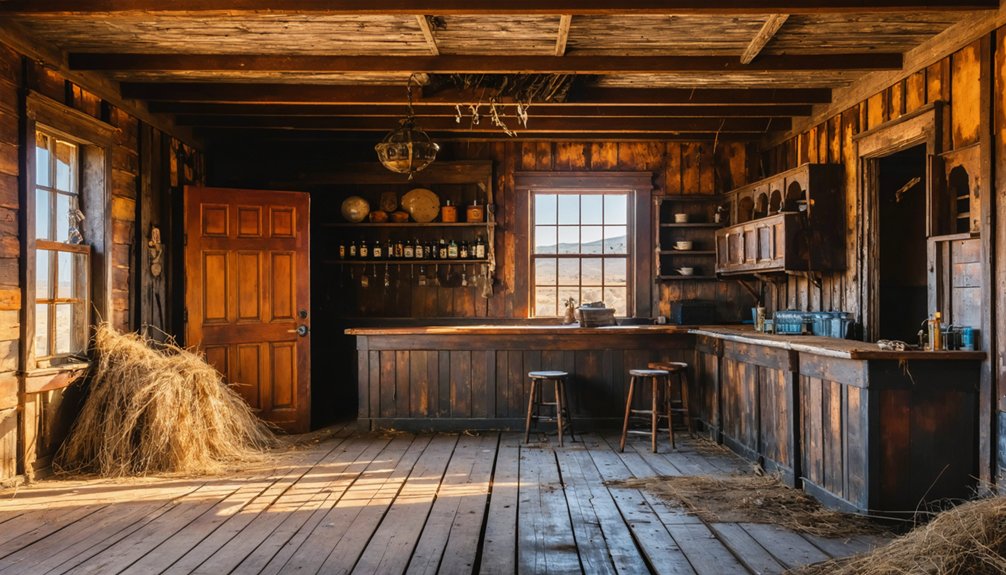
Throughout America’s ghost towns, nature wages a relentless battle against human-made structures, creating stark visual poetry in the tension between civilization’s remnants and wilderness’s return.
You’ll witness this struggle in places like Tecopa, where desert plants thrust through concrete foundations, and Centralia, where moss blankets abandoned streets in a demonstration of nature’s dominance.
Even in preserved sites like Bodie, where human resilience attempts to freeze time through “arrested decay,” you can’t stop the persistent march of vegetation through weathered wooden boards and brick foundations.
In toxic ghost towns like Times Beach and Treece, nature carefully reclaims contaminated ground, while in Thistle, Utah, landslide destruction showcases the raw power of geological forces against human settlement, leaving only scattered ruins among wild grasses.
Frequently Asked Questions
What Safety Precautions Should Visitors Take When Exploring Ghost Towns?
You’ll need safety gear like flashlights, first aid kits, and sturdy boots. Stay alert for wildlife, check building stability, travel with companions, and always inform others of your exploration plans.
Are There Any Inhabited Ghost Towns That Maintain Historical Authenticity?
Persistent preservers protect places like Bodie, California, where you’ll find authentic historical buildings frozen in time. Despite limited tourism impact, dedicated residents and caretakers maintain these rare time capsules for exploration.
How Do Property Rights and Ownership Work in Ghost Towns?
You’ll face complex property disputes in ghost towns, as ownership history can be unclear. You’ll need thorough title searches, understanding of adverse possession laws, and navigation of local zoning restrictions.
Which Ghost Towns Are Most Accessible for Visitors With Mobility Limitations?
You’ll find Bodie’s accessible attractions most accommodating, with paved paths and balloon-tired wheelchairs available. Ashcroft’s boardwalk and Garnet’s main street also offer good options despite some mobility challenges.
What Role Do Native American Communities Play in Ghost Town Preservation?
You’ll find Native American communities leading preservation efforts, safeguarding cultural significance through ancestral land reclamation, traditional ecological practices, and authentic interpretation of ghost town sites within their historic territories.
References
- https://www.authentikusa.com/us-en/blog/english-top-5-villes-fantomes-aux-usa-maj
- https://www.afar.com/magazine/must-visit-ghost-towns-in-the-united-states
- https://theweek.com/culture-life/travel/ghost-towns-usa-calico-bodie-burke-garnet-rhyolite
- https://www.atlasobscura.com/lists/americas-best-preserved-ghost-towns
- https://www.geotab.com/ghost-towns/
- https://www.altaonline.com/dispatches/a61999061/ghost-towns-whitewashed-lauren-markham/
- https://www.youtube.com/watch?v=Nw2j2-YSknU
- https://wildwestcity.com/old-west-ghost-towns/
- https://history.howstuffworks.com/history-vs-myth/ghost-towns.htm
- https://advocate.jbu.edu/2020/11/12/oklahomas-environmentally-toxic-ghost-town