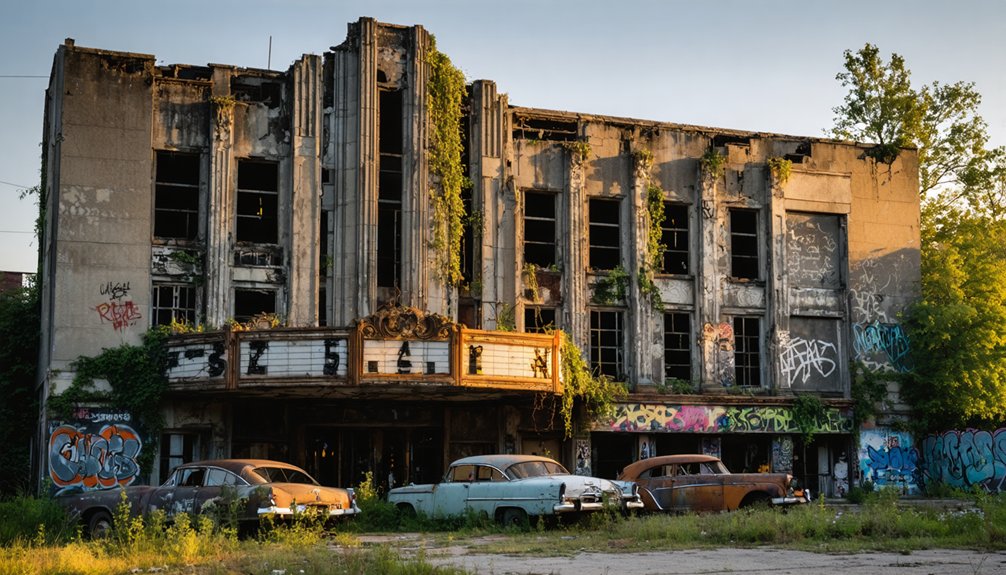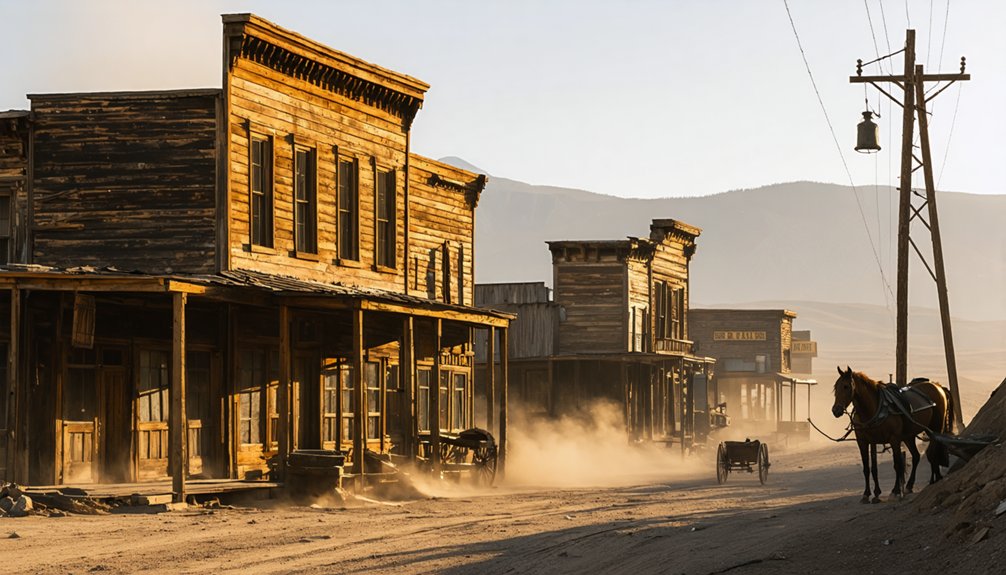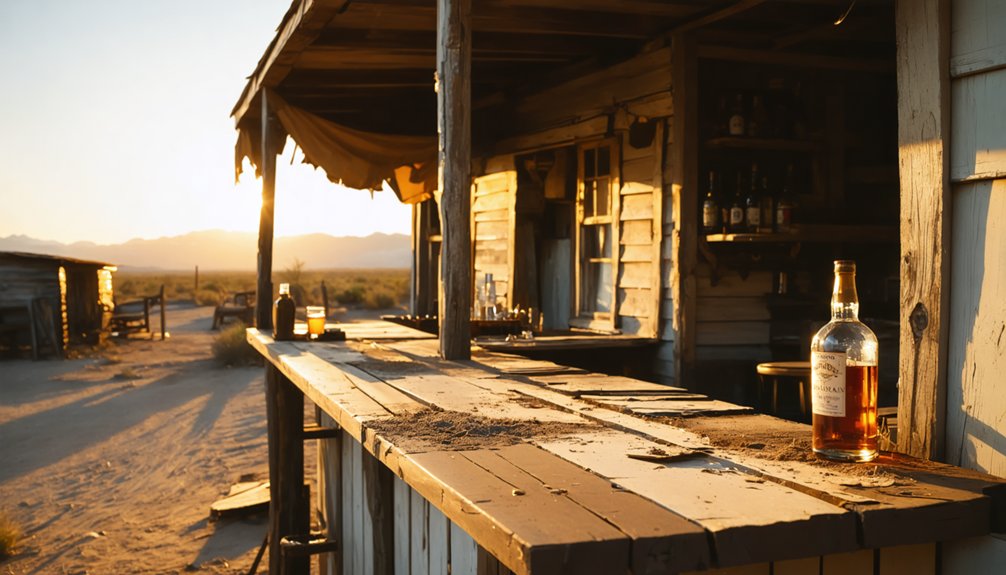
When you visit U.S. ghost towns, you’ll find remarkably authentic ruins preserved by multiple factors. Sudden mass exodus left these sites frozen in time, with original structures and artifacts untouched. Legal protections, including the National Historic Preservation Act, prevent modern development, while geographic isolation shields these locations from interference. Natural elements and local folklore provide additional preservation, leaving mining equipment, personal belongings, and architectural details intact. These elements combine to tell a deeper story of America’s frontier past.
Key Takeaways
- Sudden mass exodus left towns frozen in time, with personal belongings and equipment remaining exactly as they were abandoned.
- Legal protections through acts like NHPA and ARPA prevent unauthorized alterations and preserve historical authenticity.
- Geographic isolation and limited economic development shield ghost towns from modern interference and structural modifications.
- Original architecture and building materials remain intact due to arid climates and natural preservation conditions.
- State-managed “arrested decay” policies maintain structural integrity while allowing natural aging to preserve authentic appearance.
Legal Safeguards and Historic Preservation Methods
While abandoned ghost towns offer fascinating glimpses into America’s past, a thorough framework of legal protections guarantees their preservation for future generations.
Boarded-up buildings and deteriorating structures are preserved as they were found to maintain historical accuracy. The National Historic Preservation Act establishes strict guidelines through Section 106, requiring federal agencies to evaluate and protect historically significant sites. You’ll find multiple legal frameworks working together – ARPA prevents unauthorized excavation, while NAGPRA safeguards Native American cultural artifacts and remains.
State and local governments strengthen these protections through specialized zoning regulations and preservation ordinances. The National Park Service, established in 1916, helps manage and protect these historic sites as part of America’s cultural heritage.
When you explore these ruins, you’re witnessing sites carefully maintained through preservation challenges by SOI-qualified professionals who meet rigorous standards. Their expertise assures that ghost towns retain their authenticity while complying with federal, state, and local preservation requirements.
The Legacy of Sudden Mass Exodus
Beyond the careful preservation of these historic sites lies the dramatic story of their abandonment.
You’ll find that sudden mass exodus has left an indelible mark on America’s ghost towns, driven by economic pressures and demographic shifts that forced entire communities to relocate virtually overnight. Today’s cities face similar patterns as rising housing costs drive mass departures from urban centers.
This rapid departure preserved these places in a uniquely authentic state, creating time capsules of American life frozen at the moment of abandonment. Many of these towns became abandoned after their mines were exhausted, leaving behind remnants of once-thriving communities.
- Mining equipment still standing at drill sites, tools scattered as if workers just left their shifts
- Half-empty coffee cups and dated newspapers on diner tables, marking the town’s final day
- School desks arranged in rows with assignments still written on chalkboards
- Store shelves stocked with vintage products, price tags intact
- Personal belongings left behind in homes, telling stories of hasty departures
Nature’s Role in Preserving Ghost Town Authenticity
As nature reclaims these historic sites, it paradoxically serves as both a preservative force and an agent of change in America’s ghost towns.
You’ll find that arid climates and geographic isolation work together to maintain these haunting remnants of the past, while vegetation cover slowly embraces the structures without destroying them entirely.
Natural disasters like floods and disease outbreaks often led to towns being completely abandoned, as happened with San Francisco Township in 1863.
The natural world’s influence is remarkably balanced – wildlife interaction helps stabilize these sites rather than accelerate their decline.
Idaho’s arid conditions have helped countless ghost town structures survive intact for over a century.
You’ll notice how birds and bats make their homes in abandoned buildings while their presence actually helps maintain the structures.
Remote locations shield these treasures from human interference, allowing nature to work at its own pace.
In these untouched environments, stable temperatures and low humidity preserve wood and stone, creating an authentic window into America’s frontier past.
Original Architecture and Building Materials
The authentic character of America’s ghost towns emerges strongly through their original construction materials and methods.
Ghost towns stand as silent witnesses, their weathered materials and pioneer building techniques revealing America’s raw frontier spirit.
You’ll find that local materials dominate these historic structures, from Jacobsville Sandstone in Michigan to native timber in California’s Bodie. The architectural styles reflect genuine frontier pragmatism, with vernacular designs and balloon framing techniques that have withstood time’s test. The arrested decay policy at Bodie ensures buildings remain exactly as they were left, preserving their historical authenticity. The ornate details in buildings still showcase the grand chandeliers and staircases of a more prosperous era.
- Weather-worn wooden false fronts still stand proud on main street buildings
- Original stone foundations trace perfect footprints of frontier life
- Hand-laid masonry walls showcase local stone varieties and period craftsmanship
- Historic window frames and doorways reveal authentic spatial arrangements
- Unique adaptations like Rhyolite’s Bottle House demonstrate frontier ingenuity
These enduring structures tell an unvarnished story of American frontier determination, preserved through basic materials and straightforward building methods that defined the era.
Minimal Modern-Day Development Impact
When you explore America’s ghost towns today, you’ll find many sites remarkably untouched by modern development, with their original street layouts and building foundations remaining exactly as they were when these towns were abandoned.
The lack of new infrastructure investment stems from both geographic isolation and economic factors, as remote locations and declining populations provide little incentive for modern construction or utility upgrades. As seen in places like Bodie, California, which now draws 200,000 annual visitors, the untouched nature of these sites has become a major tourism draw. Many ghost towns emerged from areas experiencing significant population decline, with some ZIP codes seeing drops of up to 22.7% over just five years.
This preservation of authenticity is further reinforced by heritage designations and tourism interests, which actively discourage contemporary development to maintain the historical integrity of these sites.
Limited Infrastructure Investment
Due to widespread economic decline throughout the twentieth century, America’s ghost towns experienced minimal infrastructure development that inadvertently preserved their historical authenticity.
You’ll find this infrastructure neglect and economic freeze resulted in a remarkable time capsule effect, where original dirt roads, aging utilities, and period-specific structures remain largely untouched by modern interventions.
- Unpaved roads wind through towns, their gravel surfaces echoing the crunch of wagon wheels from bygone eras
- Abandoned railroad water towers stand as silent sentinels, their rusted frames untouched by progress
- Original electrical systems hang dormant on weathered poles, never upgraded to modern standards
- Historic building foundations remain unaltered by contemporary utility installations
- Natural decay claims structures gradually, with vegetation reclaiming spaces between authentic ruins
Untouched Original Layouts
Protected by both natural isolation and stringent preservation policies, America’s ghost towns maintain remarkably untouched original layouts that offer authentic glimpses into frontier life.
You’ll find these time capsules preserved by their remote locations in harsh deserts and mountains, where modern development simply can’t reach them easily.
Ghost town nostalgia drives careful preservation strategies that keep original street patterns and building placements intact.
When you explore these sites, you’re walking the same paths as frontier settlers did, thanks to preservation challenges that actually work in their favor – like difficult terrain that prevents construction equipment access and economic conditions that discourage redevelopment.
Historic designation status further protects these sites from modern alterations, ensuring that what you see today mirrors the town’s appearance during its heyday.
Cultural Heritage and Mythical Protection
The interplay between cultural heritage preservation and mythical protection narratives forms a unique safeguarding system for America’s ghost town ruins. Through cultural storytelling and artifact reverence, local communities weave tales of curses and bad fortune that discourage visitors from disturbing these historical sites.
Local legends of curses and misfortune work alongside preservation laws to protect ghost towns’ historical treasures from being disturbed.
You’ll find these protective legends working alongside formal preservation efforts, creating a dual shield that keeps these towns remarkably authentic.
- Weathered wooden doors creaking on rusty hinges in abandoned saloons
- Dust-covered bottles still lining general store shelves
- Original furniture frozen in time within partially collapsed homes
- Mining equipment standing sentinel over empty shaft entrances
- Personal belongings left behind as if their owners might return any day
These preservation methods combine state-managed “arrested decay” approaches with folklore that naturally deters vandalism and theft.
Frequently Asked Questions
How Many Ghost Towns Still Exist in the United States Today?
You’ll find over 3,800 documented current ghost towns across America, each with its own historical significance, though the exact count varies depending on how strictly you define abandonment.
What Happened to the Residents Who Suddenly Abandoned These Towns?
You’ll find most residents relocated to larger cities for jobs, while others followed new mining opportunities. Some moved due to natural disasters, and many simply sought better economic prospects elsewhere.
Can Visitors Stay Overnight in Authentic Ghost Town Buildings?
You can stay overnight in select ghost towns offering restored accommodations, but historical preservation rules limit availability. Many authentic buildings are off-limits, though some towns provide carefully renovated lodging options.
How Do Ghost Towns Handle Modern Tourist Amenities Like Bathrooms?
You won’t find modern facilities inside those haunting old buildings. Instead, you’ll use bathrooms at visitor centers or portable units strategically placed outside historic areas to protect the authentic experience.
Which Ghost Towns Are Considered the Most Haunted by Paranormal Investigators?
You’ll find the most documented haunted legends and paranormal encounters at Virginia City, Nevada; St. Elmo, Colorado; and Ruby, Arizona, where investigators consistently report unexplained phenomena and spectral manifestations.
References
- https://www.authentikusa.com/en/blog/english-top-5-villes-fantomes-aux-usa-maj
- https://theweek.com/culture-life/travel/ghost-towns-usa-calico-bodie-burke-garnet-rhyolite
- https://www.youtube.com/watch?v=xYutGKOOEo4
- https://www.wideopencountry.com/the-10-eeriest-ghost-towns-in-america/
- https://explorethearchive.com/western-ghost-towns
- https://www.geotab.com/ghost-towns/
- https://www.loveexploring.com/gallerylist/131658/abandoned-in-the-usa-92-places-left-to-rot
- https://history.howstuffworks.com/history-vs-myth/ghost-towns.htm
- https://en.wikipedia.org/wiki/National_Historic_Preservation_Act
- https://www.phmsa.dot.gov/planning-and-analytics/environmental-analysis-and-compliance/national-historic-preservation-act