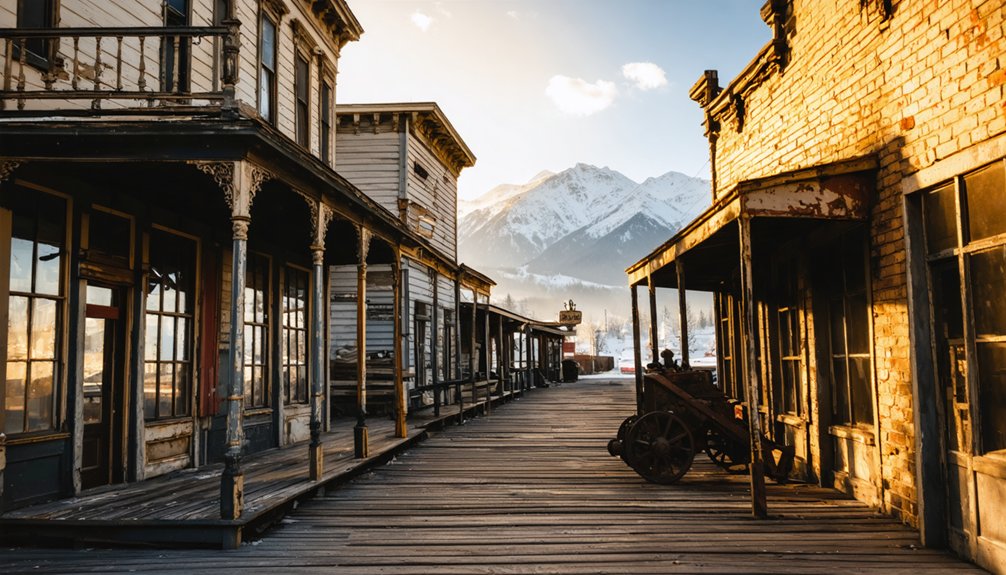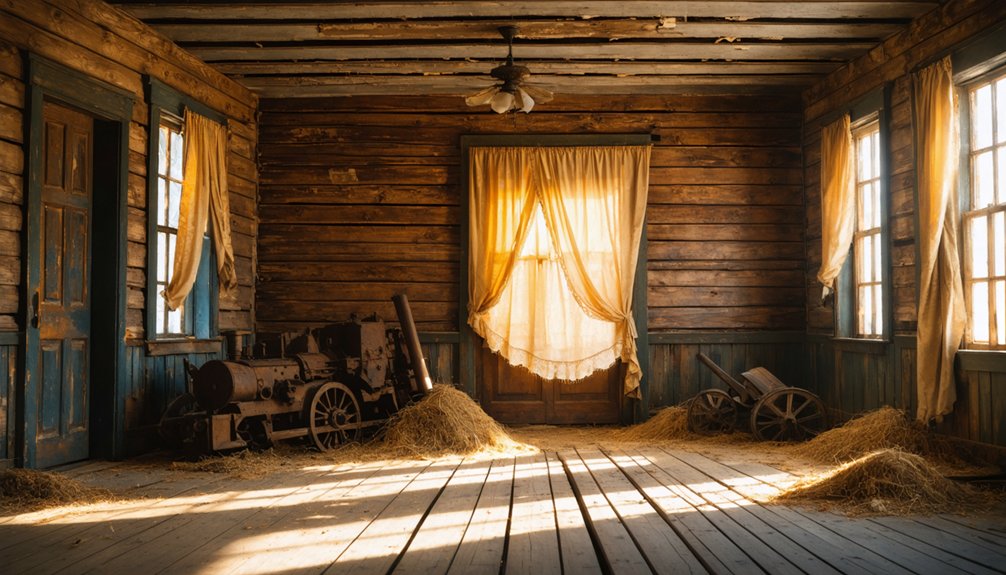
Victorian ghost towns fade into obscurity due to their remote locations, often over 100 miles from major cities, and the collapse of their single-industry economies like mining or logging. You’ll find these towns suffered from severed transportation routes, toxic environmental contamination, and costly maintenance challenges that made preservation nearly impossible. Nature’s relentless assault through harsh weather and structural decay continues to erase these historical treasures, though their untold stories of boom-and-bust America still linger in the shadows.
Key Takeaways
- Geographic isolation and loss of transportation routes cut off towns from economic opportunities and essential services.
- Economic monocultures based on mining or logging left towns vulnerable when resources depleted or industries collapsed.
- Environmental hazards from mining waste and natural deterioration make restoration prohibitively expensive and dangerous.
- Limited preservation funding and high maintenance costs prevent proper upkeep of remote historical sites.
- Many historically significant towns remain undocumented and lack infrastructure for heritage tourism development.
The Gold Rush Legacy: When Prosperity Turned to Dust
When gold was discovered in the American West during the mid-1800s, it sparked one of history’s most dramatic cycles of boom and bust.
You’ll find the gold rush legacies scattered across the landscape in forgotten communities like Bodie, where over 10,000 people once sought their fortunes. These towns flourished briefly but lived and died by the whims of mineral yields and international gold prices.
California’s history includes almost 300 ghost towns that stand as silent witnesses to the mining era.
You can trace their decline to a perfect storm of challenges: depleted ore deposits, harsh environments, and limited resources. In Bodie alone, the stamp mill operations produced an astounding 14 million dollars in precious metals over just 25 years.
When mines closed, like Bodie’s last operation in 1942, entire communities vanished. The towns’ remote locations and difficult terrain made it nearly impossible to develop alternative economies.
What you’re left with today are silent testimonies to ambition and impermanence, where even the most promising boomtowns couldn’t escape their inevitable fate.
Geographic Isolation’s Role in Historical Obscurity
Although many Victorian ghost towns once bustled with life and commerce, their extreme geographic isolation played a decisive role in their descent into historical obscurity.
Today, remnants of these ghost towns of California history serve as poignant reminders of the past and attract curious visitors. Exploring the crumbling façades and empty streets allows one to reflect on the dreams that once thrived in these now-desolate landscapes. Each site holds stories waiting to be uncovered, providing a glimpse into a bygone era that shaped the state’s rich tapestry.
You’ll find these settlements often situated more than 100 miles from major cities, with geographic barriers like mountains, deserts, and unreliable water sources hampering their survival.
This remoteness not only accelerated their economic decline but also led to historical neglect, as many sites remain unmarked and undocumented. The lack of preservation mirrors Florida’s tendency toward forward-looking development.
When railroads rerouted or closed, these towns lost their lifelines to the outside world.
Today, their isolation continues to challenge preservation efforts – historians and archaeologists struggle to access these sites, while limited infrastructure deters tourism. Many properties sit vacant but maintain their historic structures intact, awaiting potential new inhabitants.
Without nearby population centers or transportation networks, these forgotten places slip further into the shadows of American history.
Environmental Disasters and Natural Deterioration
Despite their once-thriving status, Victorian ghost towns succumbed to devastating environmental disasters and natural deterioration that rendered them uninhabitable.
You’ll find these settlements plagued by toxic contamination from mining waste, with asbestos and heavy metals poisoning the air, soil, and water supplies at levels up to 20 times above legal limits.
Underground fires and chemical hazards created additional environmental hazards, releasing deadly gases and causing sinkholes that made reconstruction impossible. Centralia’s underground coal fire continues to burn today, forcing the evacuation of nearly all residents due to toxic fumes and unstable ground.
Nature gradually reclaimed these sites as forest growth, erosion, and ground instability transformed them into dangerous, unstable landscapes – erasing nearly all traces of their Victorian-era prosperity.
Today, the United States contains 4,531 ghost towns that stand as stark reminders of environmental catastrophe and abandonment.
You can trace their decline through recurring floods that destroyed infrastructure and spread contamination, while harsh weather cycles accelerated the decay of remaining structures.
The Decline of Single-Industry Dependencies
Beyond environmental threats, the fundamental weakness of Victorian ghost towns lay in their precarious single-industry dependencies.
You’ll find these towns were built on an economic monoculture, typically centered around mining, logging, or similar extractive industries. When the primary resource ran dry or market prices plummeted, industry collapse was swift and devastating.
You couldn’t find alternative employment in these remote locations because they lacked economic diversity. Once the mines emptied or timber depleted, there was nothing left to sustain the population.
The boom-and-bust cycle was particularly brutal in the American West, where towns like Bodie and Calico flourished briefly during resource booms, only to face rapid abandonment when their silver mines became unprofitable. After the mid-to-late 1800s, these boomtowns transformed into ghost towns as their mines were exhausted.
These communities simply couldn’t adapt to changing market conditions or develop secondary industries fast enough to survive. Today, many serve as heritage tourism sites, preserving their historical and architectural features for visitors to explore.
Lost Transportation Routes and Forgotten Communities
While railroad tracks and stagecoach routes once served as lifelines for Victorian-era towns, their abandonment often spelled doom for these communities.
You’ll find that transportation decline occurred in waves: first, when railroads bypassed stagecoach stops, then when highways replaced rail routes, and finally when interstate systems redirected traffic away from established towns. Each shift left communities more isolated and economically vulnerable.
The impact of community isolation was devastating. When you lost access to crucial transportation networks, you lost everything – trade opportunities, essential services, and connection to the wider world.
Towns like Bannack, Montana, and Cahaba, Alabama, showcase how the loss of transportation infrastructure could trigger an unstoppable exodus. Whether by rail, river, or road, these forgotten communities remind us that survival often depended on staying connected to evolving transportation networks. In Bodie, California, the gold rush ended in the early 1880s, causing the town’s population to dwindle as miners sought opportunities elsewhere. In Virginia City, the discovery of the Comstock Lode brought unprecedented wealth and development to the area, until the silver mines were eventually depleted.
Preservation Challenges in Remote Locations
You’ll find that remote Victorian ghost towns face serious preservation hurdles due to their limited road access, which often consists of deteriorating wagon trails and abandoned rail lines.
The harsh mountain weather, including heavy snow, rain, and intense sun exposure, continuously breaks down historic structures through seasonal freeze-thaw cycles and erosion.
The costs of maintaining these distant sites are particularly steep, as materials and skilled labor must be transported long distances while working around challenging weather windows and difficult terrain.
Limited Access Routes
Remote access routes present one of the most significant challenges in preserving America’s Victorian ghost towns. You’ll find these historic settlements tucked away in harsh mountainous terrain or isolated desert regions, where access challenges severely limit visitor engagement.
Many towns, like Animas Forks in Colorado, sit at elevations exceeding 3,400 meters, making them nearly unreachable during winter months.
Here’s what makes accessing these sites particularly difficult:
- Original road networks were abandoned before modern infrastructure development, leaving only rough, unpaved paths.
- Historic rail services that once connected these towns have been discontinued since the early 1900s.
- Environmental regulations and preservation guidelines often restrict improvements to access routes, maintaining their authentic but challenging conditions.
Harsh Weather Damage
Since Victorian ghost towns endure some of the harshest weather conditions in America, their preservation faces constant environmental threats.
You’ll find severe temperature swings causing climatic deterioration, as winter freezes and summer heat repeatedly stress already fragile structures. When ice forms in building cracks, it expands, leading to accelerated structural decay of walls, chimneys, and foundations.
Heavy rainfall and snowmelt create additional challenges, as moisture seeps into wooden elements, promoting rot and mold growth. In these remote locations, you’re witnessing how fierce winds strip paint and erode surfaces, while heavy snow loads crush aging roofs.
Without regular maintenance to combat these relentless forces, these historic sites succumb to nature’s assault, making preservation increasingly difficult and costly.
Resource-Intensive Maintenance Costs
While Victorian ghost towns stand as monuments to America’s past, their preservation demands extraordinary financial and logistical commitments that strain limited resources.
You’ll find preservation funding stretched thin across these remote historic sites, where basic maintenance costs can soar into millions. Without steady private investment, these treasures rely heavily on volunteer involvement and sporadic donations that rarely meet their extensive needs.
Consider these critical maintenance challenges:
- Specialized restoration work requires rare expertise in period-specific craftsmanship.
- Remote locations dramatically increase operational costs for materials and skilled labor.
- Limited accessibility creates logistical hurdles for regular maintenance and emergency repairs.
The result? Essential repairs often get postponed, creating a destructive cycle where deterioration accelerates and preservation becomes increasingly costly, threatening these irreplaceable pieces of American history.
The Impact of Rapid Industrialization
You’ll find that the rise of industrial machinery in Victorian-era mining towns rapidly displaced traditional manual labor practices, forcing countless workers to seek opportunities elsewhere.
As new production methods emerged with technological advances, smaller mining operations couldn’t compete with larger, mechanized facilities that could extract resources more efficiently.
This shift drove workers toward growing urban centers, which offered diverse employment opportunities and better living conditions than the increasingly obsolete single-industry towns.
Mechanization Displaces Manual Labor
As the Industrial Revolution swept across America in the Victorian era, mechanization fundamentally transformed the nation’s economic landscape, displacing countless manual laborers from their traditional occupations.
You’ll find that this mechanical evolution created devastating ripples through communities that once thrived on human labor, leading to widespread unemployment and eventual abandonment of entire towns.
The labor shifts manifested in three distinct ways:
- Mining communities collapsed as machines replaced pickaxes and manual extraction methods.
- Agricultural towns emptied when mechanical harvesters eliminated the need for field workers.
- Manufacturing centers dissolved when automated processes superseded traditional craftsmen.
As companies rushed to adopt these new technologies, you’d witness entire populations forced to relocate to urban centers, leaving their once-prosperous communities to fade into ghost towns, stark reminders of mechanization’s human cost.
New Production Methods Emerge
During the Victorian era’s rapid industrialization, manufacturing underwent a seismic transformation that reshaped America’s economic geography. Emerging technologies brought massive factories with mechanized assembly lines, fundamentally changing how goods were produced.
You’d find these new operations concentrated in urban centers, where they could access large labor pools and transportation networks.
The industrial revolution’s emphasis on standardized production dealt a crushing blow to Victorian towns built around small-scale manufacturing and local craftsmanship. These communities, once thriving with workshops and skilled artisans, couldn’t match the efficiency of large factories.
The new production methods demanded centralized operations, integrated supply chains, and economies of scale that favored urban industrial hubs. As a result, many Victorian-era towns, unable to adapt to these sweeping changes, saw their economic foundations crumble.
Urban Centers Draw Workers
While small Victorian towns struggled to maintain their populations, America’s urban centers experienced unprecedented growth, with city residents increasing from just 6% of the population in 1800 to 40% by 1900.
This massive urban migration transformed the nation’s landscape as people sought better opportunities in rapidly industrializing cities.
You’ll find three main factors that drove workers away from Victorian towns:
- Cities offered higher-paying factory jobs and more diverse employment options compared to resource-dependent rural areas.
- Urban centers provided superior infrastructure, including better transportation, utilities, and public services.
- Progressive reforms in workplace safety, labor laws, and sanitation made city life more attractive than isolated town living.
These advantages created a self-reinforcing cycle, as growing urban populations attracted more investment and development, while Victorian towns declined into obscurity.
Beyond the Tourist Trail: Undiscovered Historical Gems
Hidden beneath overgrown forests and tucked away in remote mountain passes lie countless Victorian ghost towns that rarely grace tourist itineraries or history books.
You’ll discover these undocumented sites far from paved roads and visitor centers, their hidden histories slowly fading as nature reclaims wooden structures and stone foundations.
Unlike popular destinations such as Bodie or Tombstone, these forgotten settlements lack the infrastructure and promotion that could showcase their cultural significance.
You’re unlikely to find these places in mainstream travel guides or well-marked trails.
Weather-worn buildings, abandoned mine shafts, and deteriorating artifacts tell stories of boom-and-bust cycles that shaped America’s Western frontier.
With limited preservation efforts and dwindling resources, these authentic pieces of Victorian-era heritage continue to slip quietly into obscurity, their tales untold and their significance unrecognized.
Frequently Asked Questions
How Did Victorian Ghost Town Residents Communicate With the Outside World?
You’d rely on telegraph systems for rapid communication, postal services for letters and periodicals, and stagecoaches or trains to maintain connections with the outside world in Victorian ghost towns.
What Happened to the Personal Belongings Left Behind in Ghost Towns?
You’ll find most personal artifacts were scavenged, weathered away, or stolen by looters. Luckily, some belongings survived through historical preservation efforts in museums and protected ghost town sites.
Did Any Ghost Towns Successfully Transform Into Modern Sustainable Communities?
You’ll find remarkable urban revival success stories like Park City, Utah, which transformed from a silver mining ghost town into a thriving ski resort community, demonstrating exceptional community resilience through tourism and cultural preservation.
Were There Social Hierarchies or Class Divisions in Victorian Mining Towns?
You’d think striking gold made everyone equal, but Victorian mining towns had stark class dynamics and economic disparities, with white owners controlling wealth while immigrants and minorities faced discrimination and segregation.
How Did Women and Children Experience Daily Life in These Towns?
You’d find women managing family roles through endless domestic chores, while children split their time between basic schooling and helping with household tasks under harsh, dangerous conditions.
References
- https://www.visittheusa.com/experience/5-us-ghost-towns-you-must-see
- https://www.christywanders.com/2024/08/top-ghost-towns-for-history-buffs.html
- https://www.geotab.com/ghost-towns/
- https://stephentravels.com/top5/ghost-towns/
- https://www.youtube.com/watch?v=ONtJ-QTcMWo
- https://www.legendsofamerica.com/gt-hiddentales/
- https://www.atlasobscura.com/lists/americas-best-preserved-ghost-towns
- https://en.wikipedia.org/wiki/Lists_of_ghost_towns_in_the_United_States
- https://travelnevada.com/ghost-town/
- https://capitolmuseum.ca.gov/state-symbols/gold-rush-ghost-town-bodie/