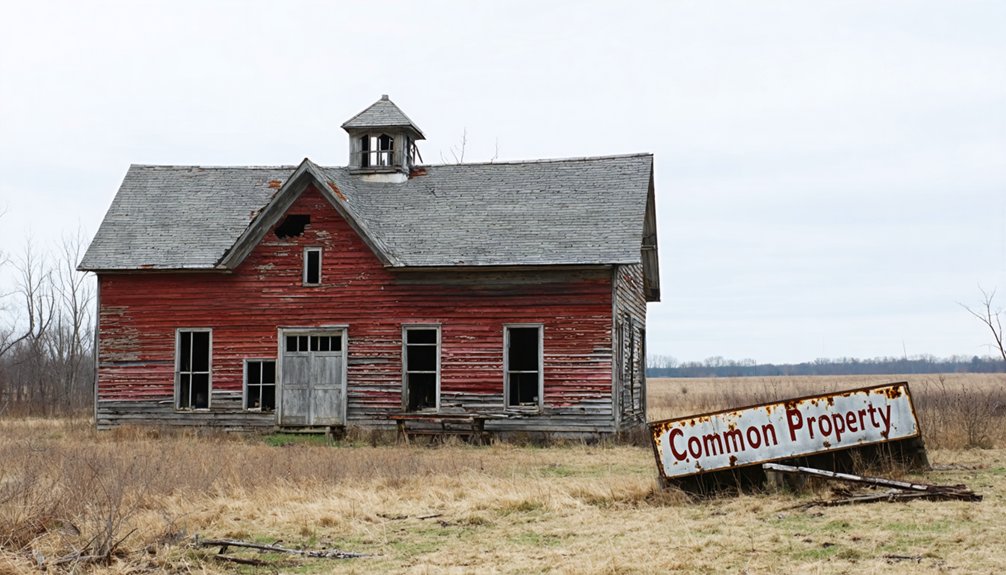
You’ll find that communal experiments in 19th century America failed due to five major challenges. Most communities couldn’t achieve financial stability, struggling with debt and inefficient production. They faced constant tension between collective ideals and individual desires. Disease outbreaks and poor land conditions devastated many settlements. Social isolation and strict moral codes limited growth. The relentless pressure from capitalist markets ultimately exposed deeper contradictions in the utopian vision.
Key Takeaways
- Chronic capital shortages and heavy debt burdens made it difficult for communes to maintain financial stability and self-sufficiency.
- Ideological conflicts between individual autonomy and collective ownership created internal tensions that undermined community cohesion.
- Geographic isolation limited access to resources and social networks, while small populations intensified interpersonal conflicts.
- Disease outbreaks and poor agricultural conditions on marginal lands severely impacted community health and food production.
- External competition from capitalist markets made it challenging for communes to remain economically viable while maintaining their values.
The Economic Reality of Failed Self-Sufficiency
While many communal experiments in America began with idealistic visions of self-sufficiency, their economic realities proved far more challenging.
Capital shortages plagued these ventures from the start, with communities like Brook Farm and Northampton Association struggling under heavy debt burdens that made sustainable operations impossible within the capitalist system. Much like these historic communes, modern public housing projects have faced similar financial sustainability challenges.
You’ll find that these communities faced a harsh paradox: they needed to generate enough internal income to maintain independence, yet couldn’t escape reliance on external markets.
This financial instability created a destructive cycle. When epidemics or other disruptions hit, reduced productivity and increased costs quickly drove communities toward insolvency.
Their collective ownership models couldn’t compete with profit-driven markets, and insufficient economic outputs forced members to maintain ties with the very capitalist economy they’d hoped to escape.
These experiments stood in stark contrast to America’s rising dominance as the largest economy since 1890, highlighting the difficulty of sustaining alternative economic models.
When Ideology Clashed With Human Nature
Although many communal experiments were founded on noble ideological principles, their strict doctrinal demands frequently collided with fundamental aspects of human behavior and psychology.
The clash between ideological rigidity and basic human desires created insurmountable behavioral challenges. You’ll find that industrious members grew resentful of supporting idle participants, while natural drives for autonomy and property ownership undermined collective models. The presence of eccentric misfits in these communities often complicated social harmony and productivity. The failure of Fruitlands after just seven months of operation exemplified how quickly these experiments could unravel.
Utopian visions crumbled as human nature prevailed – productive members resented freeloaders while individual autonomy resisted collective control.
Social dynamics deteriorated as interpersonal conflicts intensified under close living conditions and strict lifestyle controls. Leadership failures further complicated these tensions, as poor management skills and abuse of authority eroded trust and community stability.
When communes attempted to suppress individual ambition or impose harsh social rules, they discovered that human nature simply wouldn’t bend to utopian demands, ultimately leading to dissent, defection, and dissolution.
Social Isolation and Cultural Resistance
Social isolation emerged as an essential factor in the decline of American communal experiments, with both geographic remoteness and cultural barriers creating multiple challenges.
By establishing communities in remote locations, these groups limited their access to resources and diverse social networks, ultimately hampering their sustainability. As Kropotkin observed, these unfederated settlements frequently drained energy and resources from broader revolutionary movements. The communities often faced disease outbreaks that devastated their populations.
The social dynamics within communes often proved problematic. Small populations led to intense scrutiny of private lives, while larger groups struggled with resource distribution.
Cultural adaptability became a vital weakness as many communities maintained strict moral codes and unconventional practices that alienated both neighbors and potential members.
The inability to integrate with mainstream society while preserving their unique identity left many communes caught in an impossible position – either compromise their principles or face eventual dissolution through declining membership and social support.
Health Crises and Environmental Challenges
Beyond the social challenges that threatened communal experiments, physical hardships posed equally formidable obstacles to their survival. Disease outbreaks devastated communities, with smallpox and cholera spreading rapidly through crowded living quarters. When quarantines shut down schools and work, productivity plummeted.
Environmental hardships compounded these problems, as many communes settled on marginal lands with poor soil and harsh weather conditions. You’d find agricultural inefficiencies everywhere – from failing crops to inadequate food production – leading to widespread malnutrition. The New Harmony commune struggled particularly with these agricultural challenges before collapsing after just two years.
Resource shortages became a constant threat, with essential infrastructure like mills and workshops failing due to mismanagement and lack of expertise. When disasters struck, such as Brook Farm’s uninsured Phalanstery fire, communities lacked the financial reserves to recover, ultimately hastening their decline.
The Capitalist Context: External Pressures and Market Forces
Despite their idealistic visions, utopian communities in America faced relentless economic pressures from the surrounding capitalist system. You’ll find that communes like Brook Farm and New Harmony struggled with market competition, lacking the capital and scale to match established businesses.
The failures of social experiments in New York are a testament to the challenges faced by these communities. The realities of urban life often outweighed their collectivist ideals, leading to disillusionment among residents. Ultimately, the struggle for sustainability and identity within a dense metropolis highlighted the complexities of integrating alternative lifestyles with mainstream society.
They couldn’t escape the need for external trade, which forced them to operate within the very system they sought to reject. Without reliable revenue streams, these communities became dependent on wealthy patrons and outside investors.
When Robert Owen reduced his financial support of New Harmony, the experiment quickly faltered. Similarly, Brook Farm’s attempt to shift toward Fourierism and structured industries only deepened their entanglement with capitalist markets. The settlement’s over-reliance on Owen’s frequent absences contributed significantly to its downfall.
These economic realities exposed a fundamental contradiction: you can’t easily maintain communal values while competing in a profit-driven economy.
Frequently Asked Questions
Did Any American Communal Experiments Succeed Long-Term and Still Exist Today?
You’ll find several successful settlements still operating today, like spiritual retreats and eco-villages that achieved long-term sustainability through flexible structures, economic self-sufficiency, and balanced communal values.
How Did Children Raised in These Communities Adapt to Life Outside?
Over 70% of commune-raised children struggled initially. Your childhood experiences in these communities could make social integration challenging, as you’d need to learn mainstream norms, job skills, and independent living practices.
What Role Did Women Play in Leadership of Communal Settlements?
You’ll find women dominated communal governance, making up 70% of settlement leaders. They brought professional training, organized political campaigns, and pioneered social reforms through scientific approaches to community development.
How Did Communal Experiments Handle Criminal Behavior and Internal Justice Systems?
You’ll find communal experiments wildly varied in their criminal justice approaches, from harsh public shaming to gentle moral guidance. Their internal governance relied heavily on community councils, social pressure, and religious-based rehabilitation methods.
What Technologies or Innovations Emerged From These American Communal Settlements?
You’ll find communal settlements pioneered sustainable agriculture through crop rotation, water-powered mills, and shared farming tools. They also developed alternative energy solutions like waterwheel systems and innovative resource management techniques.
References
- https://fee.org/articles/the-dark-side-of-paradise-a-brief-history-of-americas-utopian-experiments-in-communal-living/
- https://www.maciverinstitute.com/perspectives/the-failed-socialist-state-in-midwestern-america
- https://www.mentalfloss.com/history/failed-utopias
- https://digitalcommons.providence.edu/cgi/viewcontent.cgi?article=1015&context=student_scholarship
- https://www.ushistory.org/us/26b.asp
- https://www.yesmagazine.org/health-happiness/2022/06/01/american-communes-failed-experiment
- https://tools4literature.weebly.com/utopia-failures.html
- https://constitutingamerica.org/90day-aer-failures-of-utopian-creation-experiments-americas-founders-and-their-warnings-against-attempts-to-re-invent-human-nature-guest-essayist-chris-burkett/
- https://www.transformatise.com/2025/09/america-failed-social-experiment/
- https://manhattan.institute/article/americas-failed-experiment-in-public-housing