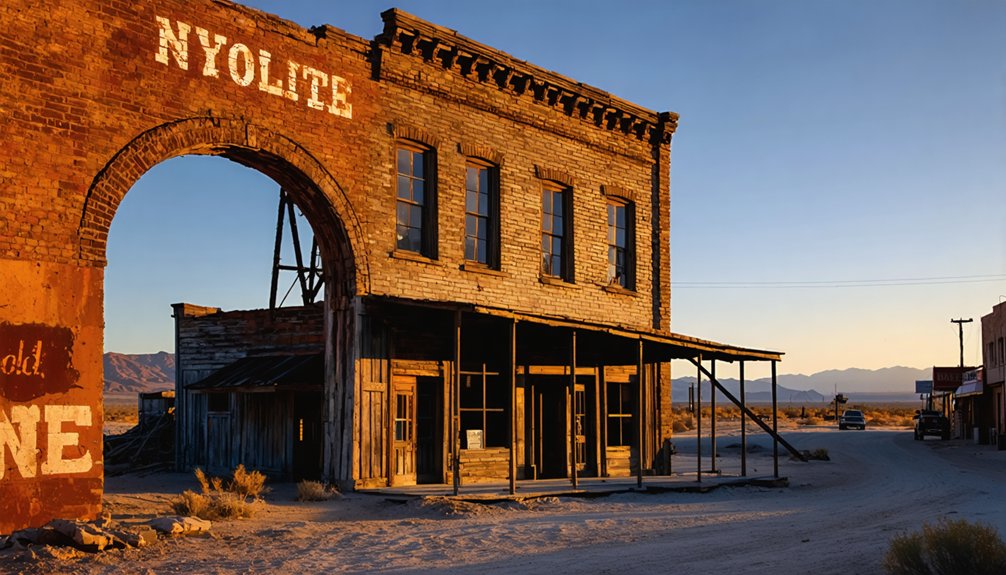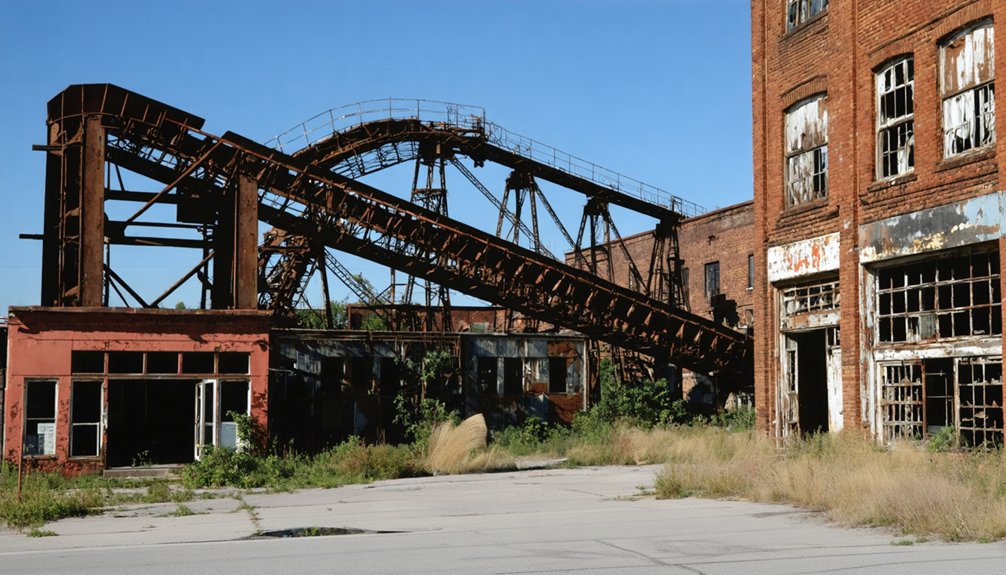
Industrial towns became ghost towns due to their dangerous reliance on single industries, with 87% of manufacturing job losses from 2000-2010 caused by automation and technological shifts. When mines closed or factories automated, communities collapsed – losing up to 30% of their workforce virtually overnight. Corporate control over housing and services, coupled with environmental damage from 1,300+ abandoned mines, made recovery impossible. The full story of America’s industrial decline reveals an even darker pattern.
Key Takeaways
- Dependence on single industries made towns vulnerable to market changes, leading to rapid economic collapse when those industries declined or closed.
- Resource depletion, especially in mining towns, left communities without their economic foundation once materials were exhausted.
- Technological advancements and automation eliminated manufacturing jobs, causing massive workforce displacement and population decline.
- Corporate control over housing, stores, and services meant entire communities collapsed when companies shut down operations.
- Environmental damage from industrial activities made areas uninhabitable and deterred new economic development opportunities.
The Rise and Fall of Single-Resource Economies
When industrial towns emerged across America in the late 19th and early 20th centuries, their fate became inextricably linked to the success of a single dominant industry.
Nineteenth-century industrial towns rose and fell with their core industries, tethered to a single economic lifeline that defined their destiny.
Whether built around coal mines, steel mills, or lumber yards, these communities lacked economic resilience due to their dependence on one resource-based enterprise.
You’ll find that this economic monoculture created inherent vulnerabilities. When industry competition intensified or technological changes disrupted production, entire communities faced devastating job losses.
Companies used company scrip as payment, keeping workers trapped in a cycle of debt and dependence. With up to 20% markups at company stores and limited opportunities for diversification, workers struggled to build financial security.
The lack of community adaptability became evident as infrastructure, housing, and essential services remained tied to single companies. By 1922, 80% of West Virginia miners lived in company-owned housing, highlighting the extreme dependence on corporate control.
When these industries declined due to global competition or resource depletion, towns often couldn’t sustain themselves, leading to widespread abandonment.
When Natural Resources Run Dry
You’ll find a clear pattern across America’s industrial ghost towns: when the mines close and natural resources are depleted, the towns that depended on them face rapid economic death.
Oregon illustrates this trend, with extensive ghost towns scattered across its landscape from defunct mining operations. The evidence shows how unsustainable extraction patterns leave communities vulnerable, with Pennsylvania’s Waynesburg and Marianna Mine serving as stark examples of population collapse after resource exhaustion. When active mining sites decreased from nine to four between 2019 and 2021, Waynesburg’s economic stability deteriorated rapidly.
Without economic alternatives in place, these single-resource towns often see their populations drop by thousands, their infrastructure crumble, and their local businesses shut down in rapid succession.
Mines Close, Towns Die
Throughout America’s industrial history, the devastating cycle of mine closures has transformed once-thriving communities into ghost towns, as evidenced by Appalachia’s dramatic coal industry decline.
You’ll find the economic fallout most severe in places like Claiborne County, TN, where coal production that once generated $71.2 million and supported 267 jobs has plummeted. The ripple effects are profound – when mines close, tax revenues collapse, taking essential services with them.
The consequences cascade through every aspect of community life. Schools shut down, infrastructure crumbles, and working-age adults flee. Over 1,300 zombie mines remain inactive yet not officially abandoned across Appalachia, creating environmental and safety hazards for local communities.
In Central Appalachia alone, coal output has dropped 80% in recent decades. What’s left behind are empty streets, shuttered businesses, and unreclaimed mine sites that cost taxpayers millions to clean up, further hampering economic recovery. A comprehensive MSHA dataset tracks these devastating declines through annual reports from every permitted coal mine in the region.
Unsustainable Extraction Patterns
Mining towns’ collapse often traces back to unsustainable extraction practices that depleted natural resources while wreaking environmental havoc.
You’ll find that resource extraction created a devastating ecological impact, leaving behind a legacy of pollution and degradation that made these areas nearly uninhabitable.
- Intensive mining stripped landscapes of natural integrity, contaminating water sources and destroying local ecosystems.
- Overuse of agricultural lands led to severe soil erosion and reduced farming productivity.
- Single-resource dependence left towns vulnerable when deposits were depleted.
- Environmental damage deterred new investment and alternative economic activities.
- Global market shifts and technological changes made remote extraction sites economically unviable.
The data shows these unsustainable practices created a perfect storm: as resources ran dry, environmental damage made it impossible for towns to pivot to new industries, sealing their fate as ghost towns. The decline of these communities mirrors cases like Desdemona, Texas, where rapid oil depletion in 1921 led to widespread abandonment and the closure of vital services. Heavy reliance on forced labor conditions in many mining operations contributed to the social instability and eventual abandonment of these industrial towns.
No Economic Alternatives
When industrial towns built their economies around a single resource or industry, they created a dangerous economic trap that would eventually lead to their downfall.
You’ll find these communities failed to develop economic resilience strategies, leaving them vulnerable when their primary industry collapsed. As natural resources depleted or market demands shifted, there weren’t enough alternative employment options to sustain the population.
Community revitalization efforts often came too late and fell short. The workforce, specialized in extractive or manufacturing skills, struggled to adapt to new sectors. In Erie, Pennsylvania and similar cities, the loss of white-collar jobs further weakened support for remaining manufacturing industries. Forrester Research predicts 3.4 million jobs will move overseas, devastating local economies.
Infrastructure and education systems remained focused on serving the dominant industry rather than preparing for change. Without economic diversification, these towns couldn’t attract new businesses or maintain their tax base.
The result? A downward spiral of job losses, declining services, and population exodus that transformed vibrant industrial centers into ghost towns.
The Impact of Technological Evolution
You’ll notice that America’s industrial towns faced a perfect storm as automation eliminated up to 25% of manufacturing jobs between 2000-2012, fundamentally altering their economic foundations.
When companies upgraded to modern facilities, they often abandoned older industrial sites, leaving behind crumbling infrastructure that cities couldn’t afford to maintain.
These technological shifts reshaped transportation networks too, as new logistics hubs emerged around automated facilities, effectively bypassing many traditional industrial centers that once thrived on their strategic locations.
Automation Reduces Worker Demand
Throughout the latter half of the 20th century, automation emerged as a primary driver of industrial decline, with data showing that 87% of manufacturing job losses between 2000-2010 stemmed from technological advancement rather than globalization.
The automation impact has been particularly severe in smaller industrial towns, where manufacturing jobs once provided stable middle-class employment.
- Manufacturing employment plummeted from 25% to under 10% of the workforce
- Smaller towns face 30% or higher job displacement rates
- Industrial robots boost productivity while eliminating human labor
- Routine manual tasks disappear as machines take over
- Local economies collapse as displaced workers migrate to cities
The ripple effects of job displacement extend beyond manufacturing, as reduced consumer spending cripples local service industries.
This technological shift has transformed once-thriving industrial communities into struggling ghost towns, especially where workers lack access to retraining opportunities.
Transportation Routes Shift Away
The technological evolution of transportation infrastructure dealt another devastating blow to America’s industrial towns.
You’ll find that early 20th-century cities thrived on efficient streetcar systems, but urban planning priorities shifted dramatically toward automobiles. When General Motors and its allies systematically dismantled streetcar networks through National City Lines, they transformed reliable rail routes into infrequent bus services, forcing workers to buy cars.
Federal policy poured money into highways while neglecting public transit, and post-WWII suburbanization scattered populations away from industrial cores.
You can trace how this deliberate restructuring of transportation infrastructure weakened traditional industrial towns that depended on concentrated, transit-linked workforces. As governments refused to fund public transit and prioritized car-centric development, once-vibrant industrial communities lost their economic coherence and social fabric.
Obsolete Infrastructure Crumbles Fast
Four critical factors accelerated the deterioration of industrial towns’ infrastructure: aging facilities from the early 20th century, mass workforce retirements, technological obsolescence, and chronic underinvestment.
You’ll find these stark realities in America’s former industrial hubs:
- Nearly half of water infrastructure workers will retire within a decade, creating severe workforce shortages.
- Infrastructure investment gaps have led to almost $1 trillion in deferred maintenance nationally.
- Century-old water and sewer systems can’t support modern industrial needs.
- Legacy electric grids and industrial plants have become functionally obsolete.
- Automation and digital manufacturing require advanced infrastructure that old facilities can’t provide.
Without skilled workers to maintain aging systems and insufficient funds for modernization, infrastructure deterioration accelerated rapidly.
The combination of outdated facilities and technological evolution left these towns unable to adapt to modern manufacturing requirements.
Corporate Control and Worker Dependencies
Corporate control and worker dependencies created a perfect storm for eventual town collapse.
You’ll find companies wielded near-total control through an insidious system of corporate paternalism, owning everything from housing to stores to police forces. This all-encompassing dominance meant workers couldn’t escape worker exploitation even in their private lives.
When you lost your job, you lost your home. When you needed food, you’d to use company scrip at the company store. If you tried to unionize, company-paid police would suppress your efforts.
The system particularly trapped immigrants and minorities who’d few alternatives. This deep dependence on a single corporate entity meant that when companies failed or moved operations, entire communities crumbled – they simply couldn’t survive without their corporate lifeline.
Environmental Disasters That Emptied Towns
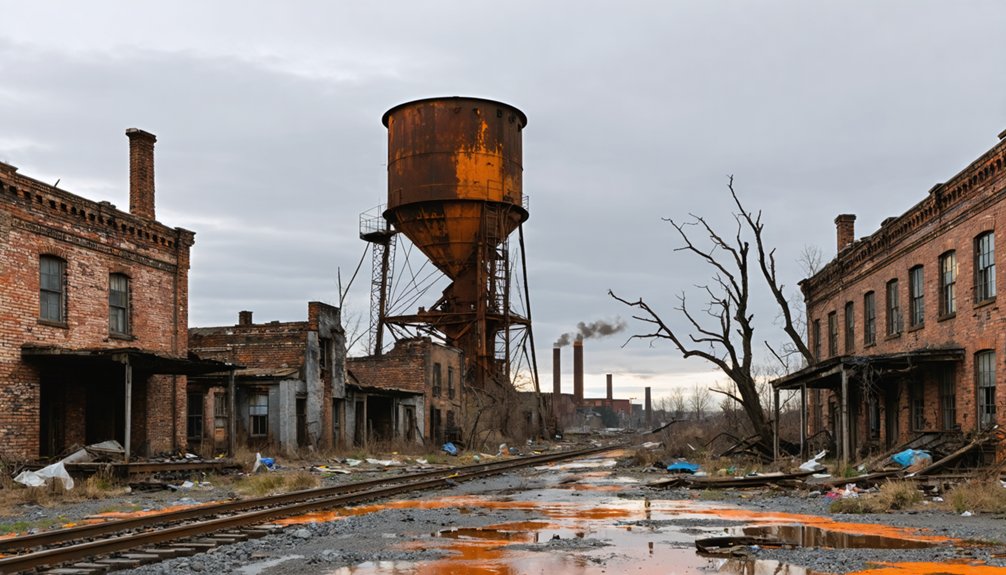
Environmental catastrophes turned bustling industrial communities into ghost towns through both sudden disasters and gradual poisoning.
You’ll find stark examples in places like Love Canal, New York, where toxic chemical dumping forced the permanent evacuation of residents, and Centralia, Pennsylvania, where an underground mine fire has burned since 1962, making the ground unstable and releasing dangerous gases.
The devastating impacts of chemical plant explosions, like the 1947 Texas City disaster, and nuclear accidents, such as Three Mile Island, have similarly rendered entire areas uninhabitable, displacing communities and erasing towns from the map.
Underground Fires Destroy Communities
While many industrial ghost towns emerged from economic decline, some communities met their end through an insidious underground threat: burning coal seams that refused to die out.
Underground fires, often sparked by trash fires or spontaneous combustion, spread relentlessly through abandoned mine networks beneath towns, leading to widespread community displacement.
- Fires can burn for decades, reaching depths of 300 feet and spanning thousands of acres.
- Toxic gases and lethal carbon monoxide levels force residents to evacuate.
- Ground collapses create dangerous sinkholes that swallow buildings.
- Steam and smoke vent through surface cracks, making land unstable.
- Infrastructure fails as roads buckle and close, cutting off essential access.
You’ll find stark evidence in Centralia, Pennsylvania, where a 1962 trash fire transformed a thriving town of 1,000 into a nearly abandoned wasteland, with fires still burning beneath the earth today.
Toxic Waste Forces Relocation
Beyond burning coal seams, toxic waste transformed numerous American industrial towns into uninhabitable wastelands.
You’ll find the most infamous example at Love Canal, where Hooker Chemical Company dumped 21,800 tons of chemical byproducts, forcing residents to flee after experiencing miscarriages and birth defects. The EPA’s Superfund program had to step in for a 21-year cleanup effort.
Similar fates befell other communities.
In Times Beach, Missouri, dioxin contamination drove out over 500 residents, while in Pensacola, Florida, the Escambia Wood Treating Company site led to the relocation of 400 households.
Companies like Alcoa left toxic legacies in towns across America, from Badin, North Carolina, to Point Comfort, Texas, where contaminated waterways and soil made continued habitation impossible.
Transportation Changes and Town Isolation
As America’s love affair with automobiles grew in the early 20th century, the transportation landscape underwent a dramatic shift that would isolate industrial towns from economic centers.
The systematic dismantling of public transit systems, particularly streetcars and interurban rail lines, left many communities stranded as urban sprawl pushed development outward.
Key factors that transformed industrial towns into isolated outposts:
- Corporate interests, led by GM and National City Lines, deliberately replaced rail systems with less efficient bus services
- Highway construction cut through established neighborhoods, destroying transit corridors
- Reduced transit frequency drove away riders, creating a death spiral for public transportation
- Car-centric urban planning prioritized roads over rail infrastructure
- Suburban expansion scattered populations too thinly to support viable transit systems
Economic Crashes and Market Shifts

When economic shocks hit industrial towns in the 1970s, they triggered catastrophic chain reactions that devastated local economies. You could see this devastation most clearly in the Rust Belt, where manufacturing jobs plummeted by 32.9% between 1969 and 1996. These towns lacked economic resilience to withstand such dramatic market fluctuations.
The domino effect was brutal: major employers shut down, damaging local tax bases and forcing cities to slash essential services. When China joined the WTO in 2001, it delivered another crushing blow, particularly to rural Southern manufacturing.
The 1970s energy crisis and new pollution regulations had already increased operational costs, pushing many factories to close or relocate. As these economic pillars crumbled, small businesses folded and urban decay spread, creating a downward spiral that many towns couldn’t escape.
The Human Cost of Industrial Decline
The devastating human toll of industrial decline manifested in three critical dimensions: massive job displacement, deteriorating mental health, and collapsing community structures.
When you examine the data, you’ll find the impact was staggering. Manufacturing lost 33% of its workforce between 2000-2009, with 8.9 million workers displaced by imports alone. The effects of job displacement rippled through communities, creating a destructive cycle of community fragmentation:
- 78,000+ manufacturing plants closed between 2000-2014
- Displaced workers faced 20-30% lower wages in new jobs
- Local tax bases shrunk, crippling schools and public services
- Mental health issues spiked among affected families
- Social networks built around factory culture disintegrated
These statistics tell a story of working Americans who’ve watched their communities transform from thriving industrial centers into struggling ghost towns.
In the shadows of these abandoned spaces lie the mysterious legends of Texas ghost towns, where tales of lost fortunes and wandering spirits abound. As locals recount the history of once-vibrant neighborhoods, they often invite visitors to share in the exploration of these forgotten places, each with their own haunting story. These narratives not only preserve the past but also weave a rich tapestry of cultural heritage that endures even in desolation.
From Boom Towns to Abandoned Places
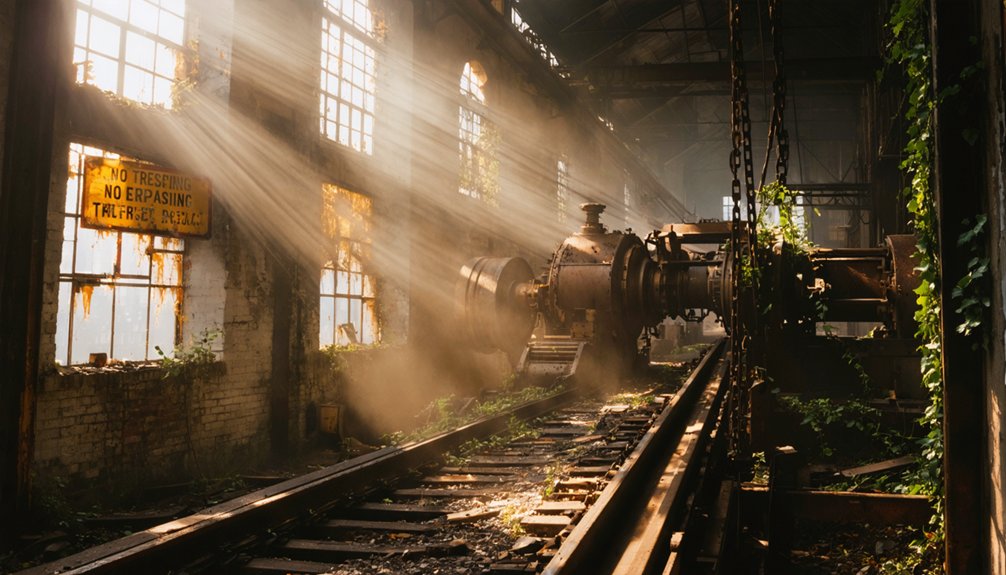
Industrial boom towns across America showcase a dramatic rise-and-fall narrative that mirrors the broader story of U.S. manufacturing. You’ll find these once-thriving communities emerged rapidly near mines, factories, and mills, with populations soaring as immigrants flocked to new opportunities.
Detroit’s growth from 79,577 to 285,704 residents between 1870-1900 exemplifies this explosive expansion.
Detroit’s population surge exemplifies the magnetic pull of industrial opportunity, drawing nearly 200,000 new residents in just three decades.
But when industries collapsed, these specialized economies couldn’t sustain themselves. You can trace their downfall to deindustrialization, globalization, and resource depletion.
In Gary, WV, for instance, coal production fell 28% while the workforce shrank 38% in just five years. The lack of economic diversification left these communities vulnerable, and their dependency on single employers proved fatal.
Without community resilience through multiple industries, many boom towns transformed into abandoned shells of their former glory.
Modern Tourism and Historical Preservation
Many abandoned industrial towns have found new life through heritage tourism, with successful preservation efforts transforming these ghostly ruins into thriving visitor destinations.
You’ll find innovative approaches to cultural preservation across the American landscape, where creative adaptations blend historical authenticity with modern amenities.
- Experience mine tours and historical reenactments in towns like Calico and Bodie
- Explore art installations and music venues in repurposed historic buildings
- Visit film locations and micro-resorts that maintain period architecture
- Discover seasonal attractions, including winter access by ski in places like Garnet
- Support local economies through guided tours, events, and authentic merchandise
These preservation initiatives don’t just protect America’s industrial heritage – they create sustainable tourism opportunities while generating jobs and revenue for local communities.
Heritage tourism has proven key to preventing further decay of these historical treasures.
Frequently Asked Questions
How Long Does It Typically Take for an Industrial Town to Become Abandoned?
You’ll typically see industrial decline unfold over 40-80 years, with urban decay accelerating after major plant closures, though some towns can collapse faster if they’re dependent on single industries.
What Percentage of Ghost Towns Have Been Successfully Revitalized in Modern Times?
Though only 10-20% of ghost towns achieve strong revitalization, you’ll find successful transformations in places like Chattanooga and Duluth, where strategic investments and economic redevelopment have created sustainable new economies.
Did Any Ghost Towns Maintain Small Permanent Populations Throughout Their Decline?
You’ll find that many industrial ghost towns retained permanent residents throughout decline, with towns like McKeesport keeping 20-30% of peak populations, demonstrating remarkable community resilience despite economic hardship.
What Role Did Organized Crime Play in Accelerating Industrial Town Abandonment?
You’ll find crime influence directly accelerated economic decline through union corruption, industry control, and political manipulation, making towns less competitive and driving away legitimate businesses and investment opportunities.
How Many Ghost Towns Were Created by Labor Strikes and Union Conflicts?
You’ll find thousands of towns affected by labor unrest and union strikes, with over 3,000 strikes yearly creating widespread disruptions. Around 150-200 industrial communities became ghost towns directly from strike-related closures.
References
- https://www.mentalfloss.com/geography/american-ghost-towns-can-still-walk-through
- https://petroleumservicecompany.com/blog/5-weird-industrial-towns-in-the-u-s/
- https://www.youtube.com/watch?v=eyOASXxAmMI
- https://www.smithsonianmag.com/travel/americas-company-towns-then-and-now-180956382/
- https://www.blackhillsbadlands.com/blog/post/old-west-legends-mines-ghost-towns-route-reimagined/
- https://historycollection.com/ghost-town-boom-bust-instant-cities-that-vanished/
- https://socialwelfare.library.vcu.edu/organizations/labor/company-towns-1890s-to-1935/
- https://www.atlasobscura.com/lists/americas-best-preserved-ghost-towns
- https://www.richmondfed.org/publications/research/econ_focus/2023/q3_economic_history
- https://prospect.org/2018/03/21/company-towns-still-us/