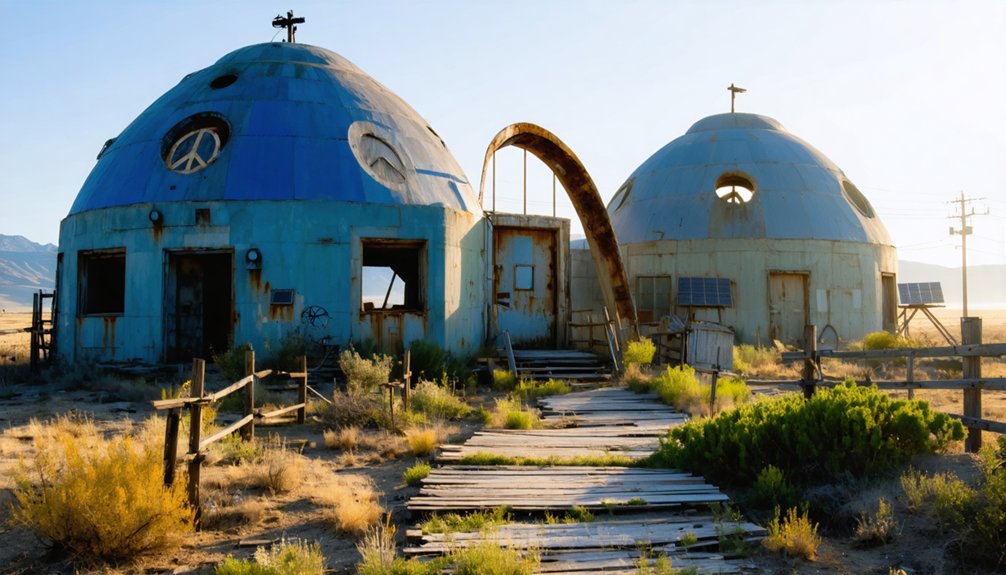
Most utopian communities in America failed within two years due to unstable financial foundations, ineffective leadership, and deep social tensions. You’ll find that these idealistic ventures couldn’t sustain themselves when faced with mounting debts, power struggles, and the harsh realities of daily communal life. Their equal wage policies and radical beliefs often clashed with capitalism’s demands, while internal conflicts over resources and decision-making fractured member unity. Understanding these complex dynamics reveals essential lessons about communal experiments.
Key Takeaways
- Financial instability crippled communities due to inadequate capital, mounting debts, and unsustainable equal wage policies.
- Poor leadership and governance structures failed to effectively manage resources and resolve internal conflicts.
- Social tensions emerged between productive and less productive members, creating deep divisions within communities.
- Idealistic visions clashed with practical realities of daily life, leading to member burnout and disillusionment.
- External economic pressures and societal resistance made it difficult for communities to maintain their alternative lifestyles.
The Fragile Financial Foundations
While utopian communities in America emerged with bold visions of social transformation, their financial foundations proved dangerously weak from the start.
You’ll find that most communities launched without securing adequate capital investments, leaving them vulnerable to economic shocks and mounting debts. Brook Farm’s experience illustrates this pattern – unpaid member investments and unexpected costs like disease quarantines quickly drained their resources.
Poor financial planning and unstable funding doomed many utopian communities before they could realize their ambitious social goals.
The lack of financial sustainability became evident as communities struggled with basic operations. Even at Harmony, the Rappites needed two full years to achieve self-sufficiency despite having highly dedicated workers. The Fourierist movement of the 1840s saw dozens of communities fail within their first few years of operation.
At New Harmony, factories sat idle due to poor organization and insufficient skilled labor. When communities did face setbacks, their debt burdens prevented recovery. Projects like Phalanxes represented massive financial commitments that, once damaged, often led to complete collapse.
Without solid economic footings, these experimental societies simply couldn’t weather the inevitable storms of establishing a new social order.
Leadership Without Practical Vision
The financial instability plaguing utopian communities reflected a deeper problem: ineffective leadership. Founders like Robert Owen spent minimal time providing operational oversight, instead focusing on recruitment and promotion while delegating daily management to less capable individuals.
This leadership absence created a dangerous disconnect between idealistic vision and practical execution. Owen’s frequent absences from Indiana contributed directly to New Harmony’s collapse after just two years. A rigid council of seven controlled all community decisions but lacked the authority to implement meaningful changes.
You’ll find that these leaders consistently underestimated human nature’s complexity, naively assuming that shared ideology would overcome natural self-interest and power struggles.
They failed to establish robust governance structures or succession plans, leaving their communities vulnerable to internal divisions and power grabs. Without proper vetting systems for new members or mechanisms to enforce accountability, they attracted free-riders while struggling to retain talented contributors.
The result was a perfect storm of mismanagement that doomed their utopian experiments to failure.
Social Tensions and Internal Divisions
You’ll find that many utopian communities struggled with leadership power dynamics, as charismatic founders often clashed with emerging leaders who challenged their authority and vision.
Even in communities that preached radical equality, class divisions persisted between educated idealists and working-class members who brought practical skills.
The frequent presence of eccentric individuals and misfits in these communities further complicated social relationships and group cohesion.
These social tensions regularly erupted into open conflicts over decision-making power and resource allocation, ultimately contributing to the dissolution of numerous utopian experiments.
The shift from pre-capitalist culture to a market economy created additional strains as communities tried to balance their idealistic goals with economic survival.
Leadership Power Struggles
Leadership power struggles emerged as a critical factor in the downfall of many American utopian communities, particularly through ideological rigidity and financial instability.
These leadership conflicts manifested in bitter disputes over governance models and resource allocation, while power dynamics grew increasingly hostile as communities faced mounting challenges.
- Robert Owen’s authoritarian leadership style and distrust of working-class members led to democratic governance failures at New Harmony.
- Financial crises intensified power struggles between trustees and sparked lawsuits that destroyed partnerships.
- Religious communities under Joseph Smith faced internal fracturing due to theocratic control and succession disputes. The lynching of Smith and his brother in 1844 by an angry mob created devastating leadership challenges.
- Communication breakdowns between leaders and members resulted in shouting matches and the exodus of skilled workers.
The inability to balance competing visions of governance while maintaining financial stability ultimately spelled doom for these ambitious social experiments.
Member Class Divides
Despite aspirations of perfect equality, member class divides plagued America’s utopian communities through economic, religious, and social stratification.
You’d find industrious members growing resentful of supporting less productive ones, while equal wage policies created tensions between those working difficult jobs and those choosing easier tasks.
Membership exclusivity further deepened these divisions, as communities like Oneida established hierarchies between founding members and newcomers. The Protestant Reformation’s influence sparked additional divisions as members debated interpretations of work ethic and divine favor.
Religious differences intensified class tension, with some members following stricter spiritual practices than others. The collective living model created additional strain as members struggled to adjust to shared resources and spaces.
Women’s roles became another flashpoint, as communities struggled between traditional gender expectations and progressive reforms.
The abolition of private property, meant to eliminate class distinctions, ironically created new forms of dependency and social ranking, ultimately contributing to many communities’ dissolution through factionalism and internal conflict.
Idealistic Principles Meet Hard Reality
When you look at the history of American utopian communities, you’ll find a stark contrast between their lofty visions and the harsh realities of daily survival.
You’ll notice their economic dreams often collapsed under the weight of insufficient resources, failed agricultural ventures, and an inability to generate sustainable income within the broader capitalist system.
Their founding principles frequently buckled as members confronted practical challenges like food shortages, inadequate housing, and internal conflicts over governance and social practices. Communities like Fruitlands lasted just seven months before dissolving due to poor living conditions and lack of food.
Vision Versus Daily Life
Throughout America’s utopian experiments, the stark contrast between idealistic visions and daily realities repeatedly undermined these ambitious social projects.
The gap between visionary optimism and practical challenges created tensions that ultimately proved insurmountable for many communities.
- You’ll find that rigid social experiments often collapsed under their own weight, as daily life demands conflicted with perfectionist ideals.
- When you examine failed communities, you’ll notice how attempts at total social control led to member burnout and exhaustion.
- You can see how the absence of pragmatic governance mechanisms left communities vulnerable to internal conflicts.
- Your study of these communities reveals that economic independence proved difficult to maintain while adhering to socialist or communal principles.
These fundamental contradictions between vision and reality ultimately doomed many utopian endeavors to failure.
Economic Dreams Fall Short
As America’s utopian communities pursued their economic visions, the harsh realities of market competition and resource management quickly exposed fundamental flaws in their idealistic models.
You’ll find that equal wage policies undermined economic motivations, as skilled workers demanded competitive pay while others lacked incentives to improve. Communities like New Harmony couldn’t achieve communal sustainability, relying instead on external funding to cover mounting losses.
The capitalist environment surrounding these experiments created insurmountable pressures.
You’d see how internal disputes over property rights and resource allocation led to inefficient decision-making. Poor management and lack of economic planning expertise doomed many communities within their first few years.
When faced with market competition, these idealistic ventures couldn’t maintain their egalitarian principles while generating sufficient profits to survive.
Principles Crumble Under Pressure
The idealistic principles that formed the foundation of America’s utopian communities faced severe tests from within their own walls. When confronted with real human behavior and complex community dynamics, these experimental societies often crumbled under the weight of their own expectations.
- Internal disputes over socialist principles and governance structures created deep divisions, making it impossible to maintain unified communities.
- The natural diversity of human desires and self-interests conflicted sharply with demands for conformity and collective decision-making.
- Leadership struggles and high turnover rates prevented stable community development, as visionary founders often failed to establish practical management systems.
- Attempts to enforce perfect harmony ignored fundamental aspects of human nature, leading to resistance from members who couldn’t reconcile individual freedom with communal responsibilities.
External Pressures and Societal Resistance
While utopian communities in America pursued their idealistic visions, they faced significant external pressures that ultimately contributed to their downfall.
You’ll find that their economic dependencies on the capitalist system proved unsustainable, as they struggled to maintain socialist values while competing in mainstream markets. Their financial challenges intensified through costly building projects and unreliable member contributions.
The surrounding society’s resistance further complicated their survival.
You’d see how societal expectations and conventional norms created an environment of suspicion and hostility toward these experimental communities. The legal and financial systems weren’t designed to protect communal property arrangements, leaving them vulnerable to bankruptcy.
Even potential allies were often alienated by the communities’ radical beliefs, limiting their opportunities for trade and integration with neighboring populations.
The Challenge of Sustainable Growth

Maintaining sustainable growth proved to be one of the most formidable challenges faced by American utopian communities. As these settlements expanded, they struggled to balance their growth aspirations with their founding principles, often leading to value dilution and eventual collapse.
- Limited access to capital made it nearly impossible to fund infrastructure expansion while maintaining financial independence from external sources.
- Communities couldn’t achieve economies of scale in their production, which undermined their self-sufficiency goals.
- Transient populations and high member turnover prevented the formation of lasting community bonds needed for sustained growth.
- Weak governance structures failed to effectively manage increased demands on communal resources as communities expanded.
Without robust systems for managing growth, many communities found their utopian ideals compromised by practical necessities, leading to their transformation into conventional settlements or complete dissolution.
The Path to Modern Integration
Despite their eventual decline, utopian communities left lasting imprints on American society through their gradual integration into mainstream culture. As you’ll find, their revolutionary social experiments, though often deemed too radical, helped shape modern discussions about communal living and economic equality.
This legacy can be seen in the ongoing efforts to address the challenges faced by failed communities in America. These areas continue to grapple with issues such as economic disparity, social fragmentation, and lack of access to essential resources. Understanding the roots of these challenges is crucial for fostering a more inclusive future.
The process of cultural assimilation wasn’t always smooth. You’d see communities like Oneida struggling to maintain their distinct community identity while facing mounting pressure from outside society. They’d often have to choose between adapting their practices or dissolving entirely.
Some, like the Shakers, managed to preserve aspects of their culture through their craftsmanship and architecture, even as their numbers dwindled. Their influence persists in contemporary intentional communities, cooperative housing movements, and ongoing experiments in alternative social arrangements.
Frequently Asked Questions
What Role Did Women Play in Leadership Positions Within Utopian Communities?
Like CEO positions today, women leaders navigated complex community dynamics, heading spiritual movements, championing social reforms, and directing health initiatives, though they often faced traditional gender constraints in utopian settings.
How Did Children’s Education Differ in Utopian Communities From Mainstream Society?
You’ll find utopian education emphasized alternative curricula focused on moral development and communal learning, replacing mainstream society’s competitive, class-based schooling with universal access and cooperative, experiential teaching methods.
What Technological Innovations Emerged From These Experimental Communities?
Ever wonder about utopia’s lasting impact? You’ll find their legacy in sustainable agriculture methods, steam-powered machinery, and communal living designs that pioneered shared workspaces – innovations we still use in modern cooperative communities.
How Did Weather Patterns and Natural Disasters Affect Utopian Settlements?
You’ll find that harsh winters, fires, and storms devastated unprepared utopian settlements. Their lack of climate awareness and disaster preparedness led to crop failures, building destruction, and eventual community collapse.
Did Any Utopian Communities Successfully Transition Into Modern-Day Intentional Living Communities?
You’ll find several utopian communities evolved into modern intentional living spaces, like the Findhorn Foundation, which successfully transformed into a thriving eco-village focused on community sustainability and cooperative governance.
References
- https://www.mentalfloss.com/history/failed-utopias
- https://fee.org/articles/the-dark-side-of-paradise-a-brief-history-of-americas-utopian-experiments-in-communal-living/
- https://historycollection.com/10-american-utopian-communities-rose-perfection-dramatically-collapse/
- https://www.yesmagazine.org/health-happiness/2022/06/01/american-communes-failed-experiment
- https://tools4literature.weebly.com/utopia-failures.html
- https://constitutingamerica.org/90day-aer-americas-founding-knowledge-of-failed-utopian-ideologies-establishing-a-us-constitution-based-on-tradition-and-natural-rights-to-prevent-tyranny-guest-essayist-joerg-knipprath/
- https://www.nps.gov/articles/utopias-in-america.htm
- https://digitalcommons.providence.edu/cgi/viewcontent.cgi?article=1015&context=student_scholarship
- https://faculty.weber.edu/kmackay/utopian_communities.htm
- https://www.hamptonthink.org/read/the-value-of-utopia-the-american-tradition-of-radical-utopianism