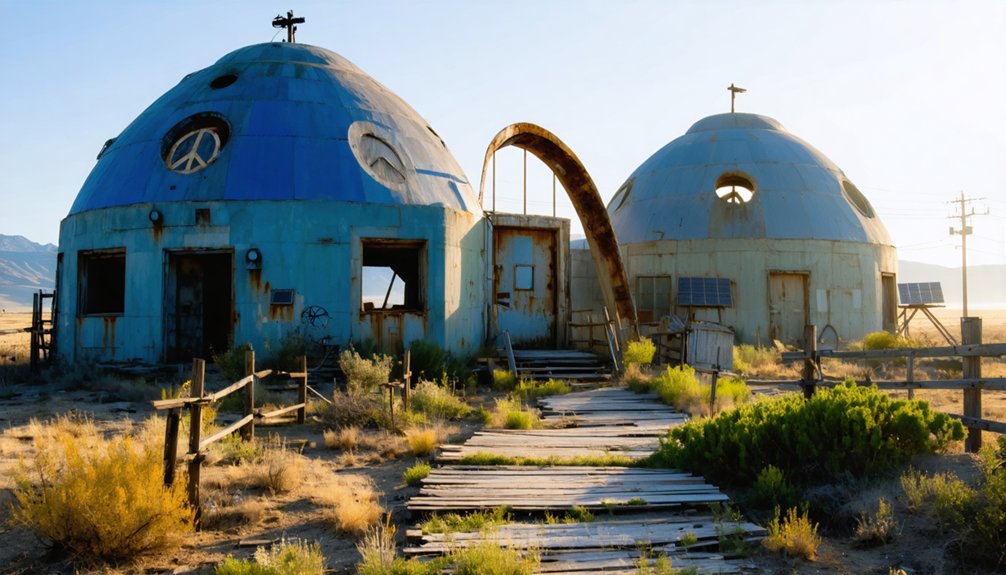
Utopian communities in the US failed due to multiple interconnected challenges you’d find in any society, but magnified by their experimental nature. Poor economic planning led to mounting debts and resource shortages, while leadership struggles created deep internal rifts. Social isolation and cultural disconnects drove high turnover rates, and many communes couldn’t balance their idealistic philosophies with practical governance needs. These systemic issues reveal deeper truths about human nature and social organization.
Key Takeaways
- Poor financial management and unsustainable economic practices led to mounting debts and failed business ventures in utopian communities.
- Leadership struggles and power concentration created internal conflicts, especially during succession periods when founders departed.
- Geographic and social isolation limited access to resources, support networks, and potential new members with needed skills.
- Ethical conflicts over labor, property rights, and resource distribution caused deep divisions within communities.
- External opposition from hostile local governments and negative public sentiment created legal and social barriers to survival.
The Economic Downfall of Communal Living
Despite the idealistic vision of self-sustaining communities, utopian enclaves across America frequently collapsed due to profound economic challenges that exposed the practical limitations of communal living. Similar to modern hyper-segregated metropolitan landscapes, these communities struggled with deep economic divides.
Poor capital management plagued these communities from their inception, with many lacking sufficient funds for basic operations or infrastructure maintenance. Brook Farm’s uninsured Phalanstery fire marked a devastating financial blow that contributed to its collapse. You’d find communes struggling with mounting debts, uninsured losses, and failed business ventures like flour mills and tanneries.
Labor challenges further compounded these issues, as communities couldn’t attract or retain skilled workers needed for economic stability. When natural disasters, epidemics, or environmental hardships struck, these financial vulnerabilities became catastrophic.
Without diversified income sources or proper market integration, most communes relied heavily on member contributions or external support. This financial fragility, combined with inadequate planning and resource constraints, ultimately led to their economic downfall.
Leadership Struggles and Power Dynamics
You’ll find that many utopian leaders, who started with noble idealistic visions, gradually succumbed to the corrupting influence of power and authority within their communities.
Jim Jones exemplified this pattern when his Peoples Temple devolved from a vision of racial equality into mass murder-suicide of over 900 followers.
The absence of clear succession plans meant that when founding leaders departed or died, these communities often descended into chaos as various factions competed for control.
During the peak of these movements in the 1840s, widespread social reform projects led to idealistic leaders breaking away to form new utopian settlements.
Even successful communes like Oneida ultimately splintered due to leadership changes gone wrong, demonstrating how critical effective succession planning was to a community’s long-term survival.
Power Corrupts Idealistic Leaders
While many utopian communities began with noble democratic ideals, their leaders often succumbed to the corrupting influence of concentrated power.
You’ll find that this corruption impact manifested as leaders prioritized personal authority over communal welfare, leading to discriminatory practices and manipulation of rules to maintain control.
The idealism conflict between founders’ original visions and their later actions created deep rifts within these communities. Thomas Morton’s Merrymount colony faced persecution after he challenged Puritan authority with his more egalitarian vision.
As power dynamics shifted from shared goals to individual interests, leaders exploited their positions, enforcing strict rules without accountability. Even in successful examples like Mormon Utah, internal dissent emerged as leadership consolidated power.
They’d often claim divine or ideological authority to justify their actions, resisting democratic governance mechanisms that might’ve limited their control.
This transformation from egalitarian principles to hierarchical structures ultimately fostered resentment, sparked internal conflicts, and accelerated the collapse of these experimental societies.
Failed Succession Planning Crisis
The leadership crisis in utopian communities extended beyond the corruption of individual leaders to expose a deeper systemic flaw: the absence of formal succession planning.
You’ll find that most communities relied heavily on their founders’ charisma without developing succession strategies for future governance.
This lack of leadership continuity created power vacuums when founders departed or died, leading to fierce competition among rival factions.
The problem was intensified by social and class divisions within communities, particularly when working-class members felt excluded from leadership roles.
The deaths of prominent colonists in 1887 at Rugby Colony triggered an exodus of residents, demonstrating how vulnerable these communities were to leadership losses.
Without established familial bonds or clear replacement protocols, these power struggles often resulted in talented members abandoning the community, further weakening its stability.
Communities that rejected traditional family structures found themselves especially vulnerable, as they’d eliminated natural succession networks that might’ve preserved institutional knowledge and leadership across generations.
Social Isolation and Community Integration Challenges
Despite their aspirations for self-sufficiency, utopian enclaves in the United States faced significant challenges stemming from social isolation and integration difficulties.
historical attempts at utopian societies often resulted in a re-evaluation of community dynamics, revealing the complexities of human relationships. Many of these societies, while innovative in their ideals, struggled to maintain cohesion in the face of external pressures and internal dissent. As a result, they frequently transformed into experimental microcosms that reflected broader societal issues rather than achieving their envisioned perfection.
You’ll find that membership challenges arose when communities attracted individuals who lacked commitment or crucial communal skills, leading to high turnover and instability. Cultural disconnects between members created internal tensions, while geographic isolation limited access to essential resources and support networks.
Communities struggled to maintain connections with surrounding towns and markets, undermining their economic sustainability. The pressure to manage administrative and managerial skills often overwhelmed idealistic community leaders who prioritized utopian visions over practical operations. The constant pressure to integrate new members while preserving social cohesion proved overwhelming. Many communities implemented trial periods to better assess potential members’ alignment with community values.
Short-term visitors and spiritual tourists further complicated community dynamics, making it difficult to establish lasting bonds. Without effective systems for conflict resolution and resource management, these utopian experiments often succumbed to internal divisions and external pressures.
Religious and Philosophical Conflicts
Religious and philosophical conflicts proved devastating to utopian communities across America, as ideological disputes repeatedly fractured these experimental societies.
Doctrinal disputes emerged as charismatic leaders clashed over spiritual legitimacy, while rigid orthodoxy and moral rigidity alienated members seeking more flexible beliefs. You’ll find that ideological clashes intensified when communities enforced strict philosophical doctrines, leading to power struggles that undermined community cohesion.
Ethical dilemmas surrounding labor, property, and resource distribution created deep divisions, while exclusionary practices based on race and religion contradicted egalitarian ideals.
The communities’ inability to balance philosophical divergence with practical governance often proved fatal. When leaders imposed punitive measures to maintain order, they sparked resentment and distrust.
Many settlements ultimately collapsed when ideological purity tests drove away members unwilling to conform.
Resource Management and Infrastructure Problems

The foundations of many American utopian communities crumbled due to their inability to establish sustainable food production systems, as evidenced by the failures at Fruitlands and Brook Farm.
You’ll find that these settlements often lacked efficient resource distribution networks, leading to waste and internal conflicts over shared materials and food stores.
The absence of proper infrastructure planning, from inadequate housing to poor sanitation facilities, created ongoing challenges that ultimately contributed to the dissolution of numerous utopian experiments.
Limited Food Production Systems
While many utopian communities in America envisioned agricultural self-sufficiency as a cornerstone of their idealistic societies, their limited food production systems often proved to be their undoing.
You’ll find that most residents lacked basic farming knowledge, making it impossible to implement effective crop rotation or sustainable practices. Their struggle was compounded by inadequate infrastructure, with primitive irrigation systems and storage facilities that couldn’t support long-term food security.
The communities faced a perfect storm of challenges: inexperienced labor, poor soil conditions, and insufficient technological support. Brook Farm failed within five years largely due to their farming inexperience.
You can trace their decline through failed livestock management, where thousands of sheep perished due to mishandling, and chronically low crop yields that couldn’t sustain their populations.
Without mechanization or proper preservation methods, these communities couldn’t overcome the fundamental barriers to agricultural success.
Inefficient Resource Distribution Networks
Beyond agricultural challenges, inefficient resource distribution networks proved to be a persistent obstacle for utopian communities throughout America.
You’ll find that fragmented supply chains and poor organizational coordination created severe distribution bottlenecks, making it difficult to meet basic community needs. Without effective communication systems, communities struggled to manage timely provisioning and sharing of goods among members.
The problems extended beyond mere logistics.
Poor resource allocation stemmed from inadequate governance structures and unclear decision-making frameworks. You’d see how the lack of defined ownership and managerial responsibility led to chronic mismanagement of communal resources.
When communities attempted to coordinate their internal economies with external markets, they faced significant constraints that limited their ability to acquire and replenish essential supplies, ultimately contributing to their decline.
Poor Infrastructure Planning
Despite ambitious visions for self-sustaining communities, utopian enclaves across America suffered from severe infrastructure deficiencies that undermined their long-term viability.
You’ll find that infrastructure design failures manifested in multiple ways: poorly planned road networks created connectivity issues and community isolation, while inadequate water and sanitation systems threatened public health.
Many settlements struggled with energy shortages due to planning inadequacies in power distribution networks.
Resource mismanagement compounded these problems, as communities often lacked expertise in maintaining complex infrastructure systems.
You can see this pattern in places like Soul City, where roads led nowhere, and Pullman, where despite initial investments of $6 million, maintenance challenges eventually overwhelmed the community.
Without proper technical knowledge or sustainable funding, these experimental societies couldn’t support the basic systems needed for long-term survival.
External Opposition and Societal Pressures

Throughout American history, utopian communities have faced persistent opposition from external forces that ultimately threatened their survival and sustainability.
You’ll find that these communities encountered external resistance on multiple fronts – from hostile local governments imposing restrictive regulations to neighboring populations who viewed their radical ideals with suspicion and fear.
Cultural misunderstandings often led to social isolation and economic barriers, as mainstream society rejected their alternative lifestyles and communal practices.
Legal challenges over land ownership and zoning regulations further strained their resources, while negative media coverage damaged their public image and recruitment efforts.
When law enforcement withdrew support from struggling communities, crime and disorder frequently followed.
The combined pressure of legal opposition, social prejudice, and economic isolation ultimately forced many utopian experiments to abandon their idealistic visions.
The Human Element: Reality vs. Idealism
When idealistic visions collided with human nature, America’s utopian communities repeatedly discovered that their lofty social theories couldn’t overcome basic psychological and practical realities.
The rigid rules at Brook Farm, Fruitlands’ extreme asceticism, and New Australia’s strict social codes all failed to account for human variability, leading to widespread dissatisfaction and eventual collapse.
Rigid social structures and extreme lifestyle demands doom utopian communities that fail to embrace human diversity and individual differences.
Leaders like Robert Owen and William Lane imposed their ideological rigidity without considering the natural diversity of human needs and desires.
At Brook Farm, residents who lacked technical skills focused on writing new constitutions rather than solving practical problems.
The Owenite settlements crumbled when industrious members grew resentful of supporting idle ones.
These experiments revealed a fundamental truth: utopian visions that ignore human nature’s complexity are destined to fail.
Frequently Asked Questions
Did Any Successful Utopian Communities Survive Into the Modern Era?
You’ll find that most utopian communities failed, but religious ones like Sabbathday Lake Shakers endured, adapting their socioeconomic structure and communal living practices to modern times through schools and charitable work.
How Did Children’s Education Work Within These Utopian Communities?
You’d find a holistic education philosophy combining intellectual, physical, and moral training. The curriculum development integrated practical skills, academic subjects, and community values through hands-on learning and cooperative instruction.
What Role Did Women Play in Leadership Positions?
You’ll find women held significant leadership roles, especially in Shaker communities where female leadership shaped community dynamics through spiritual guidance, property management, and governance – challenging mainstream society’s restrictive gender norms.
How Did Utopian Communities Handle Medical Care and Health Emergencies?
You’ll find utopian communities handled healthcare through shared responsibility – they grew medicinal herbs, provided free community health services, and coordinated emergency responses during crises like epidemics through collective quarantine and care.
What Technologies or Innovations Emerged From These Experimental Communities?
You’ll find these communities pioneered sustainable agriculture practices, communal living arrangements, and eco-friendly architectural designs like geodesic domes, recycled building materials, and cooperative resource management systems that influenced modern intentional communities.
References
- https://www.mentalfloss.com/history/failed-utopias
- https://fee.org/articles/the-dark-side-of-paradise-a-brief-history-of-americas-utopian-experiments-in-communal-living/
- https://www.yesmagazine.org/health-happiness/2022/06/01/american-communes-failed-experiment
- https://tools4literature.weebly.com/utopia-failures.html
- https://www.vice.com/en/article/failed-utopias-throughout-history-v25n1/
- https://constitutingamerica.org/90day-aer-americas-founding-knowledge-of-failed-utopian-ideologies-establishing-a-us-constitution-based-on-tradition-and-natural-rights-to-prevent-tyranny-guest-essayist-joerg-knipprath/
- https://www.nps.gov/articles/utopias-in-america.htm
- https://digitalcommons.providence.edu/cgi/viewcontent.cgi?article=1015&context=student_scholarship
- https://www.brookings.edu/articles/trend-1-separate-and-unequal-neighborhoods-are-sustaining-racial-and-economic-injustice-in-the-us/
- https://aeon.co/essays/like-start-ups-most-intentional-communities-fail-why