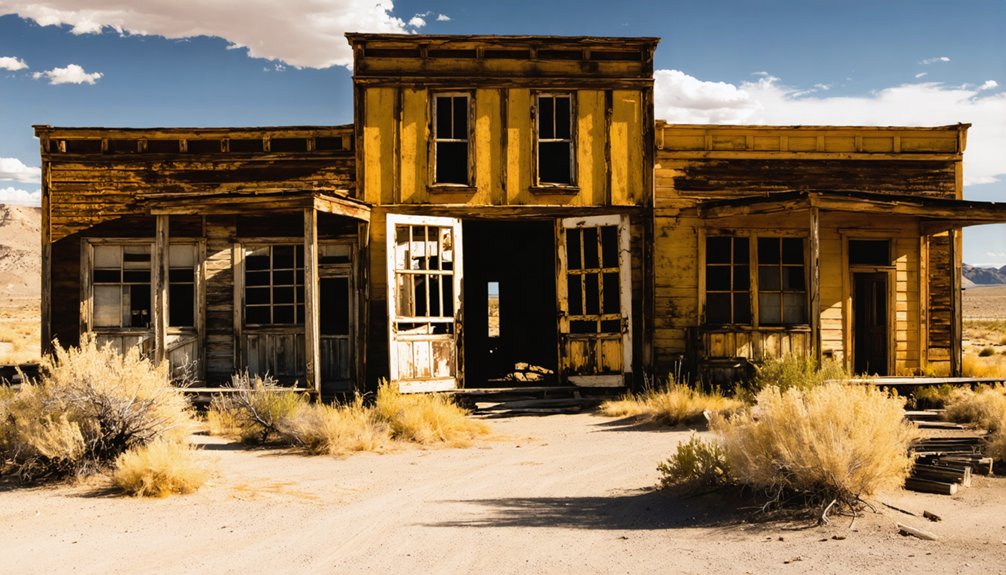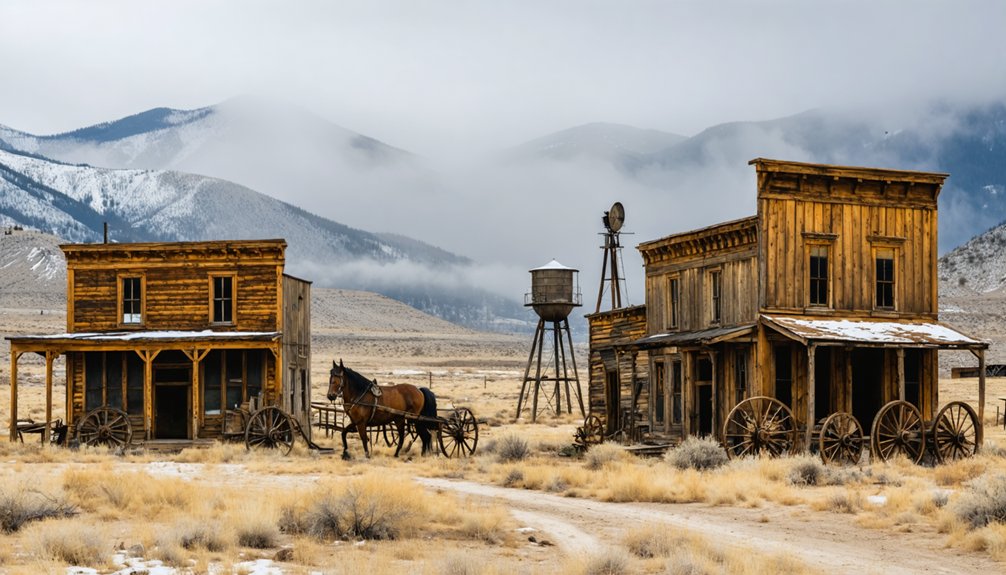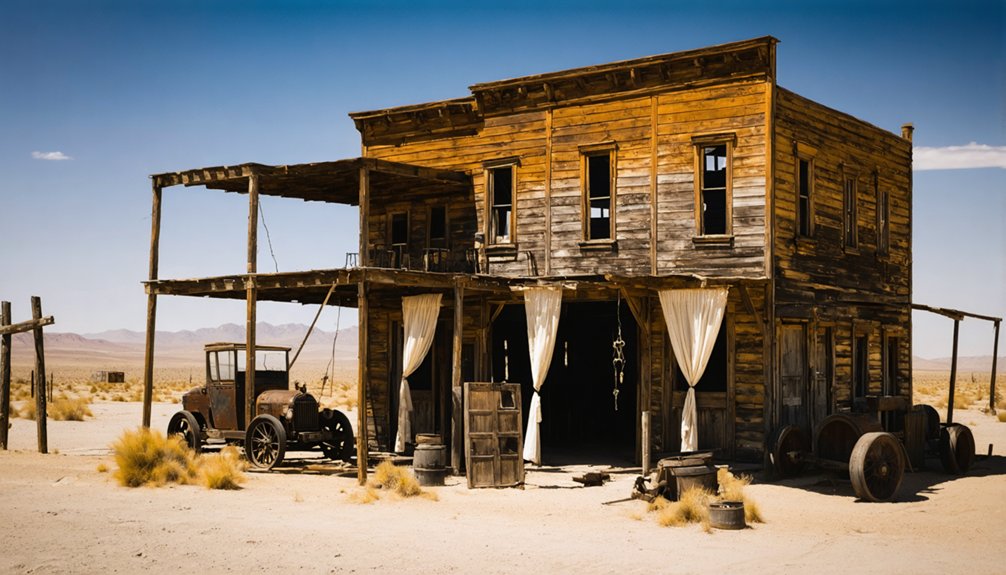
Wild West ghost towns vanished due to multiple interconnected factors you’d recognize from modern economic shifts. When precious metal deposits ran dry, mining communities lost their economic base and population. Railroad bypasses cut off crucial transportation links, while natural disasters like fires and floods devastated vulnerable towns. Technological advances, particularly diesel engines replacing steam locomotives, eliminated many railroad stops. The full story of these abandoned towns reveals fascinating layers of American frontier life.
Key Takeaways
- Mining towns collapsed after precious metal deposits were depleted, leaving no economic reason for residents to stay.
- Railroad bypasses and later interstate highways redirected traffic, cutting off vital transportation lifelines for many towns.
- Natural disasters like floods, fires, and landslides devastated vulnerable communities with limited resources to rebuild.
- Technological advances, especially diesel engines replacing steam locomotives, eliminated many railroad service towns.
- Automation in mining and farming reduced labor needs, triggering mass exodus from rural communities to urban centers.
The Rise and Fall of Mining Economies
While precious metal discoveries sparked explosive growth in Western mining towns, their economies proved remarkably fragile and short-lived.
You’d see thousands of miners rush in when news spread of gold, silver, or copper strikes, creating instant boomtowns where profits could reach $40 per ton of ore. But these mining booms rarely lasted long. Butte, Montana exemplified this pattern, as it initially stagnated by 1870s after its gold discovery before finding new life through copper mining.
The harsh reality was that once miners exhausted the easy-to-reach deposits, economic collapses followed swiftly. By the 1870s, major silver deposits were generating up to $25 million annually for U.S. mining operations.
Even the most promising strikes typically sustained towns for only months or a few years. When ore quality declined or extraction costs surpassed profits, miners would quickly abandon these settlements for the next opportunity.
Though some towns managed to diversify into ranching or other industries, most couldn’t survive the inevitable bust, transforming bustling communities into empty ghost towns.
Transportation Networks and Town Survival
Although gold and silver strikes initially attracted settlers to Western towns, transportation networks ultimately determined their long-term survival.
You’ll find that towns bypassed by railroads faced swift economic decline as they lost crucial access to affordable goods and services. Communities lucky enough to secure rail connections thrived, attracting farmers and merchants who benefited from lower shipping costs and steady customer traffic.
The pattern repeated itself when the interstate highway system emerged in the 1950s. Towns once bustling along routes like Route 66 became ghost towns after new highways redirected traffic elsewhere.
The fate of places like Glenrio demonstrates how transportation infrastructure shapes community survival – when travelers stop coming, businesses close and populations dwindle. Similar to mining communities that collapsed when their resources were depleted, these towns couldn’t sustain themselves once their economic lifelines were cut. Freeman Junction suffered this fate when its stage station burned, eliminating its role as a crucial desert waypoint.
Today, these abandoned towns serve as stark reminders of how shifting transportation patterns can seal a settlement’s fate.
Nature’s Deadly Impact on Western Communities
Natural disasters proved to be merciless forces in shaping the destiny of Western frontier towns.
You’ll find that flooding disasters wreaked particular havoc, as demonstrated when the North Canadian River wiped out Burke City, Oklahoma, while repeated floods forced Frazer’s residents to relocate and rename their town Altus.
Landslide devastation compounded these challenges, especially in mining communities where deforestation and excavation had destabilized the surrounding terrain.
Fire posed an equally formidable threat to your typical Western settlement. A devastating example occurred in Hinckley, Minnesota, where prolonged drought conditions led to one of the deadliest fires in American history.
With wooden buildings and limited firefighting capabilities, towns like Eddy, Oklahoma suffered repeated blazes.
When you factor in the harsh climate – from severe droughts to violent storms – you’ll understand why many communities simply couldn’t recover from nature’s repeated assaults.
The creation of man-made lakes and reservoirs forced numerous towns to completely abandon their original locations.
Political and Cultural Forces Behind Abandonment
Beyond environmental catastrophes, political decisions and cultural shifts played decisive roles in the abandonment of Western towns.
You’ll find that political neglect often manifested through infrastructure choices, as railroad routes deliberately bypassed certain settlements and interstate highways diverted traffic from established communities. Government policies on land use, taxation, and business regulation made many local economies unsustainable.
Government decisions shaped ghost towns’ fates through strategic infrastructure planning and policies that strangled local economies.
Cultural displacement accelerated as changing attitudes drew people toward urban centers, seeking better education, healthcare, and industrial jobs. The inability to sustain primary industries led to widespread economic collapse. The historic town of Rock Bluffs exemplifies this pattern, as the community was decimated when the railroad bypassed it completely.
You’ll see how the decline of frontier lifestyles, combined with forced relocations and federal projects like dam construction, emptied entire communities. The withdrawal of essential services – post offices, schools, and government support – further weakened towns’ resilience.
Without political advocacy or community organizations to fight back, many settlements simply faded into history.
Technological Progress and Town Obsolescence
You’ll find that the shift from steam to diesel locomotives dealt a devastating blow to many Wild West towns that had flourished as necessary pit stops for steam engines needing water and repairs.
In parallel, the rise of automated farming equipment and hybrid seeds meant fewer workers were needed to cultivate larger plots of land across the Great Plains, triggering widespread rural depopulation. After the Great Depression in the 1930s, many farmers lost their land due to mounting debt issues.
These technological advances fundamentally reshaped the Western landscape, as towns that once thrived on railroad traffic and agricultural labor found themselves stripped of their essential economic purposes. The depletion of natural resources in many areas further accelerated the abandonment of once-bustling communities.
Steam To Diesel Impact
While the shift from steam to diesel locomotives revolutionized American railroads in the mid-20th century, it left a devastating impact on numerous Western towns that had built their economies around steam-powered rail services.
You’ll find that the diesel changeover, spanning roughly 40 years, systematically eliminated the need for frequent refueling and maintenance stops that once sustained these communities.
Towns like Newburg, Missouri, which thrived as essential midway points for steam locomotives, lost their economic purpose when diesel engines enabled longer, non-stop runs.
The steam legacy lives on in abandoned repair shops and maintenance facilities, stark reminders of once-bustling railroad communities.
As diesels required less manpower and fewer service points, many Western towns saw their workforce vanish, ultimately becoming the ghost towns you can explore today.
Automation Changed Labor Needs
As technological automation swept through Western industries in the mid-20th century, countless labor-intensive towns faced rapid economic collapse.
Automation impacts hit hardest in communities dependent on mining, shipping, and manufacturing, where mechanized processes drastically reduced workforce needs. You’ll find that these changes fundamentally altered the labor market, forcing workers to migrate elsewhere for opportunities.
- Mining operations replaced human workers with automated drilling and transport systems.
- Ports transformed from bustling manual cargo centers to containerized facilities requiring minimal labor.
- Railroad towns lost relevance as automated logistics hubs centralized operations.
The ripple effects devastated local economies.
When primary employers downsized their workforce through automation, supporting businesses couldn’t survive.
This triggered a cascade of closures, transforming once-thriving communities into ghost towns as families sought work in more economically diverse areas.
The Human Stories Behind Ghost Town Migration
Behind every abandoned storefront and weathered mining shaft lies a deeply human story of hope, desperation, and survival.
You’ll find personal stories of settlers who risked everything, fleeing poverty and prejudice back east for the promise of mineral wealth or fertile farmland. These migration patterns reveal a population constantly in motion, chasing opportunities across the frontier.
The human toll was steep. You’d see mainly male communities living in harsh conditions, facing bandits, starvation, and extreme weather.
When resources ran dry or disaster struck – whether through floods, droughts, or market crashes – entire communities would pick up and move again. Their transient nature meant few put down lasting roots, making it easier to abandon towns once prospects dimmed.
Each empty building represents someone’s abandoned dream of striking it rich.
Modern Tourism and Historical Preservation
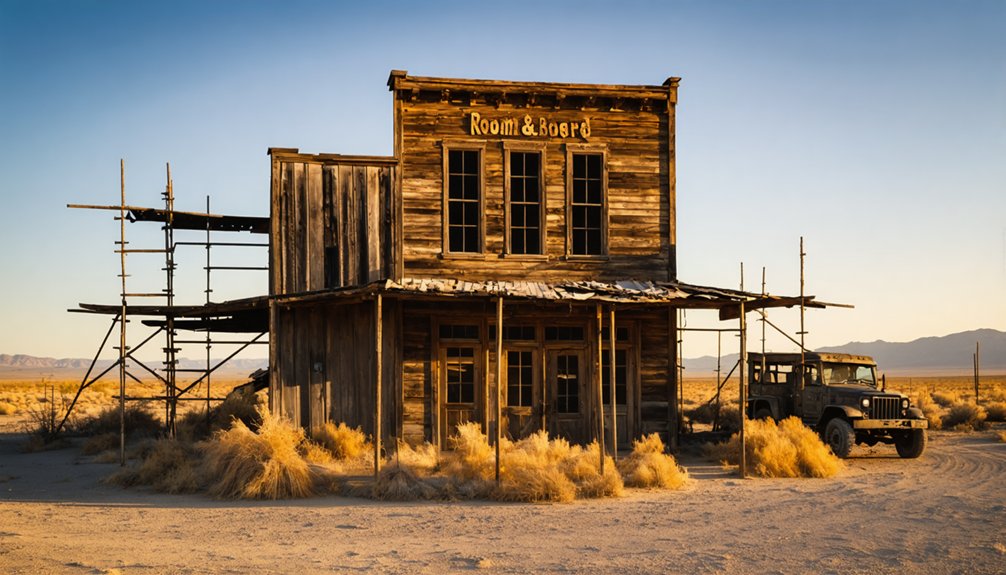
When you visit ghost towns today, you’ll find many have been transformed into living history museums where preserved buildings, artifacts, and guided tours tell the story of the American frontier.
These open-air museums protect irreplaceable historical structures through careful restoration practices and sustainable tourism revenue, as demonstrated by successful preservation efforts in Bodie, California and Jerome, Arizona.
Your tourism dollars directly contribute to saving Western heritage by funding ongoing maintenance, educational programs, and preservation projects that keep these historic sites intact for future generations.
Ghost Towns as Museums
The preservation of Wild West ghost towns as museums represents a delicate balance between maintaining historical authenticity and creating engaging tourist destinations. Through “arrested decay” preservation techniques, you’ll find carefully maintained structures that tell stories of America’s frontier past while providing living history experiences.
These sites serve as windows into the economic cycles, social dynamics, and industrial changes that shaped the American West.
- You can explore original mining buildings and authentic furnishings in towns like Garnet, Montana.
- You’ll witness historical reenactments and guided tours that bring frontier life to vivid reality.
- You’re supporting local economies through heritage tourism that creates jobs and attracts preservation funding.
Ghost town preservation efforts, though challenging and costly, continue to protect these invaluable pieces of Western heritage while offering you immersive educational experiences that connect past to present.
Tourism Saves Western Heritage
Modern tourism has emerged as an essential lifeline for preserving America’s Wild West ghost towns, transforming abandoned relics into sustainable heritage sites.
This trend has also spurred interest in other historical locations, such as abandoned villages along the coastline that tell stories of a bygone era. Tourists are drawn to the mystery and beauty of these desolate places, eager to explore their remnants and uncover their past. As a result, these sites are seeing renewed investment and attention, ensuring their stories are not lost to time.
You’ll find successful examples like Jerome, Arizona, where heritage conservation efforts have revived a once-deserted mining town into a thriving cultural destination.
Sustainable tourism creates a crucial economic engine that funds preservation while protecting historical integrity.
When you visit these sites, you’re supporting local economies through guided tours, museum admissions, and authentic crafts. This tourism model enables communities to maintain their heritage without compromising authenticity.
Through careful management and collaboration between preservation societies and eco-conscious entrepreneurs, you’re able to experience living history while ensuring these treasured sites endure for future generations.
Smart regulations and educational programs help balance accessibility with conservation needs.
Frequently Asked Questions
What Happened to the Furniture and Belongings Left in Ghost Towns?
You’ll find most furniture decayed from harsh weather exposure, while locals and treasure hunters removed valuable belongings. Some items were preserved in museums, but natural deterioration claimed the rest.
Did Any Ghost Towns Successfully Transform Into Different Types of Communities?
You’ll find successful revitalization efforts in places like Jerome, Arizona, which transformed from mining to arts, and Calico, California, where community adaptation created thriving tourist destinations from abandoned settlements.
How Did Children’s Education Continue as Towns Began Declining?
You’ll find children’s education persisted through community support and resource sharing, with consolidated schools, multi-grade classrooms, religious institutions, and traveling teachers adapting to serve students across wider rural areas.
Were There Attempts to Save Dying Towns Through Alternative Industries?
Despite 90% of attempts failing, you’ll find many ghost towns tried economic diversification through alternative livelihoods like glassblowing, tourism, and manufacturing, but their remote locations and limited resources usually doomed these efforts.
Did Ghost Town Residents Maintain Contact After Dispersing to Different Locations?
You’ll find residents kept ties through telephone lines, telegrams, and summer reunions after relocating. Despite limited communication methods, family networks and social bonds persisted through visits and shared histories.
References
- https://www.geotab.com/ghost-towns/
- https://en.wikipedia.org/wiki/Ghost_town
- https://www.atlasobscura.com/itineraries/the-wildest-west
- https://dornsife.usc.edu/magazine/echoes-in-the-dust/
- https://www.britannica.com/topic/ghost-town
- https://www.visitutah.com/things-to-do/history-culture/ghost-towns
- https://freepages.history.rootsweb.com/~gtusa/definitions.pdf
- https://www.youtube.com/watch?v=yeTVfoQxqJc
- https://wildwestcity.com/old-west-ghost-towns/
- https://hobblecreek.us/blog/entry/mining-towns-of-the-old-west