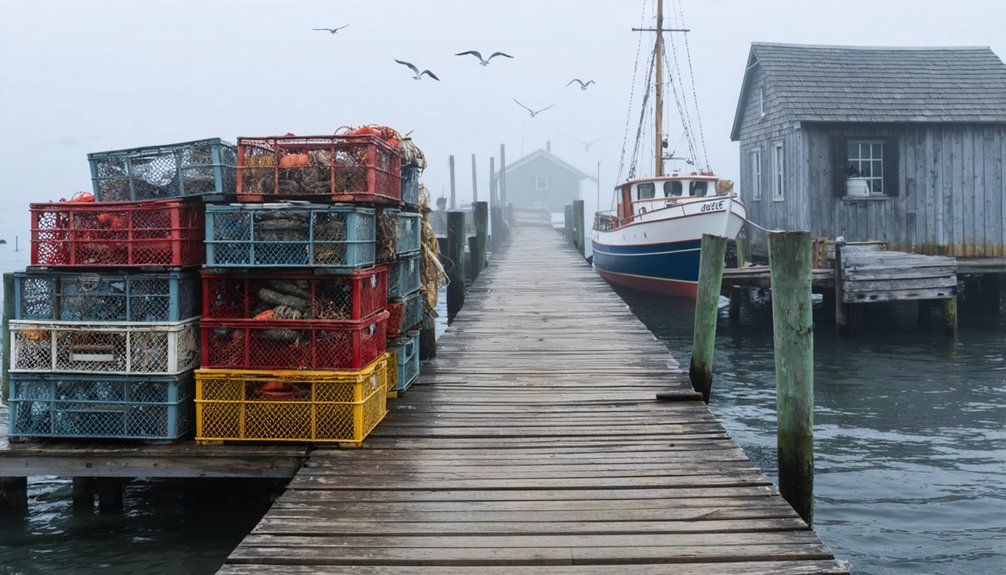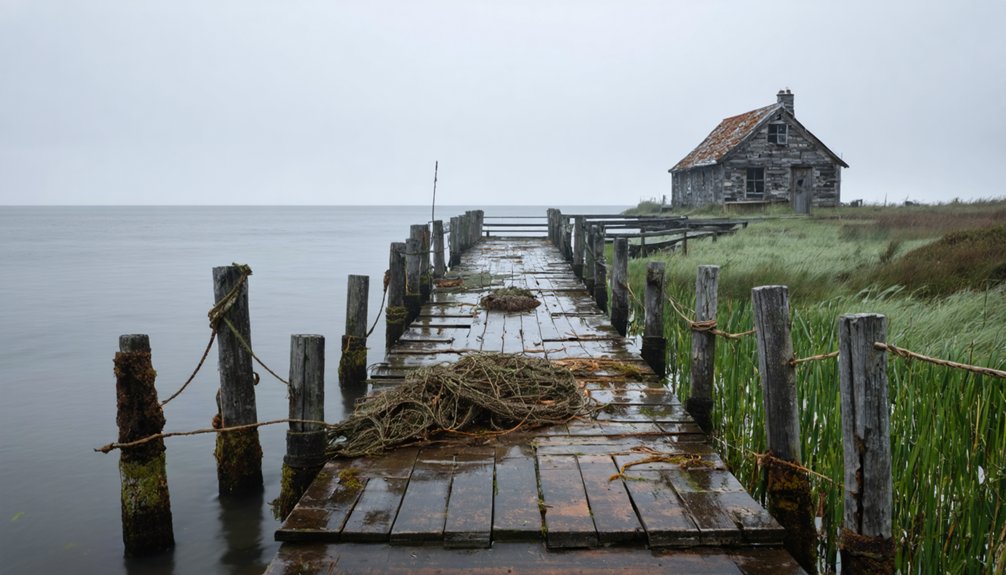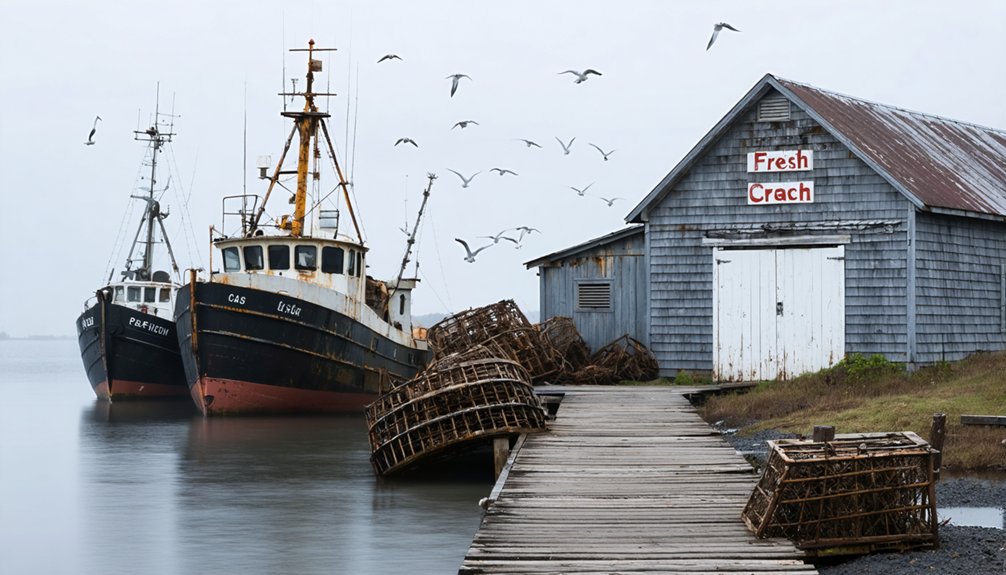
You’ll find abandoned seaside fishing communities throughout America’s coasts due to a devastating convergence of factors. The commercial fishing industry has suffered severe economic blows, with landing revenues dropping 16% to $5.9 billion in 2022 alone. Environmental challenges like habitat destruction, climate change-driven fish migration, and widespread marine pollution have crippled local fisheries. These pressures, combined with collapsing social structures in coastal towns, have forced many fishing communities to become modern-day ghost towns. The full story reveals an even more complex web of interconnected challenges.
Key Takeaways
- Declining fishing revenues and job losses force residents to relocate, with Alaska alone losing 38,000 jobs in recent years.
- Environmental degradation, including wetland loss and dead zones, makes traditional fishing grounds increasingly unproductive.
- Climate change drives fish populations to new locations, making traditional fishing areas economically unviable for local communities.
- Ghost gear and habitat destruction reduce local fish stocks by up to 30%, making fishing operations financially unsustainable.
- Social fabric deteriorates as community events disappear and key community leaders relocate, leading to population decline.
The Economic Collapse of Traditional Fishing Industries
While the U.S. commercial fishing industry once generated substantial economic activity, recent years have marked a devastating decline across multiple metrics.
You’ll find profitability decline evident in the 16% drop in landing revenues to $5.9 billion in 2022, while Alaska’s seafood sector alone lost $1.8 billion between 2022-2023.
The fishing sector still maintains 2.3 million jobs nationwide despite ongoing challenges.
The industry’s economic vulnerability stems from multiple pressures: rising operational costs, strengthening dollar, and trade barriers have squeezed margins, while inflation has weakened consumer demand for seafood.
You’re witnessing a cascading effect, with over 38,000 jobs lost nationwide in Alaska’s sector alone, reducing tax revenues by $191 million.
The rippling economic impact has devastated fishing communities, with Alaska’s massive job losses draining vital tax revenues needed for local services.
Traditional bottom trawling practices, which historically accounted for a significant portion of U.S. commercial catch, have been increasingly restricted due to environmental concerns.
The lack of revenue insurance mechanisms, unlike agricultural programs, leaves fishing communities especially exposed to market volatility and economic uncertainty.
Environmental Challenges Driving Community Abandonment
As coastal ecosystems face unprecedented degradation, fishing communities confront an intensifying array of environmental challenges that accelerate their abandonment.
You’ll find the devastation manifests through multiple, interconnected pathways that destroy both livelihoods and traditions:
- Severe habitat degradation has eliminated over 110 million acres of coastal wetlands since the 1600s, decimating fish nurseries and leaving communities exposed to storm damage. Studies have found that microplastic contamination now affects virtually all commercial seafood species.
- Ghost gear wreaks havoc on marine ecosystems, reducing local fish stocks by up to 30% while costing fisheries hundreds of thousands in annual losses. Local fishing operations lose an estimated 10% of their gear each year, contributing to the mounting economic pressure.
- Pollution effects from nutrient runoff create dead zones in over 60% of coastal waters, making fishing grounds increasingly unproductive.
- The destruction of natural storm barriers like wetlands and seagrass beds leaves these communities vulnerable to extreme weather events, forcing many to abandon their ancestral waters.
Climate Change’s Role in Fishery Decline
Because ocean temperatures continue rising at unprecedented rates, you’ll find dramatic shifts occurring in marine ecosystems that fundamentally alter U.S. fishing communities‘ economic foundations.
Climate impacts force fish to migrate northward or into deeper waters, devastating traditional fishing grounds that once sustained thriving coastal towns. You’re witnessing the collapse of generations-old fishing practices as warming waters reduce fish stock productivity and drive species beyond local boats’ reach.
The evidence is stark: marine heatwaves have increased by over 50% in three decades, while oxygen levels have plummeted up to 50% in some areas since 1960. The ocean has absorbed 93% of excess heat from greenhouse gas emissions since the 1970s, accelerating the crisis for coastal communities.
When you factor in ocean acidification‘s assault on shellfish populations and the disruption of seasonal migration patterns, you’ll understand why many fishing communities can’t sustain their traditional way of life.
The Social Fabric Unraveling in Coastal Towns
Once thriving coastal fishing communities face devastating social disintegration that parallels their economic decline.
You’ll witness the gradual erosion of social networks as fishery failures force community members to seek opportunities elsewhere, leaving behind fragmented neighborhoods and weakened support systems.
The breakdown of these maritime communities manifests in four critical ways:
- Traditional community events like fish fries and festivals disappear, severing longstanding cultural bonds.
- Key leaders and active volunteers relocate, diminishing local advocacy power.
- Social support networks collapse, increasing isolation among remaining residents.
- Reduced population leads to fewer volunteers for community organizations.
In places like Fort Ord Dunes, California, the military base closure led to a staggering 70% drop in tourism within a decade, further accelerating community abandonment.
The devastating Deepwater Horizon spill created a two-year fishing ban that crippled many Louisiana coastal communities, forcing families to abandon generations-old fishing traditions.
You’re seeing the very fabric of these communities unravel as the combination of economic pressure and social disconnection creates a downward spiral that’s difficult to reverse, fundamentally altering these once-vibrant coastal towns.
Ghost Gear and Marine Habitat Destruction
While abandoned fishing communities slowly fade into history, their legacy of derelict fishing gear continues to wreak havoc on marine ecosystems.
You’ll find staggering numbers: 160,000 lost crab traps annually in Chesapeake Bay, 250,000 in the Gulf of Mexico, and 7,000 kilometers of abandoned gillnets along Atlantic shores.
This ghost gear crushes coral reefs, smothers crucial underwater vegetation, and disrupts natural sediment patterns. Marine animals suffer devastating consequences, with an estimated 650,000 animals dying each year from entanglement in these abandoned nets.
You’re witnessing a vicious cycle of habitat loss and economic decline. When ghost gear kills marine life and damages ecosystems, it reduces fishing yields and devastates local economies.
While ecosystems are suffering, the beauty of nature can still provide solace, especially with the beautiful fall foliage in Delaware. The vibrant colors remind us of the importance of preserving our environment for future generations. Communities often gather to appreciate this seasonal splendor, fostering a sense of connection and shared stewardship.
In the Chesapeake Bay alone, removing derelict traps increased crab harvest by 13,504 tons, worth $21.3 million.
Illegal fishing practices worsen the crisis, as operators deliberately abandon gear to hide their activities.
Frequently Asked Questions
What Government Programs Exist to Prevent Fishing Community Abandonment?
You’ll find government support through TRAP’s community grants, Fishing for Energy’s disposal incentives, U.S. State Department’s international funding, and Fish Passage Program’s habitat restoration – all promoting sustainable fisheries and preventing abandonment.
How Do Abandoned Fishing Communities Impact Nearby Tourism-Dependent Towns?
You’ll find that abandoned fishing communities trigger economic decline in nearby tourist towns, reducing tourism opportunities through deteriorating infrastructure, diminished cultural attractions, and damaged coastal environments that once drew visitors.
Can Abandoned Fishing Villages Be Successfully Revitalized Through Alternative Industries?
You’ll find that abandoned fishing villages can thrive again through sustainable tourism and local entrepreneurship, but you’ll need strong community buy-in, infrastructure investment, and environmental stewardship to guarantee long-term success.
What Happens to Fishing Permits When Communities Are Abandoned?
When the tide turns, your fishing permits don’t vanish – they’ll either face revocation under use-it-or-lose-it policies, become available for permit redistribution, or await community reinvestment through regulatory transfer programs.
How Do Insurance Companies Handle Properties in Declining Fishing Communities?
You’ll find insurers withdrawing coverage, denying insurance claims, and conducting strict property assessments in declining fishing communities. They’re either canceling policies outright or shifting you to limited state-backed insurance plans.
References
- http://toolkit.climate.gov/fisheries-and-coastal-communities
- https://wwfwhales.org/news-stories/stop-ghost-gear-wwf-report
- https://earth.org/up-to-a-million-tons-of-ghost-fishing-nets-enter-the-oceans-each-year-study/
- https://www.fisheries.noaa.gov/feature-story/dungeness-crab-fishing-industry-response-climate-shock
- https://oceanconservancy.org/wp-content/uploads/2022/06/Ghostfishing_DFG.pdf
- https://www.coastal.ca.gov/publiced/marinedebris.html
- https://www.smithsonianmag.com/science-nature/ghost-gear-or-abandoned-fishing-equipment-is-haunting-the-oceans-heres-how-conservationists-are-fighting-back-180987605/
- https://www.worldwildlife.org/our-work/oceans/stopping-ghost-gear/
- https://www.fisheries.noaa.gov/feature-story/economic-snapshot-shows-alaska-seafood-industry-suffered-18-billion-loss-2022-2023
- https://www.tomorrowsfish.org/crf-news/unpacking-noaa-fisheries-2022-economic-report-on-us-fisheries