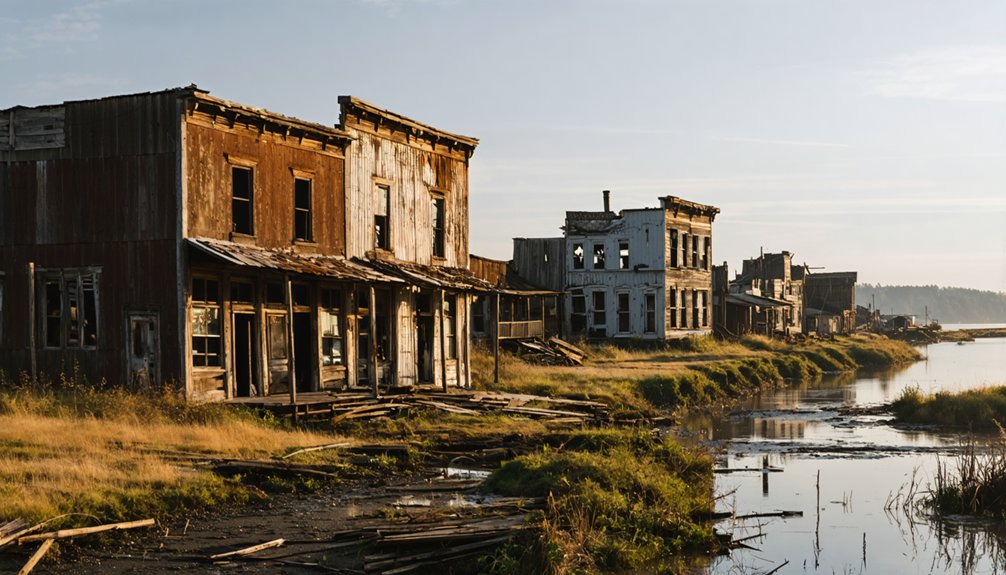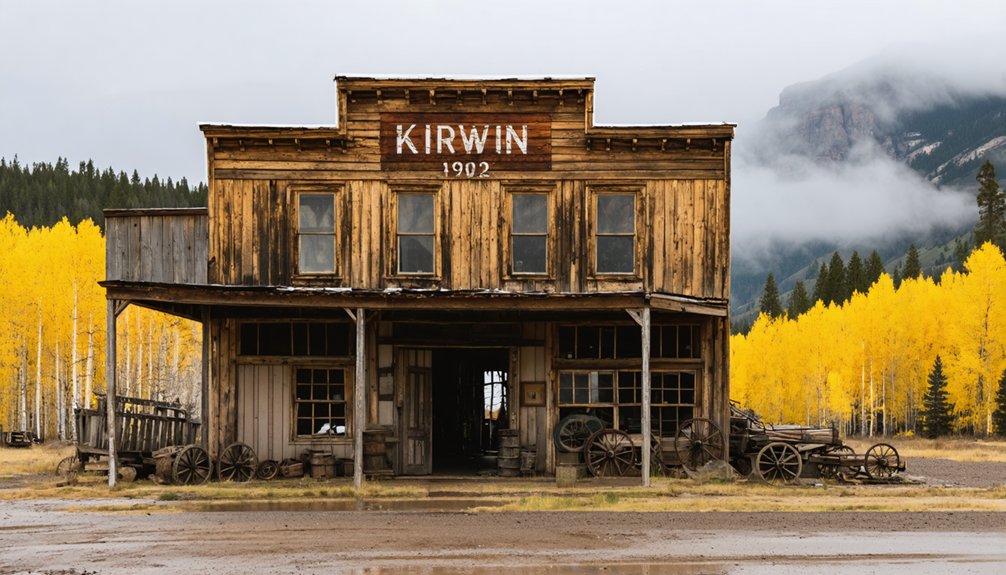
When you explore abandoned towns, you’ll discover haunting layers of human tragedy. These places tell stories of economic collapse through shuttered factories, war’s violent destruction in preserved ruins like Belchite, and nature’s devastating impact from toxic wastewater to unstoppable fires. Social decay compounds their eerie atmosphere as poverty drives residents away, leaving behind crumbling buildings and fractured communities. Each empty street and decaying structure holds untold mysteries waiting to reveal their darkest secrets.
Key Takeaways
- Sudden traumatic events like war massacres and forced evacuations leave lasting emotional imprints on abandoned communities and their ruins.
- Environmental disasters create haunting landscapes where nature reclaims human spaces, creating an unsettling atmosphere of decay.
- Social collapse and economic devastation lead to fractured communities, leaving behind empty buildings that become focal points for dark stories.
- Tragic histories of mass casualties and community displacement often spawn supernatural legends and ghostly folklore.
- Underground fires, toxic pollution, and other environmental hazards transform once-thriving towns into dangerous, forbidden zones with mysterious pasts.
The Silent Echoes of Economic Collapse
When manufacturing jobs began disappearing across America’s small towns in the late 20th century, they left behind more than empty factories – they triggered a cascade of economic devastation that continues to reshape communities today.
You’ll find the evidence of this economic decline in the 1.8 million jobs lost since 2000 in left-behind counties, where workers were forced to migrate toward stronger job markets. As populations dwindled, local tax revenues plummeted, crippling essential services like schools and healthcare.
The ripple effects created a downward spiral: closed businesses, crumbling infrastructure, and abandoned homes. Towns like Niagara Falls exemplify this decline, with its population falling from 102,000 residents in the 1960s to just 48,000 by 2020. The disappearance of local savings banks through consolidation further weakened these struggling communities.
Each empty storefront and boarded window tells a story of decline, marking communities caught in an endless cycle of economic decay.
What’s most striking is how this pattern has spread beyond traditional industrial towns – even once-thriving suburbs and Sunbelt boomtowns now face similar fates, victims of shifting economic tides and housing market collapses.
Scars of War and Forced Abandonment
While economic decline leaves towns to wither slowly, the devastation of war creates ghost towns in sudden, violent bursts that permanently scar both landscape and memory.
The history of ghost towns in Washington reveals the impact of booms and busts that characterize the region’s development. Once vibrant communities, these towns tell stories of prosperity turned to desolation, as resources were depleted or industries shifted. Today, they serve as haunting reminders of moments frozen in time, inviting exploration and reflection on what was once there.
You’ll find these haunting remnants across the world, from Belchite, Spain, where a 15-day battle in 1937 left 5,000 dead, to Oradour-sur-Glane, France, where Nazi forces massacred 642 residents in 1944. The site now stands as a preserved memorial with personal belongings still scattered throughout the ruins.
Military evacuation has also emptied communities like Imber, England, where residents were forced out for army training in 1943. General Franco’s regime forbade any restoration efforts in Belchite, ensuring its ruins would stand as testament to the violence.
These places remain frozen in time, with war remnants scattered among crumbling buildings. Rather than rebuild, some sites are intentionally preserved as memorials, their ruins standing as stark reminders of conflict’s human cost.
You’re witnessing not just abandoned structures, but shattered communities whose stories echo through empty streets.
Nature’s Wrath: Environmental Devastation
Unlike war’s sudden devastation, nature’s destructive forces create ghost towns through both gradual erosion and catastrophic events.
You’ll find evidence of this in places like Burrwood, Louisiana, where rising seas slowly consumed the coastline, and Craco, Italy, where devastating landslides forced immediate evacuation.
Environmental pollution has transformed once-thriving communities into toxic wastelands. The Mount Tarawera volcanic eruption completely destroyed the town of Taywroa in 1886, leaving only remnants frozen in time.
In Pennsylvania, toxic smoke plumes rise continuously from Centralia’s endless underground fire that has burned since 1962, while Love Canal’s chemical contamination left an indelible mark on environmental history.
Climate change accelerates these abandonments, as witnessed in Vunidogoloa, Fiji, where entire communities fled inland from rising waters.
From Chernobyl’s radioactive exclusion zone to Picher’s lead-contaminated soil, you’re witnessing how nature reclaims spaces where human activity has disrupted ecological balance, creating haunting reminders of environmental vulnerability.
When Communities Crumble: Social Decay
The most insidious force behind town abandonment isn’t environmental catastrophe – it’s social decay.
You’ll find this devastating process unfolds in predictable patterns, steadily eroding community resilience until there’s little left but empty streets and broken windows.
Consider these stark realities of social collapse:
- When poverty rates climb above 39%, you’re witnessing the first domino fall – young people flee, businesses close, and property values plummet.
- As neighborhoods empty out, crime moves in – vacant properties become magnets for illegal activities, driving social isolation.
- The remaining residents face a cruel cycle: declining services, fractured social bonds, and increasing dependence on government assistance.
What you’re seeing isn’t just physical deterioration – it’s the unraveling of the social fabric that once held these communities together.
Current trends suggest population declines of 23% could devastate thousands of U.S. cities by 2100, accelerating this pattern of decay.
In places like Youngstown, Ohio, where median home values hit rock bottom at $20,000, the economic devastation becomes painfully visible in every abandoned storefront.
Ghostly Tales and Historical Mysteries
Beyond crumbling foundations and weathered walls, abandoned towns harbor spectral stories that interweave historical fact with supernatural folklore.
You’ll find spectral guardians lingering at sites like Bramber Castle, where phantom children’s cries pierce the night, and in mining ghost towns where deceased workers’ lantern lights still flicker through abandoned shafts. These paranormal tales often stem from genuine tragedies – fires, floods, or violent conflicts that forced communities to flee. The outlaws of Panamint established their settlement after stealing silver, setting a dark tone for the town’s future. In Centralia, Pennsylvania, the underground coal fire has been burning since 1962, creating an apocalyptic landscape that feeds local ghost stories.
Phantom cries echo through castle ruins, while ghostly miners’ lights dance in abandoned tunnels, marking sites of historic devastation.
In places like Belchite, Spain, you can witness how historical bloodshed transforms into supernatural echoes, with battle sounds still haunting the ruins.
Local legends speak of cursed treasures, like the lost Auraria gold, protected by restless spirits. These stories serve as powerful reminders of unfinished business, unfulfilled dreams, and the mysterious forces that keep abandoned places alive in our collective memory.
Frequently Asked Questions
How Long Does It Typically Take for a Town to Become Completely Abandoned?
While 39% of properties face urban decay within 1-5 years, you’ll find complete town abandonment typically takes 20-40 years through economic decline, though disasters or war can accelerate historical significance into months.
Can Abandoned Towns Legally Be Claimed by New Residents or Settlers?
You can’t simply claim abandoned towns, as legal rights still exist. You’ll need to follow proper land ownership processes through tax sales, adverse possession, or government programs.
What Happens to Property Deeds and Ownership Rights in Ghost Towns?
Just like digital assets, property rights in ghost towns remain legally valid. You’ll find deeds and ownership records maintained in county offices, though deed transfer often requires extensive verification.
Do Governments Maintain Any Responsibility for Services in Abandoned Communities?
You’ll find governments still maintain basic obligations in abandoned communities, including safety inspections, emergency services, and infrastructure oversight, though services are typically reduced to minimal maintenance requirements by law.
How Do Insurance Companies Handle Properties in Officially Abandoned Towns?
While your standard policies won’t protect ghost town properties, you’ll need specialized vacant property insurance with strict risk assessments that evaluate security, maintenance, and environmental hazards for limited coverage.
References
- https://247wallst.com/special-report/2018/11/02/30-american-ghost-towns-3/
- https://en.wikipedia.org/wiki/Ghost_town
- https://www.geotab.com/ghost-towns/
- https://www.losethemap.com/scariest-ghost-towns-in-the-world/
- https://nightofthejack.com/2025/01/23/top-creepy-ghost-towns-in-america/
- https://www.britannica.com/topic/ghost-town
- https://www.loveexploring.com/gallerylist/188219/the-us-state-with-the-most-ghost-towns-revealed
- https://www.youtube.com/watch?v=aTbMdOZRZO4&vl=en
- https://inthesetimes.com/article/financial-capital-sacrifice-zones-robbing-rural-america
- https://eig.org/left-behind-places/