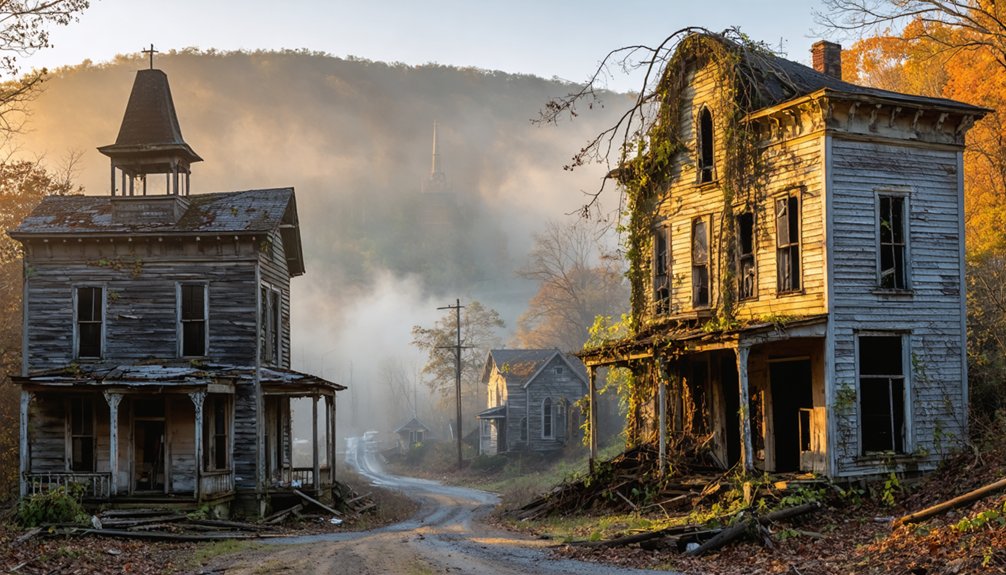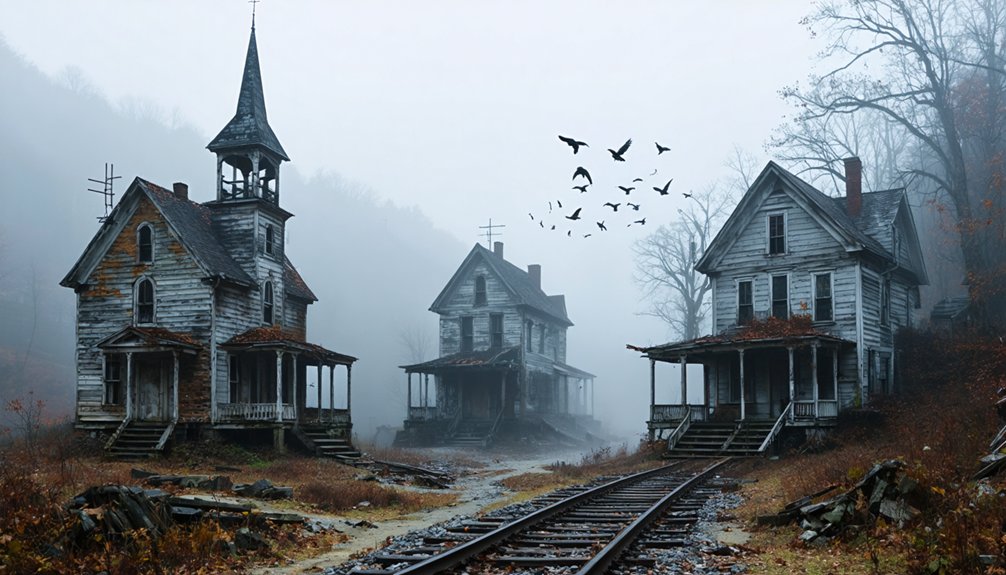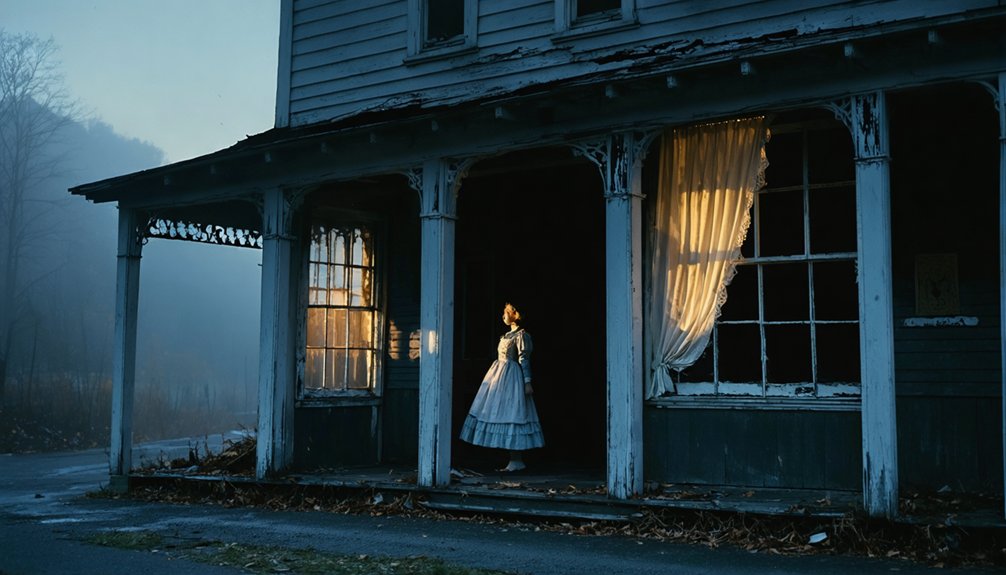
When you explore Appalachian ghost towns, you’ll encounter spectral sightings shaped by multiple converging factors. The rapid industrialization and decline of mining communities left environmental scars, with toxic air, unstable terrain, and strange atmospheric effects. These physical conditions mix with deeply-held Appalachian folk beliefs, Cherokee traditions, and generational trauma from mining disasters. The combination of environmental triggers, cultural mythology, and collective memory creates prime conditions for supernatural experiences – though there’s much more to this mountain mystery.
Key Takeaways
- Historical trauma from industrial decline and abandoned communities creates strong emotional attachments that influence supernatural interpretations of events.
- Environmental factors like mine collapses, toxic air quality, and unusual geological sounds create conditions easily mistaken for paranormal activity.
- Appalachian folk beliefs blend Native American and European traditions, making ghost stories a culturally significant way to process historical events.
- Isolation, darkness, and deteriorating structures in ghost towns create ideal conditions for sensory distortions and heightened fear responses.
- Mining-related environmental damage produces strange phenomena like ghostly fog, unexplained lights, and mysterious sounds that feed local legends.
The Historical Rise and Fall of Mountain Communities
While the rugged Appalachian Mountains presented formidable challenges to early settlers, pioneering families established scattered homesteads throughout the region during the mid-18th to mid-19th centuries.
The community origins often trace back to explorers like Daniel Boone, with families carving out lives through subsistence farming and hunting.
You’ll find these mountain towns transformed rapidly in the early 1900s as industrialization took hold.
Railroad networks opened access to timber and coal, spawning company towns complete with housing and schools.
But this prosperity wouldn’t last. Resource depletion struck hard by the 1920s-30s as logging companies stripped forests bare and coal mines emptied.
The towns that once buzzed with sawmills and miners fell silent. Some communities, like Lost Cove, were completely abandoned by the 1950s, while others vanished beneath man-made lakes.
towns abandoned after the civil war often tell stories of resilience and struggle in the face of overwhelming odds. Each crumbling structure offers a glimpse into a past shaped by conflict and the search for new opportunities. As nature reclaims these spaces, the echoes of history linger, waiting to be discovered by those who wander through the remnants of forgotten communities.
In these remote locations, residents often turned to moonshining by 1898 as a means of economic survival in the challenging mountain environment.
Among the most notable examples was Elkmont, where wealthy Knoxville families built luxurious summer homes and established exclusive social clubs in the early 1900s.
Natural Elements That Shape Ghostly Encounters
As mountain landscapes bear the scars of industrial exploitation, you’ll encounter numerous environmental factors that contribute to reports of ghostly phenomena around abandoned settlements.
The natural landscapes have undergone dramatic geological transformations through mountaintop removal mining, creating unstable terrain that groans and shifts. You’ll find valleys filled with mining debris that alter water flow patterns, leading to flash floods and eerie atmospheric effects. Local communities suffer from these deteriorating environmental conditions.
Acid mine drainage stains streams orange-red while airborne coal dust creates ghostly hazes around old towns. Underground seepage of harmful heavy metals continues to poison local water tables decades after mines close.
These environmental disruptions produce unsettling conditions – from contaminated waterways with diminished wildlife to sudden ground movements and strange sounds from collapsing mine structures.
The complex Appalachian hydrology spreads toxins unpredictably, leaving behind desolate ecosystems that fuel tales of supernatural encounters.
The Role of Appalachian Folk Beliefs and Traditions
If you’ve grown up in Appalachia, you’ll recognize how spirit stories serve as both historical records and protective warnings, passed down through generations to explain everything from tragic mining accidents to mysterious lights in the mountains.
The Cherokee people attribute the unexplained Brown Mountain Lights to spirits of grieving women searching endlessly for lost warriors after ancient battles.
You’ll find that sacred mountain beliefs blend Native American spiritual concepts with European settler traditions, creating a unique system of rules about which areas to avoid and which natural signs to heed.
One of these warnings tells residents never to answer when they hear voices calling names while walking in the dense forests.
These beliefs shape how mountain communities process death and the afterlife, with specific customs about grave orientation, funeral practices, and ways of interpreting supposed ghostly encounters that persist to this day.
Spirit Stories Through Generations
Throughout Appalachia’s rugged terrain, spirit stories have woven themselves into the cultural fabric through generations of oral transmission, serving multiple crucial functions for local communities. These familial narratives blend supernatural caution with practical wisdom, helping preserve cultural heritage while protecting community members.
- Oral traditions encode crucial safety rules through ghostly morality tales, warning you about real dangers like steep cliffs or illegal moonshine operations.
- Trauma storytelling helps process historical events, from Civil War battles to mining disasters, through communal memory. Many stories emerged after the Penn’s Creek Massacre, where spirits of the fourteen victims were said to appear to passing vehicles at night.
- Hybrid folklore merges Native American and settler beliefs, creating uniquely Appalachian interpretations of unexplained phenomena.
- You’ll find these stories reinforced at local festivals and gatherings, where they continue strengthening community bonds and cultural identity. Scholars suggest these tales gained prominence due to the mountain isolation that early settlers faced, creating a rich tradition of supernatural explanations for mysterious events.
Sacred Mountain Beliefs
Deep within the ancient Appalachian mountains, a complex tapestry of spiritual beliefs emerged from the convergence of Native American wisdom and European settler traditions.
You’ll find that these sacred landscapes were viewed as powerful thresholds where thunder beings and the Creator dwelled, shaping both indigenous and settler perspectives on spiritual power.
The mountains themselves became vessels of supernatural energy, where spiritual ancestors could manifest through various phenomena. Religious practices from Protestant Christian denominations gradually blended with these mountain beliefs.
This belief system wasn’t limited to one tradition – it merged Cherokee concepts like akiwitapottam, which emphasized humanity’s reciprocal relationship with the land, alongside European folk practices.
Local practitioners developed folk magic traditions drawing from Cherokee, African, and European influences, creating unique spiritual practices.
Mountain communities preserved these beliefs through rituals, offerings, and protective ceremonies, creating a unique spiritual framework where the physical and metaphysical domains intersected.
The isolation of these communities helped maintain these sacred mountain traditions through generations.
Death and Afterlife Customs
Beyond the sacred mountain beliefs, Appalachian communities developed intricate death and afterlife customs that shaped their understanding of mortality. These practices reflected both practical needs and spiritual beliefs, as families sought to honor their dead while protecting the living.
- Death rituals centered on home-based funerals where families kept vigil to guard both body and soul, incorporating protective talismans and personal objects.
- Ancestor offerings, including food and belongings left at graves, maintained connections between the living and departed.
- Communities believed disturbed or unmarked graves could lead to restless spirits, making proper burial customs essential.
- Traditional practices blended Christian elements with folk beliefs, using music, prayer, and storytelling to comfort both the deceased and survivors.
These customs helped mountain communities process grief while preserving cultural identity through generations.
Notable Hauntings and Documented Phenomena

Within the haunted landscapes of Appalachia, a rich tapestry of documented paranormal phenomena has emerged from its abandoned towns and historic structures.
You’ll find notable hauntings across diverse locations, from the Bell Witch Cave in Tennessee to Point Pleasant’s infamous Mothman territory.
Submerged ghost towns like Proctor and Andersonville surface during low water levels, revealing their haunting remnants and generating spectral encounters.
When waters recede, these drowned towns emerge like ancient secrets, their ghostly structures whispering long-forgotten tales.
Former mining settlements such as Thurman and Kmore harbor unexplained phenomena, with their derelict buildings and equipment serving as catalysts for paranormal activity.
Historic properties like the Broad River Inn and Nickerson Snead House offer compelling evidence of hauntings, often tied to Civil War tragedies and violent histories.
These documented phenomena continue to intrigue investigators and attract those seeking answers to Appalachia’s supernatural mysteries.
Understanding the Psychology Behind Ghost Sightings
Your brain’s heightened state of fear in reportedly haunted locations can transform ordinary stimuli into seemingly supernatural encounters through increased sensory awareness and pattern recognition.
The power of collective belief systems shapes how you interpret ambiguous experiences, as shared cultural narratives about ghosts create expectations that influence perception.
Environmental factors like electromagnetic fields, low light conditions, and infrasound frequencies can trigger physiological responses that you’re likely to misinterpret as paranormal phenomena.
Fear Heightens Our Senses
When exploring alleged ghost sightings, understanding how fear affects our sensory perception reveals a fascinating biological process at work. Your brain’s fear response triggers sensory perception enhancement, making you more alert to potential threats in your environment.
This fear induced hypervigilance activates multiple sensory systems simultaneously, creating an intensified awareness of your surroundings.
- Your visual field expands by 7.6% when experiencing fear, allowing you to scan more of your environment.
- Your amygdala activation heightens all senses while reducing rational thinking.
- Your brain becomes hypersensitive to ambiguous stimuli, leading to possible misinterpretation.
- Your sensory cortices show increased responsiveness across multiple senses, amplifying every sight and sound.
This biological response, while vital for survival, can lead you to perceive ordinary phenomena as supernatural encounters, especially in historically charged locations like abandoned mountain towns.
Beyond individual fear responses, shared beliefs profoundly shape how groups interpret potentially supernatural experiences.
When you’re exploring an Appalachian ghost town with others, you’ll find that one person’s ghostly interpretation can quickly influence the entire group’s perception. These shared experiences become part of the collective memory, reinforced through storytelling and cultural traditions passed down through generations.
You’ll notice how social dynamics amplify paranormal interpretations, especially in communities with deep-rooted folklore.
When someone claims to spot a spirit in an abandoned mining shaft or deserted homestead, others often validate and expand upon these observations. This social reinforcement, combined with cultural conditioning and suggestibility, creates a powerful feedback loop that transforms ordinary occurrences into compelling evidence of supernatural activity.
Environmental Triggers Spark Visions
Understanding ghost sightings requires examining the environmental factors that trigger visual and sensory distortions in abandoned locations.
When you explore Appalachian ghost towns, you’ll encounter a perfect storm of environmental stimuli that can spark seemingly supernatural experiences.
- Electromagnetic fields from old wiring or natural sources can affect your nervous system, causing anxiety and sensory anomalies that feel otherworldly.
- Infrasound waves, often present in mountain valleys, can induce chills, dizziness, and an unsettling sense of presence.
- Poor lighting conditions in deteriorating buildings trick your brain into seeing patterns and shapes where none exist.
- Toxic air quality from mold or carbon monoxide can trigger hallucinations and altered mental states.
These physical factors create a complex web of environmental triggers that your brain may interpret as paranormal activity, especially when combined with isolation and darkness.
How Local Legends Feed Supernatural Stories
Through generations of oral tradition, supernatural stories in Appalachian ghost towns have evolved from a rich tapestry of historical events, cultural beliefs, and unexplained phenomena.
You’ll find these tales deeply rooted in actual tragedies, with legendary embellishments added as storytellers preserve local history. Native American influences, particularly from Cherokee and Catawba traditions, weave cultural symbolism into ghost stories like the Brown Mountain Lights, where ancestral spirits supposedly search for fallen warriors.
When you explore these haunted locations, you’re encountering narratives shaped by community trauma, social bonds, and psychological responses to isolation.
Real disasters, like the Silver Bridge collapse, transform into supernatural warnings, while fog-shrouded mountains and unexplained lights create the perfect backdrop for ghost stories that continue to captivate locals and visitors alike.
Modern Tourism’s Impact on Ghost Town Mythology
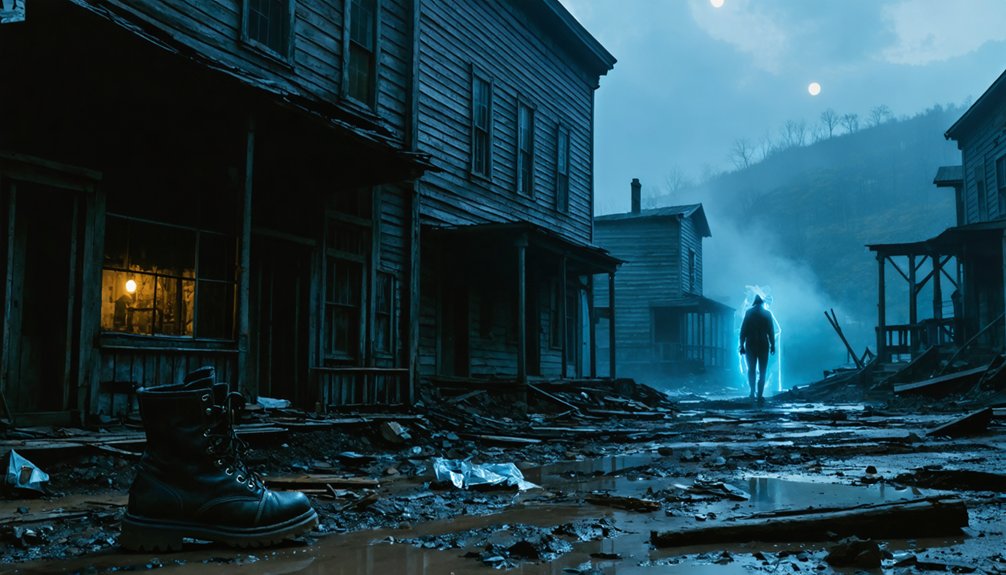
While ghost towns once stood as stark reminders of abandoned dreams, modern tourism has transformed these sites into lucrative heritage destinations that shape and perpetuate local mythology.
Today’s ghost town narratives evolve through complex tourism paradoxes, where historical preservation meets commercial storytelling.
Ghost towns walk a delicate line between preserving authentic history and crafting marketable legends that draw modern visitors.
You’ll find these impacts reflected in:
- Annual events like Appalachian Trail Days drawing tens of thousands, spreading ghostly tales beyond local boundaries
- Tourism infrastructure improvements making abandoned sites more accessible, leading to increased supernatural storytelling
- Marketing initiatives that blend historical facts with folklore, generating $1.7 million in economic impact
- Educational programs that balance authentic heritage preservation with visitor entertainment
This tourism-driven evolution creates feedback loops where mythology and commerce intertwine, continuously reshaping how you experience these haunted historical spaces.
Frequently Asked Questions
What Protective Measures Should Visitors Take When Exploring Potentially Dangerous Ghost Towns?
You’ll need essential safety gear, detailed emergency plans shared with contacts, navigation tools, and protective clothing. Stay alert, avoid isolation, maintain communication checkpoints, and respect posted warnings about structural hazards.
Are There Specific Seasons When Paranormal Activity Is Reported More Frequently?
You’ll encounter more reports of paranormal phenomena during autumn and winter, especially October through December, when longer nights, foggy conditions, and cultural traditions create an ideal atmosphere for unexplained occurrences.
How Do Electromagnetic Fields in Abandoned Mines Affect Ghost Hunting Equipment?
You’ll find that electromagnetic interference from old mine wiring and mineral deposits can trigger false readings on your ghost hunting equipment, making it challenging to distinguish between genuine paranormal activity and natural EMF sources.
Which Ghost Towns Have the Strictest Regulations Regarding Overnight Paranormal Investigations?
You’ll find impossibly strict ghost town regulations at Lost Cove, Tennessee, where overnight investigations are completely banned after countless disappearances. Mining settlements across Appalachia enforce similar harsh restrictions on paranormal research.
Do Native American Burial Grounds Near Ghost Towns Influence Reported Supernatural Activity?
You’ll find that Native Legends and traditional Burial Practices strongly influence supernatural reports near ghost towns, as sacred grounds often become focal points for unexplained phenomena and cultural spiritual beliefs.
References
- https://www.blueridgeoutdoors.com/go-outside/southern-ghost-towns/
- https://appalachian.org/lost-cove-ghost-town-in-the-national-forest/
- https://www.youtube.com/watch?v=4oHlJFXbrCk
- https://www.thewanderingappalachian.com/post/the-underwater-towns-of-appalachia
- https://appalachianmemories.org/2025/10/16/the-lost-towns-of-appalachia-the-forgotten-mountain-communities/
- https://www.youtube.com/watch?v=3F_Gv_xp3Y4
- https://roadtrippers.com/magazine/abandoned-ghost-town-smoky-mountains/
- https://npshistory.com/publications/usfs/region/8/history/intro.htm
- https://www.appalachianhistory.net/2021/04/the-vanished-community-of-lost-cove.html
- https://www.thecollector.com/history-of-appalachia-and-its-people/