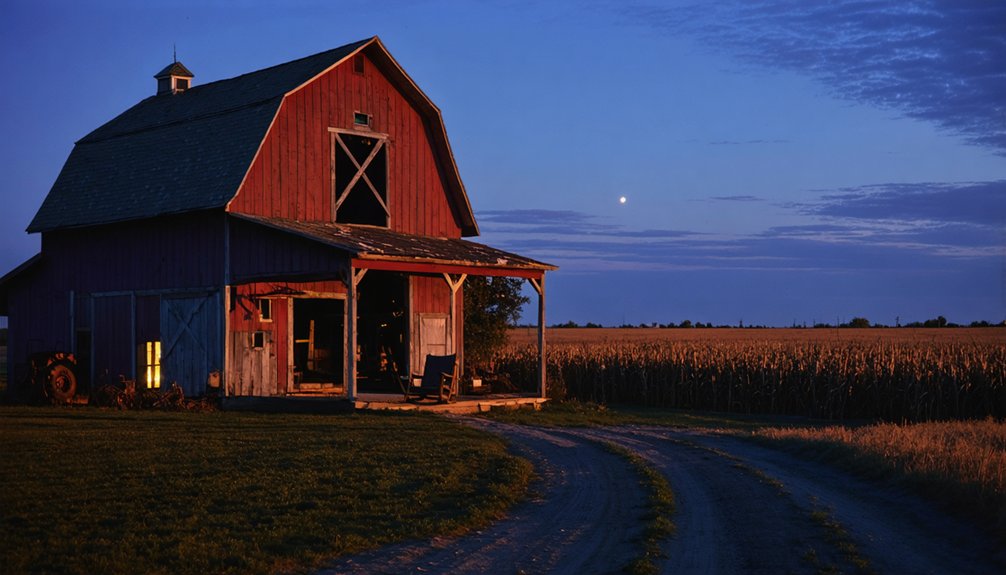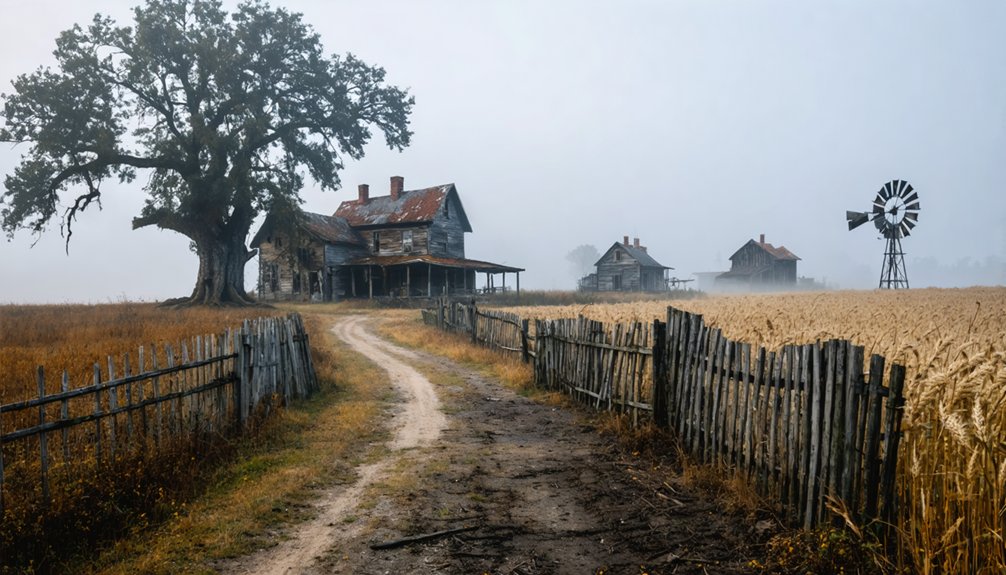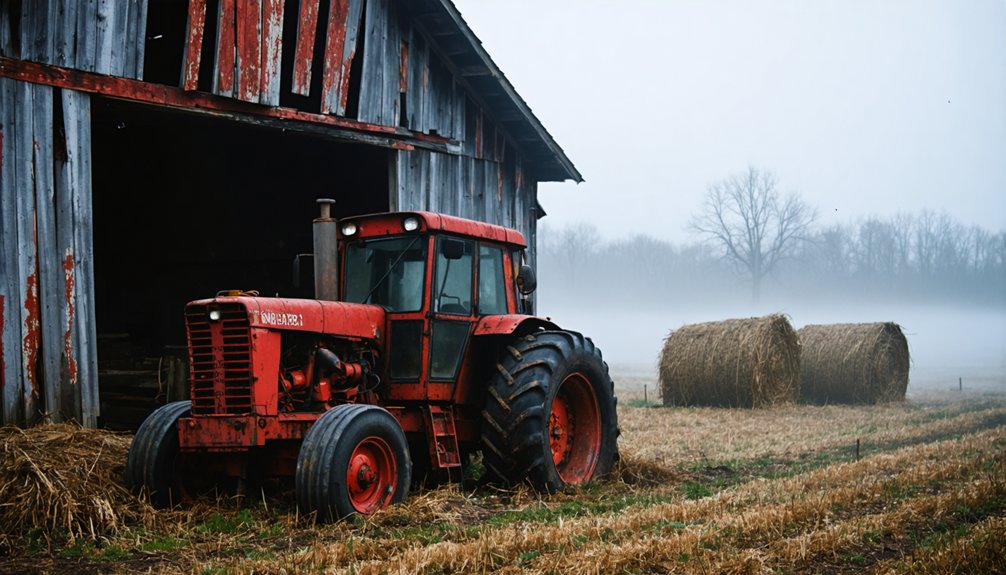
When you explore abandoned farming towns today, you’ll encounter haunting traces of America’s agricultural past. These ghost towns emerged from a perfect storm of economic pressures, with farm bankruptcies and vanishing jobs forcing entire communities to relocate. The empty barns, with their specialized architecture and worker graffiti, stand as silent witnesses to both prosperity and decline. Behind each weathered building lies a complex story of environmental challenges, youth exodus, and rural transformation waiting to be uncovered.
Key Takeaways
- Abandoned farm buildings preserve physical memories of lost agricultural communities through architectural features and worker graffiti.
- Rapid decline of farming communities creates psychological trauma, leaving emotional imprints that persist in abandoned structures.
- Agricultural heritage sites become focal points for collective memory as communities struggle with loss of traditional farming lifestyles.
- Mass exodus of farmers and youth creates a vacuum of human presence, leading to eerie, uninhabited landscapes.
- Environmental challenges and economic pressures create a stark contrast between past prosperity and current desolation in farming towns.
The Last Harvest: Agricultural Decline’s Impact on Rural Communities
While the American farming landscape has long experienced cycles of boom and bust, the current agricultural decline represents an unprecedented convergence of economic pressures.
You’ll see this harsh reality in the empty barns and fallow fields where agricultural resilience is being tested like never before. Farm bankruptcies are climbing, with 181 failures in just six months of 2025, while production costs soar to a staggering $467 billion. The rising effective tariff rates on agricultural inputs have intensified the financial burden on farmers.
Empty barns and fallow fields tell a stark story of crisis, as farm bankruptcies mount and costs crush rural dreams.
Your local farming communities aren’t just struggling – they’re transforming. Community adaptation has become critical as 155,000 agricultural jobs vanish and rural economies contract. The cattle sector shows particular strain as declining national herds reshape traditional ranching communities.
You’re witnessing a domino effect: when farmers can’t profit, local businesses close, populations drift away, and once-vibrant agricultural towns become shells of their former selves.
It’s a stark reminder of how deeply farming’s health is woven into rural America’s survival.
Echoes of the Past: Abandoned Buildings and Their Stories
These abandoned farm buildings stand as silent witnesses to America’s agricultural heritage, their weathered walls holding countless stories of rural life.
You’ll find architectural significance in every carefully planned detail – from raised barn doors preventing dampness to owl holes controlling pests. Each specialized structure tells its own tale: milk houses speak of changing sanitation standards, while empty horse stables mark the shift to mechanical farming. Today, these structures require significant investment to restore to their former glory.
Beyond their physical features, these buildings carry deep cultural narratives. Worker graffiti scrawled on barn walls, tenant quarters, and wash houses reveal complex social hierarchies and daily routines of farm life.
You’re walking through more than just empty structures – you’re experiencing layers of agricultural evolution, from the era of self-sufficient farming to the rise of industrial agriculture that ultimately led to their abandonment. The Agricultural Revolution between the 18th and 19th centuries transformed these spaces through improved farming methods and mechanization.
When Nature Strikes Back: Environmental Forces Behind Farm Town Exodus
As climate change tightens its grip on America’s heartland, you’ll find once-thriving farming communities succumbing to relentless environmental pressures.
You’re witnessing a perfect storm of climate stress: rising temperatures slash crop yields, while unpredictable rainfall patterns leave fields parched and barren. These conditions trigger a cascade of rural depopulation that’s transforming the landscape.
Rising heat waves and erratic rains devastate farmlands, forcing rural communities to abandon generations of agricultural heritage.
When farmers abandon their land, nature quickly reclaims it – but not always benevolently. The absence of traditional livestock grazing makes it increasingly difficult to control vegetation growth and prevent wildfires.
Unmanaged vegetation creates dangerous wildfire conditions, while soil degradation accelerates. You’ll see how this environmental deterioration compounds the exodus: declining agricultural productivity forces dependence on imported food, local economies crumble, and infrastructure falls into disrepair.
What’s left behind isn’t just empty buildings, but entire ecosystems teetering on the edge of collapse.
Lost Generation: How Youth Migration Changed Farm Town Destinies
The steady exodus of young people from America’s farm towns has left an indelible mark on rural landscapes already battered by environmental challenges.
You’ll find the most dramatic shifts in remote areas, where 10-20% of youth vanish each decade, leaving behind aging communities struggling to maintain their workforce.
These migration patterns aren’t just about economics – they’re deeply woven into cultural narratives.
You’re witnessing how schools, families, and communities often inadvertently push youth toward urban futures, treating departure as a marker of success.
Research reveals that spread your wings expectations shape rural youth decisions, with 63% of community leaders promoting moving away as essential for success.
Local youth aspirations clash with limited opportunities, while prevailing migration narratives suggest that staying means settling for less.
The impact varies by region: Southern and Western rural areas show some resilience, while Northern and Midwestern communities face steeper declines, transforming once-vibrant farming towns into shells of their former selves.
The trend began shifting dramatically when manufacturing jobs plummeted from 19.5 million in 1979 to under 11.5 million, fundamentally altering rural employment prospects.
Seeds of Hope: Modern Revival Efforts in Ghost Farming Towns
While many farming towns face decline, innovative revival efforts are breathing new life into America’s abandoned rural landscapes through multiple approaches.
You’ll find climate-smart agriculture initiatives transforming over 30 million acres of abandoned cropland into productive spaces for bioenergy crops and carbon sequestration. Scientists at the University of Wisconsin-Madison have developed mapping tools to identify suitable locations for these initiatives.
Through community engagement, local leaders are spearheading downtown revitalization projects that strengthen social bonds and economic resilience. Modern agricultural technology has enabled farms to achieve higher crop yields without expanding into new lands.
- Strategic infrastructure investments in broadband, water, and energy systems attract new residents and businesses.
- Conversion of fallow fields to sustainable uses like switchgrass farming and wildlife corridors.
- Place-based Main Street revival through local events and public space enhancement.
- Economic diversification by leveraging proximity to urban areas and remnant agricultural industries.
These targeted approaches demonstrate how rural communities can adapt and thrive in changing times.
Frequently Asked Questions
What Paranormal Activities Are Commonly Reported in Abandoned Farming Towns?
You’ll encounter ghost sightings of former residents, spectral phenomena like cold spots, unexplained voices, mysterious lights, and shadow figures moving through derelict barns and overgrown fields.
How Do Property Laws Affect the Exploration of Ghost Farming Towns?
Like chains binding a spirit, property rights and legal restrictions control your access. You’ll need owner permission, respect zoning laws, and understand trespassing risks before exploring ghost towns.
Which Abandoned Farming Towns Have the Most Valuable Historical Artifacts?
You’ll find the richest historical artifacts in Colonial northeastern farmsteads, where ideal artifact preservation conditions protect valuable items like large cents and crotal bells, enhancing their historical significance through time.
Are There Underground Tunnels or Hidden Spaces Beneath Old Farm Buildings?
Over 60% of pre-1900 farms contain hidden passages beneath their structures. You’ll find root cellars, storage tunnels, and subterranean structures designed for crop preservation, livestock shelter, and sometimes clandestine movement between buildings.
Do Any Ghost Farming Towns Still Maintain Active Cemeteries Today?
You’ll find active burial grounds in several ghost farming towns today, particularly in places like Terlingua, Texas and Dawson, New Mexico, where cemetery preservation continues through local community efforts and heritage programs.
In addition to these efforts, there are intriguing ghost towns from the Civil War era that attract history enthusiasts and curious travelers. These abandoned settlements serve as a poignant reminder of the past, with remnants of structures and artifacts that tell stories of the lives once lived there. Exploring these sites offers a unique glimpse into the challenges and triumphs experienced during such a tumultuous time in American history.
References
- https://faircompanies.com/articles/rural-ghost-towns-choice-for-urbanites-in-search-of-meaning/
- https://www.britannica.com/topic/ghost-town
- https://www.nps.gov/slbe/learn/historyculture/ghosttowns.htm
- https://www.legendsofamerica.com/gt-emergingghosttowns/
- https://txprobatelawyer.net/the-rise-of-ghost-towns-can-you-own-a-piece-of-abandoned-texas/
- https://texashighways.com/culture/history/what-the-heck-is-a-ghost-town/
- https://www.youtube.com/watch?v=ZiJctD8Cs70
- https://livefromthesouthside.com/10-texas-ghost-towns-to-visit/
- https://agpolicyreview.card.iastate.edu/winter-2025/usdas-outlook-2025
- https://econofact.org/the-u-s-agricultural-sector-under-stress