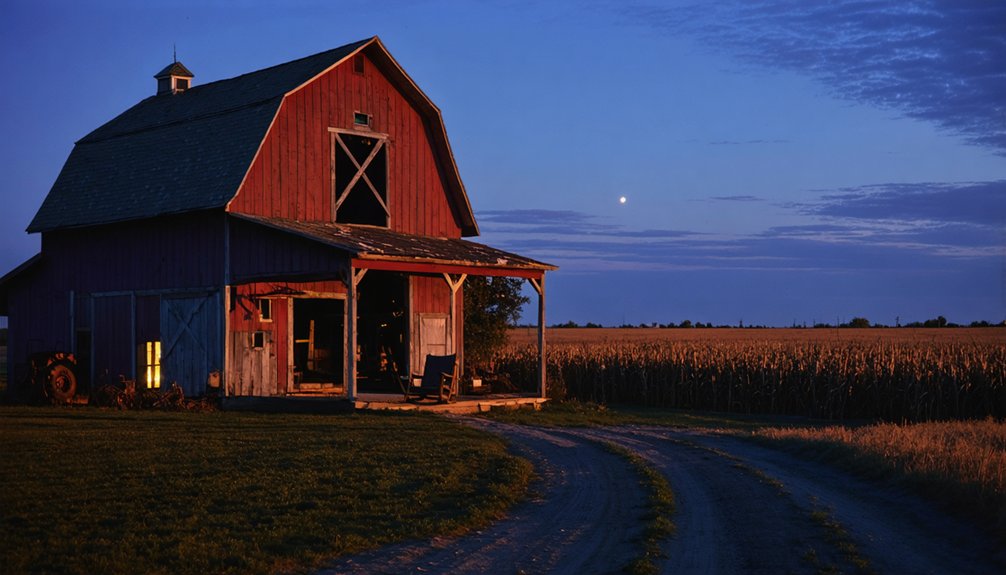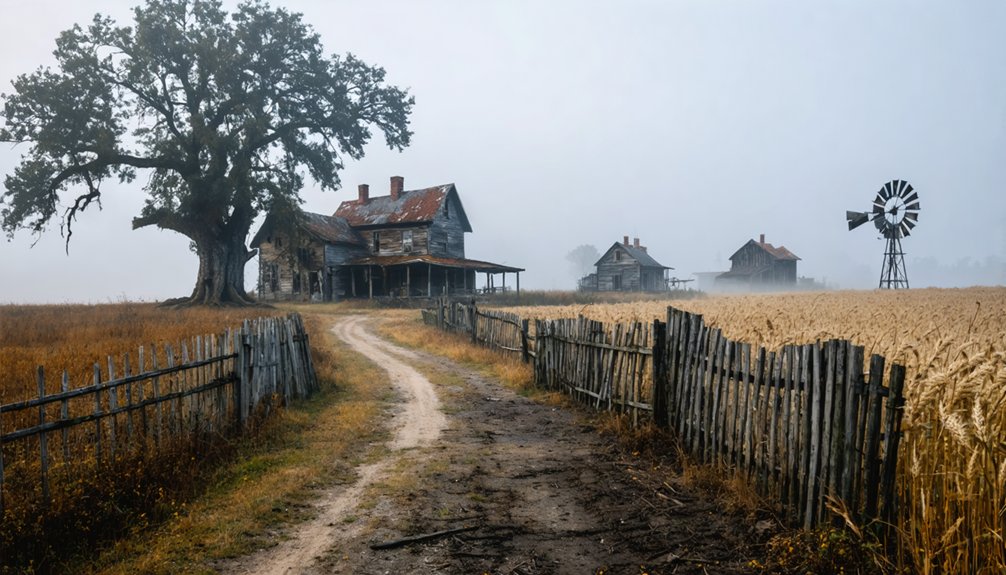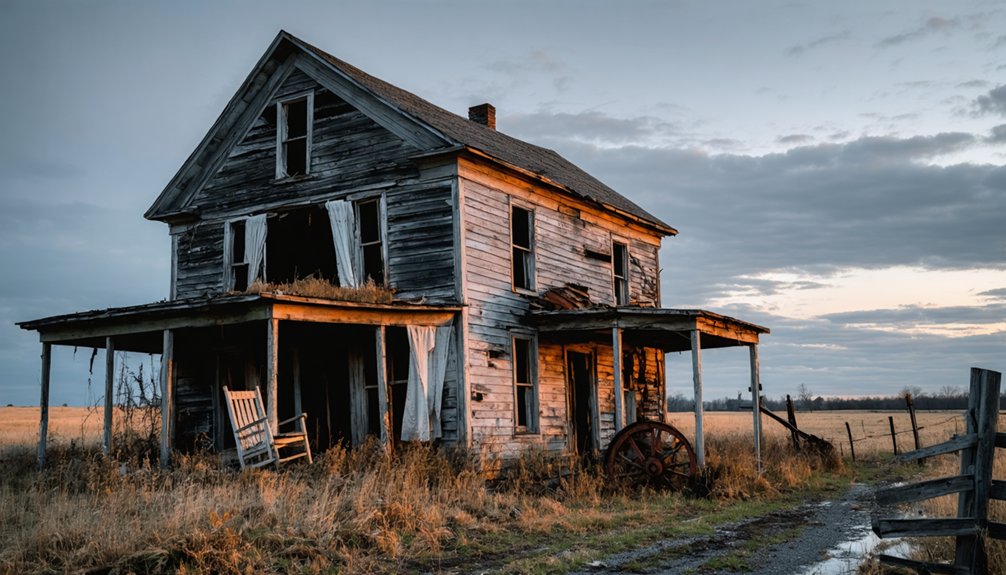
You’ll find these ghostly rural settlements deeply unsettling because they mirror profound social transformations you’re living through right now. Their empty storefronts and weathered buildings tell stories of communities that once thrived but couldn’t survive dramatic economic shifts. While some towns are experiencing revival through return migration and remote work, many remain frozen in time – stark reminders of how quickly prosperity can vanish. Their haunting presence raises crucial questions about your own community’s future.
Key Takeaways
- Abandoned rural buildings serve as physical reminders of lost community vitality and demographic shifts that transformed once-thriving towns.
- Economic disparities and poverty rates twice that of urban areas create stark visual contrasts that highlight rural decline.
- The systematic erasure of rural communities from datasets and surveys makes their struggles increasingly invisible to policymakers.
- Single-industry dependence left many towns vulnerable to economic collapse, creating a haunting legacy of lost opportunities.
- Empty storefronts and weathered architecture symbolize broader societal changes and the uneven impacts of urbanization.
The Empty Streets That Echo Our Past
As you walk through the vacant streets of America’s ghostly rural settlements, you’ll find yourself transported to a different era, where weathered buildings and fading storefronts tell stories of once-thriving communities.
Empty Main Streets whisper tales of bustling yesterdays, their crumbling facades standing sentinel over America’s forgotten small-town dreams.
You’re witnessing more than just architectural decay – you’re experiencing the physical manifestation of profound demographic and economic shifts that have hollowed out these places.
The empty main streets, with their 19th and early 20th-century structures, aren’t just fueling urban nostalgia – they’re preserving vital historical memory.
Each shuttered bank, abandoned post office, and silent storefront reveals the painful transformation these communities have undergone.
You’ll notice how aging infrastructure and reduced services have accelerated their decline, while historic preservation status keeps some buildings frozen in time, serving as powerful reminders of what was lost.
Over the past two decades, 346 rural counties experienced significant working-age population losses, leaving behind these haunting reminders of former vitality.
However, recent data shows that rural population growth has persisted for four consecutive years, suggesting a potential revival for some of these forgotten places.
Migration Patterns: A Tale of Departure and Return
While urban areas continue to draw young adults away from small towns, a fascinating reversal in migration patterns has emerged since 2020, with rural communities gaining over 430,000 residents through both domestic and international movement.
You’ll notice this shift isn’t just about numbers – it’s reshaping the very fabric of rural life.
The story of return migration reveals itself in the age demographics: while those in their mid-20s still chase urban dreams, people in their 30s and 40s are coming back, seeking affordable homes and quieter lives.
Remote work has granted this freedom, letting you choose small-town charm without sacrificing career opportunities.
Yet this revival isn’t uniform – communities near cities or in scenic areas thrive, while isolated towns still struggle to retain their population, painting a complex picture of rural America’s transformation.
Rural regions with BIPOC populations are experiencing notable growth, contributing significantly to demographic changes in many counties.
Prior to this growth, rural regions experienced population losses of 60,000 between 2017 and 2020.
The Economic Shadows Left Behind
Despite recent job growth in rural communities, the economic shadows of generational decline loom large across America’s countryside.
You’ll find stark economic disparities in regions like Appalachia and the Southern Black Belt, where poverty rates hover around 25% – double that of urban areas.
While some rural counties show remarkable resilience by surpassing pre-pandemic employment levels, this recovery masks deeper structural challenges. The widening income gap of $20,000 between left-behind counties and the rest of America underscores this disparity.
The loss of federal survey data has severely limited the ability to track these economic shifts at the county level, leaving local policymakers unable to make informed decisions.
You’re witnessing the transformation of traditional rural employment, as agricultural jobs decline despite increased production value, and manufacturing no longer offers the safety net it once did.
What’s more troubling is that you can’t fully grasp the scope of these changes – critical county-level data has vanished due to underfunding, leaving rural communities to navigate their future with incomplete economic roadmaps.
Data Blind Spots in Rural America
The growing data blindness in rural America creates a troubling paradox – you can’t fix what you can’t measure.
As data reliability plummets and rural research programs face devastating cuts, you’re witnessing the systematic erasure of rural communities from official statistics. Your ability to understand and advocate for rural America diminishes with each passing year.
- Survey response rates have collapsed from 90% to 71%, leaving rural communities increasingly invisible.
- Health research cuts mask critical issues like maternal health and substance abuse trends.
- Privacy suppression rules disproportionately silence rural economic data.
- Education data cuts threaten rural schools’ access to federal support programs.
This statistical darkness isn’t just about missing numbers – it’s about power. Economic models show bias up to 82% when analyzing suppressed rural data, making it nearly impossible to identify viable development opportunities. The termination of over 50 HHS grants focused on rural health research further deepens our knowledge gaps about these communities.
When rural communities vanish from datasets, they lose their voice in policy decisions and resource allocation battles.
Breaking Free From the Ghost Town Narrative
Rural decline isn’t inevitable – it’s a self-fulfilling prophecy driven by narrow economic thinking and cultural narratives of decay. You can see this pattern when communities fixate on single employers or industries, trapping themselves in cycles of dependency and vulnerability. Just as Pithole’s demise proved in 1868, relying too heavily on a single industry leaves towns vulnerable to devastating economic collapse.
But some towns are breaking free by embracing resilience strategies that diversify their economic base beyond traditional anchors like hospitals or school districts. Texas leaders are working to provide broadband expansion funding to help rural communities stay connected and competitive.
Community revitalization starts with rejecting the doom narrative that drives youth exodus and property devaluation. Instead of chasing last-resort solutions like prisons or toxic industries, forward-thinking rural areas are leveraging their unique assets – from natural beauty to social capital.
They’re rebuilding local institutions, restoring wealth circulation within their communities, and creating opportunities that give young people reasons to stay or return.
Frequently Asked Questions
How Do Natural Disasters Affect the Persistence of Rural Ghost Towns?
You’ll see how natural disasters overwhelm rural resilience, destroying infrastructure and forcing permanent evacuations. When communities can’t afford rebuilding costs, these settlements transform into enduring ghost towns through repeated catastrophic cycles.
What Role Do Indigenous Communities Play in Maintaining Rural Settlement Vitality?
You’ll find Indigenous communities sustain rural significance through their cultural heritage, traditional governance, and community resilience, actively managing lands, maintaining infrastructure, and fostering economic innovation despite systemic challenges they face.
Can Renewable Energy Projects Revitalize Abandoned Rural Communities?
You’ll find renewable energy projects can breathe new life into ghost towns, creating jobs and upgrading infrastructure. When you invest in community revitalization through clean power, you’re rebuilding both opportunity and hope.
How Do Seasonal Tourism Patterns Impact Ghost Town Preservation Efforts?
Like Sisyphus’s eternal struggle, you’ll find tourism economics create a rollercoaster – peak seasons fund preservation while off-season slumps drain resources. Seasonal demographics leave ghost towns truly ghostly when visitors vanish.
These deserted places hold their own stories, filled with haunting tales from abandoned towns that evoke an eerie sense of nostalgia. Each crumbling façade and deserted street whispers the memories of lives once lived, drawing in those curious to uncover the past. As night falls, the atmosphere thickens, inviting thrill-seekers to wander through the remnants of history.
What Influence Does Rural Artwork and Photography Have on Ghost Towns?
You’ll find rural artwork shapes cultural memory through artistic representation, transforming abandoned places into mysterious destinations that capture your imagination and preserve stories of communities that once thrived in these forgotten spaces.
References
- https://www.ruralmn.org/the-state-of-rural-2025/
- https://www.governing.com/urban/rural-counties-grow-for-fourth-straight-year
- https://www.richmondfed.org/publications/research/econ_focus/2025/q3_district_digest
- https://www.fwd.us/news/rural-decline/
- https://www.coopercenter.org/research/young-adults-fuel-revival-small-towns-rural-areas
- https://www.planetizen.com/news/2025/04/134829-rural-population-grew-again-2024
- https://ruralinnovation.us/blog/more-than-numbers-the-threat-to-rural-economies-when-good-data-disappears/
- http://www.ers.usda.gov/topics/rural-economy-population
- https://www.americanprogress.org/article/adversity-assets-identifying-rural-opportunities/
- https://headwaterseconomics.org/economic-development/equity/rural-capacity-map/