球
Key Takeaways
- Resource depletion occurs within 10-20 years of intensive logging, making towns unsustainable once profitable timber stocks are exhausted.
- Single-resource dependency leaves communities vulnerable to economic collapse when timber operations cease or relocate.
- Transportation network changes, particularly railroad abandonment and highway bypasses, isolated logging towns from vital economic connections.
- Environmental regulations and compliance costs force smaller logging operations to close, leading to widespread unemployment and population exodus.
- Rapid forest depletion requires 50-100 years for recovery, making it impossible for communities to sustain long-term timber-based economies.
The Rise and Fall of Timber-Based Communities
While the early timber industry relied primarily on rivers to transport logs, the introduction of railroads in the late 19th century revolutionized logging operations and sparked the emergence of permanent timber-based communities.
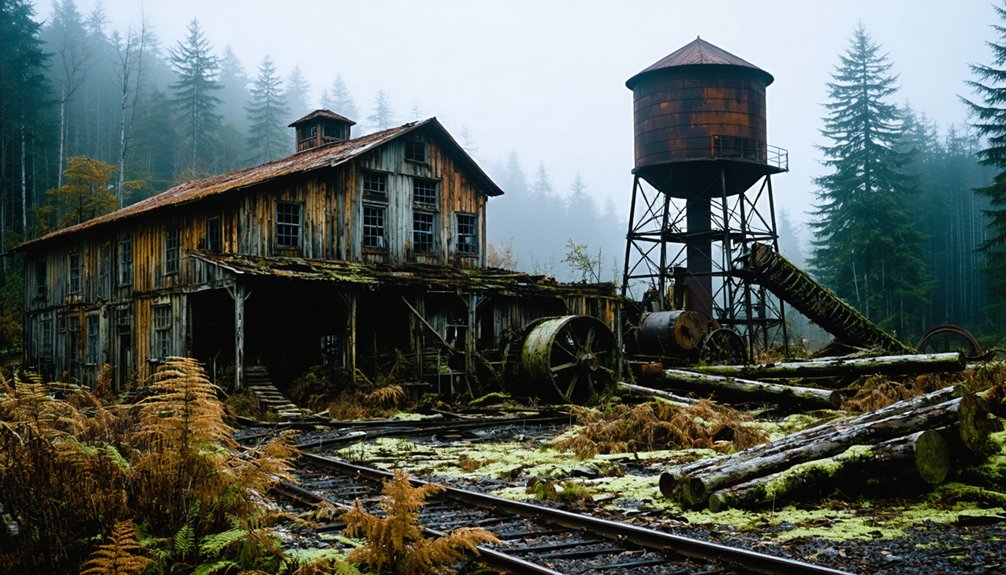
You’ll find that these railroads extended thousands of miles into remote forests, enabling year-round logging and the establishment of sawmills in previously inaccessible areas. Over 4,000 miles of track were laid across Minnesota alone to support the growing timber industry. Towns like Antigo, Wisconsin, sprouted up around these industrial hubs, embodying a rich logging heritage through their mills and wood product factories. Much like the heritage tourism trend seen in mining ghost towns, some abandoned logging communities now attract visitors interested in historical preservation.
However, your community’s resilience would be tested by the boom-and-bust nature of the timber economy.
These towns, heavily dependent on a single resource, faced inevitable decline as forests were depleted. When mills closed, unemployment soared, triggering mass exodus and transforming once-thriving communities into ghost towns.
Resource Exhaustion and Environmental Impact
When you examine historical logging towns, you’ll find a repeating pattern where intensive harvesting rapidly depletes local timber resources in 10-20 years, leaving insufficient stock for sustained operations.
The environmental damage from this rapid extraction often requires 50-100 years for forest recovery, assuming ideal conditions and no additional disturbances. The destructive impact on local communities is evident through habitat destruction affecting both wildlife and indigenous populations.
You’ll notice these depleted areas typically show severe soil erosion, disrupted water cycles, and fragmented wildlife habitats that persist long after the logging operations cease. Today, this pattern continues as the southeastern United States faces logging rates four times higher than those seen in the Amazon Basin.
Timber Depletion Cycle Patterns
Throughout the logging industry’s history, timber depletion cycles have followed predictable patterns of resource exhaustion that ultimately lead to ghost town formation.
You’ll notice these timber cycles typically span 10 to 60 years, with 30-year intervals proving insufficient for full forest recovery. As logging patterns intensify, you’ll see companies first target high-value species before moving down the value chain to less desirable timber. Modern harvester-based extraction has notably worsened environmental impacts compared to traditional methods.
The process accelerates when post-logging mortality sets in, damaging surrounding forest stands and disrupting natural regeneration. This devastating cycle has contributed to one-third of forests being lost globally over the past 10,000 years.
You’ll find that soil disturbance and altered microclimates make it harder for preferred species to recover. When timber stocks fall below profitable thresholds, companies abandon their operations, leaving behind ghost towns – a stark reminder of how resource depletion transforms thriving communities into abandoned settlements.
Forest Recovery Time Impacts
Despite the timber industry’s historical assumptions about quick forest regeneration, modern research reveals a complex matrix of recovery timelines that you’ll need to contemplate.
While soil fertility bounces back within a decade of logging impacts, other critical elements take far longer. You’ll find that above-ground biomass recovers to 144% within 24 years, but harvestable timber only reaches 41% in that same period.
The most sobering reality is that full forest recovery extends well beyond a single generation. Plant functional traits recover in 25 years, but species diversity needs 60 years, and complete structural restoration takes over 120 years. Selective logging contributes significantly to tropical forest carbon emissions through both immediate harvest damage and long-term ecosystem disruption.
Old-growth forests need active protection to prevent permanent ecosystem loss, making conservation crucial for long-term sustainability.
This extended recovery timeline means you can’t sustain continuous intensive logging in one area, explaining why logging operations often abandoned towns once local timber resources were depleted.
Land Degradation After Logging
As logging operations intensify in an area, you’ll observe a cascade of environmental degradation that extends far beyond the immediate loss of trees.
Heavy machinery compacts the soil while clear-cutting operations strip away protective ground cover, triggering severe soil erosion and nutrient depletion. The land’s ability to sustain new growth diminishes rapidly, as crucial topsoil washes away and microbial communities essential for nutrient cycling are disrupted. Like the devastating impacts seen in mining-related deforestation, the environmental damage from logging can persist for generations. This devastation contributes to approximately 4.8 million tonnes of CO2 emissions annually.
- Soil structure breaks down within months of intensive logging, leading to reduced water retention and increased runoff.
- Natural forest regeneration becomes nearly impossible as nutrient cycles collapse and soil chemistry changes.
- Conversion to tree plantations can’t restore the land’s original fertility, creating a downward spiral of diminishing returns.
Single Industry Dependence: A Fatal Flaw
While many logging towns experienced meteoric rises during America’s timber boom, their reliance on a single industry ultimately sealed their fate.
You’ll find that these communities suffered from extreme single industry vulnerability, as their entire economic structure depended on an exhaustible resource. When timber supplies inevitably ran out, towns had nowhere to turn.
The economic dependency created a devastating cycle: logging operations attracted rapid population growth, but once the forests were depleted, these same towns experienced swift abandonment.
Without diversified economies or alternative employment options, residents had no choice but to relocate. This pattern played out dramatically across Michigan and the Pacific Northwest in the early 20th century, where once-thriving logging communities transformed into ghost towns after their forests were exhausted.
Transportation Evolution’s Role in Town Abandonment
When you examine the early logging towns of North America, you’ll find they first clustered along rivers where logs could be floated downstream to sawmills and markets.
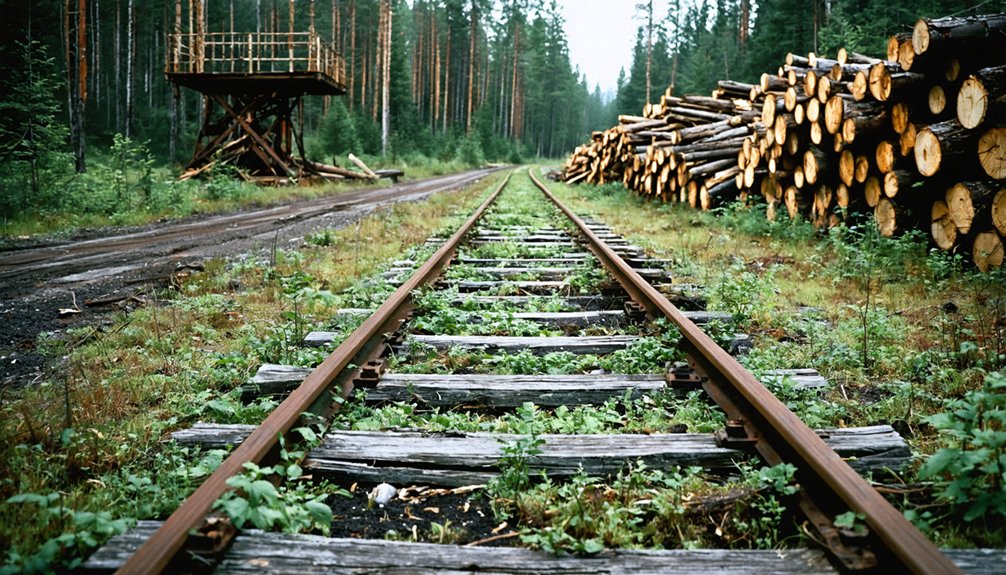
You’ll notice how these settlements later shifted to align with the expanding rail networks of the late 19th century, as steam locomotives became the dominant means of timber transport.
River Transport Decline Impact
The dramatic decline of river log drives in the 1930s triggered widespread abandonment of logging communities across America’s timber regions.
You’ll find that towns heavily dependent on river transport faced devastating economic consequences when the industry shifted to road-based logging. Communities that had flourished along riverbanks suddenly lost their economic foundation as mills closed and logging operations dispersed.
- River-dependent settlements couldn’t adapt when trucks replaced water transport, leading to mass exodus.
- Mill towns that once processed river-delivered logs became obsolete without their primary resource chain.
- The economic dependency on river-based logging left these communities vulnerable with no alternative industries.
The change reshaped the entire logging landscape, as towns that couldn’t pivot to new transportation methods were left isolated and ultimately abandoned, creating the ghost towns you can still find today.
studies of the history of ghost towns in america reveal the stories of communities that once thrived but were rendered obsolete by economic shifts. these abandoned places often serve as poignant reminders of the past, where remnants of homes and businesses stand in silent testament to the lives lived there. exploring these ghost towns offers a unique glimpse into the cultural and historical tapestry that shaped the nation.
Rail Networks Replace Rivers
During the 1880s, rail networks revolutionized America’s logging industry by replacing traditional river transport systems, fundamentally altering the geography of timber towns.
You’ll find that by 1887, Michigan alone operated 89 logging railroads, demonstrating the rapid railroad impacts on timber transportation.
This logging shift moved mills away from river mouths and directly into timberlands. Companies like Blendon Lumber transported over 40 million board feet of timber by rail, while innovations like Shay locomotives accessed previously unreachable forests.
You can trace how settlements shifted from riverbanks to railroad grades as companies consolidated their operations around rail hubs. The new rail-based system made river-dependent infrastructure obsolete – abandoned flumes, dams, and river landings became remnants of a bygone era, while centralized rail operations reshaped the industry’s geography forever.
Highways Bypass Small Towns
As America’s interstate highway system expanded throughout the 1950s and 1960s, newly constructed roads systematically bypassed numerous logging towns, triggering their rapid decline.
You’ll find that these bypass consequences hit resource-dependent communities particularly hard, as highway isolation cut them off from crucial transportation networks that once sustained their economies.
- Your town’s survival depended on highway traffic for goods, services, and tourism – when major routes shifted, local businesses couldn’t sustain themselves.
- You’d see the impact most severely in communities that had already lost their railroad connections, leaving them without efficient means to transport timber.
- Your community’s infrastructure would deteriorate as population declined, with schools, hospitals, and other essential services shutting down due to reduced tax revenue and usage.
Economic Shifts in the Lumber Market

Recent fluctuations in North America’s lumber market reveal significant economic challenges, with consumption declining 0.9% in 2024 amid weak housing starts and high mortgage rates.
You’ll find market volatility intensified by lumber tariffs on Canadian imports, which could spike prices up to 21% in 2025. Supply chain disruptions and labor shortages continue to plague the industry, with immigrant workers, who make up 30% of the construction workforce, facing restrictions.
The economic downturn has led to demand fluctuations, particularly in single-family construction and home improvements.
You’re seeing construction costs rise 6-15% due to these pressures, while timber prices fluctuate regionally. Communities that once thrived on logging now require economic diversification for survival, as persistent inflation and rising costs challenge their community resilience.
The Legacy of Company Town Structure
The rise of company towns in North America’s logging industry marked a defining shift in workforce management and community development between 1880 and 1930. You’ll find these planned communities were strategically designed to maintain control over workers through carefully structured company town dynamics.
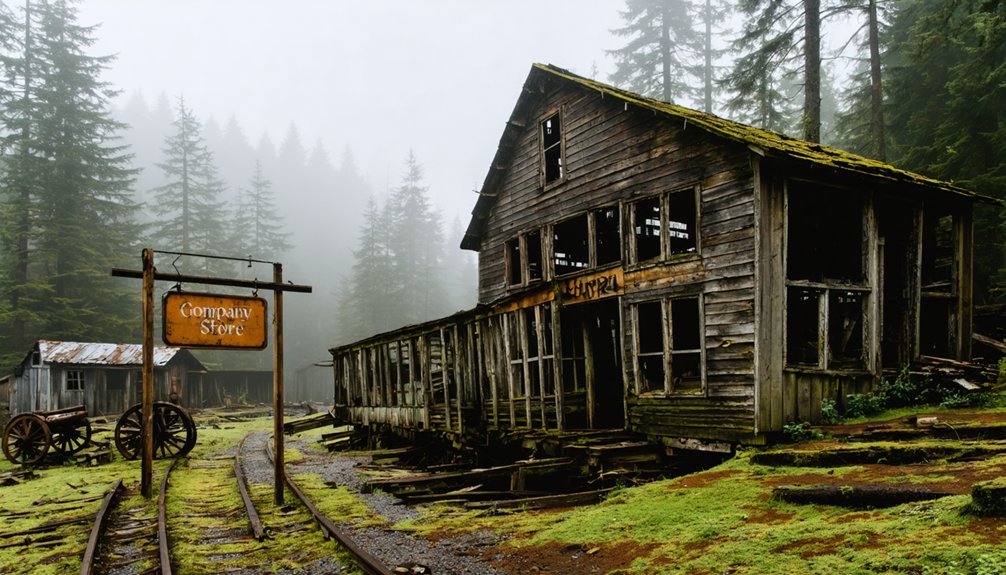
The companies owned everything – from the houses you’d live in to the stores where you’d shop, often paying you in scrip that couldn’t be used anywhere else.
Company control stretched beyond the workplace, owning your home and forcing you to shop at their stores using company-issued currency.
- Your entire life revolved around the company’s rules, with strict behavioral codes and company police enforcing order.
- You’d find distinct social hierarchies reflected in housing arrangements, separating workers by ethnicity and job status.
- The paternalistic labor relations meant you got amenities like schools and theaters, but at the cost of personal freedom.
Migration Patterns of Logging Communities
During the peak years of logging operations between 1880-1940, migration patterns in North American logging communities followed distinct cycles driven by economic necessity and labor demand.
You’ll find that migrant labor formed the backbone of these operations, with workers moving between regions as timber harvests demanded.
Infrastructure Decline and Community Exodus
As you explore abandoned logging ghost towns, you’ll notice their decline often began with the deterioration of essential transportation networks, particularly the railroad lines and gravel roads that once served as lifelines for timber transport and daily necessities.
The closure of local schools typically marked a critical turning point, as families relocated to areas with better educational opportunities for their children.
These initial infrastructure losses triggered a cascade of further service reductions, where remaining transportation routes fell into disrepair and community facilities shut down, ultimately accelerating the exodus of residents.
Abandoned Rails and Roads
Once prosperous logging communities relied heavily on their rail networks and road systems, which served as essential lifelines for transporting timber, supplies, and workers throughout the late 19th and early 20th centuries.
As logging resources depleted, the abandoned infrastructure became a stark symbol of economic decline. You’ll find that when railroads lost their economic viability, they were often dismantled or left to decay, creating physical barriers that isolated these communities from crucial markets and services.
- Deteriorating roads and rails cut off access to emergency services, supplies, and neighboring towns
- Seasonal weather damage to unpaved roads further restricted movement and deterred new settlement
- Declining tax revenues prevented proper maintenance, creating a cycle of infrastructure degradation
Empty Schools Close First
When logging towns begin their descent into abandonment, the closure of local schools typically serves as the first visible sign of community decline.
You’ll notice school demographics shift dramatically as families relocate in search of work after logging operations cease. Once schools shut down, it creates a devastating ripple effect throughout the town.
Without local schools, remaining families face difficult choices. Your children must endure long bus rides to distant districts, or you’ll need to relocate entirely.
The loss of schools triggers a rapid deterioration of other community services, as tax revenues plummet and professional workers depart.
It’s a self-reinforcing cycle – fewer families want to move to a town without schools, while existing residents increasingly choose to leave. This exodus accelerates the town’s transformation into a ghost town.
Environmental Regulations and Industry Changes
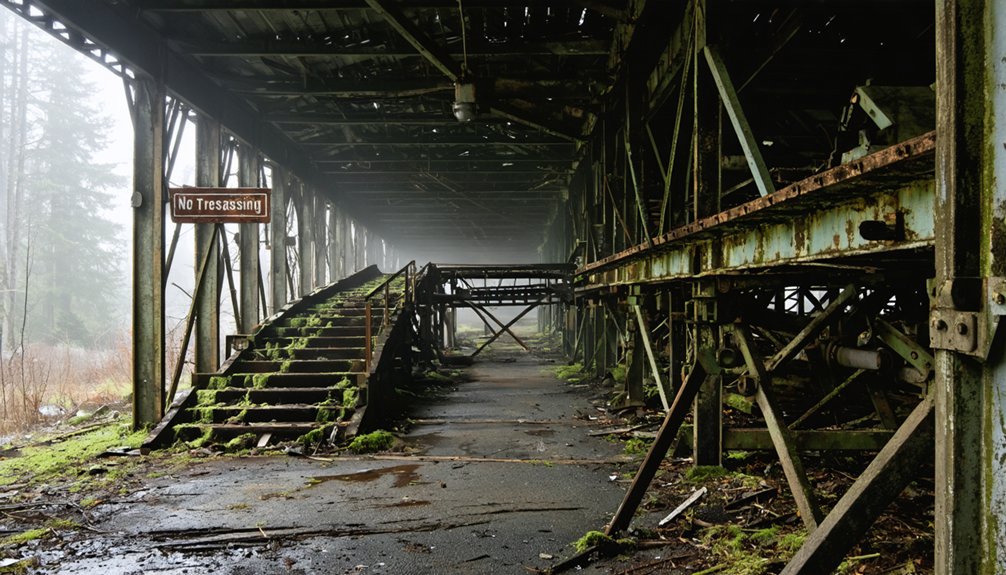
During the 1970s, a wave of environmental regulations transformed the American logging industry through landmark legislation. You’ll find that the Forest Practices Act, Clean Water Act, and Endangered Species Act created unprecedented regulatory challenges for logging operations.
These laws fundamentally changed how you could harvest timber, forcing the industry to abandon traditional clear-cutting methods and adopt more selective logging practices.
- The environmental impacts led to mandatory reforestation rules and strict protections for waterways.
- You couldn’t access many previously available logging areas, especially on public lands.
- Your operational costs increased greatly due to new equipment requirements and compliance measures.
The industry’s shift toward sustainable practices, while environmentally necessary, placed immense financial pressure on logging communities.
Environmental regulations protected forests but devastated logging communities, forcing many small operators into financial hardship during the industry’s transformation.
Small operators couldn’t afford the mounting compliance costs, leading many logging towns toward economic decline.
Social Fabric Dissolution in Logging Towns
These regulatory changes struck at more than just the economic foundations of logging communities – they accelerated the dissolution of tight-knit social networks that had defined these towns for generations.
You’d find a complex web of community bonds in these settlements, even though they were built on inherently unstable ground. Worker identity formed around shared experiences in the mills and forests, creating a distinct culture despite the transient nature of the workforce.
The company’s control over housing, stores, and social life created deep dependencies, while the isolation of these remote camps forced residents to rely heavily on each other.
When towns shut down, you’d see entire families uprooted with little notice, severing relationships built over years. These disruptions permanently altered the cultural fabric that had united logging communities.
Frequently Asked Questions
How Did Logging Ghost Towns Impact Native American Communities in These Regions?
Like shadows of broken promises, logging ghost towns carved deep scars in Native American life, causing cultural displacement from ancestral lands, disrupting traditional hunting routes, and creating lasting economic challenges for indigenous communities.
What Happened to the Machinery and Equipment Left Behind in Ghost Towns?
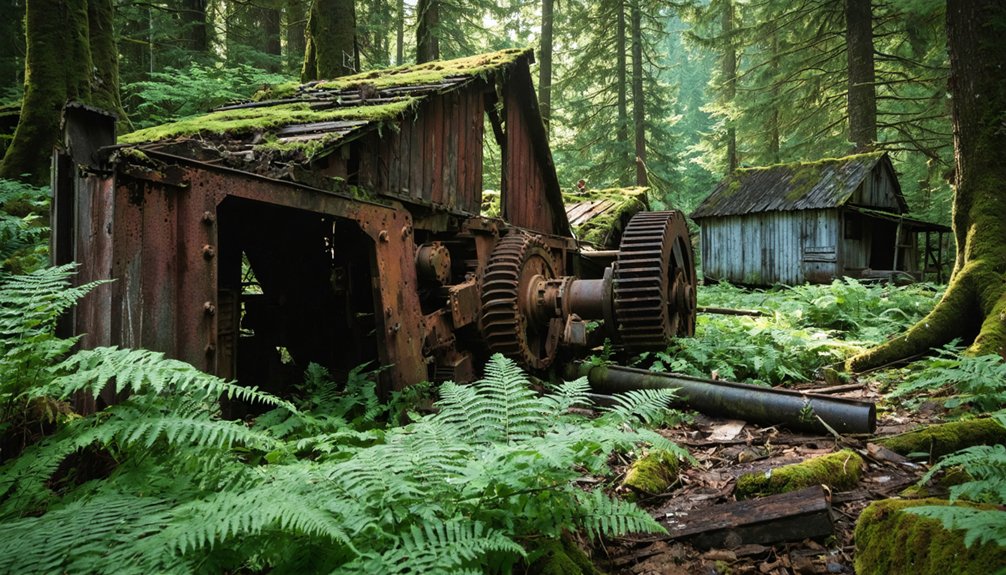
You’ll find abandoned machinery rusting in ghost towns where removal costs exceeded value. Companies relocated valuable equipment, but remote locations forced them to leave heavier pieces behind to decay naturally.
Are Any Former Logging Ghost Towns Being Successfully Revitalized Today?
You’ll find a million success stories of revitalization efforts turning ghost towns around today. Centralia, Jerome, and Barkerville have overcome economic challenges through tourism, sustainable housing, and cultural preservation projects.
How Did Women’s Roles Change in Logging Communities as Towns Declined?
You’ll find women’s labor shifted dramatically as logging declined, with women taking on forest-based income activities, increased domestic responsibilities, and essential roles in community resilience, despite facing persistent gender barriers.
Did Any Logging Ghost Towns Become Tourist Attractions or Historical Sites?
You’ll find numerous logging ghost towns transformed into tourist attractions, with sites like Val-Jalbert and Walhalla showcasing strong tourist potential through historical preservation of mills, equipment, and community buildings.
References
- https://nwitreeservice.com/blog/10-fascinating-facts-about-minnesota-and-wisconsins-rich-timber-history/
- https://www.geotab.com/ghost-towns/
- https://jasontdunn.com/files/ghost_towns_big_cities.pdf
- https://www.okhistory.org/publications/enc/entry?entry=MI028
- https://www.blm.gov/sites/default/files/uploads/AML_PUB_DecadeProgress.pdf
- https://www.loveexploring.com/gallerylist/188219/the-us-state-with-the-most-ghost-towns-revealed
- https://www.visitmammoth.com/blogs/history-and-geology-bodie-ghost-town/
- https://wou.edu/history/files/2015/08/Ron-Vorderstrasse.pdf
- https://wi101.wisc.edu/the-lumber-industry-in-northern-wisconsin/
- https://en.wikipedia.org/wiki/Ghost_town