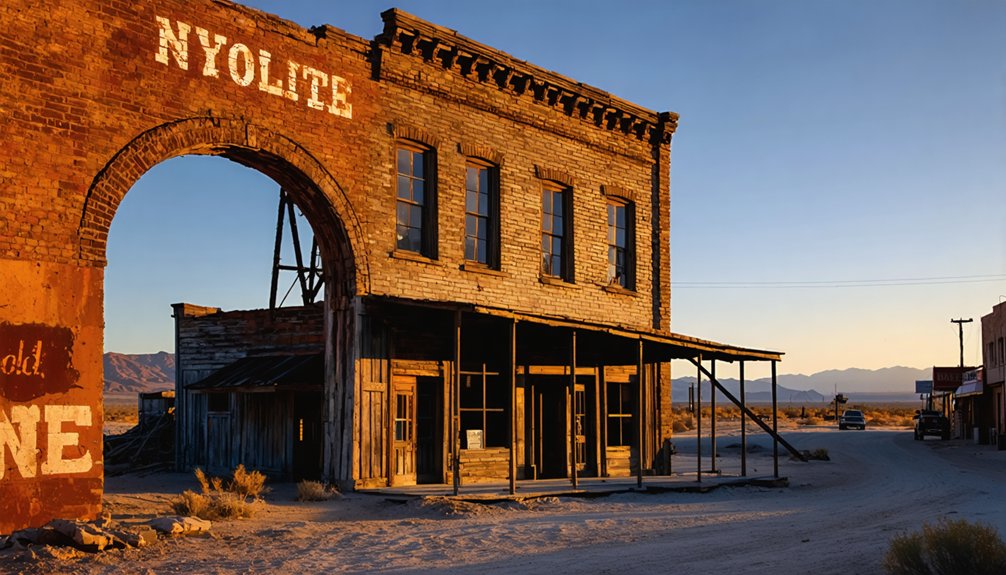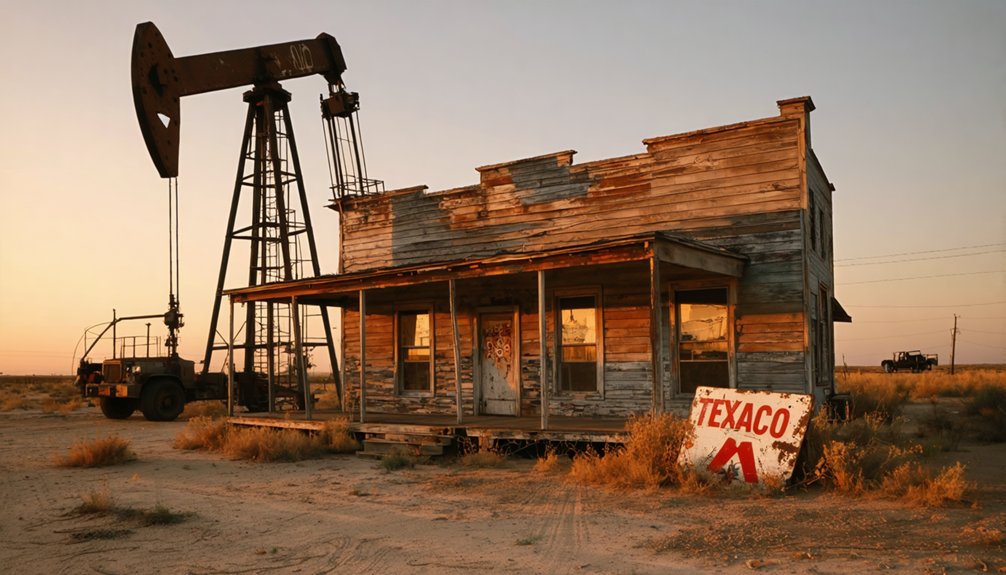
Oil boom town remnants persist because you’ll find multiple barriers preventing their removal. The cleanup costs for contaminated soil and groundwater are prohibitively expensive, while aging infrastructure creates ongoing maintenance burdens for local governments. You’ll notice legal complications from split estate ownership further complicate demolition efforts. These ghost towns also hold historical value as preserved examples of America’s petroleum heritage – a deeper story that reveals economic and social transformations.
Key Takeaways
- High cleanup and demolition costs make removing abandoned structures financially unfeasible for local governments with diminished tax bases.
- Legal complexities from split estate ownership between surface and mineral rights prevent clear authority over property decisions.
- Historical preservation efforts protect boom town remnants as educational resources and tourist attractions documenting America’s petroleum heritage.
- Environmental contamination from industrial waste and toxic soil makes land rehabilitation extremely difficult and cost-prohibitive.
- Oversized infrastructure remains because reduced populations lack resources to maintain or remove facilities built during peak prosperity.
The Economic Echoes of Single-Industry Dependence
While many thriving cities depend on diverse economic engines, single-industry towns face unique vulnerabilities that can spiral into devastating collapses.
Cities with diverse economies flourish, while towns dependent on a single industry risk catastrophic downfalls when that lifeline fails.
When you’re living in an oil town, you’ll notice how your community’s economic vulnerability extends far beyond the industry itself. As oil companies shut down, you’ll watch local businesses struggle and close their doors, unable to survive without the spending power of industry workers.
Today’s most resilient communities rely on entrepreneur-led development to build diverse economic foundations. You’ll see your town’s resilience tested as the tax base crumbles, forcing cuts to essential services like police and fire protection. The resulting deterioration often leads to increased crime rates as unemployed residents struggle to maintain stability.
The ripple effects will touch every aspect of your community, from deteriorating roads to shuttered shops. In remote areas, you’ll find these challenges intensified, as geographic isolation leaves few alternative industries to cushion the economic blow.
Physical Reminders: Abandoned Infrastructure and Ghost Buildings
The desolate shells of former oil boom towns tell their stories through layers of abandoned infrastructure.
You’ll find empty streets leading nowhere, crumbling man camps, and deteriorating industrial facilities that once hummed with activity. These ghost towns showcase the stark reality of boom-bust cycles, where rapid development leaves behind a maze of unused roads, vacant housing complexes, and aging pipelines. The stark lesson from Watford City’s previous oil boom in 1980s demonstrates how quickly prosperity can vanish. In New York alone, there are 34,000 orphaned wells scattered across the landscape, serving as stark reminders of the industry’s decline.
The economic decline in Midwest towns has especially pronounced effects on local communities, leading to rising unemployment rates and diminishing services. As families leave in search of better opportunities, schools and healthcare facilities struggle to stay afloat, further compounding the challenges faced by those who remain. This cycle of disinvestment and depopulation threatens not only the economic health of these towns but also their cultural identity and sense of community.
Beyond the abandoned structures, you’ll see the strain on local governments struggling to maintain oversized infrastructure built for populations that no longer exist.
Some sites find new purpose as tourist attractions or informal recreation areas, while others slowly decay. The landscape bears witness through unplugged wells, dormant refineries, and mothballed processing facilities – each a reflection of the temporary nature of single-industry prosperity.
Environmental Scars and Contamination Challenges
You’ll find that many former oil boom towns sit atop a toxic legacy of contaminated soil and groundwater from millions of gallons of spilled wastewater containing radioactive materials, carcinogens, and salt.
The environmental damage blocks natural recovery, as salt-saturated soil creates dead zones where vegetation can’t regrow and dangerous chemicals persist in the ground for decades.
These sites face ongoing groundwater contamination challenges, with harmful substances seeping into aquifers and drinking water sources at levels far exceeding EPA safety limits. In 2018 alone, fracking operations generated 19 billion gallons of potentially hazardous wastewater in North Dakota. The problem is compounded by an estimated orphan wells numbering over 300,000 nationwide that continue leaking toxic water near homes and streams.
Toxic Soil Blocks Recovery
Lingering beneath abandoned oil boom towns lies a toxic legacy that continues to block recovery efforts decades after the last wells ran dry.
You’ll find the soil saturated with salt-laden wastewater and chemical cocktails that create lasting barriers to ecological recovery.
The toxic soil prevents natural healing through several devastating mechanisms:
- Salt crusts form impermeable layers that block water infiltration and root growth
- Disrupted microbial communities can’t support nutrient cycling or plant life
- Compacted, structurally degraded soil resists natural revegetation
- Chemical contamination persists, making land unsafe for agriculture or development
For every barrel of crude oil extracted, an average of ten barrels of brine is produced, severely amplifying the contamination problem.
Even with modern remediation techniques, you’re facing a complex challenge – these soils often remain hostile to life long after the boom ends, leaving communities with limited options for reclaiming their land.
With nearly 2,000 documented spills in Colorado alone between 2009 and 2013, the scale of soil contamination from oil and gas operations remains a persistent environmental challenge.
Groundwater Pollution Persists
While abandoned oil boom towns struggle with surface contamination, an even more insidious threat lurks beneath – widespread groundwater pollution that’s proven nearly impossible to reverse.
You’ll find toxic migration occurring through poorly constructed wells, where faulty cement casings create pathways for dangerous chemicals to seep into aquifers. The damage extends far beyond regulated areas as injection wells, operating under excess pressure, fracture subsurface rock and disperse contaminants. States like Texas and Pennsylvania maintain stricter environmental protections against these risks. A recent study spanning 11 years of data reveals consistent increases in harmful elements near fracking operations.
What’s particularly alarming is how this groundwater contamination disproportionately affects minority and low-income communities. Your drinking water could contain benzene at six times EPA limits, while barium, chloride, and strontium levels continue rising in nearby watersheds.
Once these toxic brines infiltrate underground water sources, there’s virtually no way to clean them up.
Cultural Heritage and Historical Preservation Value
You’ll find that preserving oil boom town remnants offers tangible connections to local mining heritage through restored structures, equipment, and artifacts that tell the story of America’s energy frontier.
These preserved sites create valuable heritage tourism opportunities, drawing visitors who want to experience authentic locations where petroleum-driven communities once thrived.
The remnants serve as powerful educational platforms where you can examine industrial archaeology, study boom-and-bust economic cycles, and understand the social dynamics that shaped these unique communities.
Preserving Local Mining History
As ghost towns from America’s oil boom era quietly decay, their remnants serve as essential touchstones for preserving local mining history.
These physical testimonies of rapid growth and social transformation help you connect with your mining heritage while strengthening community identity through tangible links to the past.
When you explore these historic sites, you’ll find they offer invaluable educational opportunities:
- Original facades and interior details provide authentic glimpses into working-class life during resource extraction booms
- Preserved buildings illustrate utilitarian architecture that defined early 20th-century industrial development
- Historic structures embody narratives of economic transformation, migration, and hardship
- Protected sites serve as hands-on classrooms for understanding local history and technological evolution
These preserved remnants don’t just tell stories – they’re essential tools for understanding how resource extraction shaped American communities.
Heritage Tourism Opportunities
Since the decline of oil production, former boom towns have discovered significant potential in heritage tourism as an economic lifeline.
You’ll find these towns leveraging their unique historical assets, from preserved downtown districts to connections with notable figures like LBJ in Cotulla, Texas. Their existing infrastructure, including surplus hotels built during the fracking boom, provides immediate capacity for visitors.
National heritage designations reveal vital resources for economic diversification, offering access to federal grants and inclusion in tourism networks.
You can explore authentic early 20th-century architecture, converted rail depots, and historic oil industry sites that tell America’s energy story.
Many towns are strategically developing tourism clusters, combining museums, historic walking tours, and local dining to create compelling visitor experiences that extend beyond single attractions.
Educational Sites For Learning
Beyond their tourism appeal, oil boom town remnants serve as powerful educational platforms that chronicle America’s petroleum heritage. Through museums, preserved buildings, and interpretive centers, you’ll discover how these sites facilitate community engagement and provide hands-on learning experiences that bring history to life.
Educational programs highlight key aspects of the oil boom era:
- Original artifacts and drilling equipment demonstrations showcase technological evolution
- Preserved architecture reveals rapid urban development patterns and construction methods
- Interactive exhibits document social transformations and demographic shifts
- Museum collections tell stories of corporate influence and worker experiences
These tangible connections to the past help you understand the complex socioeconomic impacts of petroleum discovery, while preserved streetscapes and buildings illustrate how boomtowns either evolved into sustainable communities or faced decline.
Social Disruption and Community Transformation
When oil boom towns experience rapid population surges, they face severe social disruption that tears at the fabric of previously tight-knit communities.
You’ll witness social fragmentation as transient workers flood in, bringing different values and lifestyles that clash with long-term residents. The rapid changes strain mental health services, with some towns seeing up to 90% increases in cases.
You’ll find that crime rates spike, particularly violent offenses and substance abuse, while law enforcement struggles to keep pace.
The economic disparities between newcomers and locals create deep divisions, as housing costs soar and fixed-income residents get pushed out.
Traditional community bonds dissolve as trust erodes between established residents and temporary workers, leading to decreased participation in local institutions and a loss of shared identity.
The Cost Barriers of Infrastructure Removal
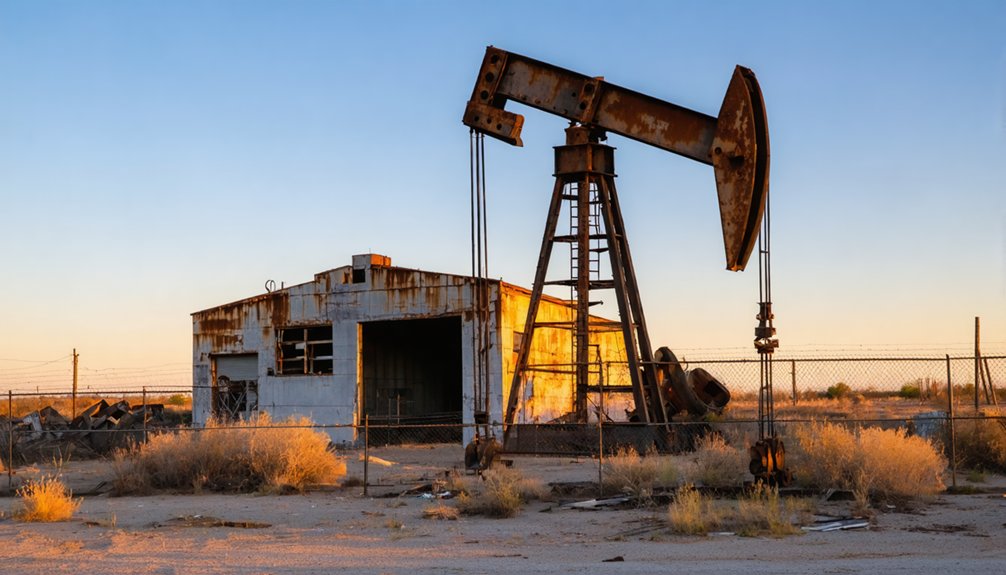
Although abandoned oil boom towns stand as haunting reminders of industry decline, the staggering costs of infrastructure removal present the most formidable challenge for recovery efforts.
You’ll find infrastructure funding gaps that create nearly insurmountable barriers, with cleanup costs reaching $151.3 billion for orphan wells alone.
- A single well decommission costs around $167,000, far exceeding industry bonds
- Technical complexities require specialized equipment and expertise
- Toxic contamination demands extensive environmental remediation
- Remote locations amplify logistical challenges and operational expenses
The massive disparity between available funds and actual removal costs leaves you facing a stark reality: even substantial federal allocations can’t bridge the gap.
Despite billions in federal support, the chasm between cleanup costs and available funding remains an overwhelming economic burden.
When companies abandon their cleanup responsibilities, you’re left with deteriorating infrastructure that continues to burden local communities and taxpayers.
Legal Complexities and Property Ownership Issues
The deep-rooted legal complexities surrounding abandoned oil boom towns stem from a historically entrenched system of split estate ownership, where surface rights remain separate from mineral rights.
You’ll find yourself severely limited in your property control, as mineral rights holders maintain legal precedence over surface owners in extraction matters.
This ownership fragmentation creates a web of challenges you must navigate. Your property value can drop up to 13% due to active mineral leases, and you’ll face difficulties securing mortgages or selling your land.
Legal disputes frequently arise from unclear titles and absentee mineral rights holders, while environmental liabilities from past extraction activities further complicate property transfers.
You’re often left dealing with outdated legal frameworks that weren’t designed to address modern conflicts between surface owners and mineral rights holders.
Tourism Potential and Educational Significance
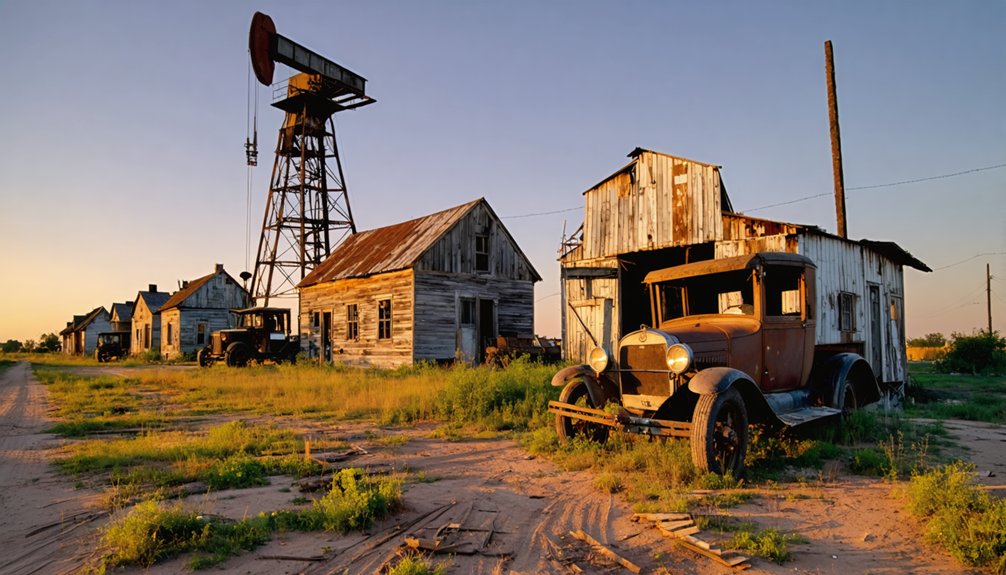
Beyond the legal entanglements of ownership, abandoned oil boom towns hold significant value as destinations for heritage tourism and educational exploration.
These sites offer unique tourist experiences through their well-preserved structures and compelling historical narratives. You’ll discover immersive learning opportunities that bring the past to life while contributing to local economic revitalization.
Step into America’s oil heritage through authentic historic sites that offer both education and adventure while boosting local communities.
- Explore visually striking landscapes filled with preserved architecture, from worker bunkhouses to industrial foundations, perfect for photography enthusiasts.
- Experience living history through guided tours, educational exhibits, and authentic reenactments depicting life during peak oil production.
- Support local economies through heritage tourism spending on accommodations, dining, and guided experiences.
- Witness firsthand the economic cycles and technological evolution of America’s oil industry through tangible remnants and interpretive displays.
Frequently Asked Questions
How Long Does It Typically Take for an Oil Boom Town to Become Abandoned?
You’ll typically see a complete abandonment timeline of 5-20 years after peak production, with economic decline starting within 2-5 years and accelerating rapidly once oil operations cease.
What Percentage of Oil Boom Town Residents Typically Stay After the Bust?
While transient workers flee, permanent residents dig in – but you’ll typically find less than 50% resident retention post-bust, as economic sustainability falters and job opportunities vanish in oil-dependent communities.
Can Contaminated Boom Town Sites Ever Be Fully Restored to Natural Conditions?
You can achieve partial ecological restoration through soil remediation, but you’ll rarely restore boom town sites to fully natural conditions due to persistent hydrocarbon contamination and permanent changes to soil structure.
Do Indigenous Communities Receive Compensation When Boom Towns Affect Their Territories?
You’ll find compensation agreements for Indigenous communities are often inadequate or nonexistent, despite legal frameworks. When payments exist, they rarely reflect true costs or respect indigenous rights to self-determination.
How Do Modern Boom Towns Differ From Historical Ones in Their Development Patterns?
In a world of infinite possibilities, you’ll find modern boom towns excel at urban planning and economic sustainability, unlike their chaotic predecessors. They’re built with diversified economies, permanent infrastructure, and organized community development.
References
- https://www.youtube.com/watch?v=eyOASXxAmMI
- https://notevenpast.org/historical-perspectives-on-the-fracking-boom/
- https://commons.und.edu/cgi/viewcontent.cgi?article=6232&context=theses
- https://www.clevelandfed.org/publications/economic-commentary/2016/ec-201613-geographic-mobility-and-consumer-financial-health-oil-boom-towns
- http://www.fossilfuelconnections.org/boomtown-social-effects
- https://en.wikipedia.org/wiki/Boomtown
- https://money.howstuffworks.com/10-boom-towns-that-went-bust.htm
- https://ysu.edu/center-working-class-studies/social-costs-deindustrialization
- https://www.bsu.edu/-/media/www/departmentalcontent/cber/pdfs/smallcities/sc2018-papers/mallach-economic-fortunes-3-5-18.pdf
- https://www.nlc.org/article/2025/05/01/how-cities-can-spark-economic-transformation-through-entrepreneur-led-economic-development/