Rust Belt ghost towns draw you into a haunting paradox of America’s industrial legacy. You’ll find abandoned factories and silent streets serving as both monuments to economic devastation and raw canvases for creative rebirth. These architectural time capsules preserve working-class narratives through crumbling concrete and overgrown lots, while revealing stark lessons about concentrated industrial dependency. Within their decay lies a complex story of innovation, collapse, and the potential for cultural renaissance through adaptive reuse.
Key Takeaways
- Rust Belt ghost towns serve as powerful reminders of America’s industrial heritage and the dramatic economic transformations that shaped modern society.
- The haunting beauty of decaying architecture and nature’s reclamation creates a paradoxical aesthetic that draws photographers and urban explorers.
- These abandoned spaces tell compelling stories of immigrant workers, labor struggles, and working-class communities that built America’s industrial might.
- Ghost towns function as living museums, preserving historical memory through their architecture, empty streets, and remaining cultural artifacts.
- The transformation of industrial ruins into artistic spaces and cultural centers demonstrates hope for renewal amid economic decline.
The Rise and Fall of American Industrial Giants
While the American Civil War marked a turning point in the nation’s history, the decades that followed would usher in an unprecedented era of industrial transformation led by pioneering titans of industry.
You’d witness figures like Carnegie, Rockefeller, and Morgan reshape America through industrial innovation and corporate consolidation, driving technological advancements that forever changed the landscape.
Their empires grew through aggressive expansion, turning small operations into vast monopolies that controlled entire sectors.
This massive urban migration brought millions of immigrant workforce members to fuel the factories, but you’d also see stark economic disparity emerge.
As economic fluctuations intensified, labor struggles became commonplace, creating social upheaval that would define the era.
Through boom and bust cycles, these industrial giants laid the foundation for both America’s rise and eventual industrial decline.
Railroad networks expanded dramatically, growing from 35,000 miles of track after the Civil War to over 200,000 miles by 1900.
The nation’s rapid industrialization created a new class divide, with one million workers losing their jobs during the devastating financial panic of 1873.
Haunting Beauty in Urban Decay
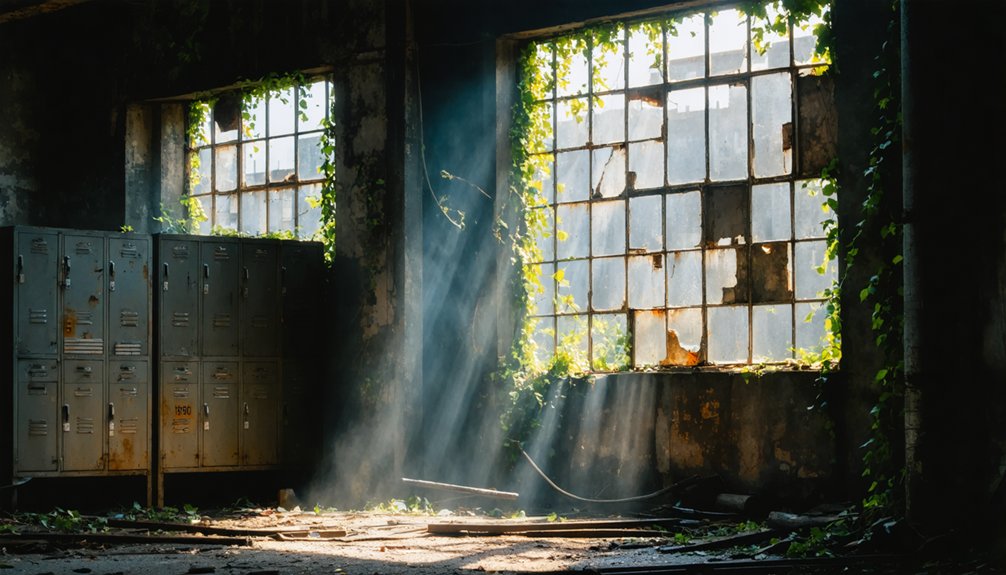
As you traverse the skeletal remains of America’s industrial heartland, abandoned factories and empty homes create a paradoxical beauty through their decay.
The haunting nostalgia of these spaces draws urban exploration enthusiasts and photographers, seeking to document a frozen moment in American history.
These decaying landscapes tell compelling stories of economic transformation:
- Peeling paint and broken windows reveal architectural details once hidden beneath industrial prosperity
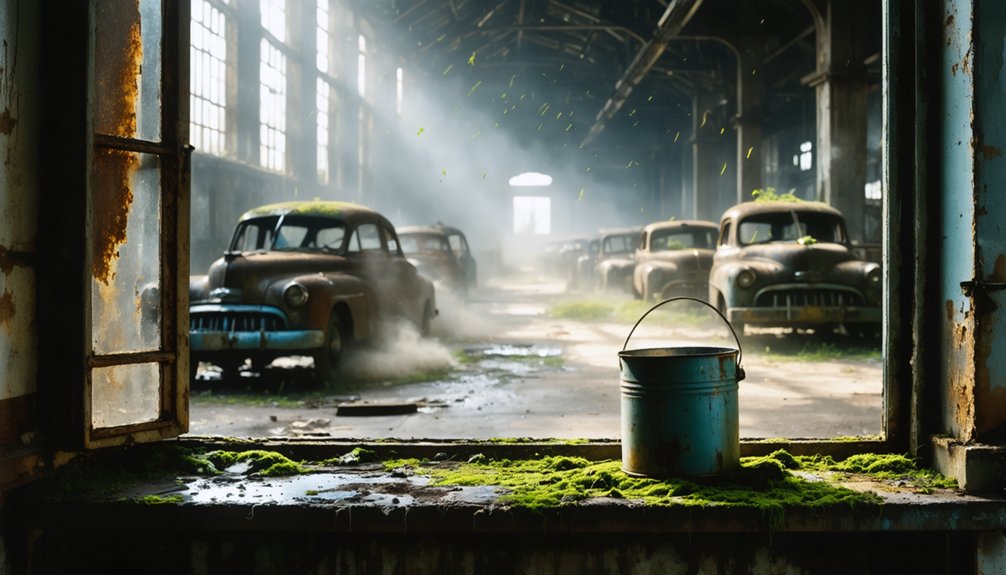
- Nature’s slow reclamation creates striking contrasts as vegetation embraces crumbling brick and rusted metal
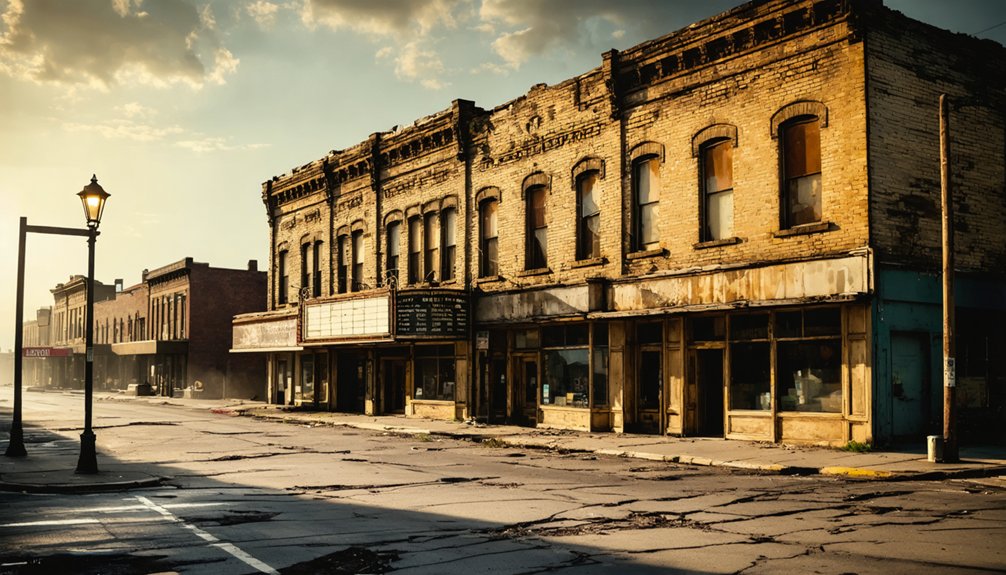
- Empty streets and vacant lots echo with the memories of bustling communities, now silent witnesses to change
In cities like Gary, Indiana, where U.S. Steel helped build a thriving community in 1906, these abandoned neighborhoods now stand as stark reminders of industrial decline.
You’ll find that these ghost towns aren’t just monuments to decline – they’re powerful symbols of American economic evolution, where each abandoned structure represents both loss and the potential for renewal.
In Detroit’s McDougall-Hunt neighborhood, the striking Heidelberg Project art installation attracts hundreds of thousands of visitors annually, proving that beauty and cultural significance can emerge from urban decay.
Time Capsules of Working-Class America
Beyond their empty storefronts and silent factories, Rust Belt ghost towns serve as powerful repositories of working-class American history.
You’ll find physical remnants that tell stories of industrial might – abandoned steel mills where generations of European immigrants and African Americans forged America’s economic backbone. These ghost towns preserve the cultural DNA of union halls, factory whistles, and blue-collar pride.
Walking through these industrial time capsules, you’ll witness how deindustrialization transformed thriving communities into shadows of their former selves. Communities like Aliquippa and Braddock still face desolation and poverty as lasting effects of industrial decline. The decline was particularly severe as manufacturing jobs halved between 1970 and 2000 across America.
The industrial nostalgia isn’t just about rusting machinery – it’s about the human experience of economic upheaval. Each shuttered business and vacant home represents displaced families, lost livelihoods, and the stark reality of capitalism’s creative destruction.
These spaces embody both the rise and fall of America’s industrial working class.
Through the Lens of History and Memory
Through decades of economic transformation, Rust Belt ghost towns have become living museums that chronicle America’s industrial rise and fall. In these abandoned landscapes, you’ll find powerful symbols of industrial nostalgia – from silent steel mills to empty worker housing that once bustled with immigrant families.
As residents adapt to economic shifts in Rust Belt towns, new opportunities for innovation and revitalization emerge. Entrepreneurs are increasingly drawn to these areas, seeking to harness the rich history while fostering modern enterprises. This blend of the past and future creates a dynamic environment where remnants of industry meet the aspirations of a new generation.
Memory preservation becomes essential as these sites tell the story of America’s economic evolution. In Stubenville, the City of Murals captures this preservation through public art depicting local history and cultural heritage. Pittsburgh’s legacy as a steel production center demonstrates how a single industry could shape an entire region’s destiny.
- Abandoned factories stand as architectural monuments to manufacturing might, their rusted frames reflecting both innovation and decline.
- Former company towns reveal distinct urban planning patterns that shaped working-class life.
- Shuttered storefronts and community spaces preserve the social fabric of an era when production defined American identity.
You’re witnessing more than decay – you’re seeing the physical embodiment of economic shifts that transformed not just places, but the very nature of American prosperity.
The Art of Abandonment and Creative Revival
You’ll find an unexpected artistic renaissance emerging from the skeletal remains of Rust Belt ghost towns, where abandoned factories and warehouses serve as vast canvases for creative expression.
Through strategic adaptive reuse policies and arts-focused initiatives, these industrial spaces are being transformed into galleries, studios, and cultural centers that honor their working-class heritage while fostering new economic opportunities. Similar to Jerome, Arizona’s success, where monthly gallery openings showcase diverse artistic talent and revitalize the local economy. Local communities and preservation societies work to maintain a delicate balance between historical authenticity and visitor engagement.
The resulting artistic communities aren’t just preserving architectural history—they’re actively reimagining these spaces through contemporary creative practices, from large-scale installations to community workshops that breathe new life into once-dormant structures.
Urban Canvas Emerges
As abandoned factories and vacant buildings dot the Rust Belt’s landscape, innovative artists and urban planners have transformed these skeletal remains into vibrant canvases of creative expression.
You’ll witness how urban revitalization through art has sparked economic renewal, turning industrial ruins into cultural hubs that attract thousands of visitors annually.
- Detroit’s Heidelberg Project demonstrates how creative expression can transform neglected neighborhoods into internationally recognized artistic landmarks.
- Participatory art installations foster community engagement while documenting the complex narrative of decline and resilience.
- Adaptive reuse of industrial spaces into galleries and performance venues creates sustainable economic opportunities.
These artistic interventions aren’t just aesthetic – they’re catalysts for economic diversification, drawing new businesses and younger demographics to previously abandoned areas while preserving the authentic character of these industrial giants.
Beauty Within Decay
The haunting beauty of Rust Belt abandonment emerges from a complex interplay of industrial decay, natural reclamation, and human memory.
You’ll find striking contrasts in these forgotten landscapes, where crumbling factories stand as silent witnesses to America’s industrial past, their weathered walls creating an unintended decay aesthetics that draws hundreds of thousands of visitors annually.
Nature’s slow reconquest adds another layer of visual poetry, with vegetation weaving through broken concrete and rusty metal.
This transformation creates a nostalgic allure that resonates deeply with photographers, urban explorers, and artists who view these spaces as raw creative canvases.
In places like Detroit’s McDougall-Hunt, you’ll discover how this industrial decomposition tells powerful stories of economic change, social upheaval, and resilience, turning abandoned spaces into profound statements about American transformation.
Art Transforms Empty Spaces
Many abandoned industrial spaces across the Rust Belt have undergone remarkable transformations through strategic arts initiatives, becoming vibrant cultural hubs that drive economic revitalization.
You’ll find artistic rejuvenation taking shape in former factories and warehouses, where creative spaces now foster innovation and community engagement.
These architectural metamorphoses offer:
- Adaptive reuse of historic buildings into galleries, studios, and performance venues
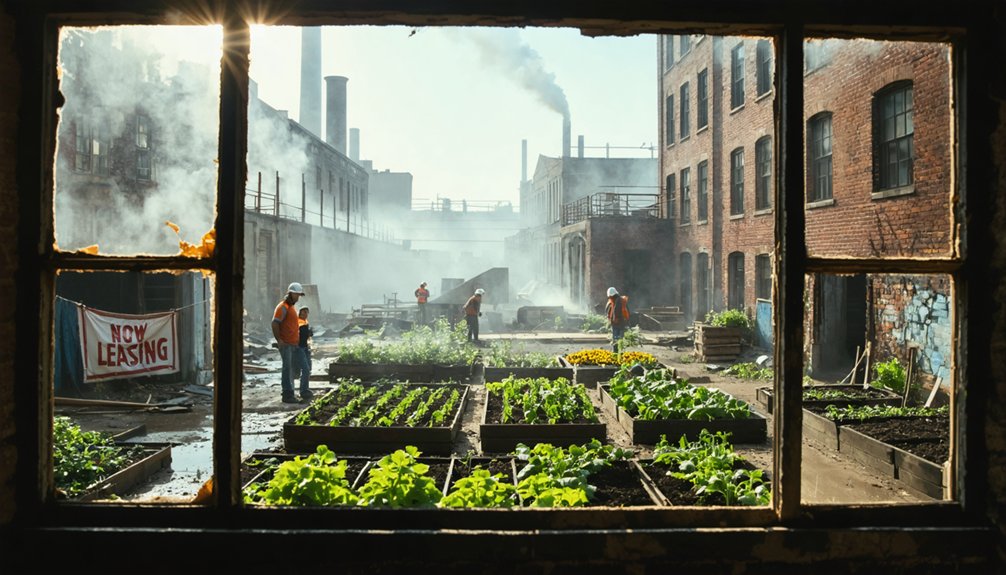
- Integration of artisanal businesses like breweries and urban farms
- Affordable live-work spaces that attract creative professionals
Through collaborative efforts between artists, developers, and local governments, these transformations breathe new life into neglected properties.
You’re witnessing a revolutionary approach to urban renewal, where creative communities view abandoned spaces not as symbols of decay, but as canvases for innovation and economic growth.
Echoes of Lost Communities and Social Bonds

Once-bustling Rust Belt communities now stand as stark symbols to the profound social bonds that industrial prosperity made possible.
You’ll find their remnants in abandoned church halls where immigrant families once gathered, and empty union buildings that hosted generation-defining meetings. These physical spaces tell stories of tight-knit neighborhoods where ethnic traditions, family connections, and shared industrial work schedules created intricate social tapestries.
Today’s landscape reveals the harsh reality of community fragmentation.
Where vibrant street life once flourished, social isolation prevails. Empty lots between occupied homes mark the physical gaps in once-continuous neighborhoods.
Once-thriving streets now stand silent, with vacant spaces between homes like missing teeth in a broken community’s smile.
Yet traces of former liveliness persist in art installations, preserved cultural rituals, and local history projects – each attempting to maintain connections to an era when industrial work united diverse communities through shared purpose and place.
Economic Scars and Cultural Resilience
If you walk through any Rust Belt ghost town today, you’ll find the economic scars etched into every abandoned storefront and factory – stark reminders of unemployment rates that once soared to 18% and poverty levels reaching 35%.
Behind the broken windows and crumbling facades, you’ll discover how these communities lost two-thirds of their populations as manufacturing jobs vanished and young workers fled.
Yet amid the industrial ruins, you’ll also witness surprising signs of cultural resilience, where local artists and community groups transform abandoned spaces into galleries and gathering places, refusing to let their towns’ identities fade entirely.
Scars Behind Empty Windows
Behind each empty window in America’s Rust Belt lies a stark economic narrative that transformed vibrant industrial centers into shells of their former prosperity.
As you explore these ghost towns, you’ll find economic decline etched into every abandoned storefront, where median incomes have plunged by 30% and unemployment has soared to 18% in places like Bruceton.
- Shuttered factories stand as monuments to lost manufacturing jobs, driving community-wide poverty rates above 35%
- Reverse gentrification has hollowed out middle-class neighborhoods, creating pockets of intense urban blight
- Social disparities widened as public services crumbled, with some areas seeing triple the crime rates
You’re witnessing the physical manifestation of structural economic shifts that have reshaped entire communities, leaving behind vacant properties numbering in the thousands – silent reminders of the region’s industrial heritage.
Art Amid Industrial Ruins
Through a remarkable cultural metamorphosis, the decaying industrial landscape of America’s Rust Belt has evolved into an unexpected canvas for artistic expression and community renewal.
You’ll find abandoned factories transformed into vibrant galleries, while massive murals breathe new life into vacant buildings. This artistic reclamation reflects both defiance and hope, as creators repurpose rusted metal and weathered wood into powerful installations that honor the region’s industrial heritage.
What you’re witnessing isn’t just aesthetic transformation – it’s economic resistance. Artists channel industrial nostalgia into documentary photographs, community-driven festivals, and site-specific sculptures that challenge the narrative of decay.
In cities like Detroit and Cleveland, grassroots collectives are turning economic scars into cultural assets, proving that creativity thrives precisely where industry has retreated, marking a powerful shift from production lines to creative spaces.
Tourism in the Shadows of Industry
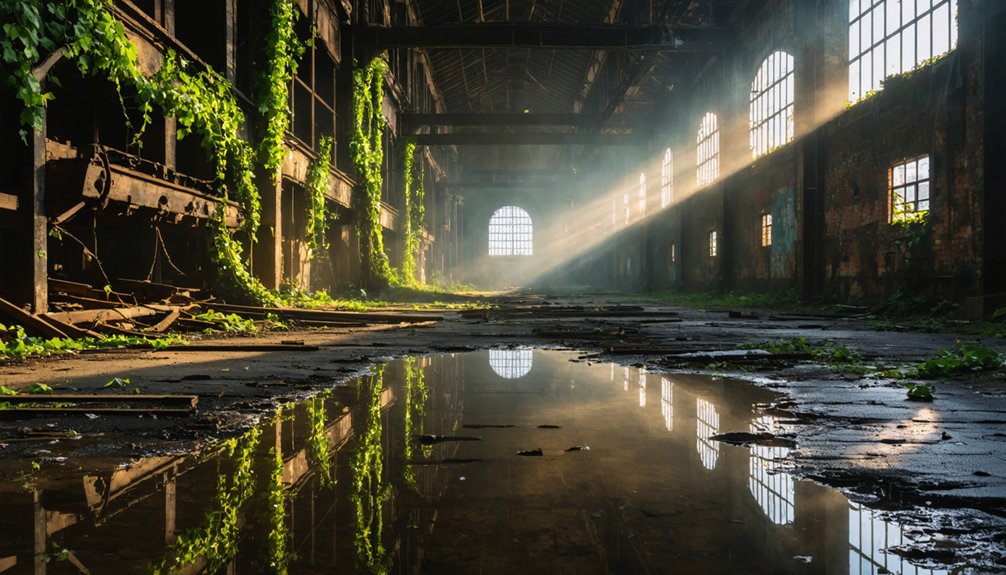
While America’s industrial heartland has experienced devastating economic decline, many Rust Belt communities have discovered an unexpected lifeline in tourism centered around their abandoned factories and mills.
Ghost town tourism transforms economic hardship into opportunity, as you’ll discover authentic industrial ruins maintained in “arrested decay” that tell stories of America’s manufacturing might.
These industrial landscapes offer:
- Interactive experiences like mine tours and worker reenactments that bring labor history to life
- Photogenic urban exploring opportunities through weathered buildings and empty streets
- Cultural events and art installations that reimagine abandoned spaces
You’ll find yourself walking through preserved steel mills and mining facilities that showcase technological heritage while supporting local economies.
Industrial nostalgia drives visitors to these atmospheric sites, where decaying architecture becomes a powerful draw for those seeking authentic American history.
Preserving Stories of American Transformation
You’ll encounter powerful personal narratives in every abandoned factory and empty storefront of America’s Rust Belt ghost towns, where former workers and residents preserve their memories of bustling industrial life.
Through oral histories, photographs, and preserved artifacts, these communities document the dramatic socioeconomic transformation from manufacturing powerhouses to post-industrial landscapes.
Your exploration of these preservation efforts reveals not just economic statistics, but the human story of American industrial rise and decline, captured in the voices of those who lived through unprecedented change.
Voices Behind Empty Streets
Behind the abandoned factories and decaying storefronts of America’s Rust Belt ghost towns lies a rich tapestry of human experiences that demand preservation.
Through community narratives and grassroots activism, you’ll discover how residents actively reshape these forgotten spaces, transforming loss into opportunity.
- Detroit’s Heidelberg Project exemplifies how art installations can preserve local memory while challenging traditional urban renewal.
- Oral histories capture the complex emotions of those who’ve weathered decades of economic decline and social dislocation.
- Citizen-led storytelling initiatives inform policy-makers about priorities beyond mere economic metrics.
You’re witnessing a powerful movement where preservation meets empowerment.
As communities reclaim their narrative through creative interventions and DIY urbanism, they’re not just documenting decay – they’re actively writing the next chapter of American transformation, ensuring their voices echo through time.
Documenting Industrial Heritage Lost
The stark statistics of America’s industrial decline tell a deeper story than mere numbers can convey. You’ll find the evidence in pollution-efficiency ratios that plummeted 3.8 times below non-Rust Belt states by 2018, marking the physical remnants of our industrial heritage.
Each shuttered factory adds to the architectural legacy that heritage documentation must preserve.
You’re witnessing a transformation more dramatic than Europe’s – while 50% of German industrial cities recovered, only 17% of U.S. counterparts rebounded.
Cities like Detroit and Cleveland lost up to 46% of their populations, leaving behind vast industrial complexes as monuments to industrial nostalgia.
These empty structures and declining neighborhoods aren’t just symptoms of economic change – they’re physical archives of America’s manufacturing might, demanding preservation before they disappear entirely.
Legacy Through Personal Memories
While steel mills and factories stand as physical monuments to industrial decline, personal memories form an equally essential foundation of Rust Belt heritage. Through community storytelling and nostalgia narratives, you’ll discover how generational ties weave together the complex fabric of these transformed landscapes.
- Oral histories preserve intimate accounts of boom-and-bust cycles, capturing stories that statistical data can’t convey.
- Memory preservation efforts, from photography to documented personal histories, shape collective identity formation.
- Cultural heritage initiatives driven by emotional resonance help determine which structures merit conservation.
Your connection to these ghost towns extends beyond architectural decay – it’s anchored in legacy building through collective memory.
As communities navigate between preservation and adaptive reuse, personal histories continue inspiring grassroots revitalization efforts that honor both past and future.
Lessons From Empty Streets and Silent Factories
Empty streets and shuttered factories across America’s Rust Belt serve as stark warnings about the devastating consequences of concentrated industrial dependency.
As you walk through these ghost towns today, you’ll find sobering lessons in urban survival and economic diversification.
These cities tell a cautionary tale of what happens when communities pin their futures on single industries.
You’re witnessing the aftermath of massive population exodus, with some areas losing up to 90% of their residents.
The abandoned homes – sometimes priced at just 14% of state averages – reveal how quickly prosperity can vanish.
What you’re seeing isn’t just decay; it’s a wake-up call about the importance of adaptable economies and resilient urban planning.
These silent streets remind you that no industry, no matter how mighty, guarantees permanent stability.
Frequently Asked Questions
How Safe Is It to Explore Abandoned Rust Belt Buildings Legally?
Sharp as a tack, you’ll need to practice urban exploration safety and secure permissions to avoid legal ramifications. Even with proper precautions, structural decay and toxic materials pose significant risks.
What Percentage of Rust Belt Ghost Towns Have Active Preservation Societies?
You’ll find active ghost town preservation societies in less than 25% of Rust Belt locations, as economic challenges and limited community involvement make sustaining organized preservation efforts difficult in these deteriorating architectural landscapes.
Are There Successful Examples of Ghost Towns Transforming Into Tourist Destinations?
You’ll find Instagram-worthy ghost town tourism success stories in Kennecott, Alaska, and Grafton, Utah, where historic preservation transformed abandoned settlements into thriving destinations with restored buildings and cultural attractions.
Which Rust Belt Ghost Towns Still Maintain Active Residential Communities?
You’ll find resilient residential communities in Detroit’s McDougall-Hunt, Pittsburgh’s tech corridors, Buffalo’s university districts, and parts of Gary, where historic preservation efforts and determined locals maintain their architectural heritage despite decline.
How Do Property Values Compare Between Abandoned and Revitalized Rust Belt Areas?
Like night and day, you’ll find abandoned properties selling for as little as $10,000, while revitalized neighborhoods see values soar above $100,000, reflecting dramatic economic transformations in these contrasting communities.
References
- https://www.lincolninst.edu/publications/articles/new-american-ghost-towns/
- https://schoolofcities.utoronto.ca/neighbourhood-abandonment-in-the-american-rust-belt/
- https://www.industryweek.com/talent/article/22028380/the-abandonment-of-small-cities-in-the-rust-belt
- https://www.cato.org/blog/economic-mobility-not-manufacturing-decline-real-rust-belt-story
- https://en.wikipedia.org/wiki/Rust_Belt
- https://www.aeaweb.org/research/rethinking-detroit-vacant-development-guarantees
- https://fiveable.me/key-terms/united-states-history-since-1945/rust-belt-decline
- https://www.britannica.com/place/Rust-Belt
- https://storymaps.arcgis.com/stories/814c00e0984d4054b56a407acc81b9f2
- https://pressbooks.pub/ahistoryoftheunitedstates/chapter/industrialization-the-rise-of-big-business-and-the-american-empire-1870-1900/