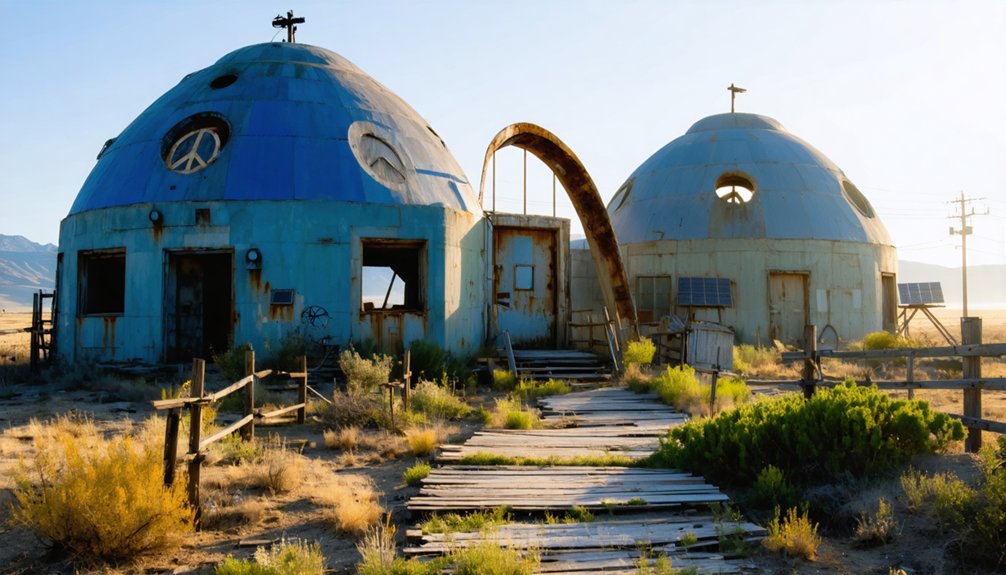
Utopian societies in the US fail because they can’t overcome fundamental human nature and practical challenges. You’ll find these communities struggle with economic instability, ineffective governance, and resource management issues that create unsustainable debt cycles. High member turnover disrupts social cohesion, while power struggles between leaders and followers intensify internal conflicts. Environmental pressures and health concerns further strain these idealistic ventures. Understanding these complex dynamics reveals deeper patterns of societal collapse that continue to shape modern intentional communities.
Key Takeaways
- Idealistic philosophies clash with practical realities, causing emotional disconnect and internal conflicts between expectations and actual experiences.
- Poor economic planning and insufficient capital lead to unsustainable debt cycles and resource management failures.
- Ineffective governance structures and power struggles create leadership instability, resulting in fragmented decision-making and community discord.
- High member turnover disrupts social cohesion, weakens cultural bonds, and creates unstable labor forces within communities.
- Inadequate infrastructure and health management lead to poor living conditions, disease outbreaks, and deteriorating mental health among members.
The Mirage of Perfect Philosophy
While utopian societies have long captured the human imagination, their foundational philosophies often prove to be their greatest weakness. You’ll find that these communities frequently stumble when their abstract theories collide with reality. The philosophical rigidity of their idealistic expectations creates an emotional disconnect between what should be and what actually is.
When you examine failed utopian visions in America, you’ll notice a pattern: communal aspirations based on unrealistic standards consistently unravel. They demand strict adherence to puritanical lifestyles, enforced socialism, or absolute cooperation that human nature simply won’t sustain. Led by charismatic messiah figures, these communities typically devolved into the very systems they originally sought to escape. At least one hundred nineteen communities emerged in early 19th century America as idealists sought to create their version of paradise.
The idealism clash becomes evident as these communities try to shape complex human behavior into their perfect philosophical mold, ultimately leading to internal conflicts, member exodus, and eventual collapse.
Economic Sustainability and Resource Management
Despite their ambitious visions, utopian communities in America consistently faltered due to fundamental economic and resource management failures. Their economic models suffered from insufficient capital investment and poor financial planning, leading to unsustainable debt cycles. Most initiatives resembled startup ventures in their brief lifespans.
This pattern of failure highlights the challenges faced by those pursuing utopian visions across American history. Each community, while inspired by ideals of equality and abundance, often became trapped in cycles of overambition and mismanagement. As they sought to create perfect societies, the harsh realities of economic constraints proved insurmountable.
You’ll find that agricultural efficiency plummeted as idealistic farming practices clashed with practical realities, while inadequate resource allocation created food insecurity and environmental degradation. The rise of these communities during the mid-19th century peak marked a critical period of widespread experimentation with communal living.
Labor management posed another critical challenge. High member turnover disrupted production methods, while communities struggled with free-riders and skill mismatches.
Ineffective labor management and constant membership changes crippled utopian communities, creating instability in their production systems and workforce.
Weak community governance structures failed to address these issues effectively. Without formal economic organization or risk management strategies, many communities couldn’t weather financial setbacks.
The dependence on external economies further undermined their cooperative ideals, forcing them to compromise their utopian principles just to survive.
Power Struggles and Leadership Dynamics
Leadership dynamics proved to be a critical fault line in American utopian societies, where ineffective governance structures and power struggles consistently undermined communal stability.
You’ll find that the absence of clear leadership accountability often led to power vacuums and factional conflicts. When charismatic leaders dominated these communities, their personal flaws and authoritarian tendencies frequently triggered internal rebellions. Like Drop City, where the lack of a formal leadership structure led to biker gang invasions.
The power dynamics became especially toxic when rigid ideological conformity was enforced, stifling necessary debate and adaptation. Without formal conflict resolution mechanisms, minor disagreements escalated into community-wide crises. Even successful communities like Mormon Utah experienced deep internal divisions over leadership and ideology.
When leaders failed to balance authority with freedom or plan for succession, their communities fractured under the weight of competing visions and personal ambitions, ultimately accelerating their collapse.
Environmental Pressures and Physical Hardships
Physical hardships in utopian societies manifested through poor sanitation and overcrowded living spaces, which fostered disease outbreaks that decimated community populations.
You’ll find that limited access to external resources and trade routes left many communities vulnerable to food shortages and material deprivation, particularly during harsh winters or periods of crop failure.
Natural disasters proved especially devastating to these isolated communes, as demonstrated when Brook Farm’s uninsured main building burned down in 1846, dealing a fatal blow to the community’s survival.
Disease and Living Conditions
While utopian societies promised ideal living conditions, the harsh realities of disease outbreaks and environmental pressures often devastated these experimental communities.
The combination of poor sanitation, overcrowded spaces, and inadequate medical care created perfect conditions for infectious diseases to spread rapidly among residents.
- You’ll find that primitive housing facilities and insufficient waste management led to unsanitary environments, greatly increasing health risks.
- Communities like Fruitlands suffered from deteriorating living conditions, with contaminated water sources and food insecurity weakening inhabitants.
- The physical isolation of these settlements meant limited access to medical resources, turning minor health issues into severe crises.
These health challenges, coupled with psychological strain from harsh living conditions, ultimately accelerated the collapse of many utopian experiments.
Resource Access Challenges
Despite grand visions of pastoral paradise, America’s utopian communities faced severe resource challenges that threatened their survival.
You’ll find these settlements often chose remote, inexpensive land with poor agricultural potential, creating immediate access disparities to essential resources. Their supply chain vulnerabilities became apparent through insufficient infrastructure, leaving them struggling to obtain basic necessities and maintain economic dependencies with outside markets. Communities without clear decision-making processes for resource allocation tended to disintegrate within their first two years.
Poor resource allocation decisions compounded their problems. Limited communal resources like clean water and fuelwood created internal tensions, while environmental limitations exposed the gaps in their agricultural practices. Sea Ranch’s attempt to create an environmentally conscious community led to property price increases that undermined its accessibility and original vision.
Their ideological resistance to technological adoption often prevented solutions that could’ve improved self-sufficiency hurdles. The harsh realities of seasonal extremes, soil exhaustion, and inadequate storage facilities further undermined their sustainability goals, revealing the stark contrast between utopian ideals and practical constraints.
Natural Disaster Impact
Natural disasters dealt devastating blows to America’s utopian communities, often triggering their ultimate dissolution through catastrophic infrastructure damage and financial strain.
Without adequate natural disaster preparedness, these settlements faced existential threats when environmental catastrophes struck, depleting their limited resources and fracturing social bonds. Recovery efforts often perpetuated a form of conspicuous resilience that favored wealthy members while marginalizing vulnerable populations.
The irretrievable loss of natural resources and ecosystems made it impossible for these communities to sustain themselves long-term, mirroring the broader environmental challenges we face today.
Key impacts of environmental disasters on utopian communities:
- Physical destruction of essential infrastructure, like the North American Phalanx’s mill fire, created insurmountable debts equivalent to $1 million today.
- Disaster recovery strategies drained financial reserves and forced communities to liquidate assets.
- Emergency responses heightened internal tensions by exposing social inequalities and straining collective decision-making processes.
The aftermath of these disasters revealed fundamental weaknesses in utopian settlements’ resilience, as they lacked the economic depth and institutional strength to rebuild while maintaining their ideological integrity.
Social Cohesion and Community Integration
Since bou
External Opposition and Legal Battles
While utopian societies sought to create alternative social structures in the United States, they frequently encountered formidable legal and social opposition that threatened their existence.
You’ll find that these communities faced multi-layered challenges that often proved insurmountable, from regulatory barriers to hostile neighbors.
- Legal challenges consistently undermined utopian settlements through property disputes, zoning restrictions, and costly battles over communal ownership that drained their resources and destabilized leadership.
- Community resistance manifested through organized opposition campaigns, social ostracism, and sometimes violent confrontations, making it difficult for utopias to recruit members or conduct business.
- Institutional barriers created additional hurdles through discriminatory policies, denial of essential services, and bureaucratic obstacles that increased operational costs and decreased quality of life for community members.
The Human Element: Psychology and Behavior
Despite their noble aspirations, utopian societies repeatedly foundered on the complex psychological dynamics of human nature. The fundamental tension between individualism vs. altruism intensified as communities grew larger, with self-interest ultimately prevailing over collective welfare.
You’ll find that attempts to enforce complete equality by dismantling family structures accelerated social collapse, as natural bonds of affiliation disappeared.
The emotional strain of maintaining artificially harmonious relationships took its toll. Members struggled under strict norms of self-denial and perfectionism, leading to burnout and resentment.
Forced harmony and rigid expectations crushed spirits, as members buckled under pressure to maintain an unnatural state of perpetual selflessness.
Power struggles emerged as egomaniacs competed for authority, creating toxic social dynamics that undermined unity. When communities tried to suppress these natural human impulses through ideological conformity or compulsory treatments, they only hastened their own demise by alienating members and fostering widespread distrust.
Health and Living Conditions

As utopian communities prioritized ideological purity over practical considerations, their health and living conditions often deteriorated into crisis. Poor housing quality and sanitation issues created breeding grounds for disease, while agricultural failures led to widespread nutrition challenges.
You’ll find these communities struggled with severe health disparities due to overcrowding effects and inadequate infrastructure.
- Disease prevalence soared due to insufficient waste management systems and contaminated water sources.
- Mental health deteriorated from social tensions, high member turnover, and the psychological strain of failed ideals.
- Malnutrition became common as communities lacked agricultural expertise and proper food storage methods.
Limited financial resources prevented these settlements from building proper medical facilities or maintaining adequate housing, creating a downward spiral of declining health conditions that contributed considerably to their ultimate collapse.
Cultural Adaptation and Change
You’ll find that American utopian societies often struggled with the gradual erosion of their distinct cultural identities as external pressures and internal tensions mounted over time.
The breakdown of group cohesion typically manifested through high member turnover, generational rejection of founding principles, and conflicts between individual and collective interests.
These cultural adaptation challenges frequently led to the dissolution of utopian communities, as they failed to strike a sustainable balance between preserving their original values and accommodating necessary changes.
Cultural Identity Erosion
When utopian communities in the United States began to expand beyond their founding members, their distinct cultural identities started eroding through various internal and external pressures. The process of cultural dilution occurred as philosophical divergence and value misalignment emerged between original members and newcomers, leading to identity fragmentation within these communities.
- Leadership erosion accelerated when founding visionaries departed, leaving communities without clear operational consistency or unified direction.
- Membership variability introduced competing interpretations of core principles, causing communal disconnection as groups splintered into opposing factions.
- External societal integration gradually transformed utopian experiments into conventional businesses, as seen when communities began monetizing their lifestyle through tourist workshops.
These factors systematically undermined the cohesive cultural foundations necessary for maintaining authentic utopian societies.
Group Cohesion Breakdown
The erosion of cultural identity directly fed into a broader pattern of group cohesion breakdown within American utopian societies.
Skill shortages played a pivotal role, as communities attracted members who lacked essential agricultural and practical abilities needed for self-sufficiency. You’ll find that this mismatch created unsustainable dependencies on external systems and sparked internal tensions.
As communities evolved, ideological conflicts emerged between founding principles and changing social needs.
When visionary leaders departed, power vacuums developed, leading to factional disputes over community direction.
External pressures, including market forces and financial debts, forced compromises that further strained group solidarity.
The constant influx of new members with divergent beliefs necessitated ongoing renegotiation of communal rules, while high turnover rates prevented the development of stable social bonds and shared traditions.
Frequently Asked Questions
How Did Children’s Education Work in These Utopian Communities?
You’ll find children learned through progressive educational philosophies emphasizing intellectual and moral growth, with communal learning that blended academic subjects, physical training, and practical skills in a socially equal environment.
What Happened to Members’ Private Property After Joining These Societies?
You’d surrender your private property ownership upon joining, with your assets pooled into communal living arrangements. Most utopian societies required this complete transfer to guarantee equality among all members.
How Did Utopian Communities Handle Marriage and Divorce Among Members?
You’ll find utopian communities enforced strict marriage customs, from premarital celibacy to naked pre-wedding inspections. Divorce policies varied widely, with some allowing separation only for adultery while others embraced free love experiments.
What Role Did Women Play in Leadership Positions?
You’ll find women’s influence varied greatly, from strong leadership dynamics in Shaker communities with equal male-female governance to limited roles elsewhere, where they often faced traditional domestic restrictions despite utopian ideals.
How Did These Communities Communicate With Each Other Across America?
Purposeful postal networks propelled your primary communications, while regional communal gatherings let you share strategies face-to-face. You’d also spread ideas through newsletters, traveling delegates, and religious association meetings.
References
- https://www.mentalfloss.com/history/failed-utopias
- https://fee.org/articles/the-dark-side-of-paradise-a-brief-history-of-americas-utopian-experiments-in-communal-living/
- https://www.yesmagazine.org/health-happiness/2022/06/01/american-communes-failed-experiment
- https://isismagazine.org.uk/2012/05/top-5-failed-utopias/
- https://tools4literature.weebly.com/utopia-failures.html
- https://www.vice.com/en/article/failed-utopias-throughout-history-v25n1/
- https://constitutingamerica.org/90day-aer-americas-founding-knowledge-of-failed-utopian-ideologies-establishing-a-us-constitution-based-on-tradition-and-natural-rights-to-prevent-tyranny-guest-essayist-joerg-knipprath/
- https://www.nps.gov/articles/utopias-in-america.htm
- https://digitalcommons.providence.edu/cgi/viewcontent.cgi?article=1015&context=student_scholarship
- https://voidnetwork.gr/2021/08/07/utopian-communities-what-makes-the-difference-between-failure-and-success/