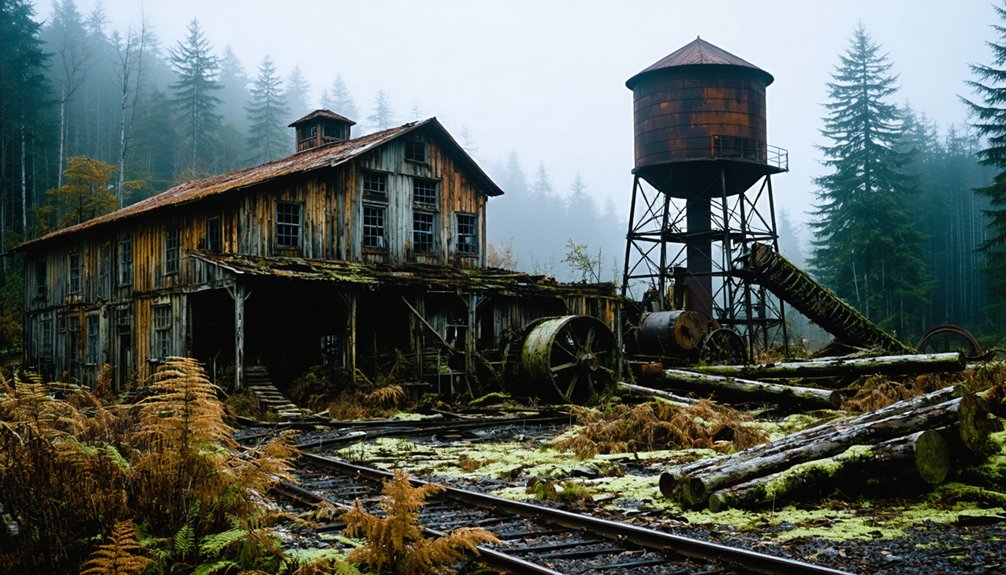
You’ll find that woodcutting communities become ghost towns through a devastating chain reaction. When mills close, jobs vanish and supporting businesses collapse, triggering mass exodus of working-age residents. This leaves behind aging populations in areas with crumbling infrastructure and vanishing services. Natural resources deplete, while global market forces and mechanization squeeze out smaller operations. The abandoned buildings and empty streets you see today tell only part of this complex story.
Key Takeaways
- Mill closures trigger massive job losses, creating a ripple effect that eliminates hundreds of related positions across supporting industries.
- Young residents migrate to urban areas for better opportunities, leaving behind aging populations and diminishing community vitality.
- Essential services like healthcare facilities, schools, and stores disappear due to declining population and economic activity.
- Infrastructure deteriorates as maintenance costs rise, leading to hazardous roads and bridges that further isolate these communities.
- Loss of traditional industries and cultural heritage sites erodes community identity, making towns less attractive for future generations.
The Cycle of Resource Depletion and Economic Downturn
When sawmills close in timber-dependent communities, they trigger a devastating chain reaction that transforms vibrant towns into economic shells.
You’ll see how one mill closure can eliminate hundreds of direct jobs while wiping out nearly triple that number in related sectors, crushing local economic resilience. The impact ripples through the landscape as logging operations struggle with weaker demand and rising costs. Michigan’s forest sector experienced a staggering $211.55 million decline in economic output. Industry projections suggest a further 9% revenue drop through 2027, deepening the economic wounds in these communities.
Your community’s resource management becomes essential as the downturn accelerates. Without steady timber demand, logging contractors vanish, suppliers shut down, and transport companies relocate.
The spatial pattern of decline spreads from the mill outward, creating economic dead zones where thriving businesses once stood. As the workforce ages and young people flee, you’re left watching your town’s liveliness drain away, marking another chapter in the story of resource-dependent communities facing obsolescence.
Environmental Impact on Community Sustainability
The environmental toll of intensive woodcutting stretches far beyond economic decline, permanently reshaping the landscape that communities depend on for survival.
When you strip away forests without sustainable practices, you’re dismantling the very foundation of community resilience. Research shows that one-fifth of forests globally are designated for selective logging, making sustainable practices crucial for long-term survival. Ancient civilizations relied on stone tools for controlled harvesting, but modern machinery enables rapid deforestation.
The cascading effects ripple through the entire ecosystem:
- Soil erosion transforms fertile land into barren terrain, making agriculture nearly impossible.
- Fragmented forests can’t sustain wildlife populations, destroying traditional hunting grounds.
- Disrupted water cycles lead to unpredictable flooding and drought, threatening water security.
- Lost carbon storage accelerates local climate changes, making weather patterns more extreme.
These environmental impacts create a domino effect that transforms thriving settlements into abandoned landscapes, as the degraded environment can no longer support the basic needs of its inhabitants.
Population Exodus and Demographic Changes
You’ll notice a stark demographic shift in woodcutting communities as young residents migrate toward urban centers, leaving behind an aging population that struggles to maintain community liveliness.
Families increasingly relocate from these resource-dependent settlements to cities offering diverse economic prospects and better social infrastructure.
The spatial pattern reveals clusters of elderly inhabitants scattered across formerly vibrant logging towns, while working-age populations concentrate in metropolitan regions where opportunities abound.
This migration trend mirrors the broader relationship between population and environment, as socio-economic factors drive people away from areas historically dependent on forest resources.
The decline of these communities parallels the loss of old forests, with over 39% of mature forest ecosystems disappearing since 1985.
Youth Leave, Elders Remain
Across once-thriving woodcutting communities, a dramatic demographic shift has reshaped settlement patterns as young residents migrate to urban centers, leaving behind an aging population of elders.
You’ll notice these stark changes in the landscape as youth migration accelerates and elder retention becomes more pronounced. The transformation manifests in four key ways:
- Traditional forestry jobs have mechanized, reducing opportunities for younger workers.
- Urban areas offer wages up to 40% higher than rural equivalents.
- Limited access to higher education drives youth to cities for advancement.
- Aging populations can’t maintain essential infrastructure or continue labor-intensive work.
This spatial reorganization creates a feedback loop: as more youth depart, remaining elders struggle to sustain community significance, further diminishing the appeal for younger generations to stay or return.
Families Seek Urban Opportunities
While traditional woodcutting settlements once sustained multi-generational households, modern urban centers now draw entire families away through an intricate web of economic and social factors.
You’ll find this urban migration driven by stark economic disparities between rural and city life – higher wages, diverse employment sectors, and better opportunities for advancement beckon families toward metropolitan areas.
As families relocate, you’re witnessing the rapid transformation of once-vibrant woodcutting communities into near-empty settlements. Rural areas face stark educational disparities with only 19% of residents holding college degrees.
The exodus creates a domino effect: fewer children attend local schools, businesses struggle to maintain customer bases, and community institutions gradually shut down. Census data shows that rural populations decreased by 19.4 percent between 2007 and 2017.
What remains is an aging population in increasingly isolated circumstances, as digital divides and deteriorating infrastructure further widen the gap between rural areas and their urban counterparts.
Infrastructure Decay in Remote Logging Towns
You’ll find the infrastructure decay in remote logging towns follows a predictable spatial pattern, starting with the gradual deterioration of rural roads and bridges that once served as crucial arteries for the timber industry.
Regular deferred maintenance costs accumulate exponentially over time when infrastructure repairs are postponed, making it increasingly difficult for these struggling communities to recover.
As these critical transportation networks crumble, you can observe how essential services withdraw from the periphery inward, leaving outlying areas increasingly isolated and underserved.
The final stage of infrastructure collapse manifests in failing utility systems, where aging power lines, water mains, and communication networks break down with increasing frequency, creating an unsustainable living environment that accelerates community abandonment.
This pattern of decline is especially severe in communities with legacy infrastructure, where outdated systems and rigid designs limit the ability to innovate or adapt to changing economic conditions.
Roads Fall Into Disrepair
Once thriving logging communities fade away, their road networks deteriorate into hazardous mazes of potholes, washouts, and unstable surfaces.
You’ll find these abandoned arteries cutting through the landscape, their compacted soils unable to properly drain rainwater. Without road maintenance or infrastructure investment, nature gradually reclaims these pathways.
The decline follows a predictable pattern:
- Timber operations cease, eliminating economic incentives for road upkeep
- Compacted soil creates drainage issues, accelerating surface erosion
- Sediment runoff pollutes nearby water bodies, damaging local ecosystems
- Communities become isolated as roads become increasingly impassable
What you’re witnessing is more than just physical decay – it’s the unraveling of crucial connections that once sustained these settlements, transforming vibrant communities into ghost towns through the slow death of their transportation lifelines.
exploring ghost towns in Arizona reveals the haunting beauty of forgotten landscapes, where nature reclaims its space amidst rusted remnants of human endeavor. Each journey into these desolate places offers a glimpse into the past, inviting visitors to reflect on the stories and lives that once thrived. As the sun sets over the skeletal structures, a sense of nostalgia hangs heavy in the air, echoing the memories of bustling streets now silent.
Essential Services Gradually Disappear
The collapse of logging town infrastructure extends far beyond deteriorating roads, reaching into every aspect of daily life.
You’ll witness the domino effect as essential services vanish one by one. Healthcare facilities close first, forcing you to travel hours for medical care. Schools consolidate or shut down entirely, pushing young families to relocate. Local stores and post offices follow, creating food deserts and communication dead zones.
Without reliable internet or phone service, you’re cut off from modern opportunities like remote work. The loss of public transportation traps those without vehicles, while degrading utility systems threaten basic living standards.
As service availability plummets, community resilience fractures. Each closure accelerates population decline, creating a downward spiral that transforms once-vibrant logging settlements into isolated shells of their former selves.
Utilities Begin Breaking Down
While essential services vanish from dying logging towns, aging utility infrastructure begins an inevitable descent into decay.
You’ll witness this deterioration spread across the landscape as decades of minimal infrastructure investments take their toll. Remote communities spiral into a self-reinforcing cycle of decline, where:
- Power grids falter under stress, leading to increasingly frequent utility outages
- Water systems develop dangerous leaks and contamination risks
- Communication networks degrade, cutting off crucial emergency services
- Harsh weather events amplify existing infrastructure vulnerabilities
You can see how this breakdown reshapes settlement patterns – as utilities fail, residents abandon their homes for more reliable locations.
The shrinking tax base makes infrastructure repairs impossible, accelerating the town’s transformation into a ghost settlement. Each utility failure pushes more people away, leaving behind a skeletal network of crumbling systems.
Market Forces and Industry Competition
Modern market forces have radically reshaped the spatial distribution of woodcutting communities across traditional timber regions, leaving behind a scattered pattern of ghost towns and declining settlements.
You’ll find that global market dynamics have triggered a 12% drop in wood trade, while mounting competitive pressures force small family operations to shutter against larger mechanized competitors. The competitive landscape has grown particularly harsh as over 100 mill closures concentrate production into fewer hands, leaving remote timber towns struggling to survive.
When you examine the spatial patterns, you’ll notice how trade barriers and price volatility create uneven development, with prosperous zones around major export hubs while interior communities wither.
This restructuring has accelerated as aging operators retire without successors, permanently altering the region’s settlement fabric.
Cultural Heritage Loss in Timber Communities

As timber communities face unprecedented disruption, their cultural heritage sites scatter across forested landscapes in varying states of decay and destruction.
You’ll witness cultural identity erosion as indigenous knowledge and traditional practices fade when ancient forests fall to industrial logging.
The spatial patterns of intangible heritage loss reveal themselves through:
- Physical damage to 10% of heritage sites annually from soil preparation and vehicle tracks
- Displacement of forest-dependent communities from their ancestral lands
- Disruption of sacred spaces and spiritual practices tied to specific forest locations
- Loss of traditional ecological knowledge as communities fragment and disperse
Without protective measures like cultural stump markings, these settlements transform into shells of their former selves, leaving behind only traces of once-vibrant cultural landscapes that sustained generations of forest-dwelling peoples.
Policy Challenges and Regulatory Pressures
Throughout woodcutting communities, a complex web of regulatory pressures and policy challenges shapes the spatial distribution of abandoned properties and economic decline.
You’ll find that strict zoning laws and regulatory compliance requirements often accelerate the transformation of once-thriving settlements into ghost towns. When you look at these communities, you’ll notice how inflexible land use policies restrict property adaptations, while maintenance codes and vacant property taxes burden struggling owners.
The lack of zoning flexibility creates barriers for repurposing buildings, forcing properties into disuse.
You’re seeing how limited government funding compounds these challenges, especially in remote areas where infrastructure costs strain local budgets. Property owners face mounting pressures from environmental regulations and safety requirements, leading to a landscape dotted with abandoned structures and declining economic activity.
Breaking Points: When Towns Reach No Return
Woodcutting communities reach a distinct breaking point when multiple destabilizing forces converge, creating an irreversible spiral of decline.
You’ll recognize these critical thresholds in the spatial patterns of community dissolution, where economic resilience collapses and community adaptation fails.
The landscape transforms through these sequential breaking points:
Each breaking point reshapes the terrain, transforming vibrant forest communities into empty landscapes through unstoppable cascading changes.
- Your local sawmills and processing facilities shut down, triggering a 24% revenue plunge that ripples through the community.
- You watch infrastructure deteriorate as tax revenues can’t sustain basic services.
- Your working-age neighbors leave in waves, creating demographic imbalances.
- Your remaining forest resources become too depleted or distant to support viable operations.
Once these thresholds are crossed, the settlement pattern shifts from a vibrant working community to an unsustainable ghost town, marking the point of no return.
Frequently Asked Questions
How Long Does It Typically Take for a Woodcutting Town to Become Abandoned?
You’ll typically see woodcutting towns fade within 10-30 years, as economic decline triggers population migration. The timeline shortens with resource depletion, especially in remote areas experiencing rapid environmental changes.
What Percentage of Former Woodcutting Communities Successfully Transition to New Industries?
You’ll find that under 50% of woodcutting communities successfully adapt, though those implementing economic diversification strategies and community resilience initiatives near metro areas achieve higher change rates around 30-40%.
Do Ghost Towns From Woodcutting Communities Differ From Mining Ghost Towns?
While 85% of mining towns left stone remnants, you’ll find woodcutting ghost towns quickly reclaimed by nature. Their logging heritage shows less economic resilience, with wooden structures deteriorating faster into forest-covered landscapes.
Can Sustainable Forestry Practices Prevent Woodcutting Communities From Becoming Ghost Towns?
You’ll find sustainable practices can prevent ghost towns by fostering community resilience through diversified economies, managed forest landscapes, and continuous resource cycles that maintain settlement patterns across generations of woodcutting communities.
What Role Do Local Indigenous Communities Play in Abandoned Woodcutting Territories?
You’ll find Indigenous communities maintaining cultural preservation through traditional land stewardship, while facing economic impact from displacement. They often reclaim abandoned territories, restoring ancestral practices and sustainable resource management.
References
- https://www.fs.usda.gov/sites/default/files/legacy_files/media/types/publication/field_pdf/forestfacts-2014aug-fs1035-508complete.pdf
- https://www.tonerbuzz.com/blog/deforestation-facts-and-statistics/
- https://pmc.ncbi.nlm.nih.gov/articles/PMC8106319/
- https://earth.org/statistics-deforestation/
- https://columbiainsight.org/why-no-one-knows-how-much-old-growth-forest-we-have-left/
- https://ourworldindata.org/deforestation
- https://gfr.wri.org/forest-extent-indicators/forest-loss
- https://ourworldindata.org/world-lost-one-third-forests
- https://www.sbcacomponents.com/media/the-economic-impact-of-sawmill-closures
- https://camoinassociates.com/resources/trends-and-transitions-in-the-forestry-and-lumber-related-markets/