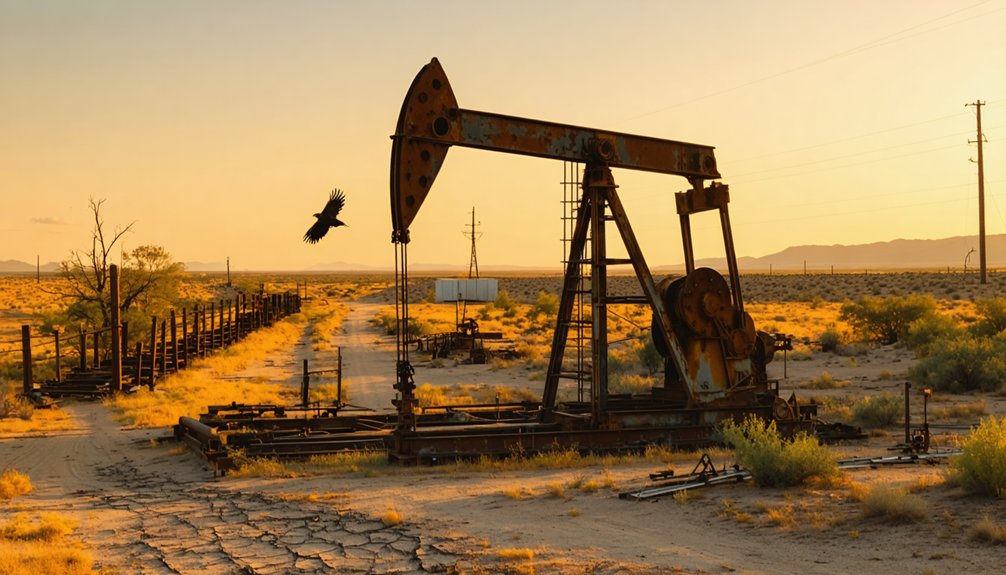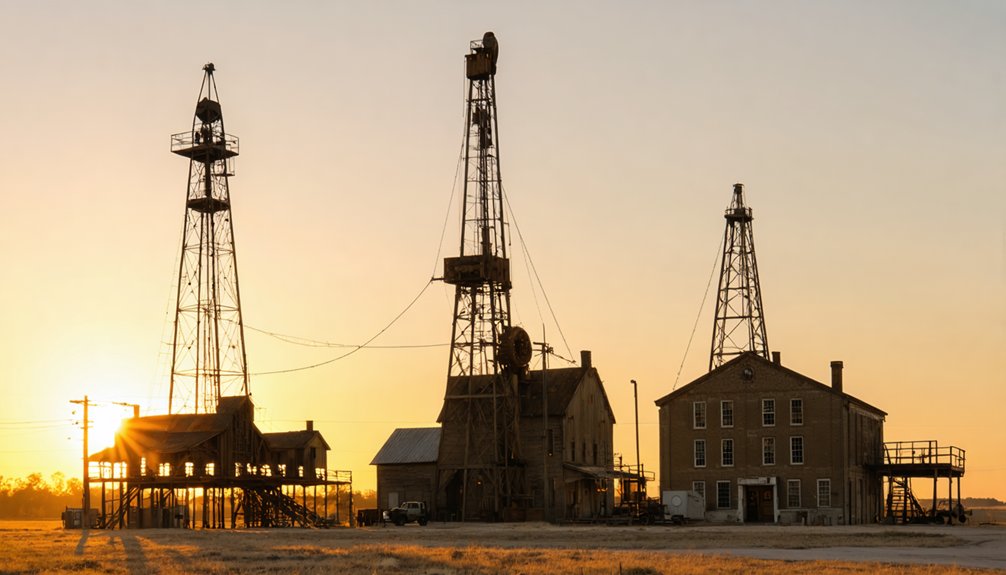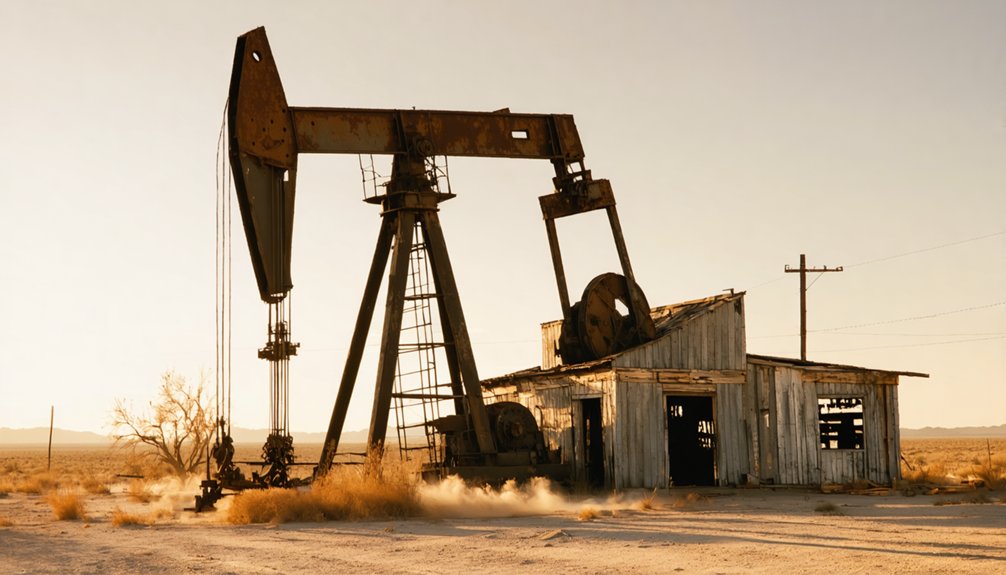
You’ll find that oil industry ghost towns vanished due to their complete reliance on a single, finite resource. When oil production declined or prices crashed, these boomtowns experienced rapid economic collapse, losing jobs and residents. Railroad companies dismantled essential infrastructure, while utilities shut down services for dwindling populations. Environmental damage, regulatory challenges, and social breakdown followed. The physical remnants of these communities slowly disappeared as nature reclaimed abandoned sites. Understanding their full story reveals complex patterns of boom-and-bust cycles in resource-dependent regions.
Key Takeaways
- Economic collapse from oil industry downturns led to massive job losses and population exodus, leaving towns unsustainable.
- Systematic dismantling of infrastructure, particularly railroads and utilities, isolated communities and accelerated their decline.
- Environmental contamination from abandoned wells and toxic emissions made areas uninhabitable and too costly to remediate.
- Loss of essential services like schools, hospitals, and emergency response forced remaining residents to relocate elsewhere.
- Physical deterioration through weather damage, vandalism, and natural reclamation gradually erased remaining town structures.
The Rise and Fall of Single-Industry Prosperity
When oil companies discover significant deposits in remote areas, they typically trigger a dramatic transformation of sleepy rural communities into bustling boomtowns.
You’ll see rapid population growth as workers flood in, followed by hasty infrastructure development aimed at serving the industry’s immediate needs.
While these towns initially experience explosive economic growth, their lack of economic diversity makes them vulnerable to devastating downturns.
When oil prices plummet or resources deplete, you’re left with a fragile economy that can’t sustain itself.
The absence of alternative industries means there’s little community resilience to weather the storm.
World War II efforts redirected resources and manpower away from these communities, accelerating their decline.
Businesses close, unemployment soars, and social services become overwhelmed.
As workers leave en masse, these once-thriving communities transform into shells of their former selves, with abandoned buildings and deteriorating infrastructure serving as stark reminders of their boom-and-bust cycle.
The story of Texas oil towns began with the historic Santa Rita No. 1 in 1923, which sparked the first major wave of oil exploration and rapid town development across the state.
When the Oil Runs Dry: Economic Collapse
The sudden collapse of oil production triggers devastating ripple effects throughout single-industry communities, where direct job losses in the upstream sector can exceed 200,000 positions during major market downturns.
Oil industry crashes create devastating waves of unemployment, with single-industry towns bearing the brunt of massive layoffs and economic devastation.
You’ll witness these impacts intensify as job market contractions spread beyond the oil fields, crushing local economic sustainability. The overall US oil workforce decreased by 40% in just ten years despite production growth.
When production plummets below critical thresholds, entire regions face catastrophic decline. You can see this in Alaska’s North Slope, where output has fallen 76% since 1990, and California’s San Joaquin basin, with a 62% drop.
The damage multiplies as capital flight accelerates, with Wall Street and pension funds withdrawing investments. This consolidates power among fewer major companies, eliminating jobs and innovative culture. States like Texas saw oil and gas receipts plummet from $15.7 billion to $9.4 billion between fiscal years 2014 and 2016.
Global crises, like COVID-19, only amplify these vulnerabilities, forcing production cuts that devastate already fragile oil-dependent economies.
The Dismantling of Vital Infrastructure
When you examine the aftermath of oil town abandonment, you’ll find that railroad companies often dismantled tracks and infrastructure first, effectively cutting off essential transportation links.
The removal of rail systems triggered a cascade of utility shutdowns, as power companies and municipal services could no longer justify maintaining operations for dwindling populations.
These infrastructure losses created a self-reinforcing cycle where remaining residents, faced with deteriorating services and isolation, had little choice but to relocate, accelerating the town’s descent into ghost status. This pattern mirrors what happened in Marianna when the late 1800s mine closed, devastating the community virtually overnight. Today, approximately 5.5 million residents in Appalachia live within one mile of abandoned mine lands, dealing with the lingering effects of these ghost towns.
Railroad Removal Isolates Communities
As railroad companies dismantled vital infrastructure across oil-producing regions, once-thriving communities found themselves suddenly cut off from essential markets and supply chains.
Railroad abandonment created severe logistical challenges that crippled local economies and accelerated their decline.
You’ll find these devastating impacts of rail removal:
- Loss of direct access to oil markets and equipment suppliers
- Increased costs for transporting heavy machinery and bulk oil
- Elimination of jobs tied to railroad operations and support services
- Reduced ability to maintain and service oil wells effectively
- Limited access to external capital and labor pools
This isolation triggered a mass exodus of working-age residents, diminishing municipal revenues and disabling public services.
Without rail connectivity, these towns couldn’t attract new industries or investment, leading to their eventual transformation into ghost towns.
The lack of proper maintenance led to nearly 8,900 orphan wells scattered across Texas, further contributing to these communities’ environmental and economic deterioration.
Sound economic reasons historically drove people to reside in these industrial areas before infrastructure removal destroyed their viability.
Utilities Shutdown Accelerates Exodus
Following railroad abandonment, oil ghost towns faced an even more devastating blow as utility companies began systematically dismantling their infrastructure.
This led to the gradual erasure of the submerged history of American towns, leaving behind only remnants of their once-thriving communities. As the structures became overgrown and forgotten, the stories of those who lived there faded into obscurity. Researching these sites now reveals layers of cultural significance that are often overlooked in modern narratives.
You’ll find that this utility abandonment created a devastating chain reaction: power outages crippled oil operations, while water and communication systems rapidly deteriorated. Without electricity, 32% of crude oil pipeline systems shut down completely, while 78% suffered partial failures.
As companies left and wells went unattended, the cycle of community disintegration accelerated. The discovery of over 34,000 orphaned wells in New York alone highlights the massive scale of abandonment these communities faced. Experts estimate that cleaning up these sites would require over $151 billion if left to government responsibility.
You’re seeing the harsh reality of how declining populations made utility maintenance unprofitable, while environmental hazards from abandoned wells forced further shutdowns. States couldn’t bridge the funding gaps to restore services, and bankrupt companies left behind millions in cleanup costs, making utility restoration virtually impossible.
Environmental Impacts and Regulatory Changes
You’ll find the toxic aftermath of abandoned oil operations continues to plague former boomtowns through contaminated soil, water, and air from leaking wells and waste pits.
The regulatory landscape changed too slowly to prevent widespread environmental damage, with insufficient bonds and enforcement leaving taxpayers to shoulder massive cleanup costs.
These environmental and regulatory challenges reshaped oil towns as toxic emissions and health risks accelerated their decline into ghost towns, making rehabilitation difficult and costly.
Toxic Legacy Lingers Today
While abandoned oil towns stand as visual reminders of the industry’s boom-and-bust cycles, their toxic legacy poses a far greater threat to public health and the environment today.
You’ll find dangerous chemical cocktails seeping from millions of forgotten wells, creating devastating health risks for nearby communities and wildlife alike.
The scale of toxic contamination becomes clear when you examine:
- Methane emissions equivalent to 16 million barrels of crude oil
- Carcinogenic benzene and VOCs polluting residential areas
- Lethal hydrogen sulfide creating deadly “dead zones”
- Contaminated water pools like Lake Boehmer poisoning ecosystems
- Widespread vegetation die-offs, including hardy mesquite trees
This invisible menace continues expanding as abandoned wells deteriorate, releasing more potent greenhouse gases and hazardous chemicals into your air, soil, and water supplies.
Regulations Reshaped Oil Towns
As environmental concerns mounted in the late 20th century, regulatory bodies like the Texas Railroad Commission emerged to oversee oil production and well plugging operations across abandoned towns.
Despite this oversight, regulatory loopholes allowed larger companies to sell aging wells to smaller operators who couldn’t afford proper cleanup, perpetuating environmental justice issues in these communities.
You’ll find that recent legislation attempts to address these challenges, though some provisions enable operators to delay well plugging until the 2040s.
The EPA’s Underground Storage Tank Program now provides federal grants for cleanup, while stricter environmental review requirements aim to protect public health.
Yet the tension between economic interests and environmental sustainability continues to shape how these ghost towns transform, as regulators balance industry needs with increasing pressure for responsible site remediation.
Social Fabric Unraveling in Dying Towns

Once thriving oil towns face devastating social collapse when industry decline sets in, triggering a cascade of community breakdown.
You’ll witness the erosion of social cohesion as environmental hazards and economic instability force longtime residents to abandon their homes. Community resilience weakens when industrial pollution creates chronic health problems and destroys agricultural land.
The social fabric tears apart in multiple ways:
- Traditional community bonds dissolve as transient workers replace established families
- Economic disparities create deep divisions between industry beneficiaries and others
- Rising living costs drive out fixed-income residents
- Health concerns from pollution breed distrust and fear
- Cultural identity fades as industrial development transforms familiar landscapes
This perfect storm of social, environmental, and economic pressures transforms once-vibrant communities into shells of their former selves.
Population Exodus and Community Breakdown
When oil reserves begin to dwindle, communities face an inevitable population exodus that transforms vibrant towns into hollow shells.
As oil wealth fades, once-thriving communities empty out, leaving behind ghostly remnants of their former prosperity.
You’ll notice population decline starts with the departure of young working families seeking opportunities elsewhere, leaving behind aging residents and diminishing birth rates. As essential services withdraw due to shrinking tax revenues, you’re witnessing a domino effect – schools close, hospitals shut down, and emergency services become scarce.
The loss of community resilience becomes apparent as empty buildings multiply and infrastructure crumbles.
Without economic alternatives to replace oil industry jobs, you’ll find residents have little choice but to relocate to areas with better prospects. This migration pattern accelerates as transportation links weaken and property values plummet, creating a self-reinforcing cycle of abandonment that’s nearly impossible to reverse.
The Physical Erasure of Town Landmarks
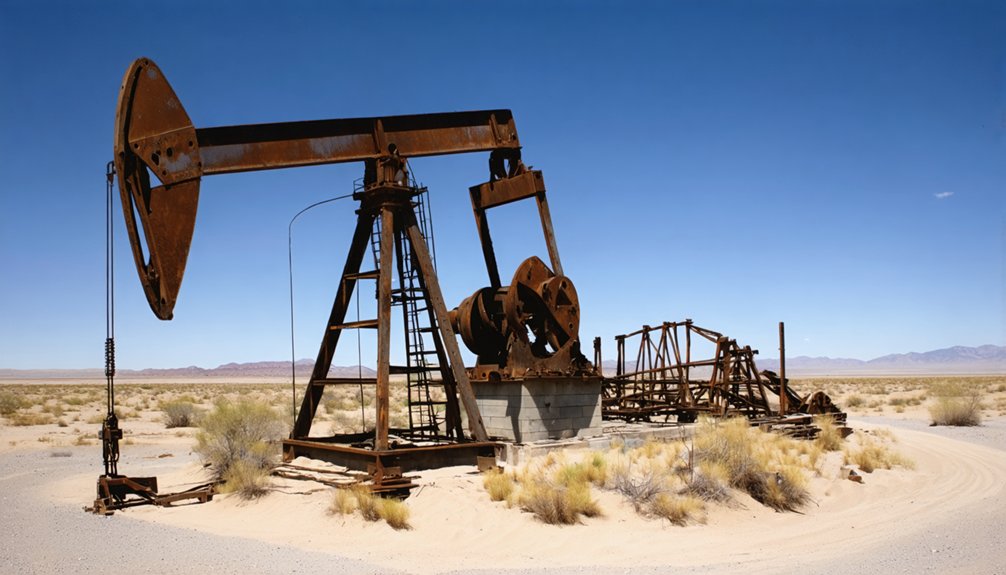
The systematic erasure of oil town landmarks begins long before nature reclaims the land.
You’ll find that oil companies initiate the process by dismantling equipment and salvaging valuable infrastructure, while regulatory requirements often mandate the removal of hazardous materials and plugging of wells.
Physical decay accelerates landmark disappearance through multiple factors:
- Harsh weather conditions deteriorate abandoned buildings
- Fires and vandalism destroy remaining structures
- Natural erosion and plant overgrowth consume industrial sites
- Safety concerns prompt removal of dangerous infrastructure
- Land use changes drive complete demolition
Without maintenance, you’ll witness how rapidly these ghost towns vanish.
The combination of intentional demolition, environmental forces, and safety-driven clearing transforms former boomtowns into empty landscapes.
This erasure is further hastened when landowners convert the areas for new development, agriculture, or conservation purposes.
Legacy and Lessons From Lost Oil Towns
Lingering effects of abandoned oil towns extend far beyond their physical remnants, creating complex environmental and socioeconomic challenges for current and future generations.
You’ll find legacy pollution haunting these communities through leaking methane, contaminated soil, and aging infrastructure that threatens public health and safety. The cost of cleanup falls increasingly on taxpayers as oil companies abandon their responsibilities through bankruptcy.
Yet you can witness community resilience emerging through grassroots advocacy and technological innovation. Modern detection methods, including drone surveys and advanced sensors, are revolutionizing how we locate and assess orphan wells.
These lessons shape current urban planning and environmental justice initiatives, pushing for equitable development that protects vulnerable populations while addressing historic contamination. The evolution of these forgotten towns offers vital insights for preventing similar challenges in future energy shifts.
Frequently Asked Questions
Did Any Oil Ghost Towns Successfully Transform Into Different Types of Communities?
You’ll find success stories like Thurber, which shifted from oil to brick manufacturing, demonstrating community revitalization through adaptive reuse of industrial infrastructure that still shapes Texas cities today.
What Happened to the Personal Belongings Left Behind in Abandoned Homes?
You’d find personal belongings in abandoned homes were either scavenged by locals, decayed from weather exposure, or destroyed by vandals. Some items were preserved by museums or claimed by returning families.
How Did Neighboring Towns Cope With the Influx of Displaced Residents?
You’ll find that neighboring towns expanded housing, upgraded infrastructure, and mobilized community support through churches and charities to help displaced families adjust, while also creating new job opportunities and social services.
Were There Attempts to Preserve Oil Town Artifacts in Regional Museums?
Like enthusiastic treasure hunters, you’ll find extensive artifact preservation efforts in regional museums across Texas and Illinois, with facilities showcasing derricks, equipment, photographs, and recreated boomtown buildings from oil’s golden age.
Did Any Former Residents Organize Reunions or Maintain Connections After Abandonment?
You’ll find many former residents organized reunion events and maintained community connections through newsletters, social media groups, and historical preservation efforts, helping preserve their shared heritage across generations.
References
- http://fortworthgazette.blogspot.com/2011/04/ghost-towns-on-brazos-shades-of.html
- https://www.geotab.com/ghost-towns/
- https://nondoc.com/2022/01/04/whizbang-oklahoma-ghost-town/
- https://en.wikipedia.org/wiki/Ghost_town
- https://www.youtube.com/watch?v=eyOASXxAmMI
- https://historycollection.com/ghost-town-boom-bust-instant-cities-that-vanished/
- https://savingplaces.org/guides/ghost-towns-on-route-66
- https://mix931fm.com/texas-ghost-towns-history/
- https://grist.org/abandoned-oil-gas-wells-permian-texas-new-mexico/
- https://www.cityandstateny.com/politics/2022/05/new-yorks-once-booming-oil-industry-and-risky-wells-it-left-behind/366655/